


Ask any two people what “cool” means and you might get three answers. It can mean a great movie, a person who never seems rattled, or just a quick “yes, fine” in a text thread. That flexibility is exactly why the word has outlived every slang rival thrown at it.
As slang, “cool” means something impressive or admirable, a person who is calm and socially confident, or simply “okay, I agree,” all in one short, low-pressure word.
What Does “Cool” Mean in Slang?
As slang, “cool” is the Swiss-army word of approval: it can mean something is impressive (“that car is cool”), that someone has calm confidence (“she is so cool under pressure”), or simply that everything is fine (“cool, see you at seven”). What ties the senses together is ease. Saying it never costs you anything, socially.
Dictionary.com lists four slang senses of “cool”: great or excellent, highly skilled or clever, socially adept, and acceptable or okay. That is a rare spread for one little adjective, and it explains why the word works in a boardroom text thread and a concert pit alike. Each sense grew out of the same core idea: staying composed when things get hot. A person who keeps their head in a crisis is literally cool, and from there it is a short hop to calling anything admirable “cool.”
Here is how the senses break down in everyday use:
Cool as praise: impressive, excellent, admirable
This is the heavyweight sense. “That movie was cool.” “You have a cool apartment.” Nothing about the temperature. It is the plain approval sense, the one dictionaries tag as slang for “great” or “excellent.” This is also the sense that faces the most competition, because every generation mints a fresh synonym, from groovy to rad to fire. (More on those in the list below.)
Cool as character: calm, confident, socially smooth
“He is cool like that, never makes a scene.” This is the oldest slang sense, tied to composure. It means someone who stays level-headed, who handles attention without chasing it. StreetSlang describes this as “calm, collected, or socially smooth,” and it is still very much alive, even when the praise sense is the one people type most.
Cool as agreement: okay, fine, no problem
“Can we meet at six instead?” “Cool.” One syllable, and the plan is confirmed. No enthusiasm required, no enthusiasm conveyed. This is the lowest-effort way to say “that works,” and it is the single most common use of the word in texts today. It keeps conversations moving without overexplaining.
Cool as reconciliation: we are good
“We are cool now.” “It is cool, forget about it.” After a disagreement or an apology, “cool” works like a reset button. It signals that the tension has passed and things are back to normal. Collins Dictionary notes this exact usage: people who are “cool again” are on good terms.
If you are searching for what “cool” means in a text, the short answer is usually the agreement sense. In a caption or review, it is usually the praise sense. And when someone calls a person cool, they mean the character sense. Context does the sorting for you.
Where Did “Cool” Come From? The Jazz-Era Origin Story
“Cool” as slang for “impressive” was used by Black American speakers as early as 1933, nearly a century ago, and grew out of jazz culture before spreading worldwide.
The story starts in African American English, not in the mainstream slang everyone assumed. Grammarphobia, citing the Random House Historical Dictionary of American Slang edited by Jonathan Lighter, reports that Black speakers were using “cool” as an adjective meaning exciting, enjoyable, or superlative as early as 1933, as in “the coolest drummer alive.” The noun sense, composure as in “keeping one’s cool,” was first recorded in 1953 and also originated in Black English. That puts the origin firmly in the jazz era: Black musicians and their audiences in the 1930s and 1940s used it to describe both great playing and the unruffled way a great player carried himself.

From the clubs, the word crossed into beatnik culture in the 1950s and the mainstream counterculture of the 1960s, and it never left. It survived the slang cycle that killed its rivals because it adapted to every context. “Groovy” got pinned to one decade. “Rad” got pinned to skateboards and surf shops. “Cool” stayed underspecified enough to work anywhere, which is exactly why it is still here.
That staying power is unusual. Linguist Donna Jo Napoli has argued that “cool” survived because it is “underspecified,” meaning it stretches across many situations without breaking, as reported by Upworthy. Linguistic anthropologist Robert L. Moore has called it “the most popular slang term of approval in the English language,” a crown it has held since the fifties and sixties when it displaced older favorites like “swell.” Nearly a hundred years after that 1933 usage, it is still the default.
The Many Faces of “Cool”: One Word, Five Jobs
“Cool” does five different jobs depending on the sentence: it praises things, describes people, confirms plans, ends arguments, and stands alone as an interjection of approval.
The adjective: “That is so cool”
Modifying a noun, cool means impressive or worth admiring. “Cool jacket.” “Cool restaurant.” “Cool trip.” It is the most flexible slot in English slang, because it fits anything from a skateboard trick to a scientific discovery without sounding forced.
The person descriptor: “She is cool”
Applied to a person, it says they are composed, confident, and easy to be around. Nobody says “cool person” about someone frantic or desperate. It carries a whiff of the jazz origin: the cool person is the one who does not try too hard.
The one-word reply: “Cool”
Standing alone, it confirms, accepts, or approves. “We can leave after lunch.” “Cool.” StreetSlang calls this “a casual yes,” and the reason it works is that it signals ease rather than enthusiasm. It is agreement without pressure, which is why group chats run on it.
The peace treaty: “It is cool” / “We are cool”
After an apology or a tense moment, “it is cool” means the issue is dropped, and “we are cool” means the relationship is intact. It is the social equivalent of shaking hands after a fight, minus the formality.
The interjection: “Cool!”
With an exclamation point, the same word becomes genuine enthusiasm. “You got the promotion? Cool!” Tone is everything here. Flat “cool” means fine; bright “cool!” means great. In text, the punctuation has to do the work the voice normally does, so that exclamation mark matters more than people think.
Cool vs. Tuff, Drip, Fire, and Chill: Which One Do You Mean?
“Cool” is the broad, all-ages approval word; tuff is hard-edged confidence, drip is expensive style, fire is hype-level excitement, and chill is relaxed ease, so the right pick depends on the energy you want.
People often use these words interchangeably, but each one colors the sentence differently. Get the table of distinctions right and you will never sound like you are guessing. Here is the breakdown:
| Word | Core Meaning | Tone | Where You Hear It | Example |
|---|---|---|---|---|
| Cool | Impressive, admirable, or fine; calm confidence | Neutral, effortless, safe for all ages | Everywhere: texts, workplaces, families, all generations | “That is a cool idea. Let us do it.” |
| Tuff | Hard, unbreakable, intimidating in a good way | Edgy, bold, masculine-coded energy | TikTok captions, sports talk, streetwear culture | “That fit is tuff. He went crazy.” |
| Drip | Expensive, fashionable style and the confidence it buys | Flashy, status-driven, aspirational | Fashion TikTok, sneaker culture, music lyrics | “His drip is insane. That jacket costs a fortune.” |
| Fire | So good it feels explosive; peak excitement | Hype-heavy, emotional, high energy | Music reactions, food posts, Gen Z comments | “This song is fire. Run it back.” |
| Chill | Relaxed, easygoing, no drama | Mellow, calm, low-pressure | Texts about plans, personality descriptions | “He is chill. Nothing stresses him out.” |
The practical rule: reach for “cool” when you want safe, universal approval, especially with mixed ages. For a deeper dive on the hard-edged cousin, see our guide to what “tuff” means in slang, and for the fashion-specific one, what “drip” means in slang. “Fire” is the choice when you are genuinely hyped; “chill” when the whole point is calm. None of them replaces the other, which is why they all survive side by side.
Slang Words for Cool: What to Say Instead
There is no shortage of slang for cool: dope, fire, sick, rad, lit, gas, and bussin are current favorites, while groovy, righteous, and boss are the vintage classics, and each fits a different era, scene, and energy level.
This is the listicle half of the query. People searching “slang for cool” often want alternatives, words that mean the same thing but with fresher flavor. Here is a solid rotation, with notes on when each one actually works. Think of it as a wardrobe: “cool” is the plain white tee, and these are the statement pieces.
The current rotation (safe to use now)
- Dope: excellent, impressive. The hip-hop era classic, first used in this sense in Jimmy Spicer’s 1981 song “Money (Dollar Bill Y’all)” according to the Oxford English Dictionary via Mental Floss. Still widely understood by every generation. Use it for music, fashion, creative work.
- Fire: extremely good, exciting. The default hype word of Gen Z comments. Use it when you are genuinely excited; it sounds flat if you are not.
- Sick: unbelievably good. A classic trick: a negative word flipped positive. Used this way since at least the early 1980s, per a 1983 book on college slang cited by Mental Floss. Still understood today. Use it for stunts, skills, and impressive feats.
- Gas: awesome, high energy. “That album is gas.” Popular in rap and sports talk. Do not confuse it with the car fuel sense; context makes it obvious.
- Lit: exciting, full of life. Peaked in the late 2010s but still alive. Best for events and atmospheres: “that party was lit.”
- Slaps: excellent, especially for music. “This track slaps.” Almost always about sound, so do not use it for a painting.
- Hits different: good in a uniquely moving way. A phrase rather than a word, and it carries more emotion than plain “cool.”
- Based: admirably authentic, unbothered by opinion. From internet culture. Use it for takes and attitudes, not for objects.
The vintage vault (know them, use with style)
- Groovy: excellent, fashionable. Jazz slang from the 1930s, mainstream in the 1960s. Today it is deliberately retro; using it is a style choice, not an accident.
- Rad: excellent, exciting. Short for “radical,” from 1970s skateboarding culture, where only the riskiest stunts were rad. Now it has fun throwback energy.
- Righteous: cool with integrity. Black Americans have used “righteous” as slang for cool since at least 1930, per the Oxford English Dictionary via Mental Floss. It carries a note of authenticity the others lack.
- Boss: excellent, top-tier. In the “excellent” sense it goes back to the mid-1800s for people great at something, and Laurence Hairston used it as pure cool-praise in 1963’s Freedomways: “That’s boss, Baby.”
- Ill: cool, impressive. The Beastie Boys’ 1986 “Rhymin’ and Stealin'” gave it its breakthrough (“I am most ill”). Same negative-flip trick as “sick.”
- Mint: excellent, top quality. College slang for cool since the 1980s, per a 1982 English Journal citation via Mental Floss. It has had a TikTok revival lately.
- Epic: grandly impressive. Slang for more than 40 years, though the “epic fail” era of the 2000s took some shine off. Use it for scale: epic waves, epic comebacks.
A word of caution: do not stack them. “That is so cool, dope, fire, and lit” reads like a thesaurus exploded. Pick one word that matches the energy of the moment and let it stand alone. The whole point of slang-for-cool words is that one sharp word beats five vague ones.
Who Says “Cool” and Where It Still Lives
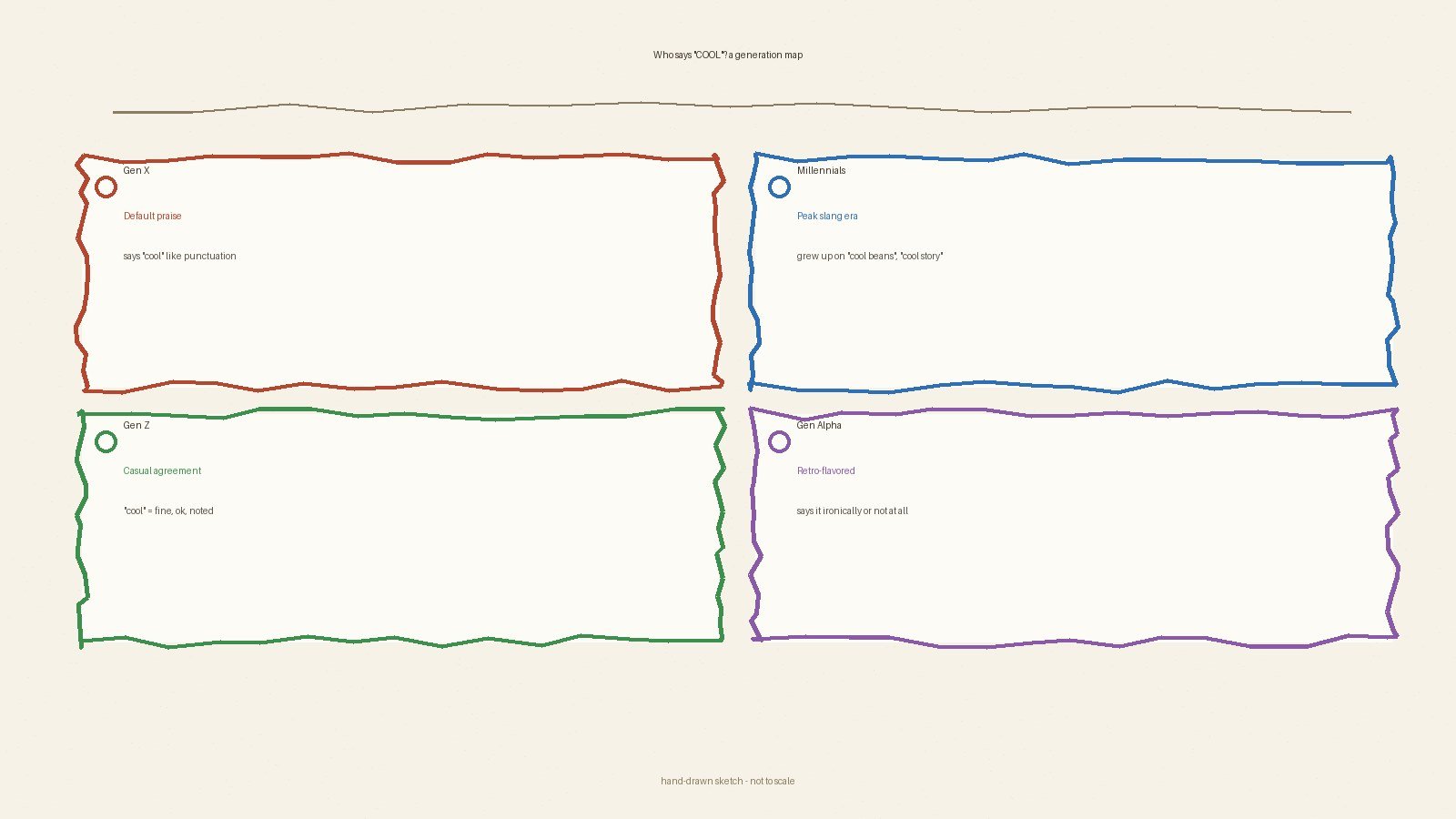
Everyone still says “cool,” but they say it differently: Gen X and millennials use it as their default approval word, Gen Z uses it mainly for casual agreement while reaching for fire or aura for real hype, and Gen Alpha is replacing it with aura, drip, and skibidi.
“Cool” is one of the rare slang words that belongs to no single generation, which is also why each generation uses it a little differently. Here is the map:
Gen X and older millennials: the default word
For anyone who came of age in the 80s, 90s, or 2000s, “cool” is the automatic approval word. It is what you say about a good movie, a smart idea, or a fun weekend. It is so automatic that many people in this group never think of it as slang at all. It is just a word.
Millennials: approval plus nostalgia
Millennials use “cool” the same way, but layered with era-specific slang memories: rad, dope, “cool beans.” Our guide to millennial slang covers that whole vocabulary. “Cool” itself survived the millennial era untouched, which says a lot, since most millennial slang did not.
Gen Z: agreement, not hype
Gen Z still says “cool” constantly, but mostly in the agreement sense: confirming plans, accepting suggestions, ending a topic. For actual enthusiasm, they reach for “fire,” “insane,” or “aura,” which has taken over the effortless-cool lane on TikTok. (We cover that shift in what “aura” means in slang.) Flat “cool” from a Gen Z texter usually means “fine, moving on,” not “wow.”
Gen Alpha: cool is the parent word
The youngest crowd is already treating “cool” as something parents say. Their words for the same idea are “aura,” “drip,” “skibidi,” and “sigma.” This is the normal cycle: every generation needs its own word, and “cool” has simply become the established one they push against.
Where you hear it most
- Text messages and group chats: the agreement sense, thousands of times a day.
- Workplaces: one of the few slang words fully acceptable in professional chat. “Cool, sending the file now.”
- Customer service and hospitality: “cool” softens replies without sounding stiff.
- Comment sections: older-skewing audiences on Facebook and YouTube use it as praise.
- Everyday speech: families, friends, small talk. It is the word you reach for when you want to be agreeable and move on.
How to Use “Cool” Naturally (and How to Reply When You Hear It)
Use “cool” when you want low-pressure approval or agreement: drop it as a one-word reply to confirm plans, pair it with a noun to praise something, and match your punctuation to your real energy level.
Because the word is so familiar, the main skill is not learning it but aiming it. A few natural patterns:
Confirming plans
- “Dinner at seven works.” / “Cool, see you then.”
- “Can we move it to Friday?” / “Cool with me.”
Praising something
- “That photo you posted is so cool.”
- “Cool jacket. Where did you get it?”
Describing a person
- “He is cool under pressure. Never panics.”
- “She was so cool about the whole thing.”
Ending a tense moment
- “Sorry I snapped.” / “It is cool. Forget it.”
- “Are we good?” / “Yeah, we are cool.”
How to reply when someone says “cool” to you
Read the energy, not just the word. If someone replies “Cool!” with an exclamation mark after your news, they are happy; a simple “Thanks!” or “Right?” keeps it going. If they reply flat “cool” to your suggestion, they are agreeing but not thrilled; either move on or ask “does that actually work for you?” if it matters. And if someone says “we are cool” after a disagreement, accept the reset. Pushing for more reassurance after “we are cool” is the fastest way to make things un-cool again.
When “Cool” Goes Wrong: Where It Does Not Belong
Do not use “cool” for serious bad news, formal writing, or moments that need real emotion, because its whole power is being low-pressure, and low-pressure is exactly wrong when the situation is high-stakes.
“Cool” is the most forgiving word in English, but it has edges. Here is where it lands badly:
Responding to bad news
“My grandmother passed away.” / “Cool” is catastrophic. When someone shares something painful, “cool” reads as cold, literally. Use real words: “I am so sorry.”
Formal or professional writing
It is fine in a Slack thread, but it does not belong in a cover letter, a formal email to a client, or an academic paper. Match the register to the room.
When someone needs enthusiasm
If your friend just told you they got engaged and you reply “cool,” they will remember it, and not fondly. Flat “cool” signals mild interest. If you are actually excited, say so with the exclamation mark or pick a stronger word.
When you mean the opposite
“Cool” can also mean emotionally distant: “she was cool toward me.” As StreetSlang notes, tone and context decide whether “cool” means admirable or aloof. If you are being chilly on purpose, fine. If you are not, watch your tone.
Describing people you do not know well
Calling someone’s outfit “cool” to their face is friendly. Calling a stranger “cool” as a personality judgment can sound presumptuous. Stick to praising things, not people, until you know them.
Cool Myths, Busted
Three myths follow “cool” around: that it is new, that it is dying, and that it only means one thing. All three are wrong, and the corrections explain why the word keeps winning.
Myth: “Cool” is modern slang from the internet era
Fact: The slang sense dates to at least 1933, when Black American speakers were already using it to mean exciting or superlative, per the Random House Historical Dictionary of American Slang via Grammarphobia. It is older than television, older than rock and roll, and about as old as commercial aviation.
Myth: “Cool” is outdated because Gen Z does not say it
Fact: Gen Z says it constantly, just in the agreement sense rather than the hype sense. And linguists keep pointing out that it has survived every rival: it outlasted groovy, swanky, phat, and on-fleek. As Upworthy reported, linguists credit its “underspecified” nature for the survival. It is not outdated; it graduated.
Myth: “Cool” only means “good”
Fact: It also means calm, socially smooth, acceptable, reconciled, and emotionally distant, depending on context. Dictionary.com lists fourteen distinct senses, four of them slang. Reducing it to “good” misses most of what makes it useful.
Myth: Saying “cool” makes you sound uncool
Fact: The word’s whole point is that it does not try hard. Nobody ever sounded try-hard saying “cool.” If anything, the people reaching for five fresh slang words a sentence are the ones trying. “Cool” is the confident choice, which is fitting, since confidence is what it originally meant.
Quick Answers About “Cool” Slang
What does “cool” mean in slang?
As slang, “cool” means impressive or admirable, calm and confident, or simply “okay, I agree.” The exact sense depends on context: praising a thing, describing a person, or confirming a plan. It is one of the most flexible approval words in English.
What is slang for cool?
Current slang for cool includes dope, fire, sick, gas, lit, slaps, and based. Older options include groovy, rad, righteous, boss, and mint. “Cool” itself is still the most universal choice; the alternatives add flavor for specific scenes and generations.
Is “cool” outdated slang?
No, “cool” is not outdated. Every generation still uses it, though Gen Z mostly uses it for casual agreement rather than hype. Linguists note it has survived since the 1930s by adapting to every context, outlasting rivals like groovy and phat. It is established, not expired.
Where did “cool” as slang come from?
“Cool” as slang originated in Black American English in the early 1930s, tied to jazz culture, where it described both exciting music and the composed way great musicians carried themselves. It spread through beatnik and counterculture scenes in the 1950s and 1960s and then into mainstream English worldwide.
What is the difference between “cool” and “chill”?
“Cool” is broad approval or confidence; “chill” is specifically about being relaxed and low-drama. A cool person might be intense and impressive; a chill person is easygoing. In texts, “cool” confirms plans (“cool, see you then”), while “chill” describes the vibe (“a chill evening”).
Can “cool” be rude?
Yes, flat “cool” can sound dismissive. Replied to exciting news, it signals you do not care. Replied to bad news, it sounds cold. It can also mean emotionally distant (“she was cool toward me”). Match your tone and punctuation to the moment.
Sources and Further Reading
- Dictionary.com’s full entry for “cool,” listing fourteen senses including four slang definitions, plus its etymology from Old English cōl.
- Grammarphobia’s “Birth of the cool,” tracing the slang sense to Black English as early as 1933 and the “keeping one’s cool” noun sense to 1953, via the Random House Historical Dictionary of American Slang.
- Mental Floss’s list of 19 synonyms for “cool,” with first-use dates for righteous, dope, rad, sick, groovy, and others via the Oxford English Dictionary.
- Upworthy’s piece on why some slang survives, with linguists on “cool”‘s “underspecified” nature and its run since around 1930.
- StreetSlang’s glossary entry for “cool,” on the casual-yes usage and its fit in texts.
- Red Kiwi’s “Cool” slang guide, with usage examples and the origin in African American Vernacular English and jazz culture.
- Collins Dictionary’s entry for “cool,” including the “cool with” and “cool again” senses.
- The Free Dictionary’s idioms entry for “cool,” covering “be cool,” “it is cool,” and the social-approval senses.



Pingback: Cool in Spanish Slang: How to Say It, Region by Region
Pingback: Cool Synonym Slang: 25+ Slang Words for "Cool" (2026)
Pingback: Aura Meaning Slang: What Does "Aura" Mean in Text and Online?
Pingback: Crack Meaning Slang: What Does Crack Mean in Text?
Pingback: Cracked Meaning Slang: What Does Cracked Mean in Gaming?
Pingback: Cringe Meaning Slang: What Does Cringe Mean Online?
Pingback: DINKS Meaning Slang: What DINKS Means Online
Pingback: Dig Meaning Slang: What Dig Meant in the 1960s