


Crack is one of those slang words that refuses to sit still: it can mean a joke, a good time, top quality, a try, or a drug, and only the sentence around it tells you which one is meant.
If you have ever read a sentence with crack in it and paused, you are not alone. I have done the same, especially with posts from Ireland and Northern England, where the crack can sound like praise, an invitation, and a question all at once. The trick is not to memorize one definition. It is to learn the handful of living uses, the clues that point to each one, and the few contexts where you should simply choose another word. This guide walks through all of them, with examples you can actually picture in a real conversation.
At a Glance: Every Living Meaning of Crack
In short, crack covers jokes, social fun, excellence, attempts, and pressure, plus one serious drug sense, and the surrounding words, the speaker, and the setting usually make the intended meaning clear within a second or two of reading, once you know what to listen for.
Think of crack as a word with several jobs, not several unrelated words that happen to look alike. Most of those jobs grew out of an old idea of a sharp sound or a sharp, quick action. A joke lands with a snap. A good time buzzes with energy. A top performer hits the mark fast. A try is a shot taken. Once you see that thread, the meanings stop feeling random.
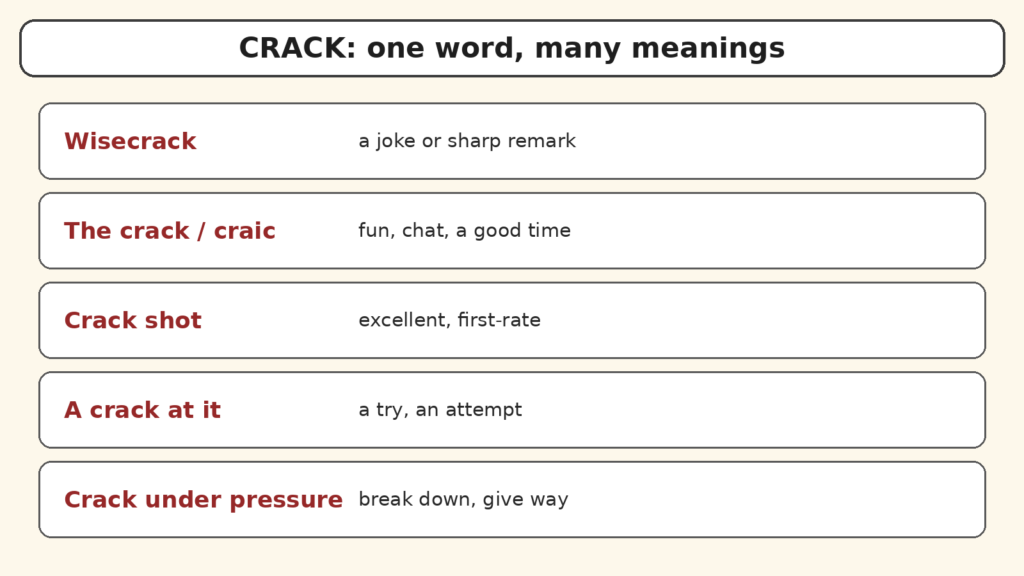
Here is the quick map. A crack can be a sharp remark or a joke. The crack, often spelled craic in Ireland, can be fun, chat, news, or the whole social atmosphere of a night out. A crack shot or a crack team means excellent, first-rate, the best of its kind. Have a crack at something means take a turn or make an attempt. As a verb, crack can mean break under pressure, solve something hard, or open something up. And in its drug sense, crack is short for crack cocaine, a serious and harmful substance that has nothing to do with jokes or fun.
The most common mix-up happens between the joke sense and the fun sense. If someone says, “He made a crack about the boss,” they mean a remark, probably a cheeky one. If someone in Dublin says, “The crack was brilliant last night,” they mean the whole evening was great fun. Same word family, very different picture. Listen for “a crack” versus “the crack,” and for whether a person or an evening is being described.
Contents
- At a Glance: Every Living Meaning of Crack
- Crack a Joke and Make a Crack: The Remark Sense
- The Crack and Craic: Fun, Chat, and a Good Night Out
- A Crack Shot and a Crack Team: When Crack Means Excellent
- Have a Crack at Something: The Try Sense
- Crack Under Pressure, Crack a Code, Crack Open a Bottle
- The Drug Sense: Crack Cocaine, Explained Briefly and Factually
- Crack vs. Similar Terms
- Usage-Context Map: Who Says Which Sense, Where, and to Whom
- What to Say Back: Replies for Each Sense
- Myth vs. Fact: What People Get Wrong About Crack
- When NOT to Use Crack
- FAQs About Crack Slang
- Sources
Crack a Joke and Make a Crack: The Remark Sense
To crack a joke means to tell one, usually on the spot, while to make a crack about someone means to fire off a sharp, often teasing remark that can be funny, cheeky, or, if it lands badly, a little rude.
This is probably the sense most English speakers meet first. Etymonline traces crack a joke to 1732, and links it to an older sense of crack as speaking or saying something, a sense that goes back to the early 1300s. That history shows in the feel of the phrase even now. You do not deliver a crack the way you deliver a speech. You crack it, quick and sharp, and then you wait to see how it lands.
A wisecrack is the polished cousin of this sense. A wisecrack is a clever, fast comeback, the kind of line that makes a room laugh before anyone has time to think of a reply. The difference is mostly tone and intent. A joke is meant to amuse. A crack about someone can be affectionate teasing between friends, or it can be a dig. The words alone will not always tell you which. The relationship does.
Examples that show the tone
“He cracked a joke about the rain and suddenly the whole meeting felt easier.” That is the friendly version, a joke used to break tension. “She made a crack about his cooking and he laughed, but only just.” That one sits on the line. If you are not sure a crack will be taken well, that uncertainty is itself useful information. A remark that needs a long explanation afterwards was probably not worth cracking in the first place.
Notice too that cracking a joke is usually a social act, not a performance. People crack jokes at dinner, in group chats, on long drives, and in the comments under a video. It is casual by nature. If someone says they cracked up, that is a step further: they burst out laughing. The joke did its job.
The Crack and Craic: Fun, Chat, and a Good Night Out
In Ireland, Scotland, and Northern England, the crack, often spelled craic, means enjoyable talk, fun, news, or the lively atmosphere of a social occasion, and “What is the crack?” is simply a friendly way of asking what is going on.
This is the sense that confuses visitors most, and it is also the one with the warmest heart. Etymonline quotes an 1869 note describing a crack as a chat with a good, kindly, human heart in it, a chat that is anything but shallow. That description still fits. When Irish friends talk about great craic, they rarely mean one joke. They mean the music, the talk, the laughter, the feeling that the night itself was good company.
Green’s Dictionary of Slang records this talk sense in Scotland as early as 1725, with lines inviting someone to sit down and share their cracks, meaning their news. Over time, the spelling craic became the familiar Irish form, while crack stayed common in Scotland and Northern England. The two spellings point to the same social world, and modern Irish writing uses craic for the fun sense almost by default.
If you want to understand how this sense works in real Irish conversation, it helps to know a bit of Irish slang and how craic fits into everyday talk. Craic sits alongside greetings, teasing, and storytelling as part of how people mark a good time together. It is less a word you define and more a word you recognize when a room feels right.
How to read “the crack” in a sentence
“What is the crack?” usually means “What is happening?” or “What is new?” It is a greeting with a question built in. “The crack was mighty” means the fun was excellent. “Good crack” can describe a person too, someone who is fun to be around. “Just for the crack” means just for fun, with no serious purpose. In each case, the word points at the social moment, not at a single joke.
This sense also connects closely to ordinary chat. A long, easy conversation with old friends over tea or in a pub is exactly the kind of thing people call the crack. If you are learning the word, that link helps: the slang sense of chat and easy talk is the nearest everyday cousin to this meaning, even though craic carries more warmth and more fun than a plain chat.
A Crack Shot and a Crack Team: When Crack Means Excellent
When crack sits before a noun, as in a crack shot, a crack team, or a crack unit, it means top-notch, first-rate, and highly skilled, a compliment that praises ability rather than personality or looks, and it is praise you can trust in a review or a recommendation.
Etymonline dates this excellent sense as slang to 1793, and suggests it may come from an older idea of doing something with quickness or smartness, or from boasting about qualities worth being proud of. Either way, the praise has a sharp edge to it. A crack shot is not merely good. A crack shot hits the target. A crack team is not merely pleasant to watch. A crack team gets results.
You will hear this sense in sport, in the military, in cooking, and in workplaces where skill is easy to see. “She is a crack researcher” means her work is sharp and reliable. “They hired a crack crew for the restoration” means they hired the best people they could find. The compliment works because it sounds earned, not gushing.
This is also where crack overlaps with other praise words. If you want a broader sense of how English piles up words for approval, the slang story of cool and effortless approval shows a different flavor of praise, relaxed where crack is sharp. And the history of awesome as enthusiastic praise shows the louder, more emotional end of the same scale. Crack sits at the skilled, understated end.
Why “crack” praise sounds different
Calling someone awesome can be about excitement. Calling someone a crack hand at something is about competence. That is why it survives in professional talk long after flashier slang fades. A manager who would never call an employee awesome in a formal report might still call a unit a crack team, because the word carries a history of proven skill.
Have a Crack at Something: The Try Sense
To have a crack at something means to attempt it, to give it a go, usually with a friendly, low-pressure tone that makes trying sound easier than succeeding, and that softens the sting if it does not work out, which keeps the whole exchange friendly.
Etymonline attests this try sense to 1830, in nautical use, and suggests a hunting metaphor, probably from the slang sense of firing a gun. You take a shot at something. You have a crack at it. The image is the same: one attempt, taken with spirit, and no promise attached.
This is one of my favorite uses of the word, because of how kind it is. “Have a crack at the recipe” sounds far less scary than “attempt the recipe.” “Let me have a crack at fixing it” sounds helpful, not boastful. The phrase gives the speaker permission to fail without embarrassment, and it gives the listener permission to say yes without raising the stakes.
Where you will hear it most
British, Irish, and Australian speakers use this sense constantly. “Fancy a crack at the quiz?” “I will have a crack at it tomorrow.” In American English, “take a crack at it” is the more familiar form, and it means the same thing. If you hear “first crack at something,” that means the first chance to try it, often before anyone else gets a turn.
Crack Under Pressure, Crack a Code, Crack Open a Bottle
As a verb, crack stretches in three common directions: to break down under strain, to solve something difficult, and to open something up, and the object of the verb tells you which direction is meant, so always check the object before you settle on a meaning.
Crack under pressure is the most human of the three. It means someone finally gives in, breaks down, or reveals something after strain. A suspect cracks in an interview. A player cracks in the final minutes of a tight match. The image is a surface that held for a long time and then gave way. It is not always a criticism. Sometimes it is simply an honest description of reaching a limit.
Crack a code, crack a safe, crack a problem
Crack a code means to solve it, to work out a system that was meant to stay hidden. The same pattern covers cracking a safe, cracking a password, and, in a looser way, cracking a tough problem at work. The Free Dictionary lists this break-into sense plainly: to manage to open or break into something. In everyday talk, the solved sense is the most common. “She cracked the scheduling problem in an afternoon” is praise for clear thinking, not a confession.
Crack open a bottle, crack a book, crack a smile
Crack open a bottle means to open it, often to celebrate, and Etymonline dates the open-and-drink sense to the 1500s. Crack a book means to open it and start studying, usually with a hint of reluctance. Crack a smile means to finally smile after holding a straight face. Each phrase keeps the old sharp-sound idea: a seal breaks, a cover opens, a face changes, all with a small, quick snap.
The old root helps here too. Etymonline traces crack back to Old English cracian, meaning to make a sharp noise, a word that was probably imitative in the first place. A crack of the knuckles, a crack of thunder, a crack in a voice: all of them are sounds or breaks that arrive suddenly. The verb phrases keep that suddenness, whether the thing breaking is a code, a bottle, or a person’s resolve.
The Drug Sense: Crack Cocaine, Explained Briefly and Factually
In drug slang, crack is short for crack cocaine, a smokable, highly addictive form of cocaine, and this sense is serious, harmful, and entirely separate from the joke, fun, and praise senses of the word, so treat that sense with care whenever it comes up.
Etymonline attests the rock cocaine sense to 1985. The Free Dictionary describes it in the same factual way, as a highly addictive freebase form of cocaine usually smoked in crystals. That is all the detail this guide needs, and all that is useful here. There are no instructions, no tips, and no glamour attached to this sense, because none belong here.
Context almost always separates this sense from the others. News reports, health information, and discussions of addiction use crack in this serious way, often alongside words like use, addiction, treatment, or recovery. A sentence about a night out in Galway, a joke at dinner, or a skilled team will not be using this sense. If you are ever unsure, look at the surrounding topic. A health or crime context points to the drug. A social, sporting, or joking context points elsewhere.
If drug use is affecting you or someone close to you, local health services and addiction support lines are the right next step. Reaching out for help is a practical move, not a source of shame, and early support tends to make recovery easier than waiting.
Crack vs. Similar Terms
Crack overlaps with several familiar words, but each one leans a different way: craic leans social, wisecrack leans clever, joke leans general, top-notch leans quality, and try leans effort, while crack alone can lean any of those ways depending on context.
| Term | Core meaning | Tone | Where you hear it | Example |
|---|---|---|---|---|
| Crack (joke sense) | A sharp remark or joke | Quick, sometimes cheeky | Everyday conversation, group chats | “He made a crack about the weather.” |
| Craic | Fun, chat, good atmosphere | Warm, social, celebratory | Ireland, Irish communities abroad | “The craic was brilliant last night.” |
| Wisecrack | A clever comeback | Smart, fast, showy | Comedy, films, banter | “She answered with a wisecrack.” |
| Joke | Something said to amuse | General, neutral | Everywhere | “Tell me a joke.” |
| Top-notch | Excellent, first-rate | Plain praise | Work, reviews, sport | “A top-notch performance.” |
| Try / have a go | An attempt | Encouraging, low pressure | Everywhere, especially UK and Ireland | “Have a crack at it.” |
The table makes one useful point clear. If you replace crack with joke in a craic sentence, you lose the social warmth. If you replace it with top-notch in a joke sentence, you lose the humor. The right replacement depends on which job crack is doing in that sentence, which is why a single dictionary definition never feels like enough for this word.
Usage-Context Map: Who Says Which Sense, Where, and to Whom
Different groups reach for different senses of crack: Irish and Scottish speakers own the fun sense, British and Australian speakers own the try sense, Americans own the wisecrack sense, and professionals everywhere use the excellent sense for skill in everyday speech.
Start with place. In Ireland, craic is everyday language, used by young and old, in pubs, at family gatherings, in texts, and in music. In Scotland and Northern England, crack for chat and fun is just as homely, though the spelling crack is more common there. In the south of England, the joke sense and the excellent sense do more of the work. In Australia, “have a crack” is a friendly standard. In the United States, “crack a joke” and “wisecrack” are the most familiar forms, and “take a crack at it” covers the try sense.
Who says it, and to whom
Friends tease each other with cracks. Colleagues praise a crack team. Coaches talk about players who crack under pressure, usually with sympathy rather than scorn. Hosts promise good craic. Grandparents in Ireland might ask about the crack, meaning the news, in exactly the same tone they would ask about family. The word travels across ages because its social senses are warm, not rebellious.
Online, the joke sense dominates. Comment sections, memes, and group chats are full of cracks, wisecracks, and people cracking up. The craic sense travels online too, especially in Irish social media, travel writing, and music coverage, where writers want readers to feel the atmosphere of a place, not just its sights.
What to Say Back: Replies for Each Sense
The right reply to crack depends entirely on which sense you just heard, so match your answer to the meaning: laugh at a joke, join in the fun, accept the praise, encourage the try, or steer a serious topic with care.
If someone cracks a joke and it is funny, laugh, or answer in kind. “Good one” or a short joke back keeps the game going. If the crack was a dig and you did not like it, a calm, plain reply works better than a sharper dig. “That one stung a bit” sets a boundary without starting a row. Friends who respect each other will adjust.
If someone asks “What is the crack?” answer with news. “Not much, just heading home” or “Great night, the band was brilliant” both fit, because the question is really “What is happening with you?” If someone promises good craic, the natural reply is enthusiasm. “Sounds perfect, count me in” tells them you understood the invitation, not just the words.
If someone says “Have a crack at it,” the kindest reply is encouragement. “Go on, give it a go” or “I will, thanks” keeps the low-pressure tone. If someone calls a colleague a crack hand at something, agree with specifics. “She really is, her last report was flawless” turns a vague compliment into a real one. And if a conversation turns to the drug sense, keep your tone serious and factual, and avoid jokes. That sense deserves a different register, and listeners will notice if you switch cleanly.
Myth vs. Fact: What People Get Wrong About Crack
Because crack has so many senses, myths pile up around it, from claims that it is only Irish, to claims that it is only rude, to claims that every use is modern slang, and each myth falls apart once you look at the word’s long and varied history.
Myth 1: Crack is only an Irish word
Fact: the fun sense is strongly Irish today, and craic is the familiar Irish spelling, but the word’s chat sense appears in Scottish writing from the 1700s, and the joke, excellent, and try senses have long lives in England, Scotland, America, and Australia. Ireland made the fun sense famous. Ireland did not invent the whole word.
Myth 2: Making a crack is always rude
Fact: a crack can be rude, but it can also be affectionate, playful, or simply funny. The difference lies in the relationship, the target, and the tone. A crack between close friends about a shared memory is teasing. The same words aimed at a stranger’s appearance would be a dig. Judge the remark by its context, not by the word crack alone.
Myth 3: Crack as excellent is modern slang
Fact: the excellent sense is old, not new. Etymonline dates a crack shot and similar praise to 1793, which puts it centuries before modern slang lists. It survived because it describes a quality people always need words for: proven, first-rate skill. New slang comes and goes. This sense stayed because it kept earning its place.
Myth 4: Craic and crack are two different words
Fact: they are spellings of the same social word, shaped by different places and times. Green’s Dictionary of Slang notes that recent use has folded Irish craic into the older English crack, and that both trace back to the same Old English root. Treating them as rivals misses the point. They are cousins who grew up in neighboring houses.
When NOT to Use Crack
Crack is a flexible word, but flexibility has limits, and there are clear moments when a plainer word, a kinder word, or silence will serve you better than any sense of crack, and this section names the clearest of those moments.
Do not use the joke sense to tease someone about something sensitive, like their appearance, their health, their family, or their beliefs, unless you are certain the teasing is welcome. A crack that punches down stops being funny the moment it lands on a sore spot. Do not use the drug sense as a joke, a nickname, or a casual insult. That sense refers to a harmful substance and to real addiction, and treating it lightly can hurt people who have lived with it.
Be careful with the fun sense outside Ireland, Scotland, and Northern England. In places where craic is unfamiliar, “What is the crack?” can be heard as a question about drugs, or simply as nonsense. If your listener does not know the sense, the warmth is lost. In formal writing, prefer precise words: use excellent for a crack team, attempt for a crack at something, and joke for a crack about a topic. Save crack for conversation, where its tone can be heard.
Finally, do not use crack to describe someone who is struggling under pressure in a cruel way. Saying someone cracked can be factual, but saying it with glee turns a human limit into a taunt. Describe the pressure, offer help, or simply leave the judgment out. The word is sharp enough without you sharpening it further.
FAQs About Crack Slang
What does crack mean in slang?
Direct answer: in slang, crack most often means a joke or sharp remark, social fun, excellent quality, or a try, and context picks the meaning. The joke sense is the most widespread. The fun sense, often spelled craic, belongs to Ireland, Scotland, and Northern England. The excellent sense appears in phrases like a crack shot. The try sense appears in have a crack at something. One serious sense, crack cocaine, is separate from all of these.
What does “What is the crack?” mean?
Direct answer: it means “What is happening?” or “What is new?” It is a friendly Irish, Scottish, and Northern English greeting that asks for news. You can answer with your plans, your news, or a short summary of your day. It is not a question about drugs in this use, and it is not rude. It is closer to “What is up?” than to any formal greeting.
What is the difference between crack and craic?
Direct answer: they are spellings of the same social word, with craic the familiar Irish form and crack the older, wider form. Craic usually points to fun and atmosphere. Crack can point to fun too, but it can also point to jokes, excellence, and tries. If you see craic, think social fun. If you see crack, check the sentence before you decide.
What does crack a joke mean?
Direct answer: crack a joke means to tell a joke, usually quickly and casually. Etymonline traces the phrase to 1732, from an older sense of crack as speaking or saying something. It suggests a joke tossed into conversation, not a rehearsed routine. People crack jokes to lighten a mood, tease a friend, or fill a silence with laughter.
What does a crack shot mean?
Direct answer: a crack shot is an excellent marksman, and by extension a crack team or crack unit is a first-rate group. Etymonline dates this excellent sense to 1793. The praise centers on proven skill, not luck. A crack shot hits the mark. A crack team delivers results. The phrase still sounds professional because the compliment is about competence.
What does have a crack at something mean?
Direct answer: have a crack at something means to attempt it or give it a try. Etymonline attests the sense to 1830, probably from a hunting image of taking a shot. The tone is encouraging and low pressure. It invites effort without demanding success. Americans often say take a crack at it for the same meaning.
Is crack slang for drugs?
Direct answer: yes, in one serious sense, crack is short for crack cocaine, a highly addictive drug. Etymonline attests that sense to 1985. This meaning is separate from jokes, fun, praise, and tries. News, health, and addiction contexts point to this sense. Social, sporting, and joking contexts point to the lighter senses instead.
Sources
Green’s Dictionary of Slang: Crack
The Free Dictionary: Cracks Idioms
Pexels photo page: Two young women enjoying pizza and a show together indoors by Gustavo Fring
Last updated on October 25, 2026



Pingback: Crank Meaning Slang: What Does "Crank" Mean in Slang?
Pingback: Crossfaded Meaning Slang: What Does Crossfaded Mean?