
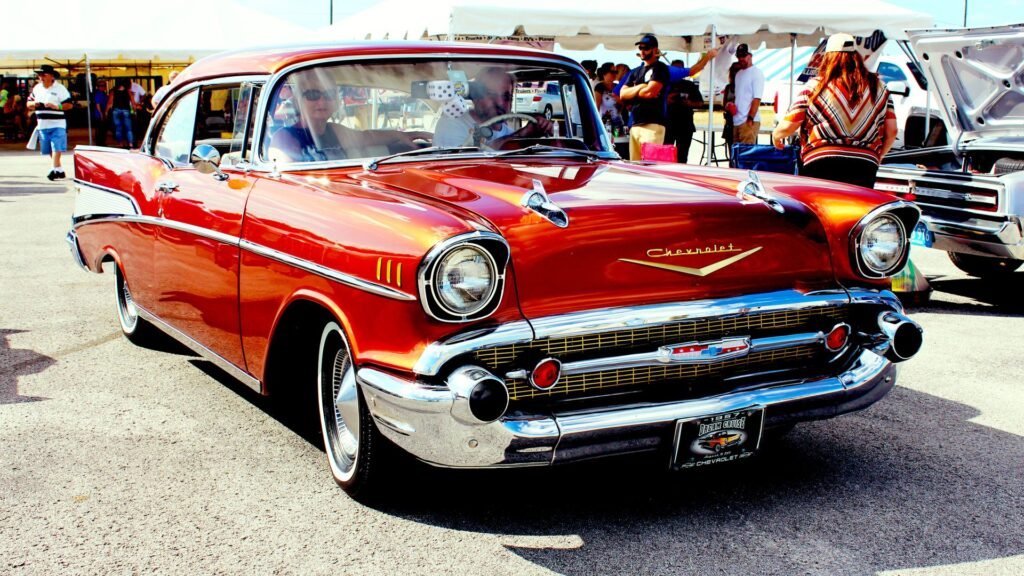

In slang, crank is a shape shifting word: a grumpy or eccentric person, a verb for turning something up or churning work out, and, in street slang, a name for methamphetamine.
That spread is why crank confuses people. One sentence can praise a party, insult a neighbour, describe a car part, and, in a very different conversation, name a drug, and only the context tells you which crank you just heard. If you learn the contexts, one by one, the word stops being a puzzle and starts being useful, especially the two verb phrases that do most of the everyday work: crank up and crank out.
This guide separates the senses cleanly. The person sense comes first, then the verb family, then the machine root that explains them both, then the drug sense, handled plainly and without detail that anyone could misuse. You will also get a comparison table, a usage map, replies, myths, and the places where crank is the wrong word entirely.
What Crank Means at a Glance
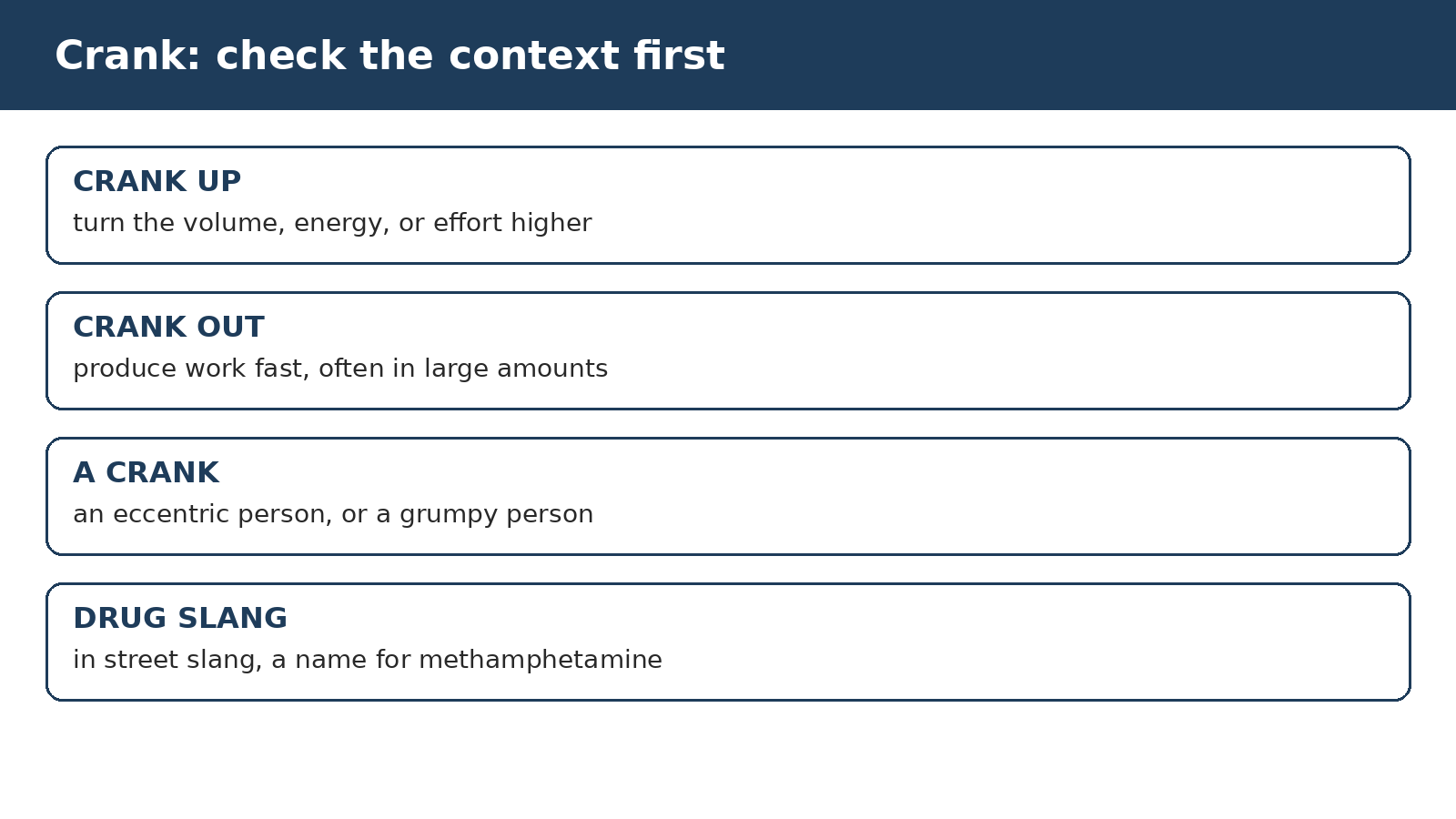
Crank has four live senses worth knowing. As a noun for a person, it means someone eccentric, stubbornly odd, or simply grumpy, depending on the sentence. As a verb, crank up means increase the volume, energy, or effort, and crank out means produce work fast and in quantity. As a machine word, it means a bent handle or shaft that turns motion into rotation. In street slang, it is a name for methamphetamine.
Most everyday uses are the first two, and most confusion comes from the last one. A friend who says “crank up the music” is not talking about drugs, a boss who says “we need to crank out the report” is not talking about a person, and a neighbour called a crank is not being accused of anything criminal. Listen for the verb or the noun, listen for music, work, cars, or people, and the right sense usually announces itself in the same sentence.
Every real sense of crank in one list
- A crank (person). An eccentric person with stubborn, unusual views, or a grumpy, ill tempered person. “Don’t mind him, he’s a bit of a crank about parking.”
- Cranky (adjective). Irritable, cross, out of sorts, often from tiredness. “She’s cranky before coffee, give her ten minutes.”
- Crank up. Increase, start, or intensify: volume, heat, enthusiasm, effort. “Crank up the heating, it’s freezing.”
- Crank out. Produce quickly and in large amounts, sometimes mechanically. “He can crank out three essays in a weekend.”
- Crank (machine). A bent arm or handle that turns a shaft, a crankshaft in a car, or a hand wound window. “This old car still has crank windows.”
- Crank call. A hoax or nuisance phone call, made to tease or annoy. “That was just a crank call, don’t call back.”
- Crank (drug slang). A street name for methamphetamine, and in some older dictionary entries, for a stimulant decongestant used illicitly. This sense is serious, and it is the one to handle with care in any conversation.
Where Crank Comes From
Crank starts as a bent thing. The Old English root points to something crooked or twisted, a weaver’s tool with a bent arm, and the machine sense kept that shape for a thousand years: a crank is an arm that turns, a handle that winds, a shaft that converts push into spin. The person sense grew out of that twist, in the way English often turns a bent shape into a bent mind.
Etymonline traces cranky, meaning cross tempered or irritable, to 1807, from crank plus the adjective ending y, and notes earlier senses of crank such as a twist or fanciful turn of speech from the 1590s. The eccentric person sense, a person irrationally fixated on one idea, is first recorded in 1833, and Etymonline suggests it may be a back formation from cranky, from the notion of a mental twist. That twist image explains a lot: a crank is someone whose thinking has taken a sharp turn away from the straight road, and stayed there.
From handle to head: how a machine word became a person word
Think of the path in three steps. First, crank is a handle you turn. Second, cranky is a mood that feels twisted out of shape, the way a bent handle looks wrong next to a straight one. Third, a crank is a person whose views feel twisted in the same way: fixed, odd, and hard to straighten out. The machine never left the word, which is why crank up and crank out still feel physical, like turning a dial or running a press, even when no machine is in the room.
The drug sense, dated plainly
Etymonline dates the methamphetamine sense of crank to 1989, from the verb, which fits the verb family neatly: a stimulant cranks a person up, in the same way a dial cranks music up. Dictionaries and slang glossaries have listed it ever since, and Encyclopedia.com lists crank plainly as crystal methamphetamine in its slang and jargon glossary. No one needs a colourful origin story for this sense. It is a street name, it is old enough to be established, and it is the sense that makes context matter most.
Crank as a Person: Eccentric, Grumpy, or Both
Calling someone a crank can mean two different things, and the difference is in the warmth of the sentence. An eccentric crank is odd, stubborn, and often harmless: the neighbour who writes long letters about street lights, the uncle with a theory about every football result, the inventor in a shed with a machine no one else understands. A grumpy crank is a different person: short tempered, complaining, hard to please in the morning. The same word covers both, and speakers slide between them without noticing.
Cambridge defines the informal person sense as someone who has strange or unusual ideas and beliefs, and gives the American grumpy sense in the same entry, with the example of someone who is a crank first thing in the morning. That pairing is the whole story: strange ideas in one sentence, bad temper in the next, and the listener has to decide which one the speaker meant. Tone helps. Said with a smile, crank is affectionate teasing. Said with a sigh, it is a complaint.
Eccentric crank: odd, fixed, harmless
The eccentric crank is fixed on one subject and will return to it, the way a barrel organ plays the same tune when you turn its handle. That image, whether it is the true origin or not, captures the behaviour: same tune, same turn, every time. “He’s a crank about compost” means he will talk about compost at length, with strong views, and will not be moved. It is rarely a compliment, but it is rarely cruel either. It says: odd, but known, and mostly left alone.
Grumpy crank: cranky before coffee
The grumpy crank is closer to cranky, the adjective. “Don’t talk to her yet, she’s a crank in the morning” means she is irritable before she wakes up properly. This use is American leaning, and it is softer than calling someone rude or mean. It excuses the mood as temporary: cranky now, fine later. If you hear crank used for a person and the sentence mentions mornings, tiredness, hunger, or a bad night, the grumpy sense is almost certainly the right one.
Crank vs an insult: where the line sits
Crank is a mild insult, not a heavy one. It stings less than idiot, less than weirdo, and far less than any slur, because it targets ideas or mood, not worth as a person. That softness is why it survives in family chats and office jokes. Even so, calling someone a crank to their face can land badly, especially if they are already upset. Use it about a third person, in a light tone, or not at all, and never use it to dismiss someone’s real concern: a neighbour worried about safety is not a crank, they are a neighbour worried about safety.
For the stronger British insult family, see our guide to British slang for idiot, and what the UK says instead. Crank sits at the gentle end of that family, closer to oddball than to any real insult.
Crank Up, Crank Out, and the Verb Family
If the person sense is the one people ask about, the verb family is the one people actually use every day. Crank up and crank out are both phrasal verbs, both built on the machine image, and both so common that many speakers use them without ever thinking of a handle or a shaft. Learn these two and you have covered most modern crank speech.
Crank up: turn it higher, start it stronger
Dictionary.com lists crank up as getting started or ready, stimulating or producing, and increasing effort or output, with examples like cranking up enthusiasm for a product and an industry cranking up after a slow period. In real life the uses are simpler: crank up the volume, crank up the heat, crank up the music for a party, crank up the pace on a run. The image is a dial turning clockwise, and the meaning follows the dial: more of whatever was already there.
Crank up also works for mood and energy. “Let’s crank up the party” means raise the energy, not just the volume. “She cranked up her training” means she increased the intensity. “The film cranks up the tension” means it builds suspense step by step. In each case, something starts low and ends high, and crank up is the verb for that climb.
Crank out: produce fast, produce lots
Dictionary.com defines crank out as making or producing in a mass production, effortless, or mechanical way, with the example of a writer able to crank out one best selling novel after another. That mechanical note matters. Crank out praises speed and volume, and it can also hint that the work was produced on a line, without much care. “She cranked out the report” can be praise for speed. “He just cranks out content” can be a criticism of quantity over quality. Listen for admiration or for a sigh, and you will know which one you heard.
Other members of the verb family
- Crank down. Reduce or end something: crank down the heating, crank down spending. Less common than crank up, but the same dial image in reverse.
- Crank in or into. Build something into a total or a plan: overhead cranked into the price. A business and accounting use, rarely heard at home.
- Get cranking. Get started, get moving: “Come on, let’s get cranking.” A friendly push, close to crack on in British speech.
- Crank handle, crank start. Turn a handle to start an engine, the literal machine job that gave the verb family its image in the first place.
The Machine Sense: Cranks, Crankshafts, and Crank Windows
Before crank was a person or a verb, it was a part. A crank is a bent arm attached to a shaft, and turning it turns the shaft. A crankshaft in a car engine does the same job at speed, turning the up and down push of pistons into the rotation that drives the wheels. A crank handle on an old car, a music box, or a pencil sharpener is the same idea in your hand: you turn, something else moves.
That is why old cars have crank windows, windows you wind up and down by hand, and why older drivers still say “crank the engine” even when they press a button. The language kept the handle long after the handle left the car. A modern driver who says “crank it up” about a car stereo is using a machine word for a digital job, and no one in the car thinks twice about it, because the image still works: turn, more, louder, faster.
Crank in Drug Slang: What It Means and Why Context Matters
In street slang, crank is a name for methamphetamine, a powerful stimulant, and it has also been used for other stimulant drugs in older dictionary entries. This section names the sense plainly, because a slang guide that hides it would leave readers unprepared, and it gives no detail about obtaining, making, or using any drug, because that detail has no place in a meaning guide.
The context that points to the drug sense is usually unmistakable once you know to look for it: talk of dealing, using, buying, or being high, talk set in a drug scene, or a sentence where crank sits beside other drug terms. A sentence like “crank up the music” has none of those markers, and the music sense wins. A sentence about someone dealing crank, or being on crank, has them all, and the drug sense wins. The word itself does not change. The room around it does.
Why does this matter for ordinary readers? Because crank is one of those words where a harmless sentence can be misread by someone from a different scene. A teenager who says “I’m cranked up” after three coffees means wired and energetic, and a listener from a drug harm background may hear something else entirely. The fix is not to stop using crank up, which is standard, everyday English. The fix is to add a detail: cranked up on coffee, cranked up for the match, cranked up about the news. One extra word removes the ambiguity, and it costs nothing.
For the neighbouring drug term that is often confused with crank, see our guide to what crack means in slang. Crack and crank are different drugs, different words, and different histories, and mixing them up is the most common factual error in this whole word family.
Crank vs Similar Words
| Word | Meaning | Tone | Example |
|---|---|---|---|
| Crank (person) | Eccentric or grumpy person | Mild, teasing or complaining | “He’s a crank about train times.” |
| Cranky | Irritable, out of sorts | Soft, often temporary | “I’m cranky, I slept badly.” |
| Grouch | A habitually grumpy person | Blunt, a little harsher | “Don’t be such a grouch.” |
| Oddball | An eccentric person | Playful, mostly kind | “She’s an oddball, in a good way.” |
| Crank up | Increase, intensify | Energetic, everyday | “Crank up the volume.” |
| Turn up | Increase, appear, arrive | Neutral, wider use | “Turn up the heat.” |
| Crank out | Produce fast, in quantity | Praising speed, or doubting quality | “She cranked out the slides.” |
| Churn out | Produce in quantity, mechanically | More critical of quality | “They churn out sequels.” |
The table shows why crank survives: it is the only word in the set that covers a person, a mood, a machine, and two useful verbs. Turn up can replace crank up in most sentences, and churn out can replace crank out, but neither replacement carries the machine image, and neither can also describe a person. When you want that image, crank is the word. When you want neutrality, turn up and produce are safer choices.
For the warm praise word that often sits beside crank up in party speech, see our guide to what cool means in text and online, and for the big American praise word, see what awesome means in slang. Crank up the music, and the next word in the sentence is often one of those two.
Who Says Crank, Where, and to Whom
Crank is used across the English speaking world, with different senses leading in different places. In the United States, the grumpy person sense, the verb family, and the drug sense are all live, and the drug sense is the one Americans are most likely to meet in news and crime reporting. In the UK, the eccentric person sense and the verb family lead, and the drug sense is recognised but less central to everyday speech. In Australia and Canada, the verb family leads, and the person sense follows close behind.
Who says it to whom depends on the sense. Crank up and crank out are safe in almost any informal setting: friends, family, colleagues, teammates, a boss to a team, a teacher to a class. A crank as a person is safe only about a third person, in a light tone, or among friends who tease each other that way. The drug sense is not casual speech at all: it belongs in reporting, in harm discussion, and in conversations where the topic is already drugs, and it should never be used as a joke about someone’s energy, because the joke can misfire badly.
A quick usage map
- Speaker: English speakers of all ages for the verbs, adults mostly for the person and drug senses.
- Place: Kitchens, cars, gyms, offices, music rooms, workshops, news reports, group chats.
- Audience: Anyone for crank up and crank out, friends and family for a crank person, a serious audience for the drug sense.
- Register: Informal for the verbs and the person sense, neutral for the machine sense, serious for the drug sense.
- Energy: Crank up is high energy, crank out is fast energy, a crank person is low, fixed energy.
How to Use Crank Naturally
Start with the verbs, because they are the safest and the most useful. Crank up needs an object or a clear context: crank up the volume, crank up the heat, crank up the pace. Crank out needs a piece of work: crank out a report, crank out dinner for ten, crank out practice questions before the exam. In both cases, the verb does the work, and the object tells the listener what kind of work it is.
- Raise something: “Can you crank up the heating? My hands are cold.” “Let’s crank up the music and clean this place.”
- Start something: “Time to crank up the project, the deadline moved forward.” “The band cranked up their set with an old favourite.”
- Produce fast: “She cranked out the invitations in one evening.” “We need to crank out a first draft by Friday.”
- Describe a person, gently: “He’s a bit of a crank about recycling, but his garden is beautiful.” “Give her a coffee, she’s cranky in the morning.”
- Describe a machine: “This van still has crank windows.” “The old engine needed a crank to start.”
Notice how each example gives the listener a second clue: heating, music, invitations, recycling, windows. That second clue is the habit that makes crank safe. A bare “crank it” can mean volume, effort, a machine, or something else entirely, and listeners will fill the gap with whatever scene they came from. A crank it plus a noun leaves no gap, and no one has to guess.
What to Say Back When Someone Says Crank
- To crank up: “On it, turning it up now.” “How high? The neighbours will hear this one.” “Cranked, let’s go.”
- To crank out: “Give me an hour, I’ll crank it out.” “Done, first draft is in your inbox.” “Slow down, quality first, then speed.”
- To a crank person: “He means well, he’s just fixed on that one idea.” “Leave him, he’s cranky today, he’ll be fine tomorrow.” “Careful, he can hear you.”
- To a crank call: “Ignore it, it’s a crank call.” “Don’t call back, that’s what they want.” “Block the number and move on.”
- To the drug sense: Do not joke, do not repeat it as gossip, and do not ask for detail. If someone needs help, a calm, private conversation is the right reply, not a slang debate.
Replies work best when they match the sense you heard. Answering crank up with a comment about a person, or answering a crank person with a comment about volume, tells the speaker you heard the word but missed the sentence. Repeat the key noun back in your reply, volume, report, person, call, and the conversation stays on track.
Myths vs Facts About Crank
Myth: crank always means drugs
Fact: the drug sense is real, but it is not the most common sense in everyday speech. Crank up the music, crank out a report, and a crank neighbour are all older, broader uses, and they outnumber the drug sense in kitchens, offices, and cars by a wide margin. Context, not the word alone, decides the sense.
Myth: crank and crack are the same drug word
Fact: they name different drugs, with different histories, and they are not interchangeable. Crack is a form of cocaine base, named for the crackling sound it makes when smoked, while crank is a street name for methamphetamine. Using one for the other is a factual error, and in a serious conversation it is a misleading one.
Myth: cranky and crank mean the same thing
Fact: cranky is an adjective for a mood, usually temporary, while a crank is a noun for a person, usually with a fixed trait. You can be cranky for an hour and be fine by lunch. Being called a crank says something more lasting about how you think or how you complain.
Myth: crank out always praises speed
Fact: crank out can praise speed, and it can criticise quality, sometimes in the same sentence. “She cranked out a brilliant draft” is praise. “They just crank out sequels” is criticism. The verb carries the machine image with it, and machines can be impressive or mindless, depending on what they produce.
Myth: crank is a new internet word
Fact: the machine sense is over a thousand years old, the person sense is from the 1800s, and the verb family grew out of both. The internet gave crank up a new home in music and gaming chats, but it did not invent the word, and it did not invent most of its senses.
When NOT to Use Crank
Do not use the drug sense casually, as a joke, or as a way to describe someone’s energy, because the joke can be heard as an accusation, and the accusation can follow a person. Do not use a crank for a person in a formal setting, in a complaint letter, or about someone with a real grievance, because the word dismisses the person instead of answering the point. Do not use crank out for careful, creative work that you want to praise for quality, because the machine image can make the praise sound backhanded.
Do not use crank in a sentence where the drug sense could plausibly be heard and you do not mean it. “He’s cranked” on its own, without a detail like coffee, music, or a match, is the classic example: it can mean wired, it can mean high, and listeners from different scenes will hear different things. Add the detail, and the sentence becomes safe again. The same caution applies to crank calls: do not call a real, mistaken number a crank call in a report, because the phrase implies intent to annoy, and a wrong number has no such intent.
Finally, do not use crank as a diagnosis. A cranky child is tired or hungry, not a crank. An eccentric neighbour is a neighbour, not a case. Slang describes speech, not people, and the kindest use of crank is the one that leaves room for the person behind the word.
Quick Answers About Crank Slang
What does crank mean in slang?
Crank means a grumpy or eccentric person, and, in street slang, methamphetamine. As a verb, crank up means increase or intensify, and crank out means produce fast and in large amounts.
What does crank up mean?
Crank up means turn something higher or start something stronger: crank up the volume, crank up the heat, crank up the pace, crank up enthusiasm for a project.
What does crank out mean?
Crank out means produce work quickly and in quantity, often mechanically: crank out a report, crank out invitations, crank out practice questions.
What does cranky mean?
Cranky means irritable or cross, usually temporarily, from tiredness, hunger, or a bad morning. “She’s cranky before coffee” means she is grumpy until she wakes up properly.
Is crank a drug word?
Yes, in street slang crank is a name for methamphetamine. That sense is real and serious, but it is not the only sense, and everyday uses like crank up the music have nothing to do with drugs.
What is a crank call?
A crank call is a hoax or nuisance phone call, made to tease, annoy, or waste someone’s time. The usual advice is simple: do not call back, block the number, and move on.
Is crank the same as crack?
No. Crack and crank are different words for different drugs, and they are not interchangeable. Crack is a form of cocaine base, while crank is a street name for methamphetamine.
Sources and Further Reading
- Cambridge Dictionary on crank: defines the informal person sense as someone with strange or unusual ideas and beliefs, plus the American grumpy sense.
- Dictionary.com on crank: lists the machine, person, and drug senses, plus crank up, crank out, crank down, and crank in.
- Etymonline on crank: traces cranky to 1807, the eccentric person sense to 1833, and the methamphetamine sense of crank to 1989.
- Encyclopedia.com on slang and jargon: lists crank as crystal methamphetamine in its drug slang glossary.
- Pexels photo page: Vintage Car by Pixabay: free license source of the featured image.
- Pexels photo page: Lineup of Classic Vintage Cars in a Showroom by Quentin Martinez: free license source of the in body image.