

There is no single “British word for idiot”. Britain has an entire toolkit of them, from the gentle numpty to the outright harsh prick, and Brits deploy them with a precision that depends on the word, the tone, and who is listening.
If you asked a Brit what they say instead of “idiot”, the answer would probably come back as a question: “which kind of idiot?” A mate who left his keys in the fridge is a plonker. A gullible soul who fell for an obvious scam is a muppet. A northern bloke being deliberately annoying is a wazzock. Each word paints a slightly different picture, and learning the differences is what separates a confident visitor from someone who accidentally starts a row in the pub.
This guide walks through the words themselves, where each one came from, how rude it actually is, who says it and where, and how to handle it when one lands on you. It also sits comfortably alongside our roundup of funny British slang if you want the wider vocabulary.
The Short Answer: What Brits Say Instead of Idiot
The most common British slang words for “idiot” are plonker, numpty, muppet, wazzock, pillock, berk, div and prat, with knobhead and prick at the harsher end. The mild ones work as playful banter between friends; the harsh ones are genuine insults, so choose based on your audience.
That is the whole game in one paragraph. Everything below is the detail that keeps you from using the right word with the wrong people. Start with the gentle end of the list and you will rarely go wrong. The harsh end is for people you are genuinely angry with, not people you are trying to befriend.
Why Britain Has So Many Words for Idiot
Britain has dozens of words for “idiot” because British humour runs on playful insults, and a rich insult vocabulary is part of the culture’s social glue. Mockery between friends is how people bond, show affection and test that everyone is comfortable with each other, so the language kept minting new ways to say it.
Listen to any group of British friends for ten minutes and you will hear it. The teasing is constant, affectionate and almost ritual. A mate does something daft, the group erupts with “you muppet”, everyone laughs including the muppet, and the conversation moves on. I have heard an office full of grown adults spend an entire Friday afternoon rotating through insults for a colleague who put decaf in the machine, and he was loving every second of it.
The insults also do practical work. They let people express frustration without real confrontation. Calling a driver a berk under your breath defuses the urge to honk for a minute. Calling your brother a plonker at Christmas dinner says “I love you and you are an idiot” in two syllables. Direct American-style confrontation often feels too heavy for British sensibilities, and a well-aimed cheeky insult lands softer than a serious complaint.
There is a regional layer too. Some of these words are national treasures, but others are fiercely local. You will hear wazzock mostly in the north of England, numpty started life in Scotland, and eejit belongs to Scotland and Ireland. Britain’s slang geography means the word that makes a Yorkshire pub laugh might draw a blank in Kent, which is half the fun of learning them.
The Words Themselves: Britain’s Favourite Ways to Say Idiot
Here are the main contenders, each with its meaning, its origin story and notes on how it lands. They are ordered roughly from gentlest to harshest, so the further down you read, the more careful you should be.
Plonker
Plonker is the friendliest heavyweight on this list: a mild, almost affectionate way to call someone silly. The British-English learning site FunkyEnglish traces plonker back to the verb “plonk”, meaning to drop something down heavily and clumsily, so a plonker is basically a person who keeps metaphorically dropping the ball. It became famous through Only Fools and Horses, the BBC sitcom in which Del Boy’s go-to insult for his brother Rodney was a booming “you plonker”. FunkyEnglish notes that every one of the show’s 64 episodes was written by John Sullivan and that the 1996 Christmas episode drew 24.3 million viewers, which explains why the word is burned into the national vocabulary. Use it on mates, on yourself, never on the boss.
Muppet
A muppet is someone gullible or foolish, the sort of person who falls for a prank you saw coming from a mile off. The how-to guide HowToSayGuide describes muppet as derived from Jim Henson’s popular puppet characters, and the comparison is the whole joke: a muppet is someone being dangled on strings by their own naivety. It is gentle in tone and very common among younger Brits. “She fell for that text scam? What a muppet” is about as harsh as it usually gets.
Numpty
Numpty is the softest word on this list, a playful term for someone who has done something daft. Ben Yagoda’s tour of British insults for Lit Hub notes the OED dates numpty to 1985 and calls it Scottish in origin, with a possible link to numbskull or even Humpty Dumpty. Nobody is quite sure, and nobody in Britain really cares. What matters is that it lands with a smile. “You left your phone in the fridge, you numpty” is said with love, not venom.
Twonk
Twonk is old-fashioned, harmless and faintly silly, which is exactly why it survives. It sounds like what it is: a soft thud of a word. Del Boy used it on Rodney alongside plonker, and it still turns up in sitcom-style banter. Nobody has been seriously wounded by “twonk” in living memory. It is the kind of word your dad uses when he is pretending to be cross, which makes it oddly endearing.
Wally
Wally is another of Del Boy’s favourites for Rodney, and it belongs to the same gentle family. It has been floating around British English since the 1960s as a word for a fool, and it carries a slightly vintage, almost nostalgic flavour. Call someone a wally today and you sound less like a modern insult comic and more like a fond 1980s uncle. That is a feature, not a bug.
Wazzock
Wazzock is the northern bruiser of the list: louder, blunter and a bit more of a genuine telling-off than the words above. Ben Yagoda’s Lit Hub piece reports the OED labels wazzock “unknown origin” and defines it as “a stupid or annoying person”, probably emerging in the North of England in the 1970s. It crossed into the headlines when a British MP called Donald Trump a wazzock in a parliamentary debate, which tells you something about its register: punchy enough for politics, mild enough for the House of Commons. Use it where northerners gather and you will fit right in.
Pillock
Pillock is a sturdy, middleweight insult: definitely calling someone an idiot, but rarely starting a fight. The Lit Hub piece gives it the OED treatment: “Chiefly Brit. Colloq. (mildly derogatory). A stupid person; a fool, an idiot”, with the first citation from 1967. Yagoda also flags that the word may be a shortening of pillicock, which turns up in King Lear when the mad beggar Poor Tom sings about “Pillicock hill”, and that Dame Helen Mirren told America “don’t be a pillock” in a 2016 Super Bowl advert against drink-driving. It is a word with literary roots and a Hollywood seal of approval.
Div
Div is short, northern and dismissive, and it pairs naturally with the phrase “a bit divvy”, meaning a bit daft. Where exactly it came from is murky, and you will find competing theories if you go looking, so treat any single origin story with suspicion. In practice it works like pillock‘s street-tougher cousin. “Don’t be a div” is said to mates who are about to do something they will regret.
Berk
Berk has the most surprising backstory on this list. An etymology dictionary entry for the word dates berk to 1936 as an abbreviation of “Berkshire Hunt” (or “Berkeley Hunt”), which is Cockney rhyming slang for one of the rudest words in English. Almost nobody using it today knows that, and the origin has faded so completely that berk now lands as a mild, slightly old-fashioned “fool”. It is a brilliant example of how a word’s history and its current sting can be totally different things. Use it freely; nobody will hear the rhyming slang underneath.
Prat
Prat is a no-frills idiot-word that has been around since the 1960s. It is a touch sharper than plonker but still nowhere near the nuclear end of the scale. It suits someone who is being an idiot in a way that is slightly annoying rather than funny, the colleague who replies-all to the company-wide email. It also works as a warm-up word in longer insults, but keep those for people you know well.
Twit
Twit is mild, a little old-fashioned and mostly the preserve of older Brits these days. The insults guide at ForeignLingo records twit’s first use in 1934, and notes it probably comes from an older verb meaning to reproach, or from nitwit. It is the word a grandmother might use, which tells you everything about its threat level. Whatever you do, do not mix it up with the next entry on this list.
Knobhead
Knobhead is where the list stops being playful. It is a genuine insult, stronger than everything above, though it can still be used jokingly between close friends. The literal image behind it is crude, and that crudeness is the point: it signals real irritation. “He’s such a knobhead” means the speaker is not smiling. Save it for people who have genuinely annoyed you, and even then, know your audience.
Prick
Prick is a proper insult, sharp and cutting, and it sits at the harsh end of the idiot-words spectrum. ForeignLingo’s guide notes it was first recorded as an insult in 1929 and that it shares its history with a crude anatomical term, which is why it bites. This is not banter vocabulary for visitors. Brits use it when they are genuinely angry: at the driver who cut them off, the stranger who pushed past, the ex who did the dirty. If someone calls you this, they are not being affectionate.
A Few Regional Favourites Worth Knowing
Britain’s nations and regions have their own house specials, and dropping one in the right place earns instant respect. These are less universally understood than the main list, which makes them feel like insider knowledge.
Eejit
Eejit is the Scottish and Irish pronunciation of “idiot”, and it is used with enormous affection. A Glaswegian calling you an eejit after you lock yourself out is basically giving you a hug. It appears in our Scottish slang guide and our Irish slang guide, and it travels well: say it with a smile anywhere in Britain and people will get the warmth. It is probably the safest “idiot” word in the entire UK.
Gobshite
Gobshite is heard a lot in the north of England and in Ireland, and it is aimed less at stupidity and more at someone talking rubbish. Gob is slang for mouth, so a gobshite is literally someone whose mouth produces nonsense. It is cruder than plonker and best treated as a proper insult rather than banter.
Noddy
Noddy compares the person to the children’s book character, all nodding head and empty grin. It is a softer, slightly old-fashioned way to say someone is being simple. The Lets Learn Slang list of British idiot-words includes noddy among its examples, describing it as the look of someone grinning and nodding through a conversation they clearly do not understand. It is rare in the wild now, but the image is instantly clear.
How Rude Are They Really?
Here is the practical ranking. The gentle words on the left work as banter between friends and even about yourself; the harsh words on the right are real insults that can genuinely offend. When in doubt, stay in the green zone and let the tone of your voice do the rest.
| Word | Meaning | Tone | Region / formality | Example |
|---|---|---|---|---|
| Numpty | Playful fool who did something daft | Gentle, affectionate | Scotland originally; fine anywhere now | “You locked the keys in the car, you numpty.” |
| Plonker | Silly, clumsy person | Cheeky, friendly | Nationwide; mates and family | “You plonker! You put salt in the tea.” |
| Muppet | Gullible fool | Gentle, teasing | Nationwide; younger speakers especially | “He believed the fake text? Muppet.” |
| Wazzock | Annoying or dim person | Blunt, proper telling-off | North of England; informal | “Stop being a wazzock and help me.” |
| Berk | Fool, contemptible idiot | Mild in practice | Nationwide; the origin is long forgotten | “That berk parked across two bays.” |
| Prat | No-frills idiot | Mildly sharp | Nationwide; informal | “Ignore him, he’s a prat.” |
| Knobhead | Genuine insult for an obnoxious idiot | Harsh; joking use only with close mates | Nationwide; informal, crude undertone | “What a knobhead, cutting in like that.” |
| Prick | Contemptible, irritating person | Harsh; real anger | Nationwide; never formal | “That prick stole my parking spot.” |
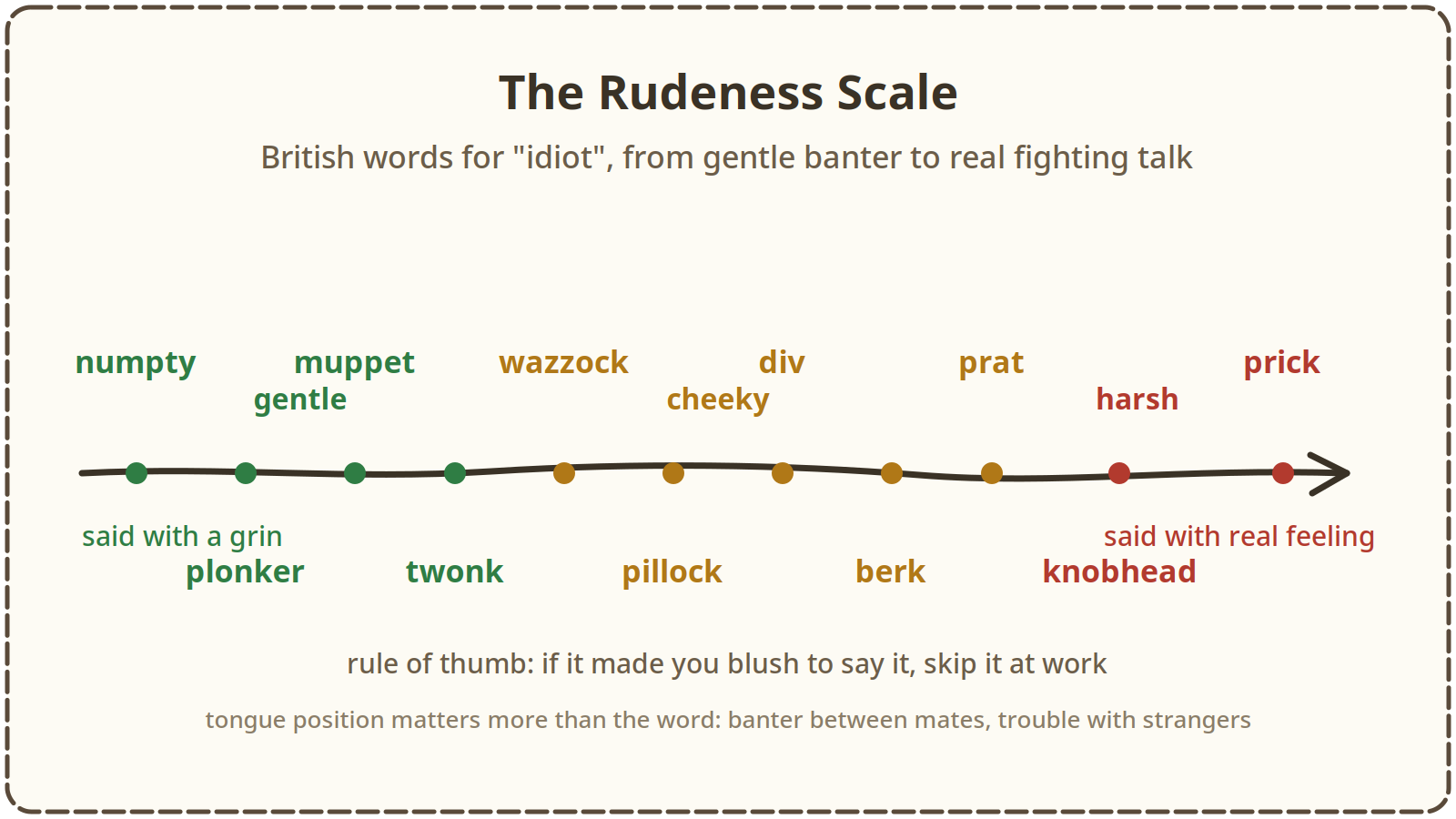
If you want a deeper tour of how these words compare on pure rudeness, our British Slang Insults guide ranks the wider insult family. The short version is simple: anything involving anatomy-derived words carries more voltage than its dictionary definition suggests, because Brits hear the rude root even when they are not saying it out loud.
Who Says These Words, Where, and to Whom
The typical scene for these words is mates together in low-stakes settings: the pub, the football ground, the group chat, the sofa during a match. The speaker is usually a friend, brother, colleague or partner; the target is usually a friend, brother, colleague or partner. Strangers, bosses and in-laws are off the menu.

The pub is the natural habitat. Insults fly between pints the way peanuts fly between hands, and being called a plonker over a beer is practically a compliment: it means you are one of the group. Football culture runs on the same fuel. Stands full of fans trade wazzock and muppet at the referee, the opposition and occasionally their own players, and the words are part of the theatre of the afternoon.
Group chats and gaming lobbies are the digital equivalent. A mate who walks into the wrong end of a map in a game is getting called a div within seconds, and he knows the drill. The words travel especially well in text because the recipient supplies the friendly tone from context. This is also where they mutate fastest: new spellings, new combinations and new targets appear in gaming and football Twitter every season.
There is also a big self-deprecating tradition. Brits call themselves plonkers and numpties constantly. “I’m such a plonker, I left the oven on” is one of the most British sentences ever written, and using the words on yourself is always safe. It signals you are in on the joke, which is the whole point of the banter economy.
Who does not get these words: anyone you need to stay professional with. Your manager, a client, a stranger at the bus stop, your partner’s parents on the first meeting. The words assume a relationship with enough goodwill to absorb the sting. Without that relationship, even the mild ones can land wrong.
How to Use Them Without Getting Yourself in Trouble
The rules are simple once you see them, and they keep every word in this guide safe to use. First, keep the harsh ones, knobhead, prick and their cousins, for people who are actually annoying you, and expect the relationship to take the hit. These are not banter words for visitors; they are real insults with real consequences.
Second, read the room before you deploy anything beyond numpty and plonker. A word that gets laughs at the pub can get you a formal warning at work. Offices do run on banter, but only between people who have earned it. If you have not yet been teased by someone, you have not yet earned the right to tease them back. Watch, wait and let a colleague call you something first.
Third, remember the hidden roots. Several of the harsher words on this list come from crude anatomical slang, and British ears hear those roots even in casual speech. Berk is the exception that proves the rule: its rhyming-slang origin has faded so far that it is genuinely mild now. For the rest, if a word made you hesitate before saying it, that hesitation is your answer.
Fourth, never use any of them to punch down. Aiming these words at someone’s actual intelligence, disability or background is not banter, it is bullying, and Brits will turn on you fast for it. The words work because everyone involved knows the target is not actually being judged. The moment that stops being true, the joke is over.
What to Say When Someone Calls You One
Getting called a plonker or numpty by a Brit is usually a good sign. It means you have been accepted into the banter circle. The worst response is to get genuinely offended, because that breaks the spell for everyone. The best response is to fire back, laugh, or agree with theatrical exaggeration.
Classic comebacks include “takes one to know one”, “cheers, you div”, and the always reliable strategy of upgrading: if they call you a muppet, call them a knobhead and watch the room decide who won. Self-deprecation works too. “Guilty as charged, I’m a right plonker” disarms almost any insult and usually earns you another round.
The tone to aim for is cheerful, not cutting. British banter is a game of escalating absurdity, not genuine cruelty. The winner is the person who makes the room laugh, not the person who lands the deepest cut. If the insults start feeling personal rather than playful, that is your cue to dial it back, and most Brits will respect you for reading the moment.
If the word was one of the harsh ones and the tone was serious, different rules apply. “Are we alright?” or a calm “steady on” signals you noticed the shift without escalating. Direct confrontation is rare in British culture, so a short, calm check usually defuses things. And if a stranger uses a harsh one on you, the most British response of all is to ignore them completely. Nothing deflates an insult like total indifference.
Myths and Mix-Ups
Myth: “Plonker” is a really rude word
It really is not. Because it sounds a bit crude, visitors often file plonker next to the genuinely rude words, but in Britain it is one of the softest insults going. Del Boy shouted it at his beloved brother on prime-time BBC television for years. If it were truly rude, that would never have happened. File it under affectionate, not aggressive.
Myth: “Berk” is harmless because nobody knows the origin
Mostly true, with one wrinkle. The rhyming-slang root behind berk is genuinely forgotten by the vast majority of speakers, which is what makes it mild. But a small number of older Brits, especially Londoners who grew up around rhyming slang, do know it. If your audience includes a sharp-eyed East End grandfather, you might raise an eyebrow. For everyone else, it is perfectly safe.
Myth: “Twit” and “twat” are basically the same word
They are not, and confusing them is one of the classic visitor mistakes. Twit is a gentle, old-fashioned word for a silly person. Twat is a harsh, crude insult for someone obnoxious. They sound alike and mean wildly different things. Say the wrong one in the wrong company and the room will go very quiet. When in doubt, say twit or say nothing.
Myth: Brits are being mean when they insult their friends
Usually the opposite is true. In British culture, the people you insult playfully are very often the people you like most. The insults are a pressure valve and a bonding ritual rolled into one. What looks like hostility to an outsider is frequently the warmest interaction in the room. The real warning sign is not the insult; it is the sudden politeness.
People Also Ask About British Slang for Idiot
What is the most common British slang word for idiot?
Plonker is probably the best-known, thanks to Only Fools and Horses, with numpty and muppet close behind in everyday use. All three are mild enough for banter. Plonker skews slightly older and more southern, numpty started Scottish but is everywhere now, and muppet is the favourite of younger speakers.
Is “plonker” rude?
No, plonker is a mild insult. Brits use it with friends and family and constantly about themselves, as in “I’m such a plonker”. It means someone did something silly or clumsy. Keep it out of formal settings and away from your boss, but among mates it is about as offensive as calling someone a goofball.
What does “berk” actually mean?
Berk means a fool or an idiot, and in everyday use it is mild. Its origin is the surprising part: it is Cockney rhyming slang, an abbreviation of “Berkshire Hunt” or “Berkeley Hunt”, rhyming with a much ruder word. Almost nobody remembers that now, which is why it lands so softly.
Is “twat” worse than “twit”?
Much worse, and they are different words entirely. Twit is a gentle, old-fashioned term for a silly person. Twat is a harsh, crude insult aimed at someone obnoxious or unpleasant. They sound similar, which makes the mix-up easy and the consequences awkward. Learn the difference before you use either.
What is the difference between “numpty” and “plonker”?
Both are gentle words for a silly person, but they have different flavours. Numpty is Scottish in origin and feels warm and daft, the word for a mate who locked himself out again. Plonker is cheekier and more southern, tied to Del Boy’s catchphrase, and suits clumsy mistakes. In practice they are interchangeable in friendly banter.
What does “muppet” mean in the UK?
In the UK, calling someone a muppet means they are being foolish or gullible, like someone being dangled on strings. It comes from Jim Henson’s Muppet characters and is used for people who fall for obvious tricks or do something naive. It is gentle, common among younger Brits, and almost always said with a grin.
Sources
- FunkyEnglish: Plonker, Meaning, Origin and Del Boy
- Literary Hub: Bell-ends, Pillocks, Numpties, and Sh*tgibbons, by Ben Yagoda
- FindWords: definition and etymology of “berk”
- HowToSayGuide: How to Say “Idiot” in British
- ForeignLingo: British Slang Insults, 40 Examples With Meaning And Tone
- Lets Learn Slang: British Slang For Idiot, 10 Examples