
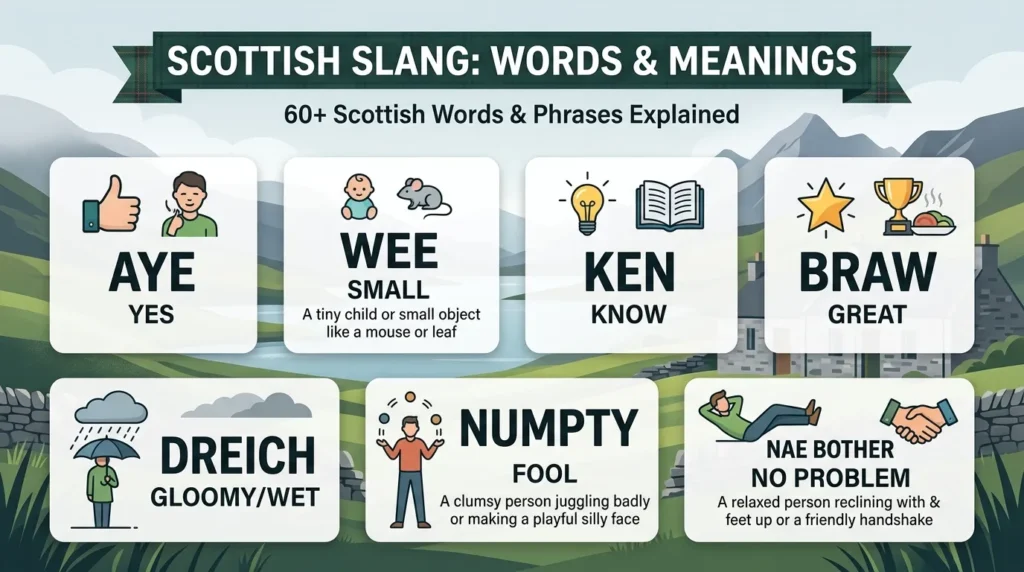

Scottish slang is a broad collection of informal words, expressions, and everyday phrases used across Scotland. Some are modern slang, while many come from Scots, Scottish English, or regional speech. Common examples include aye for yes, wee for small, ken for know, bairn for child, and braw for good or excellent.
The important thing is that Scottish slang is not one fixed vocabulary shared identically by everyone in Scotland. Usage changes by region, age, community, and situation. A phrase that sounds perfectly ordinary among friends may feel old-fashioned, strongly regional, playful, or rude somewhere else. Learning the meaning is useful, but understanding the tone and context is what makes Scottish slang much easier to follow.
Quick Answer: Scottish Slang at a Glance
| Term or Phrase | Meaning | Tone | Usage |
|---|---|---|---|
| Aye | Yes | Neutral | Very common |
| Wee | Small, little | Neutral/friendly | Very common |
| Ken | Know | Casual | Common |
| Bairn | Child | Neutral | Common/regional |
| Bonnie | Beautiful, attractive, pleasant | Positive | Common |
| Braw | Good, excellent | Positive | Common |
| Blether | Chat or talk | Friendly | Common |
| Crabbit | Grumpy, bad-tempered | Informal | Common |
| Dreich | Cold, wet, gloomy | Descriptive | Common |
| Minging / mingin | Disgusting, unpleasant | Negative | Informal |
| Numpty | Foolish person | Mild insult | Common |
| Bampot | Foolish or crazy person | Insult/playful | Informal |
| Radge | Wild, angry, or aggressive person | Informal | Context-dependent |
| Muckle | Large, big | Informal/regional | Common in some areas |
| Nae bother | No problem | Friendly | Very common |
| Get tae | Go away / get lost | Blunt | Informal |
| Gonnae | Going to / please, depending on phrase | Casual | Common |
| Dinnae | Don’t | Casual | Common |
| Cannae | Can’t | Casual | Common |
| Hame | Home | Casual/regional | Common |
| Messages | Shopping/groceries | Regional | Common in Scotland |
| Gutties | Trainers or gym shoes | Informal | Regional |
| Shoogle | Shake or wobble | Informal | Regional |
| Auld | Old | Informal/Scots | Common |
| Hen | Term of address, often for a woman | Friendly | Context-dependent |
What Is Scottish Slang?
Scottish slang refers broadly to informal vocabulary and expressions associated with speech in Scotland. However, there is an important distinction: not every Scottish word is technically slang.
Scots is a language variety with a long history, and many words that outsiders call Scottish slang are actually established Scots vocabulary or forms commonly used in Scottish English. Words such as aye, wee, bairn, ken, and dinnae can function as ordinary parts of everyday speech rather than special slang used only by young people.
Scottish speech also varies considerably across the country. Glasgow, Edinburgh, Aberdeen, Dundee, the Highlands, the Borders, and the islands can have different vocabulary and pronunciation. Some expressions are widely understood throughout Scotland, while others are strongly associated with particular regions.
That is why Scottish slang is better understood as a mixture of Scots vocabulary, Scottish English, regional expressions, modern slang, nicknames, insults, and conversational phrases rather than one standardized list.
The Most Common Scottish Slang Words
Aye
Aye means yes.
It is one of the easiest Scottish expressions for English speakers to recognize. It can be used by itself or as part of a longer sentence.
Example:
“Are you coming with us?”
“Aye.”
Depending on tone, aye can sound enthusiastic, neutral, doubtful, or even sarcastic. The word itself is not rude.
Wee
Wee means small or little, but it has a much wider everyday use than the standard English word “small.”
Someone might talk about a wee cup of tea, a wee walk, or a wee while without necessarily emphasizing that the thing is genuinely tiny.
Example:
“I’m just going for a wee walk.”
It can also add warmth or informality to a sentence.
Ken
Ken means know.
You may hear it in expressions such as “I ken” or “Dinnae ken”, meaning “I know” and “I don’t know.”
Example:
“I dinnae ken where he went.”
It is particularly associated with Scots and Scottish speech, although familiarity varies by region.
Bairn
A bairn is a child.
Example:
“She’s got two bairns at home.”
The word is strongly associated with Scottish and northern British speech. It is not an insult or offensive expression.
Bonnie
Bonnie generally means beautiful, attractive, or pleasant.
It can describe a person, place, day, or thing.
Example:
“What a bonnie view.”
When describing someone, it can function as a compliment. It may sound especially regional or traditional to people outside Scotland.
Braw
Braw means good, fine, excellent, or pleasant.
Example:
“That was a braw meal.”
It can describe experiences, people, objects, weather, or general circumstances.
Blether
A blether is a chat or conversation, while to blether means to chat or talk.
Example:
“We sat down for a blether.”
The word is generally informal and can be affectionate. Calling someone a blether can also suggest that they talk a lot.
Crabbit
Crabbit means grumpy, bad-tempered, or irritable.
Example:
“He’s been crabbit all morning.”
It usually describes someone’s mood rather than being a serious insult.
Dreich
Dreich describes weather or surroundings that are dull, cold, wet, gloomy, and generally miserable.
Example:
“It’s a dreich day outside.”
It is particularly useful because there is no single everyday English word that captures exactly the same combination of unpleasant weather and atmosphere.
Minging or Mingin
Mingin means disgusting, dirty, unpleasant, or revolting.
Example:
“That kitchen is absolutely mingin.”
The expression is informal and can be fairly blunt.
Numpty
A numpty is a foolish, silly, or incompetent person.
Example:
“I locked my keys in the car again. What a numpty.”
It is generally a mild insult and can easily be used playfully among friends.
Bampot
A bampot is a foolish, crazy, or badly behaved person.
Example:
“Some bampot left the door open.”
It is more strongly associated with Scottish informal speech than standard English and can be playful or insulting depending on delivery.
Radge
Radge can describe someone who is wild, aggressive, angry, or out of control. It can also describe the behavior itself.
Example:
“He went completely radge when he heard the news.”
Because the word can suggest genuine anger or aggression, it is more context-sensitive than numpty.
Muckle
Muckle means large, big, or substantial.
Example:
“That’s a muckle house.”
It is more regional than some of the everyday expressions on this list, so you should not assume every Scottish speaker uses it regularly.
Hame
Hame means home.
Example:
“I’m heading hame after work.”
It is a recognizable Scots form and appears in everyday speech, writing, songs, and traditional expressions.
Auld
Auld means old.
Example:
“My auld phone finally stopped working.”
You will also see it in traditional expressions and phrases such as auld acquaintance.
Hen
Hen can be used as an informal term of address, particularly toward a woman.
Example:
“Awright, hen?”
It can sound warm and friendly in the right setting, but visitors should avoid assuming that every person will appreciate being addressed this way.
Pal
Pal means friend or mate.
Although the word exists throughout English, it is especially recognizable in Scottish conversational expressions such as “awright, pal?”
Tone matters. A friendly “pal” and a sarcastic “pal” can have completely different effects.
Also Read: SYFM Meaning Slang: What Does SYFM Mean?
Common Scottish Slang Phrases
Nae Bother
Nae bother means no problem, don’t worry about it, or you’re welcome, depending on the situation.
Example:
“Could you help me with this?”
“Aye, nae bother.”
It is one of the most useful expressions for visitors because it can communicate reassurance and friendliness.
Dinnae
Dinnae means don’t.
Example:
“Dinnae worry about it.”
It is a common Scots form that may appear in casual speech and informal writing.
Cannae
Cannae means can’t.
Example:
“I cannae stay long.”
It is frequently heard in informal Scottish speech.
Gonnae
Gonnae is associated with going to, but in everyday phrases it can function more like will you / please, depending on context.
Example:
“Gonnae shut the door?”
Here, the speaker is essentially asking, “Will you shut the door?” or “Please shut the door.”
Havnae
Havnae means haven’t or have not.
Example:
“I havnae seen him today.”
Didnae
Didnae means didn’t.
Example:
“I didnae hear you.”
Whit
Whit means what.
Example:
“Whit are you doing?”
It is one of the spelling forms that can immediately make written Scottish dialogue look different from standard English.
Fae
Fae means from.
Example:
“Where are you fae?”
The expression is particularly recognizable in Scottish speech and writing.
Fit Like?
Fit like? means how are you? or how’s it going?
It is especially associated with the north-east of Scotland and should not be treated as a universal Scottish greeting.
Haud Yer Weesht
Haud yer weesht means be quiet or stop talking.
It is informal and can sound blunt. Among friends it may be playful, but it is not the safest expression to use with strangers.
Get Tae
Get tae means go away or get lost.
The expression can range from playful dismissal to a much stronger command depending on what follows it and how it is delivered.
Away and Bile Yer Heid
Literally, this means go away and boil your head. In actual conversation, it is a humorous or dismissive way of telling someone to go away or stop talking nonsense.
It is not normally meant literally.
Aye, Right
Aye, right can mean something very different from a straightforward “yes.”
Depending on tone, it can communicate disbelief, skepticism, or sarcasm.
Example:
“I’m definitely going to wake up at five tomorrow.”
“Aye, right.”
This is an excellent example of why Scottish expressions cannot always be translated word-for-word.
Pure Dead Brilliant
Pure dead brilliant is an emphatic way of saying something is really excellent.
Example:
“That concert was pure dead brilliant.”
The expression is strongly associated with informal Scottish speech, particularly urban Scottish usage.
Gie It Laldy
Gie it laldy means give it your best effort, put a lot of energy into it, or go all out.
Example:
“She really gie’d it laldy during the performance.”
It can describe enthusiastic effort in sport, music, work, or other activities.
Whit’s Fur Ye’ll No Go By Ye
This well-known Scottish saying roughly means what is meant for you will not pass you by.
It is often used as a reassuring or philosophical expression when something has not worked out.
The phrase is more of a traditional saying than modern slang, but people searching for Scottish expressions commonly encounter it alongside slang vocabulary.
Haste Ye Back
Haste ye back means come back soon or return soon.
It is a friendly farewell rather than a literal instruction to hurry.
Peely-Wally
Peely-wally describes someone who looks pale, washed-out, or unwell.
Example:
“You’re looking a bit peely-wally today.”
It can be teasing among friends, but it may be inappropriate if someone is genuinely sick.
Scottish Slang for Everyday Things
Scottish informal vocabulary is not limited to greetings and insults. Many words describe ordinary objects, places, actions, and routines.
| Scottish Term | Meaning | Example |
|---|---|---|
| Messages | Groceries or shopping | “I’m away for the messages.” |
| Gutties | Trainers or gym shoes | “Bring your gutties.” |
| Breeks | Trousers | “Where are my breeks?” |
| Baffies | Slippers | “I left my baffies upstairs.” |
| Close | Shared entrance or passageway | “Meet me at the close.” |
| Cludgie | Toilet | “Where’s the cludgie?” |
| Gaff | House or home | “We’re having everyone round to my gaff.” |
| Lecky | Electricity | “The lecky’s gone off.” |
| Kirk | Church | “The old kirk is nearby.” |
| Loaby | Hallway or lobby | “Leave your shoes in the loaby.” |
| Midden | Rubbish heap or messy place | “The garden’s a midden.” |
| Motor | Car | “He’s got a new motor.” |
| Skelf | Splinter | “I’ve got a skelf in my finger.” |
| Shoogle | Shake or wobble | “Give it a shoogle.” |
| Hing | Thing | “Pass me that hing.” |
Some of these words are strongly regional. Hearing one does not mean every Scottish speaker would naturally use it.
Also Read: Torta Slang: Meaning, Context, and Usage Explained
Scottish Slang for People and Personalities
Scottish informal speech is particularly rich in words for describing someone’s personality.
| Term | Meaning | Tone |
|---|---|---|
| Numpty | Foolish person | Mild/playful |
| Bampot | Foolish or crazy person | Informal |
| Dafty | Silly person | Mild |
| Radge | Wild, angry, or aggressive person | Stronger |
| Walloper | Foolish or obnoxious person | Insulting |
| Bawbag | Vulgar insult based on a crude anatomical term | Offensive/vulgar |
| Glaikit | Foolish, clueless, or stupid | Insulting |
| Crabbit | Grumpy person | Mild |
| Gallus | Bold, cheeky, or confident | Often positive/playful |
| Bonnie | Beautiful or attractive | Positive |
| Braw | Good, impressive, excellent | Positive |
Bawbag
Bawbag is a vulgar Scottish insult. Literally, it refers to the scrotum, but in conversation it is commonly directed at a person as a strong insult.
It can sometimes appear in joking banter between people who know each other well, but it should not be treated as a harmless everyday greeting. With strangers, at work, or in formal situations, it is inappropriate.
Glaikit
Glaikit describes someone as foolish, clueless, or lacking sense.
Example:
“Don’t stand there looking glaikit.”
It is insulting, although the intensity depends heavily on tone and relationship.
Gallus
Gallus can describe someone who is bold, cheeky, daring, or confidently assertive.
It can be positive, teasing, or mildly critical.
Example:
“That was a gallus thing to say.”
Whether the person is being admired or criticized depends on delivery.
Scottish Slang for Food, Drink, and Social Life
Some Scottish expressions are closely connected with everyday social life.
Cuppa
A cuppa means a cup of tea, as it does in other parts of the UK.
Example:
“Fancy a cuppa?”
Dram
A dram traditionally refers to a small measure of whisky or another alcoholic drink.
Example:
“Fancy a wee dram?”
The phrase wee dram is especially familiar in Scottish cultural contexts.
Craic
Craic, pronounced roughly like “crack,” refers to fun, conversation, entertainment, or what is happening socially.
Example:
“What’s the craic?”
This is an informal expression associated with Irish and Scottish usage, although its meaning and cultural associations can vary.
Blootered
Blootered means very drunk.
It is strongly informal and is not appropriate in professional communication.
Pished
Pished means drunk.
It is vulgar or very informal compared with neutral words such as “drunk” or “intoxicated.”
Scottish Slang for Weather and Feelings
Scotland’s vocabulary contains many expressive ways to describe mood and surroundings.
Dreich
As noted above, dreich describes cold, wet, dull, gloomy weather.
Scunnered
Scunnered means fed up, disgusted, frustrated, or thoroughly tired of something.
Example:
“I’m absolutely scunnered with this weather.”
It can describe emotional exhaustion as well as strong annoyance.
Boak
Boak relates to feeling sick or vomiting, and the phrase “giving me the boak” means something is making you feel nauseous or disgusted.
Example:
“That smell is giving me the boak.”
Spewin
Spewin means vomiting or being sick.
It is highly informal and is generally used in casual conversation.
Scottish Slang on Social Media and in Text Messages
Scottish slang does not become a completely different language when it moves online. Much of the same vocabulary appears in text messages, comments, group chats, gaming conversations, and social media.
You might see written forms such as:
- aye instead of yes
- nae instead of no or not any
- dinnae instead of don’t
- cannae instead of can’t
- didnae instead of didn’t
- fae instead of from
- whit instead of what
- ken instead of know
- wee instead of little
- hame instead of home
Informal spelling can also reflect pronunciation, but that does not mean there is always one “correct” phonetic spelling. Scottish speech differs significantly by region, so online spellings can vary.
Social media has also helped people outside Scotland encounter Scottish vocabulary. However, online exposure can blur regional boundaries. A word used naturally in Glasgow may not be equally common in Aberdeen, the Highlands, or the Borders.
For that reason, seeing a Scottish expression online does not automatically mean it is used by every Scottish speaker.
Also Read: ICL Meaning Slang: The Real Meaning and How to Use It
How Scottish Slang Changes by Region
One of the biggest mistakes beginners make is treating Scottish slang as a single national vocabulary.
Scotland has substantial regional linguistic variation.
Glasgow and the West
Glasgow speech is particularly well known for distinctive vocabulary, strong pronunciation patterns, humor, and informal expressions. Words such as radge, bampot, gallus, and pure dead brilliant may be especially recognizable in urban west-coast speech.
That does not mean every person in Glasgow uses every expression.
Edinburgh and the Central Belt
Edinburgh shares plenty of vocabulary with other parts of Scotland but also has its own local expressions and speech patterns. Words such as braw, wee, aye, and messages may be familiar well beyond the city.
Aberdeen and the North-East
North-East Scottish speech has distinctive vocabulary and expressions. Fit like?, meaning “How are you?”, is one well-known regional example.
A visitor may hear words here that are less familiar in other parts of Scotland.
Highlands and Islands
Speech in the Highlands and islands can show additional regional influences and vocabulary. Some expressions may be familiar across Scotland while others are much more local.
It is better to treat “Highland slang” as a broad category rather than assuming that all Highland communities speak exactly alike.
Scottish Slang vs. Scots: What’s the Difference?
This distinction matters.
Scottish slang is an informal umbrella term people often use for casual Scottish words and expressions.
Scots is a recognized language variety with its own vocabulary, grammar, spelling traditions, literature, and regional forms.
Scottish English refers to forms of English used in Scotland that may contain Scottish vocabulary, pronunciation, grammar, and expressions.
These categories overlap, which is why calling every Scottish word “slang” can be misleading.
For example, aye and wee may be casually described as Scottish slang by English-speaking visitors, but they have much deeper linguistic histories than the label “slang” suggests.
The practical lesson is simple: if you are learning Scottish vocabulary, do not assume every unfamiliar word is slang. Some are ordinary Scots words, some are Scottish English expressions, and some really are slang.
How to Understand Scottish Slang From Context
Context is often more important than the individual word.
Look at the surrounding sentence
If someone says:
“I cannae make it tonight.”
The meaning of cannae is easy to infer from the sentence: the speaker cannot make it.
Pay attention to tone
An expression like numpty can be affectionate teasing between friends or a genuine insult from someone who is angry.
Consider the relationship
A close friend may call you hen, pal, or numpty without intending offense. A stranger using the same expression may sound very different.
Consider the region
A highly regional expression may be completely natural in one part of Scotland but unfamiliar elsewhere.
Look for humor
Scottish banter often relies on exaggeration, teasing, understatement, and deliberately colorful insults. Literal translation does not always capture the intended meaning.
Real Scottish Slang Examples in Conversation
1. Greeting a friend
“Awright, pal?”
Meaning: “How are you?”
A natural casual greeting.
2. Agreeing
“Aye, that sounds braw.”
Meaning: “Yes, that sounds great.”
The tone is positive and relaxed.
3. Saying there is no problem
“Can you give me a hand?”
“Aye, nae bother.”
Meaning: “Yes, no problem.”
4. Saying you don’t know
“Where’s Jamie?”
“Dinnae ken.”
Meaning: “I don’t know.”
5. Complaining about weather
“It’s absolutely dreich today.”
Meaning: The weather is cold, wet, gloomy, or miserable.
6. Teasing a friend
“You left your keys in the door again, ya numpty.”
Here, numpty is probably playful rather than deeply offensive because of the familiar relationship.
7. Asking someone to stop
“Haud yer weesht for a minute.”
Meaning: “Be quiet for a minute.”
Depending on tone, this can range from teasing to blunt.
Scottish Slang for Friends and Friendly Conversation
If your goal is simply to understand casual Scottish conversations, start with words that are unlikely to cause offense.
Useful beginner expressions include:
- Aye — yes
- Nae bother — no problem
- Wee — small/little
- Braw — good/excellent
- Bonnie — beautiful/pleasant
- Pal — friend
- Hen — informal term of address
- Blether — chat
- Ken — know
- Hame — home
- Awrite / awright — alright
- Ta — thanks
- Gonnae — will you / going to, depending on context
These are generally more useful for learners than memorizing a list of swear words.
Scottish Slang Insults: Mild to Strong
Scottish speech is famous for creative insults, but not all insults carry the same weight.
Mild or playful
- Numpty — fool
- Dafty — silly person
- Glaikit — foolish or clueless
- Walloper — fool or obnoxious person
More strongly insulting
- Bampot — foolish or wild person
- Radge — aggressive or out-of-control person
- Bawbag — vulgar insult
The relationship between speakers matters enormously. Scottish banter can turn an insult into an expression of familiarity, but that does not make every insult safe to use with strangers.
A visitor should generally understand these terms before attempting to use them.
Also Read: HB Meaning Slang: Happy Birthday, Homeboy, or Something Else?
Are Scottish Slang Words Offensive?
Some are completely harmless.
Aye, wee, braw, bonnie, blether, and nae bother are not inherently offensive.
Others are mild insults.
Numpty, dafty, and glaikit can be teasing or insulting depending on tone.
Some are vulgar.
Bawbag, for example, is explicitly crude and should be treated as an offensive insult outside familiar informal settings.
The key distinction is between the word itself and how the word is being used. Even a normally harmless word can sound rude when delivered aggressively, while a mild insult can be affectionate between close friends.
Can Non-Scottish People Use Scottish Slang?
Yes, but understanding is easier than imitation.
If you are visiting Scotland, studying Scottish culture, or chatting with Scottish friends, using a few familiar expressions naturally is unlikely to be a problem. The safest approach is to use words you understand rather than trying to reproduce an exaggerated Scottish accent or forcing slang into every sentence.
Avoid using highly regional, vulgar, or identity-sensitive expressions simply because they sound funny.
For example, saying “Aye, nae bother” in an appropriate casual conversation is very different from deliberately performing an exaggerated stereotype of Scottish speech.
Natural usage is usually more respectful than imitation.
Common Mistakes When Learning Scottish Slang
Treating all Scottish slang as universal
Scotland has regional differences. A word used constantly in one community may be uncommon somewhere else.
Assuming every Scottish word is slang
Some words are part of Scots or Scottish English rather than slang in the narrow sense.
Copying pronunciation from spelling
Written Scottish slang can represent pronunciation, but spellings vary. There is not always one official way to write a spoken expression.
Using insults too quickly
Understanding bampot, radge, or bawbag does not mean you should immediately start calling people those things.
Confusing humor with permission
Scottish banter can be sharp, but strangers should not assume that every joke or insult is automatically acceptable.
Overusing slang
If every sentence contains Scottish expressions, it can sound forced. A few natural words are better than a performance.
Similar Terms You May Confuse
| Term | Meaning | Main Difference | Typical Context |
|---|---|---|---|
| Aye | Yes | Scottish/Scots form of agreement | Everyday speech |
| Nae | No/not any | Different grammatical uses from simple “no” | Casual speech |
| Ken | Know | Scots vocabulary | Casual speech |
| Wee | Small/little | Often adds warmth or informality | Everyday speech |
| Braw | Good/excellent | Positive evaluation | Casual speech |
| Bonnie | Beautiful/pleasant | Often describes appearance or pleasant things | Casual speech |
| Bampot | Foolish person | Stronger insult than numpty | Informal |
| Numpty | Fool | Often milder/playful | Informal |
| Radge | Wild/angry person | More associated with anger or unruly behavior | Informal |
| Dreich | Gloomy, wet weather | Describes atmosphere/weather rather than a person | Descriptive |
Who Uses Scottish Slang?
There is no single age group or type of Scottish person who “uses Scottish slang.”
Some expressions are used across generations because they are ordinary parts of local speech. Others are more strongly associated with particular regions, social groups, or informal settings.
Young people may create or popularize newer expressions, while older words can remain common in family or regional speech. Online communication can also spread local expressions beyond their original communities.
The safest description is therefore that Scottish slang and Scots vocabulary vary according to region, age, social setting, family background, and personal speech habits.
Does Scottish Slang Change Over Time?
Yes.
Like every living variety of language, Scottish vocabulary changes. Some expressions become less common, some remain stable for generations, and others move between regional speech and wider British or international English.
Media, music, television, migration, tourism, and social media can all expose people to expressions outside their local area.
At the same time, older words do not necessarily disappear simply because newer slang appears. Some survive because they remain useful, humorous, expressive, or strongly connected with local identity.
That means a phrase can be both traditional and completely understandable in modern conversation.
Why Does Scottish Slang Sound So Different?
Several things can make Scottish speech difficult for someone who is unfamiliar with it.
First, Scottish speakers may use vocabulary that is not common in other varieties of English. Second, Scots forms can alter familiar words, as with whit for “what” or dinnae for “don’t.” Third, pronunciation varies substantially across Scotland.
Accent and vocabulary also interact. Even when you know what a word means, a fast conversational sentence can still be difficult to understand.
This is why learning individual translations is only part of the process. Listening to how words work in complete sentences is much more useful.
Scottish Slang vs. Scottish Accent
These are not the same thing.
A Scottish accent concerns pronunciation: how words sound when spoken.
Scottish slang and vocabulary concern the words and expressions being used.
Someone can have a strong Scottish accent while using mostly standard English vocabulary. Another person can use many Scots expressions while having a relatively mild Scottish accent.
Keeping these concepts separate makes Scottish speech easier to understand without turning every pronunciation difference into “slang.”
Scottish Slang Pronunciation Tips
There is no single Scottish pronunciation because Scotland has many accents.
A few useful observations:
- Aye generally sounds like “eye.”
- Ken is usually pronounced like “ken” in English.
- Wee sounds like the English word “wee.”
- Braw is commonly pronounced approximately like “brah.”
- Fit like? is often pronounced close to “fit like.”
- Cannae and dinnae have pronunciation patterns that vary with accent.
- Gonnae can sound quite different depending on the speaker.
If you are learning these expressions for travel or conversation, focus first on recognizing them. Perfectly reproducing a regional pronunciation is not necessary.
How to Learn Scottish Slang Naturally
Start with words that appear in ordinary conversation.
A useful beginner group is:
aye, wee, ken, braw, bonnie, bairn, pal, blether, nae bother, hame, cannae, dinnae, messages, and dreich.
Next, learn the expressions through complete sentences rather than isolated translations.
For example, don’t memorize only:
dreich = bad weather
Instead, understand:
“It’s a dreich day.”
That makes it easier to recognize the emotional meaning of the word.
Finally, pay attention to regional differences. If a Scottish friend uses a word you don’t understand, asking what it means is usually more useful than assuming the word has one universal definition.
Also Read: DL Meaning Slang: What Does DL Mean in Text?
Frequently Asked Questions
What is the most common Scottish slang?
There is no single “most common” Scottish slang word because usage varies by region and situation. However, expressions such as aye, wee, ken, braw, dinnae, cannae, and nae bother are widely recognizable and useful for understanding everyday Scottish speech.
What does “aye” mean in Scottish slang?
Aye means yes. It is one of the most recognizable Scottish expressions and can be used in ordinary conversation. Tone can change its effect, so “aye” may sound enthusiastic, neutral, doubtful, or sarcastic depending on the situation.
What does “wee” mean in Scotland?
Wee means small or little, but it is often used more broadly in Scottish speech. Someone might say “a wee cup of tea” or “a wee walk” even when the size is not especially important. It can add an informal or affectionate quality to a phrase.
What does “ken” mean in Scottish slang?
Ken means know. You may hear phrases such as “I ken” for “I know” or “I dinnae ken” for “I don’t know.” It is associated with Scots and Scottish speech rather than being modern internet slang.
What does “braw” mean in Scottish slang?
Braw generally means good, excellent, fine, or pleasant. It can describe a person, object, experience, meal, or day. For example, “That’s braw” can mean “That’s great.”
What does “numpty” mean in Scotland?
A numpty is a foolish or silly person. It is usually a relatively mild insult and can be playful between friends. Someone might jokingly say, “You numpty,” after a friend makes an obvious mistake.
Is Scottish slang the same everywhere in Scotland?
No. Scottish vocabulary varies by region, generation, community, and personal speech habits. Some expressions are widely understood across Scotland, while others are particularly associated with places such as Glasgow, Edinburgh, Aberdeen, or particular Highland and island communities.
Is Scottish slang offensive?
Some Scottish expressions are harmless, some are mild insults, and others are vulgar or offensive. Words such as aye and wee are not inherently offensive, while stronger insults should be used cautiously. Context, relationship, and tone can significantly change how an expression is received.
Conclusion
Scottish slang is much more than a collection of funny words. It reflects the variety of Scots, Scottish English, regional speech, local humor, and everyday communication across Scotland. Words such as aye, wee, ken, braw, bonnie, and nae bother are useful starting points, while expressions such as dreich, blether, numpty, and radge show how much meaning can be packed into a single local word.
The biggest lesson is to pay attention to context and region. Not every Scottish expression is slang, not every word is used everywhere, and not every colorful insult is suitable for casual use with strangers. If you learn the meaning, listen for the tone, and avoid forcing expressions into conversation, Scottish vocabulary becomes much easier—and much more interesting—to understand.
Frequently Asked Questions
What are 10 common Scottish slang words?
Ten useful examples are aye (yes), wee (small), ken (know), braw (good), bonnie (beautiful), bairn (child), blether (chat), dreich (gloomy/wet), numpty (fool), and crabbit (grumpy).
What do Scottish people call a friend?
Pal is a common informal word for a friend. Depending on the region and relationship, you may also hear other casual terms of address. Context matters because some expressions can be friendly among people who know each other but sound overly familiar from a stranger.
What does “nae bother” mean?
Nae bother means no problem, don’t worry, or sometimes you’re welcome. It is a friendly, informal expression and one of the easiest Scottish phrases for visitors to understand and recognize.
What does “dreich” mean?
Dreich describes weather or surroundings that feel cold, wet, dull, gloomy, or miserable. It is particularly useful because it expresses more than simply “rainy.” It conveys the generally unpleasant atmosphere of the conditions.
What does “bampot” mean?
A bampot is a foolish, crazy, or badly behaved person. It can be a genuine insult, although close friends may use it jokingly. It is informal and should not be treated as appropriate language for professional situations.
What is a Scottish word for “home”?
Hame is a Scots form meaning home. You may hear someone say “I’m going hame”, meaning “I’m going home.” The spelling reflects Scots usage rather than standard English spelling.


Pingback: 80s Slang: 50 Popular Words & Phrases Explained
Pingback: NTM Meaning Slang: What It Means in Text and Chat
Pingback: 1920s Slang Words and Their Meanings From the Jazz Age
Pingback: BTA Meaning Slang: What It Means in Text & TikTok
Pingback: Dominican Slang: 30 Words, Meanings, and Examples
Pingback: Blue Waffles Slang: Meaning, Origin, and Online Use
Pingback: Tweaking Meaning Slang: Definition, Uses & Examples
Pingback: Belfast Slang Meaning: Words, Phrases & What Locals Say
Pingback: British Slang for Idiot: 14 Words Brits Use Explained