


NTM usually means ‘not too much’ or ‘nothing much’ in texting and online slang. It is a short, relaxed reply people send when someone asks what they are doing, how things are going, or what is happening. But those same three letters can also mean ‘not to mention’ mid-sentence, ‘don’t do too much’ in the pattern ‘NTM on’ someone, and something sharply different in French. Where NTM sits in the message decides which one you just got, and this guide gives you a 10-second test to tell them apart.
Quick Answer
| Field | Meaning |
|---|---|
| Most common meaning | Not Too Much / Nothing Much, a shrug |
| Mid-sentence | Not To Mention |
| “NTM on” | Don’t Do Too Much |
| French | A severe vulgar insult, never send in French chats |
| Formal | Next Twelve Months, finance and business only |
| Tone | Relaxed, informal, sometimes flat or defensive |
| Pronunciation | Spelled out N-T-M |
| Formality | Not suitable for professional writing |
Table of Contents
- The 10-Second Test: Where NTM Sits Tells You What It Means
- What Does NTM Mean in Text? The Shrug
- NTM Meaning ‘Not To Mention’: The Connector
- ‘NTM On…’: The Warning
- NTM in French: The Same Letters, A Very Different Message
- Other Meanings You Might See
- NTM on TikTok, Snapchat, Instagram, and in Texts
- The 7 Tones of NTM
- NTM vs Its Closest Cousins
- Who Uses NTM?
- Where NTM Came From
- How to Reply When Someone Sends NTM
- When NOT to Use NTM
- Myths vs Facts About NTM
- Frequently Asked Questions
- Sources and Further Reading
The 10-Second Test: Where NTM Sits Tells You What It Means
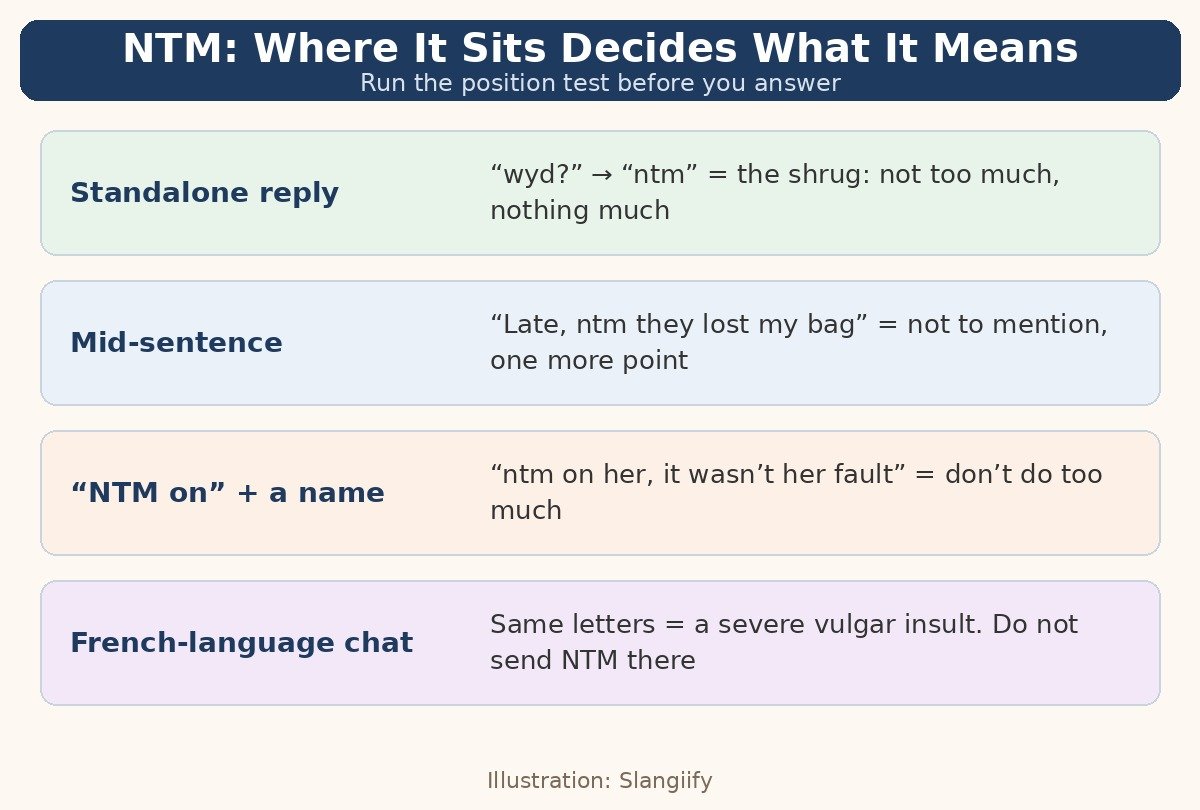
Most of the confusion around NTM comes from treating it as one fixed phrase. It is not. The same three letters do three different jobs, and the job is decided by where they sit in the message. Run these three checks in order and you will land on the right reading almost every time.
Check 1: Position. Look at where NTM sits. A standalone reply, or NTM at the start of a short reply, is the shrug: not too much, nothing much. NTM in the middle of a sentence, between two complaints or two points, is the connector: not to mention. NTM before the word “on” plus a person is the warning: do not do too much to that person. Position alone settles most cases, so start there before you guess at tone.
Check 2: Question. Look at the message that came just before it. A check-in question, such as “wyd?” or “what are you up to?”, invites the shrug. No question at all, just a sentence that keeps going after NTM, invites the connector. Criticism of a person, or a pile-on forming in a group chat, invites the warning. If the message before it is a question, the answer is almost always the shrug.
Check 3: Language. Look at the language of the chat. If the conversation has any French in it, stop and re-read. In French, NTM is a severe vulgar insult, not a shrug. The letters are the same, the meaning is not, and sending the English shrug into a French chat is a mistake you do not want to make. When French is present, assume the French reading until the context proves otherwise.
Here is the test on three short messages. First, “wyd?” gets the reply “ntm, just chilling.” That is the shrug: a standalone reply to a check-in question. Second, “He showed up late, ntm he forgot the tickets.” That is the connector: NTM sits mid-sentence and tacks one more complaint onto the first. Third, “ntm on her, it wasn’t her fault.” That is the warning: NTM sits before “on” plus a person and asks everyone to ease off. Same letters, three jobs, and position tells you which one you are looking at.
What Does NTM Mean in Text? The Shrug
In most English chats, NTM is a shrug in three letters. It means “not too much” or “nothing much,” and it answers a simple question: what is going on with you right now? The answer is, not a lot, and that is fine. It is the texting version of a small shoulder lift, a way to say life is calm without writing a whole paragraph about a calm day.
The two phrases, “not too much” and “nothing much,” sit in the same slot and do the same job. Some guides say one of them leads, and other guides say the opposite, and no frequency study exists to settle the argument. This guide makes no dominance claim. Treat them as near-synonyms, and read the shrug the same way whichever phrase the sender had in mind. What matters is the shape of the reply, short and low-key, not which of the two expansions came first.
The check-in shrug
The most common form is the check-in shrug. Someone asks “wyd?” or “what are you doing?” and the reply comes back as “ntm, just chilling, u?” The first half answers the question and the second half bounces it back, so the chat keeps moving. This is the friendly version of the shrug, and it works because it gives the other person something to work with: a small detail, “just chilling,” and a question of their own. If you want your NTM to land well, this is the shape to copy.
The bare shrug
The bare shrug is just “ntm” on its own, sometimes with a full stop. Between close friends it is flat but not rude. It says the day is quiet and the sender has nothing to report, and a close friend will read it that way without a second thought. With someone you do not know well, the same message can read as closed off, because there is nothing for them to hold on to. The letters are the same in both cases. The relationship decides how they land.
The tired shrug
The tired shrug adds a small detail about energy. “ntm, pretty chill day tbh” says the day was quiet and the sender is a bit worn out, but nothing is wrong. It is honest without being heavy, and it invites a gentle reply rather than a big conversation. People send this version at the end of a long day, when they want to stay in touch but do not have the energy for a long chat. A kind reply is usually “same, rest up” or a question about tomorrow.
The caption shrug
The caption shrug shows up under photos and videos. “ntm, just vibing today” sets a mood for a picture of a quiet afternoon, a coffee, a walk, or a view from a window. It tells the audience that nothing dramatic happened, and that is the point. The caption is relaxed on purpose, and it works best with a calm photo. Paired with a busy or dramatic photo it would feel out of place, which is a good reminder that the shrug only fits quiet moments.
NTM Meaning ‘Not To Mention’: The Connector
Mid-sentence, NTM changes jobs. It stops being an answer and starts being a connector, short for “not to mention.” It tacks one more point onto a list that is already running, and it usually shows up when someone is venting. The first complaint sets the tone, and NTM adds the second one, as if to say the list is longer than it first looked.
Two examples show the pattern clearly. “The flight got delayed three hours, ntm they lost my bag” starts with a delay and adds a lost bag, so the bad day gets worse in one breath. “I’m tired, ntm I’m hungry” starts with tiredness and adds hunger, so a small complaint becomes a pair. In both cases NTM sits between the two points, and you could swap in “not to mention” or “and on top of that” without changing the meaning. If the swap works, you have found the connector.
This reading is easy to miss because it looks like the shrug at first glance. The difference is position. The shrug stands alone as a reply, while the connector sits inside a sentence that was already going somewhere. Check what comes before NTM: if it is a complaint or a point, and something follows after it, the connector is the right call.
‘NTM On…’: The Warning
The warning reading is the only one a dictionary documents. Wiktionary lists the English slang sense of NTM as an initialism of “not too much,” referring to insults or criticism, with the example “ntm on her it wasn’t her fault.” In plain words, “NTM on” someone means do not do too much to them: ease off, stop the pile-on, leave them alone.
On TikTok, comment threads use “NTM on” a creator or a celebrity to shut down criticism. A video draws a wave of harsh comments, someone writes “ntm on her,” and the message is clear: the jokes have gone too far. It is a defence, not an attack, and it works because it is short enough to post in a fast-moving thread. The person writing it is usually a fan, a friend, or just someone who thinks the criticism is unfair.
Because this reading is a warning, tone matters more than usual. It is firm, and it can sound sharp if the chat is already tense. But its purpose is to protect someone, and most readers in the thread will understand it that way. If you see “NTM on” plus a name, read it as a call to back off, not as a shrug.
NTM in French: The Same Letters, A Very Different Message
In French, NTM is the written abbreviation of the vulgar insult “Nique ta mère,” which glosses in English as “f*** your mother.” It is a severe insult, not a casual curse word, and it is aimed at someone’s mother, which is why it lands so hard. Anyone who sends it in a French chat is picking a fight, or ending a conversation in the worst way. There is no soft version of it, and no friendly context that makes it okay.
The French reading gained wide visibility through Suprême NTM, the French hip-hop duo formed in the late 1980s. Their name put the letters in front of a huge audience, and the letters have carried that meaning in French ever since. Wiktionary lists this French sense alongside the English ones, which is a useful reminder that the same abbreviation can live two very different lives in two languages.
The rule here is simple. If the conversation has any French in it, skip the abbreviation and write “not much” instead. Do not trust that the other person will read NTM in English, because the French reading is the one they grew up with. One short message is not worth a serious insult, and writing the full phrase costs you nothing.
Other Meanings You Might See
Outside the three main readings, NTM shows up in a few smaller corners. Most of them are rare, and some are only reported by one competitor guide, so treat them as background rather than as live readings you are likely to meet in a chat.
Next to Me
Some lists give “next to me” as a meaning of NTM. This one is competitor-reported only, and it is rare in real chats. If someone writes “ntm” while talking about where they are sitting, it could fit, but in practice people write the words out, or they use a different abbreviation. Do not reach for this reading first.
Next Twelve Months
In finance and business writing, NTM can mean “next twelve months,” as in a forecast for the year ahead. This is a formal use only. It lives in reports, earnings notes, and analyst writing, and it has nothing to do with texting. If you see NTM in a business document, the finance reading is the right one. If you see it in a DM, it is not.
Nontuberculous Mycobacteria
In medicine, NTM stands for nontuberculous mycobacteria, a group of bacteria that can cause lung infections. Wiktionary lists this sense, and doctors and medical writers use it every day. It will never be the meaning in a text message, but it is a good reminder that three letters can belong to many worlds at once.
There are also expansions you should not teach as live readings. “Need to meet,” “nice to meet,” “new to me,” “need to move,” “nice teamwork,” and “not too mad” in games are all things the letters could stand for, but they are not what anyone is observed to mean when they type NTM. They come from acronym lists that work backwards from the letters, not from real chats. Leave them out of your reading of a message.
NTM on TikTok, Snapchat, Instagram, and in Texts
NTM does not change its meaning from one platform to the next. Position decides on every platform, just as it does in a plain text message. What changes is the setting, and the setting changes how a flat reply lands. A bare “ntm” in a disappearing DM feels different from the same letters in a public comment, even though the meaning is the same.
TikTok
On TikTok, captions use the shrug to set a mood: “ntm, just vibing today” under a calm video tells viewers the day was quiet. Comments under a creator’s question use the shrug too, as a short answer to “what are you guys doing?” And “NTM on” plus a name in the comments is the warning, asking other commenters to stop criticising a creator. All three readings live on TikTok, and position sorts them out.
Snapchat
On Snapchat, NTM shows up in streak replies and disappearing DMs, where messages are short and fast. Flat tone costs the most here, because a disappearing message gives the other person nothing to re-read and no context to lean on. A bare “ntm” on Snapchat can feel like a door closing. Add warmth before you send it: a detail, a question, or even a snap of what you are doing makes the same three letters feel friendly.
On Instagram, NTM appears in DMs, comments, and story replies. In a DM it reads much like a text message, private and low-key. In a public comment it reads more dismissive than a DM, because everyone can see the short reply and no one can see the friendship behind it. In a story reply it usually answers a question sticker or a casual “what’s up” with a quick shrug. If you are replying in public, add a word or two so the shrug does not look like a brush-off.
Text Messages and Group Chats
Text messages are the home ground of NTM. The most common exchange in the world of texting is probably “wyd?” followed by “ntm, u?” It is short, it is honest, and it keeps the chat alive without making a big deal of a quiet day. In a group chat, the warning reading does its best work: defending one person in front of everyone, in three letters, is quick and clear, and the whole group sees the defence at once.
The 7 Tones of NTM
NTM is short, but it is not one tone. The same letters can sound relaxed, warm, tired, flat, venting, defensive, or dangerous, and the words around them set the tone. Learn the seven tones and you will stop misreading the shrug as a snub.
- Relaxed: “ntm, just chilling.” Nothing is happening, and that is fine. This is the default tone, and it is the one most people mean most of the time.
- Warm: “ntm, just tired lol, hbu?” The sender adds a laugh and a question back, so the shrug feels like an invitation to keep talking.
- Tired: “ntm, pretty chill day tbh.” The day was quiet and the sender is low on energy. It asks for a gentle reply, not a big plan.
- Flat: bare “ntm.” Short, with a full stop, and nothing after it. It can feel closed, especially with someone you do not know well.
- Venting: “He showed up late, ntm he forgot the tickets.” The connector adds a second complaint, and the tone is frustrated, not calm.
- Defensive: “ntm on her, it wasn’t her fault.” The warning steps in to protect someone. It is firm, and it is meant to stop the criticism.
- Cross-language danger: the French insult. In a French chat the same letters are a severe insult, and the tone is hostile by definition.
When you are unsure which tone you are hearing, look at what came with the NTM. A detail or a question back means warmth. A full stop and nothing else means flatness. A complaint before it means venting. A name after “on” means defence. The letters stay the same, and the company they keep tells you the tone.
NTM vs Its Closest Cousins
NTM sits in a family of short texting replies, and it is easy to mix them up. The table below sets them side by side, so you can see what each one does that the others do not.
| Term | Meaning | What It Does Differently | Typical Context |
|---|---|---|---|
| NTM | Not too much / nothing much, not to mention, don’t do too much | Reports low-key status, adds a point, or warns | Check-ins, venting, defending someone |
| NM | Nothing much, or never mind | Near-twin of NTM, but NM can also mean “never mind” and cancel a sentence, which NTM never does | Check-ins and quick corrections |
| IDK | I don’t know | Shrugs at knowledge, not at activity | Questions with no clear answer |
| WYD | What are you doing? | The opener that NTM answers | Starting a chat |
| HBU | How about you? | The bounce-back that follows the shrug | Right after an answer |
| TBH | To be honest | A softener that rides with the shrug | Honest replies and opinions |
The NM comparison is the one that trips people up most. NM and NTM look alike, and in the shrug sense they are near-twins. But NM has a second job that NTM never does: it can mean “never mind” and cancel a sentence that came before it. NTM never cancels anything. It reports, it adds, or it warns, and that is all. If you see NM after a sentence that gets taken back, you are looking at “never mind,” not at NTM’s cousin doing NTM’s job.
ATP is another three-letter initialism that only makes sense from the sentence around it, just like NTM. Its meaning shifts with position and context, so the same test applies: read the sentence first, then the letters.
Who Uses NTM?
NTM is used most by younger internet users, frequent texters, and social media communities, and by casual friend groups who text every day. It is a fast reply for people who live in their messages, and it fits the rhythm of a chat where short answers keep things moving. But it is not limited to one age group. Anyone who texts a lot can pick it up, and many older texters use it too once they have seen it a few times.
How it lands depends on who sends it. From a friend, take the shrug at face value: it means the day is quiet, not that the friendship is cooling. From a crush, it usually means “nothing to report,” not rejection, so do not read a breakup into three letters. From a partner, judge the pattern across days rather than one message: a week of bare “ntm” replies says more than a single quiet evening does. From a coworker or a boss, never send it upward. A short shrug to a manager reads as careless, and a work chat is not the place for it.
Where NTM Came From
The honest answer is that the origin of NTM is undocumented. There is no documented coiner, no first tweet or first post that anyone can point to, and no reliable story about who invented it. Like most texting shorthand, it grew up in use rather than arriving with a launch date, and the people who used it first did not stop to record the moment.
The most likely home is the SMS era, when keypads were slow and messages cost money per message. Short replies saved time and money, and “ntm” fit the limits of a small screen. The oldest user-dictionary entry traced so far dates to 2004, but that is competitor-reported, not established fact, so treat it as a clue rather than a birth certificate. What is clear is that the shrug is old in internet terms, and it was already settled long before the apps we use today existed.
Snapchat, Instagram, and TikTok revived it, giving the old shrug new places to live. The warning reading is the newer arrival, spreading through TikTok comment threads where short defences travel fast. The French reading is older in its own way, carried by the late-1980s duo Suprême NTM, whose name fixed the insult meaning in French culture decades ago. One thing is certain: NTM is not a TikTok invention. TikTok gave it a new stage, but the letters were already old when the app arrived.
How to Reply When Someone Sends NTM
Your reply should match the reading you just got. A shrug invites a light reply, a connector invites sympathy for the vent, and a warning invites agreement or a change of subject. The reply bank below is keyed to each reading, so you can pick the one that fits.
Shrug and keep talking
When the shrug is friendly, keep the chat going with a small question: “Same tbh, you doing anything this weekend?” It accepts the quiet day and opens a new topic at the same time, so the conversation has somewhere to go.
Shrug and let it end
When the other person sounds tired or busy, it is kind to let the chat rest: “Same, ntm here too.” It matches their energy, it says you understand, and it leaves the door open for later without demanding more words now.
Shrug and turn it into a plan
When a quiet day is a chance to meet up, turn the shrug into a plan: “ntm, want to grab coffee later?” A slow day is the best day for a simple plan, and the reply turns a dead end into an invitation.
Connector and venting too
When NTM is the connector, join the vent before you try to fix it: “Ugh, and ntm the wifi died too.” Shared frustration is the point of the message, and matching it shows you are listening. Advice can come later, after the vent has had its moment.
Warning and you agree
When someone writes “ntm on” a person and you agree, say so plainly: “Fair, I will drop it.” It ends the pile-on, it respects the defence, and it moves the chat on to something better.
Any reading, end warmly
Whatever the reading, you can always end warmly: “ntm, good luck on your test though.” It works after a shrug, after a vent, and after a warning, because it adds a kind word to a short exchange. Warmth costs nothing, and it is the easiest way to make sure a short reply does not feel cold.
When NOT to Use NTM
NTM is a casual tool, and casual tools have edges. There are places where it does not belong, and knowing them is as useful as knowing what it means.
At work, never use NTM in professional messages or client threads. A bare “ntm” in answer to a real question from a colleague or a client reads as careless, and it can make a simple request look ignored. Write the full answer instead, even if it takes a few more words. The same rule holds in school: a teacher check-in deserves a sentence, and a bare “ntm” in reply to “are you okay?” reads as a closed door. If a teacher or a classmate asks how you are, answer in words.
In serious conversations, about grief, conflict, or health, NTM deserves more than a shrug. Those moments need real sentences, because a short reply can feel like the other person’s pain does not matter. Save the abbreviation for light chats, and give heavy news the words it deserves.
With people from different language backgrounds, write the full phrase. A friend who speaks French, or who chats in French, may read NTM as the insult, not the shrug. In French chats, the rule is absolute: do not send the letters at all. And if someone tells you your NTM felt dismissive, believe them and add the words next time. A small detail and a question back turn the same reply from cold to warm.
Myths vs Facts About NTM
A short abbreviation collects a lot of confident claims, and not all of them hold up. Here is what people say about NTM, set against what the evidence actually supports.
| Myth | Fact |
|---|---|
| NTM means not too much in about 90% of cases | That figure comes from a competitor, and no study supports it. There is no published count of how often each reading appears, so no percentage can be trusted. |
| ‘Nothing much’ is fading | Unsupported trend, rejected. There is no evidence that one shrug phrase is fading while the other grows. |
| NTM means need to meet | Unverified. No real chats show people using NTM to mean “need to meet.” |
| NTM means nice to meet, new to me, or need to move | Acronym-list padding, rejected. These are things the letters could stand for, not things people are observed to mean. |
| NTM has a different meaning on each platform | Rejected. Position decides the meaning on every platform, from TikTok to a plain text message. |
| NTM is a TikTok invention | Rejected. NTM predates TikTok, and the oldest user-dictionary entry traced so far dates to 2004. |
| A short NTM reply is always rude | False. Texting habits vary, and a short reply between close friends is usually just a quiet day, not a snub. |
Frequently Asked Questions
What does NTM mean in text?
NTM usually means ‘not too much’ or ‘nothing much,’ a short, relaxed reply when someone asks what you are doing. Run the position test before you decide: a standalone NTM is the shrug, a mid-sentence NTM means ‘not to mention,’ and ‘NTM on’ someone means ‘don’t do too much.’
What does NTM mean, not too much or nothing much?
Both, in the same slot. The two phrases sit in the same place in a reply, and guides disagree about which leads. No frequency study exists to settle it, so this guide treats them as near-synonyms and makes no dominance claim.
What does NTM mean on TikTok?
On TikTok, captions use the shrug, as in “ntm, just vibing today.” When someone writes “NTM on” a creator, it is the warning: don’t do too much to that person. Position decides, just as it does in a text message.
What does ‘NTM on someone’ mean?
“NTM on someone” means “don’t do too much,” the only dictionary-documented reading. Wiktionary gives the example “ntm on her it wasn’t her fault.” It asks people to ease off the insults or criticism aimed at that person.
What does NTM mean in French?
In French, NTM is a vulgar insult aimed at someone’s mother, made famous by the hip-hop duo Suprême NTM. Never use it in a French-language chat. If a chat has any French in it, write “not much” instead.
Is NTM rude?
In English, NTM is not rude, just informal. A bare “ntm” can read dismissive, especially with someone you do not know well, so add a detail or a question back when you want to sound warm. In French, it is a severe insult, so the answer there is very different.
Can I use NTM at work or school?
Generally no. Casual peer chat is fine, but anywhere formal you should spell it out. At work, a short shrug in answer to a real question reads as careless, and at school a teacher check-in deserves a full sentence.
Sources and Further Reading
The dictionary reading in this guide comes from Wiktionary, which lists both the English slang sense and the French sense of NTM. The position test, the worked examples, and the tone guide come from TextsMeaning, whose guide to NTM in text walks through the same three readings. Wordyil also explains the three meanings of NTM in text, and its examples helped shape the connector section above.
- Wiktionary, “NTM”
- TextsMeaning, “NTM Meaning in Text: The Position Test”
- Wordyil, “Meaning of NTM in Text: 3 Meanings Explained Clearly”
The takeaway: NTM usually means not too much or nothing much, a short shrug in answer to a check-in. Run the position test every time: check the position, check the question, and check the language. A shrug answers a check-in, a sentence answers a real question, and if the chat has any French in it, do not send the letters at all. Keep the test in mind and three letters will stop surprising you. For more slang that changes with context, read about SYFM, explore Scottish slang, and explore Irish slang.


Pingback: 1920s Slang Words and Their Meanings From the Jazz Age
Pingback: Tweaking Meaning Slang: Definition, Uses & Examples
Pingback: BTA Meaning Slang: What It Means in Text & TikTok
Pingback: Philly Slang: 25 Words and Phrases Locals Actually Use
Pingback: Blue Waffles Slang: Meaning, Origin, and Online Use
Pingback: Irish Slang Explained: Craic, Grand, Eejit & More
Pingback: ATM Slang Meaning: What ATM Means in Text (Explained)