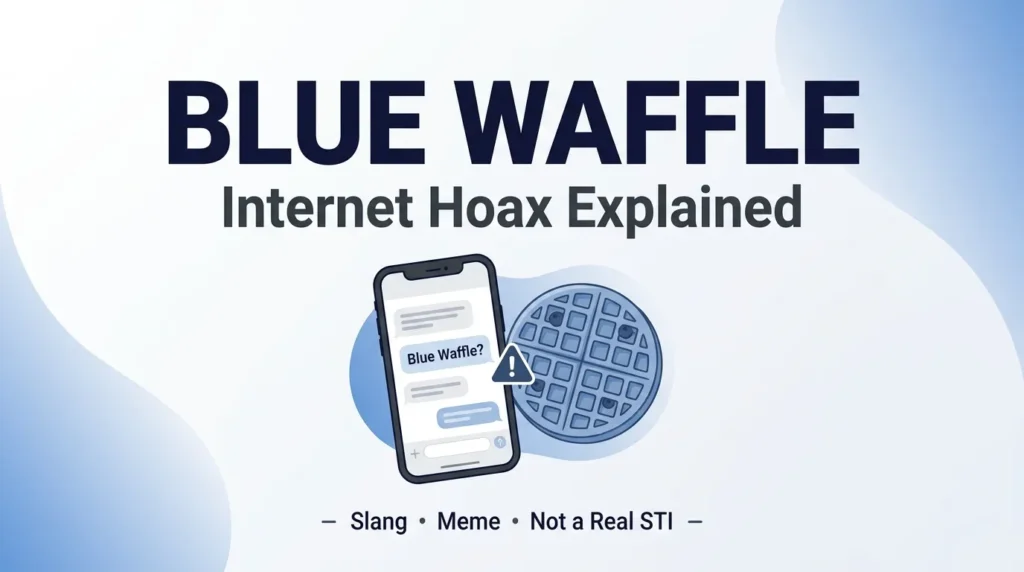

Blue waffles slang refers to an old internet hoax about a fictional sexually transmitted infection (STI). The phrase became associated with shocking, misleading images and online pranks. It does not describe a real STI, medical diagnosis, or recognized health condition.
Today, “blue waffle” is usually mentioned as an internet joke, shock meme, or “don’t search this” reference. Its meaning is generally the same across TikTok, Reddit, Discord, messaging apps, and other social platforms. Context mainly changes whether the person is joking, baiting curiosity, or explaining the old meme.
| Quick Answer | Meaning |
|---|---|
| Most common meaning | An old internet hoax about a fictional STI |
| Typical context | Memes, jokes, online pranks, internet nostalgia |
| Medical term? | No |
| Tone | Crude, shocking, joking, or intentionally provocative |
| Formality | Very informal |
| Safe for work or school? | Usually no |
| Current usage | Mostly meme-driven or a reference to older internet culture |
What Does Blue Waffles Slang Mean?
The most common meaning of blue waffles slang is a reference to a fabricated sexual-health rumor that spread online as shock content.
For example:
“Someone told me to search blue waffle, but I knew it was an old internet prank.”
In that sentence, “blue waffle” does not identify an actual illness. It refers to the notorious online hoax and the disturbing material historically associated with it.
The phrase can therefore function in two closely connected ways:
- As the name of the fictional condition in the original rumor
- As shorthand for the internet prank or meme built around that rumor
These are not really competing definitions. They are two parts of the same internet phenomenon.
Is Blue Waffle a Real STI?
No. Blue waffle is not a recognized STI or medical diagnosis.
The old rumor claimed that a sexually transmitted infection could produce dramatic blue discoloration and other extreme genital symptoms. Those claims were fabricated.
The phrase should not be used as a medical explanation for real symptoms.
This distinction matters because internet slang can sometimes sound surprisingly clinical. Calling something a “disease” does not make it medically real.
People who have genuine concerns about genital pain, unusual discharge, sores, irritation, swelling, discoloration, or possible STI exposure should rely on qualified healthcare guidance rather than an internet meme.
Why Is It Called “Blue Waffle”?
The name combines two intentionally provocative ideas.
“Waffle” has been used in some crude slang as a reference to female genitalia, while “blue” was associated with the fake discoloration shown in material connected with the hoax.
The combination helped make the phrase sound strange enough to trigger curiosity.
That curiosity was central to how the prank worked. Someone might tell another person:
“Whatever you do, don’t search blue waffle.”
Instead of discouraging the search, the warning often made the person more curious.
In other words, the phrase became successful online partly because its name revealed almost nothing about what someone would encounter.
Why Do People Say “Don’t Google Blue Waffle”?
“Don’t Google blue waffle” became part of the meme itself.
The warning acts as reverse psychology. Telling someone not to search for an unexplained phrase can make them want to know what everyone else apparently knows.
A typical exchange might look like this:
Person A: “Do you know what blue waffle means?”
Person B: “No.”
Person A: “Don’t Google it.”
That final warning creates the bait.
Historically, the prank depended heavily on search curiosity and shock value. Today, people may repeat “don’t Google it” simply because they recognize the old joke, even if they are not actually trying to show anyone disturbing content.
This is an important difference between its literal meaning and its conversational function.
The literal reference is a fictional disease.
The conversational function is often: “You either know this infamous internet joke or you are about to become curious about it.”
Also Read: What Does BTA Mean? Slang, Texting, and Social Uses
Blue Waffle Meaning in Text and Social Media
There is no strong evidence that blue waffle has a completely different established meaning on major messaging or social platforms.
The surrounding conversation matters more than the app.
| Context | Likely Meaning | Typical Intent |
|---|---|---|
| Private text or group chat | Reference to the old hoax | Joke or prank |
| TikTok or short-form video | Old internet meme reference | Reaction, explanation, or curiosity bait |
| Reddit or forums | Internet-culture reference | Nostalgia, humor, or explanation |
| Discord or gaming chat | Shock-joke reference | Casual joking or trolling |
| Educational discussion | Example of internet misinformation | Explanation |
| Workplace communication | Rare and inappropriate in most situations | Usually avoid |
Blue Waffle Meaning on TikTok
On TikTok, the phrase generally refers to the same old internet hoax.
A video may mention it as part of:
- “Things older internet users remember”
- Disturbing internet-history discussions
- “Things you should never search” jokes
- Reaction videos
- Meme-history explanations
It is not a distinct TikTok code with a separate widely accepted definition.
Blue Waffle Meaning on Reddit and Discord
On Reddit, Discord, forums, and group chats, people may use the phrase as an inside joke.
Someone who understands the reference may react immediately, while another person may ask what it means.
That difference in knowledge is sometimes the entire joke.
How Context Changes the Meaning
Although the underlying reference stays consistent, the speaker’s purpose can change.
1. Someone is explaining internet history
“Blue waffle was one of those shock-search jokes people talked about years ago.”
Here, the term is being discussed neutrally.
2. Someone is trying to prank a friend
“You’ve never heard of blue waffle? Search it.”
Here, the speaker is using curiosity as bait.
3. Someone recognizes an accidental reference
Imagine someone posts a photograph of an ordinary blue-colored waffle.
A commenter might write:
“That name brings back bad internet memories.”
The comment is a joke based on the older meme rather than a statement about the food itself.
4. Someone uses it as exaggerated shock humor
A person may reference “blue waffle” simply because it has a reputation for being disturbing.
In this situation, the speaker may not be talking about the fictional disease in any serious sense.
What Tone Does “Blue Waffle” Have?
The phrase is usually associated with crude or shock-based humor.
Depending on context, the tone may be:
- Joking
- Immature
- Nostalgic
- Gross-out humor
- Provocative
- Intentionally uncomfortable
- Sarcastic
It is rarely neutral when casually dropped into conversation because many people familiar with the term know its explicit background.
However, the phrase can be used neutrally when discussing internet history, slang, misinformation, or digital culture.
Real Conversation Examples
Between friends
A: “My friend told me to look up blue waffle.”
B: “It’s an old internet hoax. You don’t need to search for the images.”
Here, the second person is explaining the reference rather than continuing the prank.
In a group chat
A: “Does anybody remember blue waffle?”
B: “That is some old-school internet trauma.”
The tone is nostalgic and joking.
On social media
Comment: “People discovering blue waffle for the first time in 2026 is wild.”
The speaker is referencing the age of the meme and the fact that newer users may not recognize it.
During a health conversation
A: “Is blue waffle actually an STI?”
B: “No. That part was an internet hoax.”
Here, accuracy matters more than the joke.
When someone sees literal blue waffles
A: “I made blue waffles for breakfast.”
B: “That phrase has a very different internet meaning.”
The joke depends on the difference between literal food and slang.
In a professional setting
A: “Should we use that phrase in the presentation?”
B: “Probably not. It has an explicit internet meaning.”
The phrase is generally unsuitable for ordinary professional communication.
Also Read: NTM Meaning Slang: What It Means in Text and Chat
Is “Blue Waffle” Slang, a Meme, or an Internet Hoax?
It can reasonably be described as all three, but each label emphasizes something different.
Internet hoax
This is the most important description because the supposed medical condition was fabricated.
Shock meme
The phrase spread because people used it to provoke disgust, surprise, or curiosity.
Slang expression
People eventually began using “blue waffle” as shorthand for the entire joke, not simply for the fictional disease.
For that reason, someone searching for blue waffles slang meaning is usually trying to decode an internet-culture reference rather than learn a conventional slang word used in everyday speech.
Grammar, Spelling, and Pronunciation
The most established form is:
blue waffle
The plural blue waffles also appears, especially in searches and casual conversation.
It normally functions as a noun phrase.
Pronunciation:
blue WAH-fuhl
Capitalization is unnecessary unless the phrase begins a sentence or appears in a title.
You may see variations such as:
- blue waffle
- blue waffles
- blue waffle disease
- blue waffles disease
Adding “disease” reflects the original fictional story. It does not make the phrase medically legitimate.
Is Blue Waffle Offensive or Inappropriate?
“Blue waffle” is not generally used as a slur against a specific identity group, but it is still an explicit and potentially offensive expression because of its sexual and graphic associations.
It is usually inappropriate for:
- Professional emails
- Workplace meetings
- School assignments unrelated to the topic
- Formal writing
- Conversations where sexual language would be unwelcome
Among friends who already understand the reference, it may appear as crude humor.
Even then, context matters.
There is also an important distinction between joking about an old internet meme and using the myth to shame someone’s sexual behavior or hygiene. The original rumor became mixed with false and stigmatizing claims about women’s bodies, sexual activity, and cleanliness. Those claims should not be treated as health information.
Common Misunderstandings About Blue Waffles Slang
“It is the name of a real infection.”
No. The supposed disease is fictional.
“It means something different on TikTok.”
Usually not. TikTok may revive or remix the joke, but the underlying reference remains the same.
“The disturbing images prove the condition exists.”
No. An image shared with a medical-sounding caption is not evidence that a named disease exists.
“People still use it like normal everyday slang.”
Not usually.
The expression is better understood as a recognizable internet-culture reference than as ordinary slang people regularly use to communicate a new idea.
“The plural has a different meaning.”
Generally no.
“Blue waffle” and “blue waffles” usually point to the same meme or fictional condition when used as slang.
Similar and Commonly Confused Internet Terms
| Term | Meaning | Main Difference |
|---|---|---|
| Blue waffle | Old fictional-disease shock hoax | Refers to one specific internet meme |
| Shock content | Material created to provoke a strong reaction | Broad category |
| Bait-and-switch meme | Content where the expected result is replaced with something unexpected | Describes the prank technique |
| NSFW | Warning that content may be unsuitable for work or public viewing | A content warning, not the name of a meme |
| Internet urban legend | A widely shared online story with questionable or false claims | Broader category of online folklore |
“Blue waffle” fits into several of these categories, but they are not synonyms.
For example, something can be NSFW without being a hoax, and an internet urban legend does not necessarily involve graphic material.
Who Uses the Term Today?
Current use appears largely tied to internet culture rather than ordinary conversation.
The phrase may be more familiar to people who encountered online shock humor during the late 2000s and early 2010s. For them, a modern reference can function as nostalgia for a particular era of internet culture.
Younger users may encounter it later through:
- Meme retrospectives
- TikTok videos
- Reddit discussions
- Group chats
- “Old internet” content
- Curiosity-based challenges
Usage varies widely. Knowing the term does not indicate that someone regularly uses it.
Where Did the Blue Waffle Meme Come From?
The phrase became widely associated with internet shock culture in the late 2000s and early 2010s.
Its spread relied on a simple bait-and-switch formula:
- Someone mentioned the strange phrase.
- Another person asked what it meant.
- They were encouraged to search for it.
- Search results or shared material exposed them to disturbing imagery.
- The newly shocked person sometimes repeated the prank with someone else.
That repeating cycle helped the phrase survive far beyond the original material.
Pinning down every detail of its earliest creation is difficult, so claims about one exact inventor or perfectly documented first appearance should be treated cautiously.
What is clear is that its identity became tied to search-engine pranks, shock imagery, and fabricated sexual-health claims.
Also Read: Scottish Slang: 60+ Words and Phrases With Meanings
Why Did the Hoax Spread So Effectively?
The phrase combines several features that make online rumors memorable.
It sounds harmless
“Blue waffle” sounds more like unusual food than an explicit internet reference.
That contrast makes the reveal more surprising.
It creates an information gap
A person hears the phrase but receives no explanation.
Their brain wants to close that gap.
People warn others not to search
The warning creates even more curiosity.
Shock encourages sharing
A strong emotional reaction can make people repeat a joke simply to watch someone else react.
The fake story sounded medical
Adding terms such as “disease,” “infection,” and “symptoms” gave the rumor a superficial appearance of credibility.
This is one reason the meme is also a useful example of how misinformation can spread through language.
How to Reply When Someone Mentions Blue Waffle
The best response depends on why they mentioned it.
If they genuinely do not know
“It’s an old internet hoax about a fake STI.”
That gives them the answer without continuing the bait.
If someone tells you to search for it
“I know the reference. I’m good.”
Simple and clear.
If someone thinks it is medically real
“Blue waffle isn’t a recognized STI. If you’re worried about actual symptoms, use real medical information.”
This separates the joke from legitimate health concerns.
If friends are joking about it
“That is an ancient internet reference.”
This acknowledges the joke without needing graphic detail.
Real-World Interpretation
“Blue waffle” is unusual because its practical meaning often comes less from what the words define and more from what the speaker expects you to do next.
A normal slang term helps communicate an idea.
This phrase often works by withholding the idea.
Someone mentions it, refuses to explain it, and waits for curiosity to take over.
That makes blue waffles slang a useful example of search-bait language: the phrase itself becomes a trigger for an action rather than simply a label for an object or concept.
Its continued recognition also shows how internet folklore can outlive the websites, search results, and online culture that originally made it famous.
Frequently Asked Questions
What does blue waffle mean in slang?
“Blue waffle” is internet slang connected to an old hoax about a fictional sexually transmitted infection. It became widely known as a shock joke in which people encouraged others to search for the term. It is not the name of a legitimate medical condition.
Is blue waffle a real STD?
No. There is no recognized STD or STI called “blue waffle.” The disease described in the internet rumor was fabricated. Real sexual-health symptoms should be evaluated using legitimate healthcare information rather than descriptions attached to online shock memes.
What does blue waffle mean on TikTok?
On TikTok, “blue waffle” usually refers to the same older internet hoax. It may appear in meme-history videos, reaction content, “things you should never search” posts, or nostalgic discussions about older internet culture. There is no separate widely established TikTok definition.
Why do people tell you not to search blue waffle?
That warning is part of the original style of prank. Saying “don’t search it” makes people curious about an unfamiliar phrase. Historically, that curiosity could lead users toward disturbing or misleading imagery, so the warning itself became part of the meme.
Is saying blue waffle offensive?
The phrase is explicit and can be considered crude or inappropriate, particularly at work, school, or around people who do not welcome sexual humor. It is not generally treated as a conventional identity-based slur, but its graphic background makes casual use risky in formal or unfamiliar settings.
Does blue waffles have another slang meaning?
There is no major unrelated slang meaning that consistently competes with the internet-hoax definition. “Blue waffles” can, of course, literally describe waffles that are blue. When the phrase appears in slang or meme discussions, however, it usually refers to the old shock hoax.
Is blue waffle still used today?
Yes, but mostly as an internet-culture reference rather than active everyday slang. It may resurface in memes, reaction posts, Reddit discussions, TikTok videos, or jokes about older internet trends. Modern use often depends on nostalgia or on younger users discovering the reference for the first time.
Conclusion
Blue waffles slang refers primarily to an old internet hoax built around a fictional STI and shock-based imagery. It is not a real disease, recognized medical term, or secret platform-specific code.
In modern conversations, the phrase is more likely to function as an internet-history joke, curiosity trap, or nostalgic meme reference. TikTok, Reddit, Discord, and private messages may give it different tones, but they generally do not change its underlying meaning.
The most useful takeaway is simple: understand the reference without treating the fictional medical claims as fact. When real sexual-health concerns are involved, internet slangiify should never replace reliable healthcare guidance.

Pingback: Foid Slang Meaning: What It Means and Why It’s Offensive
Pingback: Tweaking Meaning Slang: Definition, Uses & Examples
Pingback: SSA Meaning Slang: What It Means on TikTok & Text
Pingback: Dominican Slang: 30 Words, Meanings, and Examples
Pingback: 4th Hole Meaning Slang: What Does "4th Hole" Mean in Text and Online?