
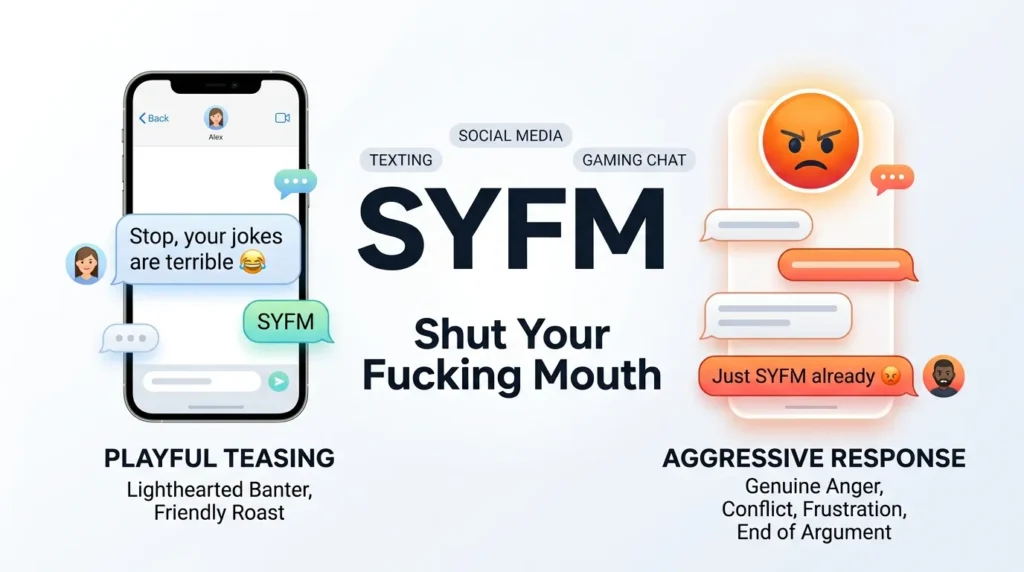

SYFM most commonly means Shut Your Fucking Mouth. It is a blunt, vulgar piece of internet slang that tells someone to stop talking, and it can sound either hostile or playful depending on who says it and where it shows up.
If you saw SYFM in a text, a comment, or a TikTok caption and had to guess what it meant, you are not alone. The four letters look harmless, but they stand for one of the strongest shut-downs in online slang. This guide breaks down the full meaning, the tone, the origin, and the exact situations where it works, plus the ones where it will get you in trouble.
Here is the short version first. If you only need the definition, the table below gives it to you in seconds. If you want to know whether someone was joking or picking a fight, keep reading, because the letters alone will not tell you that.
Quick Answer
| Detail | Quick answer |
|---|---|
| Meaning | Shut Your Fucking Mouth |
| Basic meaning | Telling someone to stop talking |
| Tone | Usually harsh, rude, sarcastic, or confrontational |
| Formality | Highly informal |
| Language level | Vulgar/profane |
| Common settings | Texts, chats, comments, gaming, social media |
| Can it be playful? | Yes, especially among close friends |
| Professional use | Not appropriate |
| School use | Generally inappropriate |
| Is context important? | Very much |
Table of Contents
- Quick Answer
- Where SYFM Actually Came From
- What SYFM Means in Text
- Playful or Aggressive? The SYFM Tone Decoder
- SYFM Usage-Context Map
- SYFM on TikTok, Discord, Snapchat, Instagram, and Gaming
- SYFM vs STFU vs SYBAU vs GTFO
- When NOT to Use SYFM
- How to Reply to SYFM
- SYFM Myth vs Fact
- Safer Alternatives to SYFM
- Real Conversation Examples
- Frequently Asked Questions
- Sources and Further Reading
Where SYFM Actually Came From
SYFM feels like a brand-new TikTok invention, but it is not. The phrase behind it has been shouted on screen since 2008, and the acronym itself started spreading years before it blew up in 2025. If you want the short version of the origin story, here it is: a movie scene became a sound clip, the sound clip became a meme, and the meme turned four angry words into four letters.
The audio comes from Bronson, the 2008 film starring Tom Hardy as Charles Bronson, the real-life British prisoner. In one scene, Hardy screams “Shut your fucking mouth!” at full volume. The film reached UK cinemas on March 13, 2009, and that single shouted line is the whole engine behind SYFM. Know Your Meme traces the viral audio to that exact scene, and once you hear the clip, the connection is obvious. The words are the same, the anger is the same, and the only thing that changed is the format.
The clip did not jump straight from the film to your feed. It took a few steps. YouTuber MuqriBlue posted the scene on February 22, 2022, and that upload gave the internet an easy clip to grab. A few months later, on May 24, 2022, TikToker @aneurinaustin used the audio in a meme about that one friend who constantly talks about their ex. The joke landed because the audio sounds like an instant, over-the-top reaction to someone who will not stop talking, which is exactly how people use the letters now.
Then the audio went quiet for a while, until it came roaring back in late May 2025. This time, people started adding it to videos of children telling cringeworthy stand-up jokes, and the contrast between a kid on stage and Tom Hardy screaming made the clips spread fast. TikToker @morphelius.wetness posted one on May 26, 2025, and it picked up roughly 1.1 million likes in a week. Three days later, on May 29, 2025, TikToker @14__fg__14 used the sound over a clip of kid comedian Nathan Bockstahler on America’s Got Talent, and that version passed 1.7 million likes in four days. By June 1, 2025, TikToker @boomy090 had swapped SYFM into the “SYBAU” Lazer Dim 700 meme image, which tied the two terms together in one picture.
That last detail matters, because SYFM did not appear out of nowhere. The acronym is based on the precursor term SYBAU, an earlier piece of slang built the same way, by taking a rude spoken phrase and squeezing it into letters. SYFM follows the same pattern, and it borrowed some of SYBAU’s audience when the two started showing up in the same memes. If you have seen both terms, that shared history is why they feel like siblings.
“Shut your fucking mouth!” – Tom Hardy as Charles Bronson in Bronson (2008)
So no, SYFM is not a brand-new 2026 TikTok term, even though it feels like one. It is a 2008 movie line, a 2022 acronym, and a 2025 viral sound all rolled into one. The 2025 wave is what pushed it into mainstream feeds, and the letters are what let it travel so far. Spelled out, the phrase is too rude for most comment sections and captions. Shortened to SYFM, it slips past filters, looks like any other piece of texting slang, and still carries the full punch of the original line. That is the trick, and that is why you keep seeing it.
What SYFM Means in Text
In a text message, SYFM means the full phrase in short form. It is not a softened version, and it is not a code word with a secret second meaning. When someone types those four letters, they are saying “shut your fucking mouth” without typing the whole thing out. The force is the same. The only difference is that the acronym looks lighter on the screen than the words it stands for, which is part of why people use it.
Here is the letter-by-letter breakdown:
- S – Shut
- Y – Your
- F – Fucking
- M – Mouth
The F in the middle is doing most of the work. “Shut your mouth” on its own is rude, but it is the kind of thing a parent or a teacher might say. Add the F-word and the whole phrase turns hostile. That is why the acronym hits harder than it looks. The letters hide the profanity, but anyone who knows what they stand for hears the full phrase in their head.
So how do you tell what someone meant when they sent it? Use the 10-second tone test. Ask yourself three quick questions before you react:
- Who sent it? A close friend who jokes with you all day is a very different sender from a stranger or someone you argued with yesterday.
- What came just before it? If you just said something silly or over the top, SYFM is probably a joke. If you just said something that started a fight, it probably is not.
- Is there a laughing emoji? A 😂 or 💀 next to it usually means the sender is laughing. No emoji at all, or an angry one, usually means they are not.
Run through those three questions and you will get the tone right most of the time. For example, your best friend texts SYFM with three laughing emojis right after you send a terrible joke. That is playful, and the right reply is a laugh or a joke back. But if someone sends SYFM alone, with no emoji, right after you disagreed with them in a group chat, that is a warning shot, and the right move is to step back rather than fire something back.
People type the acronym instead of the full phrase for a few simple reasons. It is faster, it looks less aggressive on the screen, and it can slip past chat filters that would flag the full words. It also feels less direct, which makes it easier to send. None of that changes what it means, though. Like other acronym slang, such as the one explained in our guide to ICL meaning slang, the short form is just a shortcut. The meaning rides along with it, word for word.
Playful or Aggressive? The SYFM Tone Decoder
SYFM is one of those terms that can mean two opposite things, and the letters will not tell you which one. The same four letters can be a joke between best friends or the start of a real fight. The difference is never in the acronym. It is in the relationship, the timing, and the signals around it. This section is your decoder, so you can read the room before you react.
Signs SYFM Is Playful
When SYFM is a joke, there are usually clear clues. Look for one or more of these:
- Laughing emojis. A 😂, 🤣, or 💀 next to SYFM almost always means the sender is laughing. People do not usually add crying-laughing faces to a real threat.
- You just said something ridiculous. If you made a wild claim, told a terrible joke, or said something over the top, SYFM is the punchline. It is the other person saying your take was so bad it deserved a shut-down.
- It is a close friendship. Close friends trade fake insults all the time. If you and this person regularly roast each other, SYFM is just the newest weapon in that back-and-forth.
- There is a history of joking insults. If your chat history is full of playful jabs, one more is not a surprise. The pattern is the proof.
- Gaming banter. In a game lobby, SYFM is often part of the trash talk. Teammates and rivals say far worse to each other, and nobody takes it home with them.
Playful insults are a whole style of humor, and SYFM fits right into it. Friends use it the same way they use the rough jokes in our roundup of British slang insults: the words sound harsh, but the friendship underneath them is solid, and everyone in the group knows it. The insult is the joke, not the message.
Signs SYFM Is Serious
When SYFM is serious, the clues point the other way. Watch out for these:
- No joking language. There is no “lol”, no emoji, no “haha”, and nothing else that softens it. The message is just SYFM, alone, and it reads cold.
- No friendly emojis. If the message has no 😂 or 😅, or it has an angry or eye-roll emoji instead, the sender is not laughing.
- An argument just happened. If you were just disagreeing, correcting the person, or calling them out, SYFM is probably them telling you to drop it, and they mean it.
- Personal insults came with it. When SYFM shows up next to name-calling or attacks on someone’s character, it is not banter. It is part of a real insult.
- Short, cold replies follow. If the next messages are one-word answers, long silences, or “whatever”, the conversation has turned. SYFM was the turning point.
Here is the rule that settles it when you are still unsure: if you would not comfortably say “shut your fucking mouth” out loud to that person, in that moment, do not assume SYFM is safe to send them. Say the full phrase in your head first. If it sounds too harsh for the situation, the acronym is too harsh too. The letters do not make it polite. They only make it shorter.
Misreading the tone is easy, and it happens in both directions. Some people take a joke seriously and start a fight over nothing. Others laugh off a real warning and keep pushing until the other person snaps. When you are unsure, ask. A quick “Are you joking?” costs nothing and clears up the whole conversation. It is always better than guessing wrong.
SYFM Usage-Context Map
SYFM changes its meaning with its setting. The same letters can be a joke, a warning, or a full-blown insult, and the setting decides which one it is. This map lays out the most common situations, who is talking, and what they probably mean.
| Who says it | Where | To whom | Likely intent |
|---|---|---|---|
| Close friends joking | Private chat or group chat | A friend who jokes back | Playful teasing, usually after a silly or over-the-top comment |
| Someone in an online argument | Comment section or reply thread | A stranger or rival they disagree with | Hostile shut-down, meant to end the argument |
| A gamer | Gaming chat or voice lobby | Teammates or opponents | Trash talk or frustration, often not personal |
| A meme poster or commenter | Meme or comment section | Followers or anyone reading | Humor or reaction, playing off the Bronson audio |
| A romantic partner | Private messages | Their partner | Usually joking, but risky if the relationship is tense |
| A coworker | Workplace chat or email | A colleague or boss | Almost always inappropriate, even as a joke |
| A student | School chat or classroom | A classmate or teacher | Rude, and likely to lead to trouble |
| A stranger | Any public or private chat | Someone they do not know | Confrontational, and likely to start a fight |
The pattern is simple. With close friends, in private, SYFM is usually a joke. With strangers, at work, or at school, it is usually a problem. The closer the relationship and the more private the setting, the safer it is. The further you get from that, the more likely it is to land badly. If the row that matches your situation says “hostile” or “inappropriate”, believe it.
SYFM on TikTok, Discord, Snapchat, Instagram, and Gaming
SYFM does not mean exactly the same thing on every app. Each platform has its own habits, its own audience, and its own way of using the term. Here is how it plays out across the five places you will see it most.
SYFM on TikTok
TikTok is where SYFM lives loudest. The Bronson audio is the star here, and most TikTok uses of SYFM are either the sound itself or a caption that plays off it. Creators add the audio to clips of people talking too much, telling bad jokes, or saying something nobody asked for. The caption might just read “SYFM 😭” while the video does the rest. In comments, people drop SYFM as a reaction to a video they find annoying or over the top. On TikTok, the tone is usually playful, because the whole point is the joke, and the audio does the shouting for you. Examples:
- Caption on a video of a friend telling a long story: “SYFM challenge: impossible 😭”
- Comment under a cringe stand-up clip: “syfm bro please 💀”
- Reply to someone spamming the same take: “SYFM we heard you the first time”
SYFM on Discord
On Discord, SYFM shows up in fast-moving server chats and in gaming channels. Servers with friends use it as a joke, often with a reaction gif or a voice channel shout to match. In public servers, it can turn hostile fast, because strangers do not share the same history and the chat moves too quickly for tone to come through. A SYFM in a debate channel usually means the conversation is over, at least for that person. If a moderator sees it aimed at someone, it can count as harassment, so the setting matters a lot here. Examples:
- Friend spamming memes in the group channel: “SYFM 😂😂”
- Argument in a debate channel: “SYFM. You are wrong and you know it.”
- Someone mic-spamming in voice chat: “syfm or I am muting you”
SYFM on Snapchat
Snapchat is where SYFM feels most like a text between friends. Snaps disappear, chats are private, and the audience is usually people you actually know, so the tone leans playful. Someone might send SYFM over a snap of their friend talking nonstop, or drop it in a chat after a bad joke. Because the messages vanish, people also feel freer to send it, which is worth remembering: a screenshot lasts forever even when the snap does not. Snapchat is also full of short acronym slang, so SYFM sits next to terms like the one covered in our guide to HB meaning slang, and regular users read them all the same way, as fast shorthand between friends. Examples:
- Reply to a snap of a friend ranting: “syfm 😭😭”
- Chat after someone sends ten messages in a row: “SYFM challenge failed”
- Private story caption on a joke video: “syfm I am crying”
SYFM on Instagram
On Instagram, SYFM shows up in comments, in DMs, and in Reels captions. Reels are the TikTok-style home of the Bronson audio, so creators use the sound the same way they do there. In comments, SYFM is often a reaction to a reel, a hot take, or an influencer saying something people disagree with. In DMs it works like a text, playful between friends and risky with anyone else. One thing to know about Instagram is that comments are public and tied to your name, so a hostile SYFM in a comment thread is visible to everyone and hard to take back. Examples:
- Comment under a reel of someone bragging: “SYFM 😂”
- DM after a friend sends a wild take: “syfm you are actually insane”
- Reel caption using the Bronson audio: “POV: you will not stop talking. SYFM.”
SYFM in Gaming
Gaming is where SYFM feels most at home, because trash talk is part of the culture. In voice chat and text chat, players throw it at teammates who will not stop talking, at opponents who are gloating, or at anyone who makes a bad play and then tries to explain it. Most of the time it is not personal. It is heat-of-the-moment frustration, and it fades when the match ends. But it can cross a line, especially when it is aimed at one player again and again, or when it comes with slurs or threats. Most games let you mute and report, and those tools exist for a reason. Examples:
- Teammate talking over the whole squad: “SYFM and play the game 😂”
- Opponent gloating after a lucky kill: “syfm bro it was luck”
- Someone blaming everyone else for a loss: “SYFM. You died first.”
SYFM vs STFU vs SYBAU vs GTFO
SYFM is not the only way to tell someone to stop talking online. It belongs to a whole family of blunt acronyms, and they are easy to mix up. The four below are the ones you will see most often, and they are not interchangeable. Here is how they compare.
| Term | Full phrase | Tone | Main difference | Typical context |
|---|---|---|---|---|
| SYFM | Shut Your Fucking Mouth | Harsh, confrontational, sometimes playful | A direct order to stop talking, tied to the Bronson audio | Texts, TikTok, gaming, comments |
| STFU | Shut The Fuck Up | Harsh, blunt, often angrier | Targets the talking itself more than the person, but lands just as hard | Arguments, gaming, heated chats |
| SYBAU | Shut Your Bitch Ass Up | Harsh and insulting | Contains an extra gendered insult, so it can land harder and feel more personal | Memes, TikTok, confrontational comments |
| GTFO | Get The Fuck Out | Dismissive, angry | Tells someone to leave, not to stop talking | Arguments, gaming, telling someone to go away |
The closest pair is SYFM and STFU. They mean almost the same thing, and people use them in the same situations. The small difference is the flavor. SYFM sounds like a movie line because it is one, and that gives it a slightly dramatic feel. STFU is plainer and often reads angrier, because it has no meme behind it to soften it. If someone sends STFU, assume they are more annoyed than someone who sends SYFM with a laughing emoji.
SYBAU deserves a special note. It is the precursor term that SYFM is based on, and the two travel in the same circles, but SYBAU can land harder. The extra insult in the middle of it makes it feel more personal and more degrading, and it can read as gendered. If you are choosing between the two, SYFM is the safer one, and neither is safe with strangers. GTFO is the odd one out in this group, because it does not ask anyone to stop talking. It tells them to leave. That makes it a dismissal rather than a shut-down, and it usually shows up when someone wants the other person gone, not just quiet.
All four of these terms share one rule: the acronym does not make the insult polite. Shortening a rude phrase hides the words, but everyone who knows the letters hears the full phrase. If you would not say the full version out loud, do not send the short version either. For a closer look at another blunt term from the same family, see our guide to FAFO slang meaning, which breaks down a phrase that works the same way.
When NOT to Use SYFM
SYFM is a strong phrase, and strong phrases need clear limits. There are plenty of situations where it is not funny, not appropriate, and not worth the fallout. If any of the situations below match yours, pick a different way to say it.
- Work emails and chats. Never send SYFM to a coworker, a manager, or a client, even as a joke. In a work chat, it reads as hostility, and it can end up in a screenshot in front of HR. There is no version of it that is safe at work.
- At school. Do not send it to a teacher, and think twice before sending it to a classmate. Schools treat it as swearing and disrespect, and it can mean detention, a call home, or worse.
- Messages to strangers. If you do not know the person, you do not know how they will take it. A stranger has no reason to read it as a joke, and many will read it as a threat or an insult.
- To teachers, clients, or anyone you need to impress. The moment you send it, the other person has a permanent record of you talking that way. First impressions do not recover from it easily.
- During a serious conversation. If someone is talking about something that matters to them, SYFM shuts the conversation down in the worst way. It tells them their feelings do not matter, and it is hard to take back.
- When someone is upset. If a person is crying, angry, or stressed, SYFM pours fuel on the fire. It will make them feel attacked, and it will make the situation worse.
- When you are unsure how it will land. If you have to ask yourself whether it is safe, it probably is not. The doubt itself is the answer. Use a softer phrase instead, and save SYFM for the friends who already know your humor.
The cost of getting this wrong is real. A SYFM sent in anger can end a friendship, get you muted or banned from a server, or get you in trouble at school or work. The letters are small, but the message is not. When the stakes are high, the safe move is always the calmer phrase.
How to Reply to SYFM
Someone just sent you SYFM. What now? The right reply depends on the tone, and the tone test from earlier in this guide still applies. Here is what to say in each situation, with replies you can copy as they are.
If It Was Playful
When a friend sends SYFM as a joke, the best reply is to play along. Laugh, fire back a joke of your own, or lean into the bit. The goal is to keep the fun going, not to win the exchange. Good replies include:
- “😂 You wish.”
- “Make me.”
- “Okay okay, I will stop 😂”
- “Rude. Accurate, but rude.”
These work because they match the energy. Your friend was joking, and you are joking back. Nobody gets hurt, and the conversation moves on. The only thing to avoid is answering a joke with a real insult, because that turns a bit into a fight for no reason.
If You Are Not Sure
When you cannot tell whether SYFM was a joke, do not guess. Ask. A short, honest question clears up the tone in seconds, and it shows the other person you are paying attention. Good replies include:
- “Are you joking?”
- “What do you mean?”
- “Wait, are you actually mad?”
These replies are safe because they give the sender a chance to explain. If they were joking, they will say so, and you can laugh it off. If they were serious, you will find out before you make it worse. Either way, you asked instead of assuming, and that is always the smarter move.
If It Was Aggressive
When SYFM is clearly hostile, do not answer it with another insult. That only feeds the fight, and it hands the other person exactly what they wanted. The strongest reply to an aggressive SYFM is a calm one that ends the exchange. Good replies include:
- “Okay, I will leave it there.”
- “Got it. I am done with this.”
- “I am not doing this right now.”
After that, step away. Mute the chat, close the app, or walk away from the conversation for a while. You do not have to win an argument with someone who has already stopped listening. If the person keeps going, block or report them. Your time is worth more than a stranger’s anger.
If You Want to Set a Boundary
Sometimes SYFM is not a one-off. Sometimes a person keeps talking to you that way, and you need it to stop. In that case, say so directly and calmly. A clear boundary works better than a comeback, because it tells the person exactly where the line is. Good replies include:
- “You don’t need to talk to me like that.”
- “I am happy to talk, but not like this.”
- “Please do not speak to me that way.”
Boundaries work best when you stick to them. If the person does it again, repeat the boundary once, then leave the conversation. You do not owe anyone a third chance to talk to you that way.
SYFM Myth vs Fact
SYFM has picked up a few myths as it spread, and some of them change how people use it. Here is what is actually true, and what is not.
| Myth | Fact |
|---|---|
| It is a brand-new 2026 TikTok term. | The Bronson clip is from 2008, the acronym spread in 2022, and it went viral again in May 2025. It only feels new because the 2025 wave pushed it into mainstream feeds. |
| It means “See You For More.” | No. That is a misreading. SYFM stands for “Shut Your Fucking Mouth,” and the other reading does not match how anyone actually uses it. |
| It is always serious. | No. Friends use it playfully all the time, usually with laughing emojis and after a joke. The tone test in this guide shows how to tell. |
| It is always a joke. | No. In arguments it is genuinely hostile, and people send it when they want someone to stop talking right now. |
| Shortening profanity makes it polite. | No. The acronym hides the words, but everyone who knows the letters hears the full phrase. It is just as rude, only shorter. |
| It is safe to use with anyone online. | No. With strangers, at work, or at school, it reads as rude or hostile. It is only safe with close friends who already joke that way. |
The biggest myth is the first one, because it makes people treat SYFM like a harmless new trend. It is not harmless, and it is not new. It is a movie line from 2008 that found a second life as an acronym, and it still carries the anger of the scene it came from. Knowing that history helps you respect what the letters actually mean.
Safer Alternatives to SYFM
Sometimes you want someone to stop talking, but SYFM is too strong for the moment. These alternatives say the same thing without the profanity, and each one fits a different mood. Keep them in your back pocket for work, school, family chats, and any conversation where SYFM would land badly.
| Alternative | Tone | When to use it |
|---|---|---|
| Please stop | Polite and firm | When you need someone to stop, but you want to stay respectful |
| Can you stop? | Direct but calm | When you are annoyed but still in control of the conversation |
| Enough | Firm and final | When you want the topic closed, no discussion |
| Let us leave it there | Calm and mature | When you want to end an argument without making it worse |
| Give me a second | Light and casual | When you just need a pause, not a full stop |
| Okay, okay 😂 | Playful and light | When a friend is joking and you want to play along |
The right alternative depends on the moment. “Please stop” works almost everywhere, and it is the safest choice when you are not sure. “Enough” works when you need a firm end to a topic. “Okay, okay 😂” works when the whole thing is a joke and you just want to laugh it off. None of these will get you in trouble at work or school, and none of them will start a fight with a friend. That is the point: you can set a boundary without using words you would regret.
Real Conversation Examples
Examples make the tone easier to see than definitions do. Here are seven short conversations that show SYFM in real situations, with a one-line note on what it means in each one.
1. Friendly teasing.
A: “I could beat you at this game with my eyes closed.”
B: “SYFM 😂 you lost the last three rounds.”
What it means: B is joking. The laughing emoji and the game context make it playful, and A should laugh it off.
2. Genuine anger.
A: “You always do this. You never listen to me.”
B: “SYFM. I am done talking about this.”
What it means: B is angry and wants the conversation to stop. This is not a joke, and the right move for A is to step back.
3. Gaming.
A: “Bro I died because you were not covering me.”
B: “SYFM and play 😂”
What it means: B is trash-talking in the middle of a game. It is heat-of-the-moment banter, and it will be forgotten when the match ends.
4. Shock.
A: “I just ate twelve tacos in one sitting.”
B: “SYFM 💀 there is no way.”
What it means: B is shocked and laughing. The skull emoji shows disbelief, not anger, and the message is a reaction, not an attack.
5. Online argument.
A: “That take is terrible and you know it.”
B: “SYFM. Nobody asked.”
What it means: B is shutting A down in public. It is hostile, it is meant to end the argument, and it will probably make it worse.
6. Close friends.
A: “I am literally the funniest person in this group.”
B: “SYFM 😭😭 you are not.”
What it means: B is teasing a close friend. The double crying-laughing emojis and the friendship make it safe, and A knows it is a joke.
7. Unclear context.
A: “I think we should change the plan for Saturday.”
B: “SYFM”
What it means: This one is unclear, and that is the point. With no emoji and no joke before it, A cannot tell if B is joking or annoyed. A should ask, “Are you joking?” instead of guessing.
Notice how the same four letters do completely different jobs in these examples. The words never change, but the relationship, the emoji, and the message before it change everything. If you like this kind of context-heavy slang, our guide to Torta slang breaks down another term that shifts its meaning with the situation, and it is a good next read.
Frequently Asked Questions
What does SYFM mean in text?
SYFM means “Shut Your Fucking Mouth” in text. It is a blunt way to tell someone to stop talking. The tone depends on who sends it and what came before it, so it can be a joke between friends or a real insult in an argument.
Is SYFM a bad word?
Yes, SYFM contains a swear word. The F in the middle stands for a profanity, so the full phrase is vulgar even when the letters look harmless. The acronym hides the swear word, but it does not remove it.
Is SYFM rude?
Usually, yes. SYFM is rude by default, because it tells someone to shut up using profanity. Between close friends who joke that way, it can be playful. With anyone else, assume it will come across as rude.
What does SYFM mean on TikTok?
On TikTok, SYFM usually refers to the viral Bronson audio of Tom Hardy shouting “Shut your fucking mouth!” Creators add the sound to videos of people talking too much or telling bad jokes, and commenters drop SYFM as a reaction. On TikTok, the tone is mostly playful.
What does SYFM mean on Snapchat?
On Snapchat, SYFM means the same thing, “Shut Your Fucking Mouth,” usually sent as a joke between friends. Because Snapchat chats are private and the audience is people you know, it leans playful there. It is still rude if it is sent in anger or to someone who does not joke that way.
What is the difference between SYFM and STFU?
They mean almost the same thing, but SYFM comes from the Bronson movie audio and STFU does not. SYFM stands for “Shut Your Fucking Mouth” and STFU stands for “Shut The Fuck Up.” Both tell someone to stop talking. SYFM often feels slightly more meme-like, while STFU often reads angrier.
Can SYFM be used jokingly?
Yes, SYFM can be used jokingly between close friends. When it comes with laughing emojis, after a silly comment, and inside a friendship where playful insults are normal, it is a joke. If any of those are missing, do not assume it is safe to send.
Sources and Further Reading
The facts in this guide, including the origin dates and the viral timeline, come from the sources below. If you want to dig deeper into the meme history or compare definitions, these are good places to start.
- Know Your Meme: SYFM (Slang) – the full origin and viral timeline for the term and the Bronson audio.
- EnglishPairs: What Does SYFM Mean in Text? – a clear breakdown of the meaning in texting and online chats.
- Fapelli: What Does SYFM Mean? – another take on the definition, tone, and everyday uses.


Pingback: Scottish Slang Words and Meanings Made Simple
Pingback: Tweaking Meaning Slang: Definition, Uses & Examples
Pingback: Flamingo Meaning Slang: What Does It Mean in Text?
Pingback: Cyberpunk Slang Explained: Choom, Gonk, Preem and More
Pingback: 1920s Slang Words and Their Meanings From the Jazz Age
Pingback: NTM Meaning Slang: What It Means in Text and Chat
Pingback: YN Meaning Slang: What YN Means on TikTok and in Text
Pingback: New York Slang Words: Meanings, Examples, and Usage