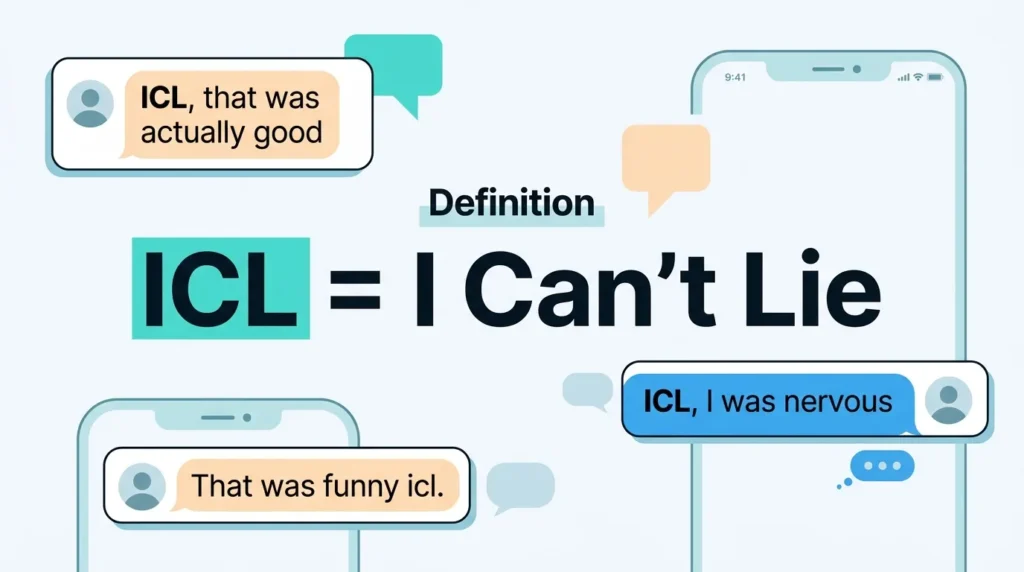

If you see ICL in a text, comment, or private message, it most commonly means I can’t lie. It is an informal internet abbreviation used when someone wants to introduce an honest opinion, confession, reaction, compliment, or blunt observation. For example, “ICL, that movie was actually good” simply means “I can’t lie, that movie was actually good.”
The meaning is usually straightforward, but the tone can change with the sentence around it. ICL may sound sincere, surprised, playful, blunt, or slightly confrontational depending on what follows. It is common in casual online communication, while less common interpretations exist in other contexts.
Quick Answer
| Question | Answer |
|---|---|
| What does ICL mean in slang? | I can’t lie |
| What does ICL mean in text? | Usually “I can’t lie” |
| What does it express? | Honesty, sincerity, admission, or a strong opinion |
| Tone | Casual, direct, conversational |
| Formality | Very informal |
| Where is it used? | Texts, DMs, comments, group chats, and casual online conversations |
| Can it have other meanings? | Yes, depending on context |
| Is it appropriate for formal writing? | Usually no |
| Similar expressions | NGL, TBH, honestly, to be real |
| Example | “ICL, your idea was pretty good.” |
What Does ICL Mean in Slang?
In modern internet slang, ICL means “I can’t lie.”
It works as a short honesty marker. Someone writes ICL when they want to make it clear that the statement they are about to make is their genuine opinion or feeling.
For example:
ICL, I really liked that song.
The natural meaning is:
I can’t lie, I really liked that song.
The person is not literally saying that lying is impossible. Instead, ICL adds the feeling of honestly, to be honest, or I have to admit.
It can introduce positive, negative, or neutral statements:
- “ICL, that outfit looks amazing.”
- “ICL, I was nervous before the test.”
- “ICL, that episode was boring.”
- “ICL, I didn’t expect you to win.”
- “That was a good idea, ICL.”
The abbreviation can appear at the beginning or end of a sentence, although placing it at the beginning is especially natural when it introduces an opinion or admission.
ICL Meaning in Text Messages
When someone sends ICL in a normal text conversation, the safest interpretation is I can’t lie.
It usually tells you that the person is about to say what they genuinely think.
Consider this message:
ICL, I thought you were going to lose.
Here, ICL makes the statement sound like an honest admission rather than a carefully worded opinion.
Another example:
That was actually hilarious icl.
Here, the abbreviation comes at the end and reinforces the speaker’s sincerity.
ICL can therefore work almost like punctuation for attitude. The core statement carries the literal information, while ICL tells you how seriously or honestly the speaker wants that statement to be taken.
This is one reason the abbreviation can appear in very different conversations. It does not describe one specific emotion. It simply frames what follows—or sometimes what came before—as a candid thought.
ICL Meaning on Social Media
ICL can have the same basic meaning across social platforms: I can’t lie.
You may encounter it in:
- Comments
- Direct messages
- Group chats
- Captions
- Replies
- Gaming conversations
- Memes
- Casual posts
The surrounding message matters more than the platform itself. If someone writes:
ICL this update is actually good
the abbreviation is still functioning as “I can’t lie,” regardless of where the message appears.
It is therefore better not to assume that ICL has a completely different definition simply because it appears on a particular app. Current online usage consistently centers on the “I can’t lie” interpretation.
ICL on TikTok
On TikTok, ICL can appear in comments, captions, replies, and slang-heavy conversations.
For example:
ICL this trend is getting old.
The speaker is emphasizing that the criticism is their genuine opinion.
It can also appear in more positive comments:
ICL she absolutely nailed this.
The tone here is approving rather than negative.
ICL on Snapchat
In Snapchat messages, ICL generally works like ordinary texting slang.
For example:
ICL I miss summer already.
The abbreviation adds a personal, sincere feeling to the statement.
ICL on Instagram
Instagram comments and DMs may use ICL in much the same way:
ICL this picture goes hard.
Here, ICL means the person is being genuine about their reaction.
ICL in Gaming Chats
Gaming conversations often use short abbreviations because players want to communicate quickly.
Someone might write:
ICL, that was the worst round we’ve played.
Or:
You carried us that game icl.
In both cases, the abbreviation signals an honest assessment.
Also Read: HB Meaning Slang: Happy Birthday, Homeboy, or Something Else?
How Context Changes the Meaning of ICL
Although “I can’t lie” is the dominant slang meaning, context determines exactly what the speaker is trying to communicate.
Look at these examples:
Honest compliment
ICL, your new haircut looks really good.
The speaker is giving a sincere compliment.
Honest criticism
ICL, that update made the app worse.
The speaker is openly expressing dissatisfaction.
Personal admission
ICL, I was scared to text her.
Here, ICL introduces a vulnerable confession.
Surprise
ICL, I didn’t think you would actually do it.
The speaker is emphasizing that they genuinely did not expect the outcome.
Agreement
ICL, you’re right about that.
The abbreviation strengthens the sense that the speaker is admitting the other person’s point is correct.
The easiest way to interpret ICL is therefore to read the whole sentence, rather than treating the three letters as the complete message.
What Tone Does ICL Have?
ICL is usually casual and conversational, but its emotional effect depends heavily on what comes after it.
Friendly
ICL, you did really well.
This sounds supportive and sincere.
Playful
ICL, you are so dramatic 😂
The abbreviation can make a teasing statement feel more conversational.
Blunt
ICL, that idea makes no sense.
Here, ICL can make the speaker sound especially direct.
Vulnerable
ICL, I actually miss talking to you.
The phrase can introduce a more personal admission.
Sarcastic or confrontational
ICL, you’re really going to complain about that?
In this case, the surrounding wording and punctuation can make the statement sound challenging rather than warm.
This distinction matters: ICL itself is not automatically rude, sarcastic, or emotional. The sentence and relationship between the people determine the tone.
Real Conversation Examples
Example 1: Friends
Alex: Did you like the movie?
Sam: ICL, I thought it was better than the first one.
Here, ICL introduces an honest opinion.
Example 2: Compliment
Mia: I wasn’t sure about this outfit.
Jess: ICL, it looks really good on you.
The speaker is reassuring Mia and emphasizing sincerity.
Example 3: Confession
Ryan: Were you nervous before the interview?
Chris: ICL, I was freaking out.
ICL introduces a candid admission.
Example 4: Criticism
A: What do you think of the new update?
B: ICL, I don’t like it.
The abbreviation makes the criticism sound direct and personal.
Example 5: Surprise
A: I actually finished the whole project last night.
B: ICL, I didn’t think you’d finish it that fast.
Here, ICL emphasizes genuine surprise.
Also Read: DL Meaning Slang: What Does DL Mean in Text?
Example 6: Casual agreement
A: That restaurant was overrated.
B: ICL, I thought the same thing.
The speaker is reinforcing their honest agreement.
Example 7: Dating conversation
A: Be honest. Did you enjoy the date?
B: ICL, yeah. I had a really good time.
Here, ICL gives the response a more sincere and personal feel.
How to Use ICL Naturally
Using ICL is simple if the situation is informal.
You can place it before a statement:
ICL, I’m exhausted.
You can also place it after the main thought:
That was actually fun, icl.
The most natural uses tend to involve opinions, reactions, admissions, compliments, and observations.
A few natural patterns include:
ICL + opinion
ICL, I prefer the old version.
ICL + confession
ICL, I forgot about the meeting.
ICL + compliment
ICL, your presentation was really good.
Statement + ICL
That game was wild icl.
You generally do not need to use ICL repeatedly in the same conversation. It works best when the speaker wants to emphasize a particular thought.
Is ICL the Same as NGL?
ICL and NGL are very similar, but they are not literally the same abbreviation.
- ICL = I can’t lie
- NGL = not gonna lie
- TBH = to be honest
All three can introduce an honest opinion or admission.
For example:
ICL, that was impressive.
NGL, that was impressive.
TBH, that was impressive.
The overall message is very similar.
The difference is mainly in the exact phrase and personal style. A person may prefer one abbreviation over another based on their usual online vocabulary.
ICL vs. TBH
TBH means to be honest.
It can function similarly to ICL:
TBH, I don’t really like it.
ICL, I don’t really like it.
Both indicate that the speaker is giving a candid opinion.
However, ICL has the more literal idea of “I can’t lie,” while TBH directly means “to be honest.”
For most casual conversations, the practical difference is small.
ICL vs. NGL
NGL means not gonna lie.
It is perhaps one of the closest comparisons to ICL because both expressions explicitly signal honesty.
Compare:
ICL, that was impressive.
NGL, that was impressive.
Both can mean something close to:
Honestly, that was impressive.
The distinction is mostly grammatical wording and individual preference rather than a completely different communicative purpose.
Also Read: Cap Slang Meaning: What “Cap” and “No Cap” Really Mean
Is ICL an Acronym or an Initialism?
In slang usage, ICL is more accurately described as an initialism because it comes from the first letters of the words:
- I = I
- C = can’t
- L = lie
It is generally understood letter by letter rather than as a single spoken word.
In written communication, however, most people do not stop to think about the technical classification. They simply recognize ICL as a short form used in casual internet conversation.
Should ICL Be Capitalized?
You may see both:
- ICL
- icl
Lowercase icl is especially natural in casual texting and social media.
For example:
icl that was funny
The lowercase form fits the relaxed style of online conversation.
Uppercase ICL can also be used:
ICL THAT WAS CRAZY
Capitalization can sometimes make the abbreviation look more emphatic, although the basic meaning remains the same.
There is no need to capitalize it in every casual message.
Who Uses ICL?
ICL is strongly associated with modern internet and texting culture, particularly casual conversations among younger online users. It can appear in different online communities rather than belonging exclusively to one platform.
That does not mean every young person uses it or that older people cannot understand or use it.
Internet slang spreads across age groups and communities, especially when expressions become common in memes, comments, chats, and other online spaces.
It is therefore better to think of ICL as informal internet slang rather than as a word belonging exclusively to one generation.
Is ICL Formal or Informal?
ICL is very informal.
It is appropriate for situations such as:
- Texting friends
- Casual DMs
- Group chats
- Informal comments
- Gaming chats
- Casual social-media conversations
It is generally not appropriate for:
- Formal business emails
- Academic essays
- Professional reports
- Official applications
- Formal correspondence
If you need the same idea in a professional setting, simply write “honestly,” “to be honest,” or another appropriate phrase.
For example, instead of:
ICL, I disagree with this approach.
a professional message might say:
Honestly, I have some concerns about this approach.
Is ICL Rude or Offensive?
No. ICL is not inherently rude or offensive.
The phrase itself simply means “I can’t lie.”
However, the statement that follows can be blunt, critical, or uncomfortable.
Compare:
ICL, you look great today.
with:
ICL, your idea is terrible.
The first is complimentary, while the second is harsh. The difference comes from the statement, not from the abbreviation itself.
This is an important distinction when interpreting a message. Seeing ICL does not automatically mean that someone is about to insult you.
Also Read: Goyim Slang Meaning: What Does Goyim Mean?
Can ICL Sound Passive-Aggressive?
It can, depending on the sentence.
For example:
ICL, you really thought that was a good idea?
This could sound mocking or confrontational.
But:
ICL, I really appreciate you helping me.
is clearly positive.
Tone also depends on punctuation, emojis, previous messages, and the relationship between the people communicating.
If you are unsure whether someone is being serious or sarcastic, look at the surrounding conversation instead of interpreting ICL by itself.
What Does ICL Mean at the End of a Sentence?
ICL does not have to appear at the beginning.
For example:
That movie was actually amazing icl.
Here, it still means “I can’t lie.”
Placed at the end, it often works like a final emphasis marker. The speaker first gives their opinion and then adds ICL to reinforce that they genuinely mean it.
Another example:
You actually did a good job icl.
The speaker is essentially saying:
I have to admit, you did a good job.
This placement is especially natural in casual online writing.
Can ICL Mean Something Else?
Yes. Context can produce other interpretations of the same letters.
One recorded slang interpretation is “I care less,” although this is considerably less universal than “I can’t lie.” Another meaning is “In Christian love,” which belongs to a different context.
There are also completely unrelated uses of ICL outside internet slang. For example, the same letters can appear as a technical or professional abbreviation.
That means you should not automatically expand every instance of ICL to “I can’t lie.” The surrounding words usually make the intended meaning obvious.
ICL as “I Care Less”
When someone uses ICL to mean “I care less,” the context is usually about indifference.
For example, a message might suggest:
ICL what they think.
The intended idea would be that the speaker does not care about another person’s opinion.
This interpretation is much less dependable in ordinary slang conversations, so context is especially important.
ICL as “In Christian Love”
ICL can also appear as “In Christian love” in a religious or correspondence-related context.
This is not the meaning you should normally assume when you see ICL in a casual social-media message.
If the surrounding conversation is clearly religious or formal, however, the alternative interpretation becomes more plausible.
How to Tell Which ICL Meaning Someone Means
Use a simple context check.
1. Look at the sentence
If ICL introduces an opinion, confession, compliment, or reaction, “I can’t lie” is the strongest interpretation.
ICL, that song is fire.
Clearly an honesty marker.
2. Check the topic
A casual conversation about movies, relationships, school, gaming, or social media strongly favors the slang meaning.
3. Look at the surrounding words
If the sentence communicates indifference, another expansion may be possible.
4. Consider the communication setting
A casual DM and a formal document do not necessarily use ICL in the same way.
5. Read the whole conversation
The previous and following messages can provide enough information to remove the ambiguity.
The key is not to interpret three letters in isolation.
How Should You Reply to ICL?
You do not need a special response just because someone uses ICL. Reply to the actual statement.
If someone says:
ICL, that was really good.
You could answer:
Right? I thought so too.
Or:
Honestly, same.
If they say:
ICL, I was nervous.
A supportive response might be:
I get that. I would’ve been nervous too.
If the message is critical:
ICL, I don’t like the new design.
You can simply respond:
Fair enough. What don’t you like about it?
The best response depends on the meaning and tone of the entire message.
Common Mistakes When Reading ICL
Mistake 1: Assuming it is always negative
ICL can introduce praise just as easily as criticism.
ICL, you killed that presentation.
That is likely a compliment.
Mistake 2: Treating it as a serious warning
Someone writing ICL is not necessarily about to reveal something dramatic.
ICL, this pizza is amazing.
It can be completely ordinary.
Mistake 3: Assuming it has one meaning everywhere
ICL has other possible expansions outside its dominant slang usage.
Mistake 4: Using it in formal writing
Because ICL is casual internet shorthand, spelling out the thought is usually better in professional or academic communication.
Mistake 5: Focusing on ICL instead of the sentence
The words surrounding the abbreviation usually tell you what emotional meaning the speaker intends.
When Should You Use ICL?
Use ICL when you want to make an informal statement sound candid or genuine.
Good situations include:
- Sharing an honest opinion
- Admitting something
- Giving a sincere compliment
- Expressing surprise
- Agreeing with someone
- Making a blunt but casual observation
For example:
ICL, I didn’t expect to enjoy that game.
ICL, you were right.
ICL, I really needed that break.
Avoid using it when the setting requires formal language.
Also Read: Torta Slang: Meaning, Context, and Usage Explained
Real-World Interpretation of ICL
The most useful way to understand ICL is to treat it as a tone marker rather than a complete message.
When someone writes ICL, they are essentially signaling, “I’m going to be real with you.”
That does not tell you whether what follows will be positive or negative. The rest of the sentence supplies that information.
This explains why ICL can appear before a compliment, criticism, confession, joke, disagreement, or simple observation without changing its fundamental definition. It frames the statement as candid.
Frequently Asked Questions
What does ICL mean in text?
ICL usually means “I can’t lie.” It is informal internet slang used to introduce an honest opinion, reaction, confession, compliment, or blunt observation. For example, “ICL, I actually liked it” means “I can’t lie, I actually liked it.”
What does ICL mean on TikTok?
On TikTok, ICL generally means “I can’t lie.” It can appear in comments, captions, replies, and casual conversations when someone wants to emphasize that an opinion or reaction is genuine. The meaning normally stays the same across casual social-media contexts.
Is ICL the same as NGL?
They are very similar. ICL means “I can’t lie,” while NGL means “not gonna lie.” Both can introduce an honest opinion or admission. In many casual messages, replacing one with the other would not substantially change the meaning.
Is ICL rude?
ICL itself is not rude or offensive. The tone depends on the statement around it. “ICL, you look great” is positive, while “ICL, that’s a terrible idea” is blunt. The abbreviation simply emphasizes that the speaker is being candid.
Can ICL mean something other than I can’t lie?
Yes. In some contexts, ICL can have other meanings, including “I care less” or “In Christian love.” These are less likely in ordinary internet slang, so the surrounding conversation should be considered before choosing an interpretation.
Is ICL appropriate for work?
Generally, ICL is too informal for professional writing. In a workplace email or formal message, use phrases such as “honestly,” “to be honest,” or “I have to admit” instead. Casual workplace chats may be different depending on the relationship and communication culture.
What is the difference between ICL and TBH?
ICL means “I can’t lie,” while TBH means “to be honest.” Both are informal expressions used to signal sincerity. The practical difference is small, and either may introduce an opinion, confession, compliment, or reaction.
How do you reply when someone says ICL?
Respond to the actual statement rather than the abbreviation. If someone says, “ICL, that was amazing,” you could say, “Same!” If they share a personal confession, respond to the feeling or information they shared. ICL does not require a special reply.
Conclusion
ICL slang meaning is usually “I can’t lie.” In texts and casual online conversations, it acts as a quick signal that someone is about to share an honest opinion, reaction, confession, or observation. It can appear at the beginning or end of a sentence and can sound positive, negative, playful, vulnerable, or blunt depending on the surrounding words.
The main takeaway is simple: when you see ICL in a casual message, start with “I can’t lie” as the likely meaning. Then check the full sentence and conversation for context, especially when the abbreviation appears outside ordinary internet slang.
Related Slang Terms
Explore more slang meanings from our dictionary:


Pingback: Torta Slang: Meaning, Context, and Usage Explained
Pingback: SYFM Meaning Explained: Tone, Uses, and Examples
Pingback: Irish Slang Explained: Craic, Grand, Eejit & More
Pingback: Tweaking Meaning Slang: Definition, Uses & Examples
Pingback: Flamingo Meaning Slang: What Does It Mean in Text?