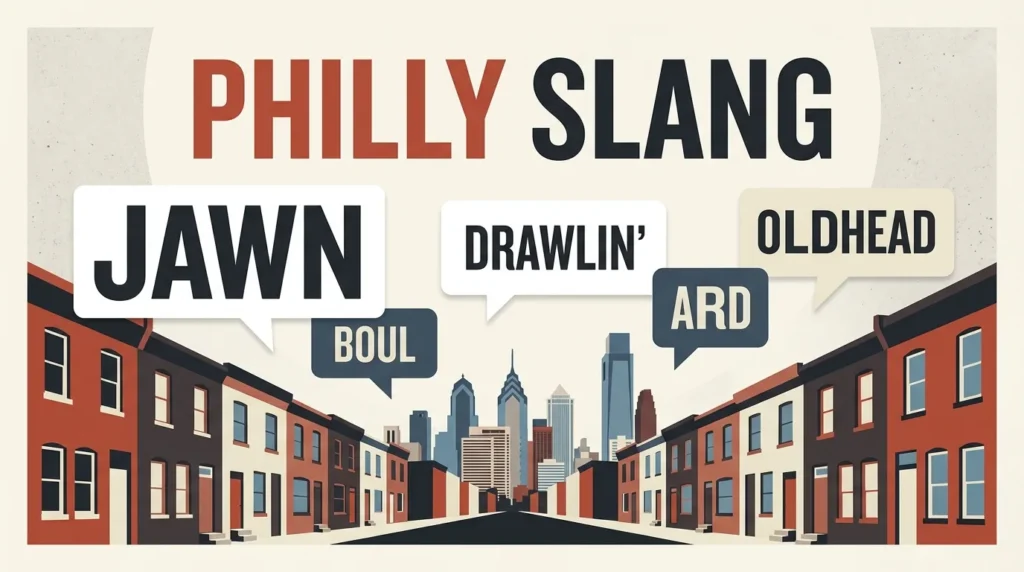

Philly slang is the informal vocabulary associated with Philadelphia and the surrounding region. Its best-known word is jawn, an all-purpose noun that can stand for a thing, place, event, or sometimes a person. Other strongly associated expressions include boul, drawlin’, ard, oldhead, and yamean.
Not everything people call Philly slang is technically slang. Wooder reflects local pronunciation, hoagie and water ice are regional vocabulary, and words such as bet and finna are heard in Philadelphia but are not unique to the city. Usage also changes by neighborhood, generation, social group, and speaker, so no single list represents every Philadelphian.
| Quick Answer | Details |
|---|---|
| Best-known Philly slang word | Jawn |
| Strongly associated terms | Jawn, boul, drawlin’, ard, oldhead |
| Regional vocabulary | Hoagie, water ice, youse |
| Local pronunciation | Wooder, Iggles |
| Typical setting | Casual speech, texting, social media, friends |
| Formality | Highly informal |
| Important warning | Some expressions come especially from Black Philadelphia speech or youth culture and can sound forced when copied without context |
What Is Philly Slang?
Philly slang is the informal language associated with Philadelphia English, especially vocabulary that developed within local communities and became recognizable across the city.
That definition needs an important qualification: Philadelphia does not have one uniform way of speaking. A teenager in North Philly, an older resident of South Philly, and someone from the suburbs may share certain expressions while using many others differently.
Some of the city’s most recognizable slang has particularly strong connections to Black Philadelphia and African American English. Words can then spread beyond the communities where they developed through schools, music, television, sports, texting, and everyday city life.
It is also useful to separate three things that often get mixed together:
- True slang: jawn, boul, drawlin’
- Regional vocabulary: hoagie, water ice, youse
- Accent or pronunciation features: wooder, Iggles
All three can sound distinctly Philadelphian, but they work differently.
Quick List of Popular Philly Slang
| Term | Simple Meaning | Tone | Usage Note |
|---|---|---|---|
| Jawn | A person, place, thing, or event | Neutral to playful | Extremely context-dependent |
| Boul | Guy, boy, person | Casual | Strongly associated with Philly speech |
| Young boul | Younger guy | Casual | Can be friendly or condescending |
| Oldhead | Older person | Casual | Can show respect or teasing |
| Drawlin’ | Acting out, doing too much | Critical/playful | Tone changes with context |
| Ard | All right, okay | Casual | Often a reply |
| Yamean | You know what I mean? | Casual | Many spellings exist |
| Bid / biddin’ | Joke, teasing, making fun | Playful to insulting | Context matters |
| Ocky | Fake, inauthentic | Negative | More associated with younger speech |
| Youse | You, plural | Neutral/casual | Regional dialect rather than pure slang |
| Wooder | Local pronunciation of “water” | Neutral | Accent feature |
| Hoagie | Long sandwich | Neutral | Regional vocabulary |
| Water ice | Philadelphia-style frozen dessert term | Neutral | Regional vocabulary |
| Iggles | Local-sounding pronunciation of “Eagles” | Playful | Accent-based |
| Wit / witout | With or without onions | Practical | Famous cheesesteak-order shorthand |
Popular Philly Slang Words and Meanings
Jawn
Meaning: Almost any person, place, object, event, or other noun that the listener can identify from context.
Pronunciation: Roughly “jawn,” rhyming closely with dawn in many American accents.
Jawn is the word most closely identified with contemporary Philadelphia slang. You might hear:
“Pass me that jawn.”
The speaker does not need to name the object because everyone involved already knows what is being discussed.
It can also describe an event:
“You going to that jawn tonight?”
Or something someone likes:
“That new jawn is nice.”
The meaning is not literally “thing.” It works more like a flexible substitute noun whose exact reference comes from the conversation.
The plural is jawns:
“Put those jawns over there.”
When jawn refers to a person, especially a woman, the tone becomes more sensitive. Depending on the speaker and situation, it can sound casual, complimentary, impersonal, or objectifying. Calling an unfamiliar person a “jawn” is therefore different from using the word for shoes or a restaurant.
Boul
Meaning: A guy, boy, man, or person.
Boul is one of the clearest examples of slang strongly associated with Philadelphia.
Example:
“Who that boul over there?”
Here, boul simply means something close to guy or dude.
Spelling varies. You may see:
- boul
- bul
- bol
- buhl
There is no universal spelling system for spoken slang, although boul has become one of the most recognizable written forms.
The word is strongly connected with informal local speech, particularly within Black Philadelphia communities. Using it naturally depends on the speaker and social setting rather than simply substituting it for “guy” in every sentence.
Young Boul
Meaning: A younger boy or man.
Example:
“Young boul can really hoop.”
The phrase can sound friendly, affectionate, dismissive, or slightly condescending.
An older speaker might use young boul simply to distinguish a younger man. Among people of roughly the same age, however, calling someone “young boul” can imply that the person is inexperienced or immature.
That is why tone and relationship matter as much as the literal definition.
Oldhead
Meaning: An older person, especially someone older than the speaker.
Example:
“Ask the oldhead. He knows what happened.”
Oldhead does not automatically mean elderly. A teenager might use it for someone in their thirties, while an adult speaker could mean someone considerably older.
It can convey respect for someone experienced:
“The oldheads put us on to that music.”
It can also be teasing:
“You don’t know that song? You an oldhead now.”
The word exists outside Philadelphia too, but it has a particularly recognizable place in local speech.
Drawlin’
Meaning: Acting out, doing too much, behaving strangely, being unreasonable, or crossing a social line.
Example:
“You drawlin’.”
That short sentence can cover several ideas:
- You’re doing too much.
- You’re acting ridiculous.
- You’re out of line.
- You’re playing around too much.
- You’re making a bad decision.
Context determines how serious it is.
If a friend puts ketchup on something everyone else considers unacceptable:
“Nah, you drawlin’.”
That could be playful.
If someone genuinely behaves disrespectfully:
“You drawlin’. Chill.”
The same expression becomes criticism.
You may also see spellings such as drawling, drawn, or drawlin because people are representing a spoken form in writing.
Also Read: YN Meaning Slang: What YN Means on TikTok and in Text
Ard
Meaning: All right, okay, understood, or agreed.
Ard compresses all right into a short response.
Example:
Person A: “I’ll call you when I get there.”
Person B: “Ard.”
Depending on delivery, it can mean:
- Okay.
- Sounds good.
- I understand.
- Fine.
- Let’s do it.
It may also start a sentence:
“Ard, what we doing now?”
That works much like “All right, what are we doing now?”
Yamean, Yamsayin, and Nahmean
These written forms attempt to capture conversational phrases such as:
- you know what I mean?
- you know what I’m saying?
Example:
“We gotta leave early, yamean?”
There is no single official spelling.
You might encounter:
- yamean
- ya mean
- yamsayin
- yamsaying
- nahmean
- know what I mean
The spelling often reflects how the speaker hears or pronounces the phrase. This is common with slang that became widely written only after texting and social media made everyday speech visible on screens.
Bid and Biddin’
In some Philadelphia speech, bidding means joking about someone, roasting them, or making them the target of humor.
Example:
“Stop biddin’ on me.”
Meaning:
“Stop making jokes about me.”
A person who regularly becomes the target of jokes might also be called the bid.
Example:
“Why you always making me the bid?”
This usage is especially dependent on social group and generation, and similar senses also occur outside Philadelphia. It should not be confused with the unrelated standard meanings of bid, such as offering a price or serving a prison sentence.
Ocky
Meaning: Fake, counterfeit, questionable, or inauthentic.
Example:
“Those sneakers look ocky.”
The implication is that the shoes may not be genuine.
The spelling varies, and the term does not belong to every Philadelphia speaker’s vocabulary. It has appeared especially in younger, informal speech.
Because pronunciation-based slang can have several possible histories and spellings, it is better not to claim a single unquestioned origin for ocky.
Philly Words That Are Local but Aren’t Exactly Slang
One of the biggest mistakes in lists of Philly slang is treating every unusual Philadelphia word as slang.
Several famous examples are better understood as regional vocabulary or pronunciation.
Hoagie
In Philadelphia, a hoagie is the familiar long sandwich made on a roll with meats, cheeses, vegetables, or other fillings.
Elsewhere, similar sandwiches may be called:
- subs
- submarine sandwiches
- heroes
- grinders
Calling it a hoagie is part of Philadelphia’s regional vocabulary rather than youth slang.
Water Ice
Water ice refers to the frozen fruit-flavored dessert often called Italian ice elsewhere.
Locally, someone might say:
“Let’s get water ice.”
The expression itself is standard regional vocabulary.
The Philadelphia accent makes it even more distinctive because water may sound closer to wooder.
Wooder
Wooder is not really a slang replacement for water. It represents a pronunciation associated with the Philadelphia accent.
A sentence such as:
“Can I get some wooder?”
still contains the ordinary word water. What changes is its pronunciation.
That distinction matters because an outsider intentionally saying wooder is imitating an accent, while someone saying jawn is choosing a different vocabulary item.
Youse
Youse functions as a plural form of you.
Example:
“What are youse doing tonight?”
It performs the same grammatical job that y’all does in many other parts of the United States.
Youse is associated with Philadelphia and other communities in the Northeast and Mid-Atlantic, so it is regional rather than uniquely Philadelphian.
Iggles
Iggles is a humorous written representation of how Eagles may sound in a strong Philadelphia accent.
You may encounter phrases such as:
“Go Iggles!”
It is less a separate slang word than a local pronunciation turned into a playful spelling.
Wit or Witout
At a cheesesteak counter, wit and witout are shorthand for with onions or without onions.
For example:
“Whiz wit.”
means a cheesesteak with Cheese Whiz and onions.
This is highly recognizable Philadelphia food-ordering language, although it is more specialized shorthand than everyday slang.
MAC Machine
Some older Philadelphia-area speakers may remember MAC machine as a common term for an ATM.
The expression comes from an older regional banking network and is much less useful as modern youth slang.
If you hear it today, the speaker’s generation may matter more than the neighborhood.
Also Read: Dominican Slang: 30 Words and Phrases You’ll Actually Hear
Philly Slang vs. General American Slang
Another common problem is labeling nationally widespread expressions as uniquely Philadelphian.
Philadelphia speakers certainly use words such as:
- bet
- say less
- finna
- no cap
- wack
- outta pocket
- wassup
- bro
But hearing a term frequently in Philly does not prove that it originated there or belongs exclusively to Philadelphia.
Many widely shared expressions have roots in African American English before spreading through music, texting, memes, sports, gaming, and social media.
A useful distinction is:
Strong Philly identity:
jawn, boul, drawlin’
Regional Philly vocabulary or pronunciation:
hoagie, water ice, wooder, youse
Common in Philly but widespread elsewhere:
bet, finna, no cap, say less, outta pocket
This distinction makes Philadelphia speech more interesting, not less. Cities develop distinctive language partly by creating new terms and partly by giving wider expressions local pronunciations, meanings, and social roles.
How Philly Slang Works on Social Media and in Texts
Philadelphia slang usually keeps the same basic meanings online, but writing introduces a new issue: spelling.
Spoken slang can exist for years without anyone needing to decide how it should look on a screen.
Once people start texting it, several spellings appear.
For example:
Boul
- boul
- bul
- bol
- buhl
Drawlin’
- drawlin
- drawn
- drawling
You know what I’m saying?
- yamsayin
- yamsaying
- nahmean
- yamean
None of these variations automatically tells you that the writer “doesn’t know how to spell.” Informal spellings often represent attempts to reproduce pronunciation and identity in writing.
Capitalization usually does not matter either:
“That jawn crazy.”
and
“that JAWN crazy 😂”
use the same word, although capitalization can add emphasis.
How Context Changes Philly Slang
Philadelphia slang is especially dependent on context.
Consider jawn:
“Pass me that jawn.”
Meaning: an object.
“That jawn was packed.”
Meaning: probably a location or event.
“I heard that new jawn.”
Meaning: perhaps a song, album, video, or other release.
“Those jawns clean.”
Meaning: possibly shoes, clothes, cars, or another plural item.
The listener identifies the meaning through shared knowledge.
Now consider drawlin’:
“He charged you $40 for that? He drawlin’.”
Meaning: unreasonable.
“You wore that in the snow? You drawlin’.”
Meaning: making a questionable decision.
“Bro, stop. You drawlin’ 😂.”
Meaning: you’re being ridiculous or too funny.
The dictionary-style definition matters less than the social situation.
Real Philly Slang Conversations
Conversation 1: Jawn
A: “Where the charger at?”
B: “That jawn right next to you.”
Here, jawn means the charger.
Conversation 2: Drawlin’
A: “I’m wearing shorts. It’s only 25 degrees.”
B: “You drawlin’.”
The speaker thinks the decision is ridiculous.
Conversation 3: Ard
A: “Meet me outside at eight.”
B: “Ard.”
Meaning: Okay.
Conversation 4: Boul
A: “Who fixed your phone?”
B: “That boul around the corner.”
Boul refers to a guy.
Conversation 5: Oldhead
A: “You still got CDs in your car?”
B: “Don’t start.”
A: “Oldhead behavior.”
Here, oldhead is playful teasing.
Conversation 6: Biddin’
A: “Why everybody laughing at my shoes?”
B: “They just biddin’. Don’t worry about it.”
Here, the group is making jokes at the person’s expense.
Conversation 7: Yamean
A: “I’m trying to save money, so I’m staying in tonight, yamean?”
B: “Yeah, I got you.”
Yamean works as a conversational check for understanding.
Also Read: What Does BTA Mean? Slang, Texting, and Social Uses
Similar Philly Terms and Their Closest Equivalents
| Philly Term | Rough Equivalent | Main Difference |
|---|---|---|
| Jawn | thing / one / joint | Can replace an unusually wide range of nouns |
| Boul | guy / dude | Strong Philadelphia association |
| Drawlin’ | trippin’ / buggin’ | Often implies behavior is excessive or out of line |
| Ard | alright / aight | Local pronunciation and spelling |
| Oldhead | older dude / OG | Age and social relationship affect tone |
| Youse | y’all | Regional plural form of “you” |
| Biddin’ | roasting / clowning | Can describe joking at someone’s expense |
These are rough equivalents, not perfect translations.
Replacing every instance of jawn with thing, for example, can remove some of the social meaning carried by the original word.
Where Did Philly Slang Come From?
There is no single origin for Philadelphia slang because the city’s vocabulary developed through several overlapping communities and generations.
One especially important influence is African American English in Philadelphia. Terms including jawn, boul, and drawlin’ became strongly connected with Black Philadelphia speech before becoming more broadly recognized as symbols of the city.
The development of jawn is relatively well understood compared with many local expressions. It is generally connected to the slang use of joint, which could refer to a place or thing. Philadelphia speakers developed the pronunciation and unusually flexible local use now associated with jawn. The precise path and timeline are difficult to reduce to one exact moment because spoken slang often circulates long before it appears regularly in print.
Other expressions have murkier histories.
That is normal.
Slang often spreads through:
- families
- neighborhoods
- schools
- music
- sports
- social groups
- migration
- texting
- social media
By the time outsiders notice a word, people may already have been saying it for years.
Why Philly Slang Has So Many Spellings
There is no official spelling authority for everyday slang.
When people write a word they mostly learned by hearing it, they naturally choose letters that seem to match the sound.
That is why someone may insist on boul while another person types bul.
The disagreement itself reveals something about slang: these expressions belong primarily to conversation and community, not standardized writing.
Texting has made the variations much more visible.
Someone can pronounce the same expression consistently for years, then suddenly have to decide whether it should be typed as:
yamean, ya mean, or yamsayin.
The meaning survives even when the spelling changes.
Do Different Generations Use Different Philly Slang?
Yes.
Some Philadelphia expressions are durable enough to cross generations, while others rise and disappear quickly.
Jawn has become unusually stable and recognizable.
Terms connected with particular youth groups can change much faster.
Older speakers may also use regional words younger speakers rarely think of as slang, such as MAC machine, while younger speakers may mix local vocabulary with national internet slang.
Age also changes meaning.
For example, young boul depends partly on who says it to whom. A fifty-year-old addressing a teenager creates a different social meaning from one seventeen-year-old saying it to another.
Can Outsiders Use Philly Slang?
They can, but knowing a definition does not automatically make an expression sound natural.
A visitor saying:
“Can you pass me that jawn?”
in the right context is easy to understand.
Trying to add jawn to every sentence simply to sound Philadelphian can feel performative.
This matters because local slang does more than communicate definitions. It can signal:
- neighborhood familiarity
- age
- friendship
- cultural background
- humor
- shared experience
- local identity
Understanding the language is often more valuable than trying to imitate it.
Formal vs. Informal Usage
Most Philly slang belongs in casual conversation.
Usually Fine
Depending on your relationship with the listener:
- friends
- siblings
- casual texting
- group chats
- social posts
- school friends
- sports conversations
Use More Carefully
- customers
- strangers
- teachers
- supervisors
- new acquaintances
- public-facing business communication
Usually Avoid
- academic papers
- legal documents
- formal business writing
- resumes
- official applications
- professional reports
A Philadelphia business may deliberately use jawn in branding to emphasize local identity, but that is a stylistic choice rather than formal English.
Is Philly Slang Offensive?
Most common Philadelphia slang words are not inherently offensive.
Words such as ard, drawlin’, and boul are usually ordinary informal expressions.
But meaning and impact can change depending on the target.
Jawn Referring to a Person
Calling an object a jawn is normally harmless.
Calling a woman a jawn can sound neutral in one social group and objectifying or disrespectful in another. Context, relationship, and speaker matter.
Oldhead
Oldhead may be affectionate, respectful, or teasing, but it can also sound dismissive when someone is being reduced to their age.
Biddin’
Friends may enjoy roasting each other.
The same comments aimed at someone who is uncomfortable can simply become insulting.
The practical rule is simple: slang does not erase ordinary social boundaries.
Respectful Use of Philadelphia Slang
Philadelphia slang is local language, not a costume.
You do not need to imitate a Philadelphia accent to understand or appreciate it.
A few useful habits make usage more natural:
- Pay attention to how people actually use a word before copying it.
- Do not assume every Philadelphian speaks the same way.
- Recognize the influence of Black Philadelphia communities on much of the city’s best-known slang.
- Avoid exaggerated phonetic spellings meant to caricature an accent.
- Be cautious when a slang word refers to a person rather than an object.
- Accept that meanings can change across generations and neighborhoods.
Knowing when not to use a word is part of knowing what it means.
Philly Slang as Local Identity
The most interesting Philadelphia expressions do more than replace standard English words.
Consider the difference between:
“Give me that thing.”
and:
“Give me that jawn.”
Both communicate the basic request.
The second sentence can also communicate familiarity with a particular speech community.
The same is true of boul, drawlin’, and ard. Their practical definitions are simple. Their social meanings are richer.
That is why local slang can survive even when everyone already knows perfectly good standard-English alternatives.
The point is not that Philadelphia lacks another word for thing.
The point is that jawn sounds like Philadelphia.
Also Read: NTM Meaning Slang: What It Means in Text and Chat
Also Read: Cyberpunk Slang Explained: Choom, Gonk, Preem and More
Frequently Asked Questions
What does jawn mean in Philly slang?
Jawn is a flexible noun that can refer to an object, place, event, idea, or sometimes a person when the listener can determine the meaning from context. “Pass me that jawn” may refer to almost any nearby object, while “that jawn was packed” could describe a restaurant, party, concert, or other place or event.
What does boul mean in Philadelphia?
Boul usually means a guy, boy, man, or person. Someone might say, “That boul over there,” in roughly the same way another speaker would say, “That guy over there.” Spellings such as bul and bol also appear because the expression developed primarily in speech rather than standardized writing.
What does drawlin’ mean in Philly?
Drawlin’ means someone is acting out, doing too much, behaving unreasonably, or crossing a social line. It can be playful or serious. Telling a friend “you drawlin’” after a ridiculous joke is different from saying it during an actual disagreement.
What does ard mean in Philly slang?
Ard is an informal pronunciation and spelling of all right. It can mean “okay,” “I understand,” “sounds good,” or “agreed.” It often appears as a short response: “I’ll meet you at seven.” “Ard.”
Is wooder actually a Philly slang word?
Not exactly. Wooder represents a Philadelphia-area pronunciation of water rather than a separate slang word. This makes it an accent feature. Jawn, by contrast, is an actual vocabulary item with its own slang function.
Is hoagie Philadelphia slang?
Hoagie is better classified as regional vocabulary than slang. It is Philadelphia’s familiar term for a long sandwich that may be called a sub, hero, or grinder elsewhere. People of different ages can use the word in completely ordinary conversation.
Do all Philadelphians use jawn?
No. Jawn is strongly associated with Philadelphia, but that does not mean every resident uses it regularly. Vocabulary differs with neighborhood, age, cultural background, family, social group, and personal speaking style.
Are words like no cap and finna Philly slang?
They can certainly be heard in Philadelphia, but they are not specifically Philadelphia slang. Both have circulated much more widely, particularly through African American English and national youth and internet culture. A useful Philly slang guide should distinguish genuinely local expressions from widespread slang that Philadelphians also happen to use.
Conclusion
Philly slang is most recognizable through words such as jawn, boul, drawlin’, ard, oldhead, and yamean, but Philadelphia speech is broader than a slang list. It also includes regional vocabulary such as hoagie and water ice, accent features such as wooder, and nationally shared expressions used alongside distinctly local ones.
The biggest key is context. A jawn can change meaning from one sentence to the next, drawlin’ can be playful or critical, and oldhead can show affection or disrespect depending on the relationship. Understanding those social cues gives you a much more accurate picture of how Philadelphia actually talks.
Related Slang Terms
Explore more slang meanings from our dictionary:

Pingback: Dominican Slang: 30 Words, Meanings, and Examples
Pingback: Bricked Up Slang Meaning: What It Means Online