


OD in slang means overdoing it, or extremely, depending on how it is used. Say “that pizza is OD good” and it means extremely good. Say “you are OD right now” and it means you are doing too much. The two letters started as short for overdose, and the slang meaning grew out of that idea of too much: too much of a drug became too much of anything. In serious health conversations, OD still means overdose, so context is everything with this one.
OD is a small word doing a lot of jobs. It works as an intensifier, a mild call-out, a verb, and a medical term, sometimes in the same conversation. This guide breaks down each job, shows how it sounds in texts, TikTok comments, and gaming chats, traces where the slang came from, and explains when to use it and when to leave it alone.
Table of Contents
- What Does OD Mean in Slang?
- OD as an Intensifier: OD Plus an Adjective
- You Are OD: The Call-Out Meaning
- OD in Texting, TikTok, and Gaming
- Where OD Comes From
- OD vs Similar Slang Terms
- When NOT to Use OD
- OD in Health and Medical Contexts
- Other Meanings of OD
- How to Reply When Someone Says You Are OD
- Quick Answers About OD
What Does OD Mean in Slang?
In slang, OD usually means overdoing it or doing too much, and it also works as a simple intensifier meaning very or extremely. The meaning depends on where it sits in the sentence. Put OD before an adjective and it turns the volume up: “OD tired” means extremely tired, “OD funny” means really funny. Point it at a person and it becomes a call-out: “you are OD” means you are overreacting, pushing a joke too far, or going beyond what the moment needs.
Wordhurst puts it neatly: OD has two main jobs in casual speech, and both come from the same idea of too much. As an intensifier it strengthens the word after it. As a call-out it tells someone they have crossed a line. The sentence around it always tells you which job it is doing, so you rarely need to ask.
| Detail | What it is |
|---|---|
| Most common slang meaning | Overdoing it, doing too much, extremely |
| As an intensifier | Very, extremely, seriously (OD good, OD tired) |
| As a call-out | You are overreacting or going too far |
| Serious meaning | Overdose, in medical and news contexts |
| Verb forms | OD, ODing or OD’ing, OD’d (past tense) |
| Where you see it | Texting, TikTok, Instagram, Snapchat, gaming chats |
| Tone | Playful, complimentary, or critical depending on context |
| Pronunciation | O-D, saying each letter: oh-dee |
| Origin | Short for overdose, reshaped in New York street talk and hip-hop |
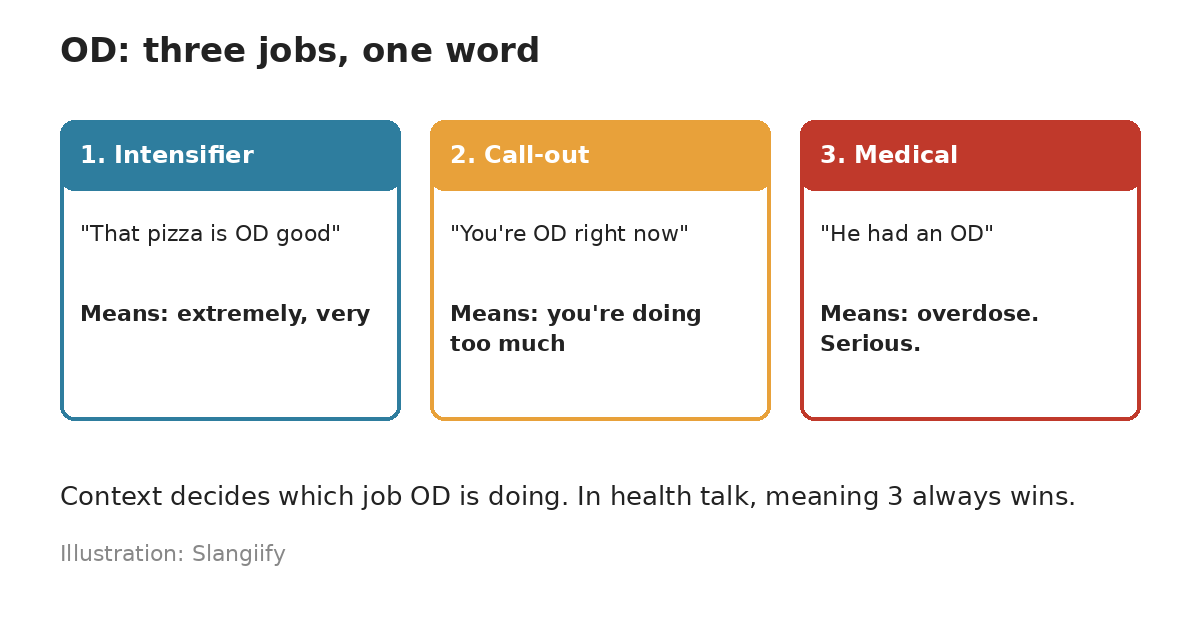
The two jobs, side by side
Compare these and the pattern becomes obvious.
That movie was OD good.
Meaning: the movie was extremely good. OD is praise here.
You are OD with the jokes today.
Meaning: you are pushing the jokes too far. OD is a gentle warning here.
He had an OD.
Meaning: this is the medical sense, an overdose, and it is serious. Nothing playful about it.
The same two letters, three completely different weights. That is why OD rewards a second of attention before you reply.
OD as an Intensifier: OD Plus an Adjective
The intensifier job is the friendliest use of OD, and it is the one spreading fastest on TikTok. OD sits right before an adjective and makes it stronger, the same way very, mad, or hella do. The sentence would still make sense without it, so OD is there purely for feeling and emphasis.
It works for almost anything: food, weather, outfits, jokes, prices, exhaustion. “This pizza is OD good.” “The line was OD long.” “Your fit is OD clean today.” “I am OD tired.” In each case OD replaces very or extremely, but it sounds more casual and more current. Wordhurst notes that people use it for positive things as often as negative ones, which is why “OD good” and “OD expensive” can both sound natural in the same conversation.
A few things to notice about this use. First, it almost always comes before the adjective, not after it. People say “OD cold,” not “cold OD.” Second, it pairs with extremes already, so doubling up sounds off: “OD very good” is redundant. Third, it stays informal. Dropping “OD good” into a work email or a school essay will confuse the reader or make you sound like you are texting your friends by accident.
OD as a verb: ODing and OD’d
OD also works as a verb, and Cambridge Dictionary records the full set of forms: OD’s, OD’ing, OD’d. “Stop ODing” means stop overreacting. “He OD’d on the cologne” means he wore way too much of it. “I OD’d on chocolate cake” is the playful, food version Cambridge itself gives as an example of the informal humorous sense. The verb form is where the overdose root shows most clearly, because it keeps the idea of taking too much of something and applies it to anything: food, attention, drama, compliments.
You Are OD: The Call-Out Meaning
When OD describes a person instead of a thing, it turns into a mild call-out. Saying “you are OD” or “bro is ODing” means the person is overreacting, exaggerating, or pushing something too far. It is close to “you are doing the most,” and the tone is usually playful between friends. But it can sound annoyed if someone is genuinely upset with you, so the relationship matters as much as the words.
Picture the scene Diffsense describes: a friend starts yelling at a waiter because the water did not have enough ice, and someone at the table says, “Yo, you are ODing right now.” Nobody thinks an ambulance is needed. Everyone understands the message: your reaction is wildly out of proportion to the situation. That is the call-out doing its job.
When it stings and when it does not
Between close friends, “you are OD” is often a joke, a way to say “relax” without a lecture. The speaker is usually smiling, and the reply is usually a laugh or a “my bad.” From a stranger, a teacher, or someone you barely know, the same words can land as an insult, because there is no shared trust to soften them. And when the person being called out is upset about something real, even a friendly “you are OD” can feel dismissive. If someone is crying about a genuine problem, telling them they are overdoing it is not funny, it is cold. Read the emotion in the room before you use it.
OD in Texting, TikTok, and Gaming
OD lives mostly in fast, informal spaces, and each platform gives it a slightly different flavor.
Texting and group chats
In texts, OD is shorthand for a reaction you do not want to spell out. “Bro is OD funny” means the friend is hilarious right now. “You OD stressed about that test” means the stress looks excessive from the outside. “That price is OD expensive” means the price is shocking. Because texts lack tone of voice, the words around OD carry the feeling: an emoji, a “lol,” or an exclamation mark tells the reader whether it is praise or a complaint.
TikTok and Instagram comments
On TikTok, OD shows up in two ways. As a reaction to a video, “this is OD cute” or “that transition is OD clean” means extremely, and it is a compliment. As a reply to a person in the video, “she is OD” means she is doing too much, usually for attention. Wordhurst notes that OD is one of many short slang words spreading through TikTok right now, along with huzz and LWK, which is why you see it under videos that have nothing to do with each other. It is part of the shared comment-section vocabulary now.
Gaming chats
In gaming, OD usually describes power or difficulty. “That weapon is OD strong” means it is overpowered. “That boss fight is OD hard” means it is extremely difficult. “He is OD at this game” can mean he is insanely good, which is praise, or insanely try-hard, which is not. The game itself usually clears up which one.
Snapchat
On Snapchat the meaning stays the same: excessive or extreme. “That is OD funny” under a story means extremely funny. The platform changes nothing except the speed, since snaps disappear and the slang moves with them.
Also Read: Tea Slang Meaning: What Tea Means in Text and Online
Where OD Comes From
OD started as an abbreviation of overdose, and dictionaries still list it that way. Cambridge Dictionary records OD as a slang verb meaning to take an overdose of a drug, and as a noun meaning an overdose. From that heavy starting point, speakers stretched the idea: too much of a drug became too much of anything. Too much food, too much cologne, too much drama. The medical root never disappeared, but the slang meaning grew up next to it.
The intensifier use is linked to New York street talk and hip-hop, where Wordhurst says OD came to describe people or things that were simply too much. Diffsense traces the same path: through the late 1990s and early 2000s, OD seeped into hip-hop lyrics as a metaphor, with rappers talking about ODing on a beat or having OD money, which shifted the meaning from a literal medical emergency to a figurative expression of abundance. Once a word becomes a metaphor, its path to general slang is short. Social media then carried it far beyond the city, and it is now common in texts, TikTok captions, and gaming chats everywhere.
That history explains the split personality of the word. The overdose root gives OD its edge and its danger. The hip-hop and internet journey gives it its playfulness. Both live in the same two letters, and the speaker’s context decides which one shows up.
OD vs Similar Slang Terms
OD overlaps with several other slang words for excess, but each one has its own lane. This table compares them the way an EAV table should: term, meaning, and the difference that matters.
| Term | Meaning | How it differs from OD | Typical context |
|---|---|---|---|
| OD | Overdoing it, or extremely | The baseline: covers both praise and criticism | Texting, TikTok, gaming, everyday chat |
| Extra | Too dramatic or overly noticeable | Usually describes a person’s style or personality | Social situations, behavior, fashion |
| Doing the most | Trying too hard, excessive effort | More direct phrase, always about a person | Group chats, call-outs, jokes |
| AF | Very, extremely (intensifier) | Only an intensifier, never a call-out | Texting, captions, emphasis |
| Overkill | More than necessary | Usually about actions or effort, not feelings | Work, gaming, planning, reactions |
| Hella | Very, a lot (intensifier) | Regional roots, softer and less edgy than OD | Casual speech, West Coast influence |
The practical difference: if you want to praise something, OD and AF both work, but OD sounds newer and more online. If you want to call someone out, OD and “doing the most” both work, but OD is shorter and lighter. Extra is the best choice when the issue is someone’s whole vibe rather than one moment.
When NOT to Use OD
OD is casual slang, and like all casual slang it has places where it does not belong. Getting these wrong is more than a style mistake, because the medical meaning is always sitting right behind the slang one.
Never in serious health conversations
This is the biggest rule, and Wordhurst states it plainly: avoid OD in serious talk about health, where it still means overdose. A slang reply like “I am about to OD” can worry people who do not know the slang, and it can feel hurtful to someone who has lost a friend or family member that way. If the conversation involves drugs, medicine, hospitals, or someone struggling, use plain language. There is no joke worth that misunderstanding.
Not at work or school
OD is informal, and most professional settings need clearer language. Saying “that deadline is OD tight” in a meeting will confuse anyone who does not follow internet slang, and it can sound careless. In schoolwork, essays, or emails, write “extremely” or “excessive” instead. Save OD for friends and group chats.
Not when someone is genuinely upset
Telling an upset person they are OD is a fast way to make things worse. It dismisses their feelings in two letters. If a friend is crying or angry about something real, listen first. The call-out can wait, or it can be skipped entirely.
Not as a joke about actual drug use
Joking “I OD’d on pizza” is fine, and Cambridge even gives the chocolate cake version as a standard example. Joking about actual drugs with OD is different. It can sound like you are making light of something dangerous, and it can worry people who care about you. Keep the joke on food, work, and drama, where it belongs.
OD in Health and Medical Contexts
Outside of casual slang, OD commonly means overdose, and this meaning deserves respect. An overdose happens when someone takes more of a substance than the body can safely handle, whether that is a prescription drug, an over-the-counter medicine, or an illicit substance. Cambridge Dictionary defines the noun sense plainly: an overdose, a dangerously large amount of a drug, with examples like “that is the first symptom of an OD.”
Diffsense adds useful detail on the medical side: according to the Centers for Disease Control and Prevention, overdoses can be accidental or intentional, and the signs are specific, including pinpoint pupils with opioids, slow or stopped breathing, and an inability to wake up. If you suspect a medical overdose, the slang goes out the window. This is an emergency situation, and in many regions naloxone (Narcan) has become a standard first-aid response for opioid-related incidents.
The rule for telling the two meanings apart is simple. If the conversation involves medicine, drugs, hospitals, or someone’s health, OD means overdose. If it involves a friend being dramatic, a meal being too big, or a video being too funny, it is slang. The surrounding words almost always make it clear, but when they do not, assume the serious meaning and ask.
Other Meanings of OD
OD is a busy abbreviation, and a few professional fields use it for completely different things. Diffsense covers the main ones, and Cambridge adds another.
Optometry: Ocular Dexter
On an eye prescription, OD stands for Ocular Dexter, Latin for right eye. Its counterpart OS, Ocular Sinister, means left eye, and OU means both eyes. If you are ordering glasses or contacts online, mixing up OD and OS means blurry vision and a headache, so the letters matter here in a very literal way.
Business: Organizational Development
In human resources and management, OD means Organizational Development: the work of changing a company’s culture and processes to make it more effective, covering team building, change management, and leadership training. When a CEO says “we need to focus on our OD strategy,” they are talking about the office, not drugs or slang.
Engineering: Outside Diameter
Buying pipe or working on an engine, OD means Outside Diameter, the measurement across the outer edges of a tube. It pairs with ID, Inside Diameter, and mixing the two up means parts that do not fit. Diffsense puts it memorably: a 1-inch OD pipe will not fit into a 1-inch ID fitting.
Science: Optical Density
Cambridge Dictionary also lists OD as short for optical density in physics: the degree to which an object or material reduces the intensity of light passing through it. It shows up in microbiology, where optical density measurements of bacterial cultures are a common technique.
How to Reply When Someone Says You Are OD
The best reply depends on whether they are complimenting you or calling you out, and whether they are joking.
If they mean it as a compliment
Someone says: “Your setup is OD.”
Haha thanks! I had to make it look good.
Take the compliment and move on. They are saying it is extremely good.
If they mean you are doing too much
Someone says: “You are OD.”
How am I doing too much?
Or, lighter: “Maybe a little.” Both keep the chat friendly while showing you heard them. Wordhurst suggests the same approach: a quick, light reply keeps the chat friendly, and you can still explain yourself if you were serious.
If the meaning is unclear
Ask directly. “OD in a good way or bad way?” takes two seconds and prevents a misunderstanding. With a word this flexible, asking is smarter than guessing.
If they say “stop ODing”
They want you to calm down. The smoothest reply is to laugh it off and actually dial it back: “Okay okay, I am done.” Arguing that you are not OD usually proves their point.
Quick Answers About OD
What does OD mean in texting?
OD usually means overdoing it or doing too much in texting. It can also mean something is extremely good, bad, difficult, or intense depending on the sentence. “That song is OD good” is praise, while “you are OD” is a call-out.
What does OD mean on TikTok?
On TikTok, OD means extremely, as in “this is OD cute,” or it is a reply telling someone they are being too much. Wordhurst lists it among the short slang words spreading through TikTok right now, along with huzz and LWK.
Does OD mean overdose?
Yes. In medical or serious conversations, OD means overdose. Cambridge Dictionary lists both the slang verb sense and the noun sense, an overdose of a drug. The surrounding topic decides which meaning applies.
What does “you are OD” mean?
It means you are acting too much, being dramatic, or going too far. It is similar to saying you are doing the most or that you should calm down. Between friends it is usually playful, but it can sting if the person is genuinely upset.
What does “stop ODing” mean?
Stop ODing means stop overreacting or stop doing too much. Friends say it when someone is being dramatic or going over the top, and the expected reply is to laugh it off and relax.
Is OD a compliment?
Sometimes. A phrase like “that song is OD good” is a compliment because it means extremely good. But “you are OD” can also criticize someone for doing too much. The sentence and the tone decide which one it is.
Is OD appropriate for work conversations?
Usually not. OD is informal slang, and many professional settings need clearer language. It is better suited for casual conversations, texts, and social media, not emails or meetings.
Sources & Further Reading
- Cambridge Dictionary: OD: records OD as a slang verb (to take an overdose; informally, to have too much of something, often food), a noun meaning an overdose, and an abbreviation for optical density.
- Wordhurst: OD Meaning in Slang: the two slang jobs of OD, its origin in overdose, the New York street talk and hip-hop link, common mistakes, and how to reply.
- Diffsense: What Does OD Mean?: the medical reality of overdose, the hip-hop evolution of the slang, and the professional meanings: ocular dexter, organizational development, and outside diameter.
The short version: OD in slang means overdoing it or extremely, and which one applies depends on the sentence. Before an adjective it is praise or emphasis. Aimed at a person it is a light call-out. In a health conversation it still means overdose, and that meaning always wins. Use it with friends, keep it out of work and serious talk, and when someone says you are OD, the smartest reply is usually a laugh and a step back.



Pingback: FUPA Meaning Slang: What It Means and How People Use It
Pingback: PDA Meaning Slang: What It Means in Text and Conversations
Pingback: Aussie Slang: Common Australian Words, Meanings & Uses
Pingback: Slime Meaning Slang: What Does Slime Mean in Text and Online?
Pingback: 304 Slang Meaning: What Does 304 Mean in Text and Online?
Pingback: Whip Car Slang: What “Whip” Means When Talking About Cars