


PDA means Public Display of Affection: romantic or physical affection shown openly in front of other people. Holding hands on a walk, a quick kiss at a cafe table, a hug at the airport arrivals gate. If other people can see it and it signals romance, it counts as PDA. The letters themselves are neutral. The reaction they get depends on who is watching, where it happens, and how far it goes.
People search for PDA as slang because it shows up constantly in texts, captions, and comment sections., alongside other texting abbreviations like ATP. Strictly speaking it is an abbreviation, not a slang word, and Cambridge Dictionary lists it as informal and humorous. But in everyday use it behaves exactly like slang: short, casual, and loaded with tone. This guide covers what PDA means, why couples do it, where culture draws the line, the etiquette that keeps it cute instead of cringey, and the other things those three letters can stand for.
Table of Contents
- What Does PDA Mean?
- PDA in Texting and on Social Media
- Why Do People Show PDA? The Psychology Behind It
- PDA Around the World: Culture Draws the Line
- PDA Etiquette: The Unspoken Rules
- When PDA Crosses the Line
- PDA vs Similar Terms
- Myths About PDA People Still Believe
- How to Reply When Someone Mentions PDA
- Is PDA Actually Slang?
- Other Meanings of PDA
- Quick Answers About PDA
What Does PDA Mean?
PDA stands for Public Display of Affection, and it means any romantic physical affection shown where other people can see it. Holding hands counts. So does hugging, cuddling on a park bench, sitting close with an arm around someone, or kissing in a restaurant. The key part is the audience: the same kiss behind closed doors is private, but in front of strangers it becomes PDA.
The term covers a wide range, and that range is exactly why people argue about it. A couple holding hands on a walk and a couple making out on a subway seat are both doing PDA, but nobody reacts to them the same way. Lovepanky describes PDA as an umbrella term that includes literally every form of physical contact between a couple in public, from hand-holding to kissing to cuddling. The word itself does not say whether the affection is sweet or too much. The people watching decide that, and they often disagree with each other.
Here is a quick snapshot of the term before we go deeper.
| Detail | What it is |
|---|---|
| Full form | Public Display of Affection |
| Most common meaning | Romantic affection shown openly in public |
| Typical examples | Holding hands, hugging, kissing, cuddling, sitting close |
| Where you see it | Texts, social media, dating talk, everyday conversation |
| Tone | Can be positive, negative, or neutral depending on context |
| Formality | Casual and widely understood across age groups |
| Pronunciation | P-D-A, saying each letter: pee-dee-ay |
| Is it slang? | Technically an abbreviation, used like slang in casual speech |
What counts as PDA, and what does not
Not every touch in public is PDA. A handshake, a pat on the back, or a hug between old friends is friendly, not romantic. PDA needs the romantic signal: body language that tells onlookers these two people are a couple. That is why the same hug reads differently at a wedding and at a bus stop. Context does the work, not the gesture alone.
It also helps to separate PDA from affection in general. Affection is the feeling and the behavior, private or public. PDA is only the public slice of it. A couple can be deeply affectionate at home and never show PDA, and a couple can show plenty of PDA while barely talking to each other at dinner. The display and the relationship are two different things.
PDA in Texting and on Social Media
In texting, PDA almost always refers to Public Display of Affection when the conversation involves dating, couples, or social situations. People use it to comment on a couple, describe their own comfort level, joke about a romantic moment, or criticize behavior they think went too far. The sentence around it sets the tone, not the letters.
Here are the ways it usually shows up in chats.
They are always doing PDA at school.
Meaning: they show affection publicly very often, and the speaker probably finds it a bit much.
I am not really into PDA.
Meaning: the person does not enjoy showing affection in public, or does not enjoy watching it.
Cute PDA honestly.
Meaning: the person finds the affection sweet and has no problem with it.
You two need to stop with the PDA.
Meaning: playful teasing between friends, telling a couple to tone it down.
PDA on Instagram, TikTok, and in captions
On social media the term stretches a little further. It covers not only what couples do in person, but also what they post: couple photos, romantic reels, anniversary tributes, and kiss clips. A comment like “the PDA in this video is adorable” is about the content, not a real-life moment. And when a celebrity couple posts something loved-up, the comments fill with people debating whether it is cute or calculated, which is the same argument people have about PDA on the street.
That is also where PDA meets gossip. A PDA-heavy clip of a famous couple can become the day’s tea in minutes, with everyone weighing in on whether the affection looked real or staged. The abbreviation travels well online because it packs a whole judgment into three letters.
Also Read: OD Meaning Slang: What Does OD Mean in Text and Chat?
Why Do People Show PDA? The Psychology Behind It
People show PDA for reasons that go deeper than habit. Lovepanky breaks the psychology into four main drivers, and a study from the University of Kansas published in The Journal of Sex Research backs up the first one: many people engage in PDA to enhance their image or social status. Being seen with an attractive or desirable partner can feel like a status signal, and the public setting is the whole point.
The other reasons are just as human. PDA signals relationship status, telling everyone nearby that both people are taken. It offers comfort and reassurance, a quick physical check-in that says “I am here, I am yours” without words. And sometimes the reason is simpler than any of that: because they can. Two people who are happy together do not always need a strategy. They hold hands because it feels good.
Why some people love it and others hate it
The split usually comes down to upbringing, personality, and past experience. Lovepanky points out that someone raised in a home where parents showed affection openly often finds PDA normal, while someone raised in a more reserved household can find it foreign or uncomfortable. Confidence plays a role too. Some people enjoy the attention and the small thrill of pushing a boundary. Others fear judgment, feel exposed, or carry bad memories from a past relationship where affection was used as control.
There is also the reassurance angle. Some people need PDA to feel desired and secure in the relationship, and the public part matters because it proves the affection is not being hidden. Their partner may read the same gesture completely differently, as showing off. That mismatch is the source of half the arguments couples have about PDA, and it is worth talking about directly instead of guessing.
PDA as a love language
Physical touch is one of the five love languages, and PDA is simply physical touch in a public setting. For someone whose main love language is touch, a hand on the shoulder in a crowd can matter more than a long text at night. For someone whose love language is words or acts of service, the same gesture can feel unnecessary. Neither side is wrong. They are speaking different languages, and PDA is where the translation gap shows.
PDA Around the World: Culture Draws the Line
What counts as acceptable PDA changes dramatically by country and community. In many parts of the United States, Western Europe, and Latin America, holding hands and a quick kiss in public barely register. In more conservative cultures, even holding hands can draw stares or disapproval. Lovepanky notes that growing up in a conservative culture usually means less exposure to PDA, which makes it feel stranger and less acceptable later.
This matters most when traveling or dating across cultures. A gesture that feels sweet and normal at home can read as rude or shocking somewhere else, and in a few countries public affection can even break local laws or customs. The safe rule is simple: watch what local couples do, and match that. If nobody around you is holding hands, take the hint.
Generations differ too. Younger people who grew up with social media tend to be more relaxed about PDA, both in person and online. Older generations often prefer affection kept private, not because they disapprove of romance but because they were raised with a stricter line between public and private life. When a family dinner turns awkward over a kiss at the table, that generation gap is usually the real story.
PDA Etiquette: The Unspoken Rules
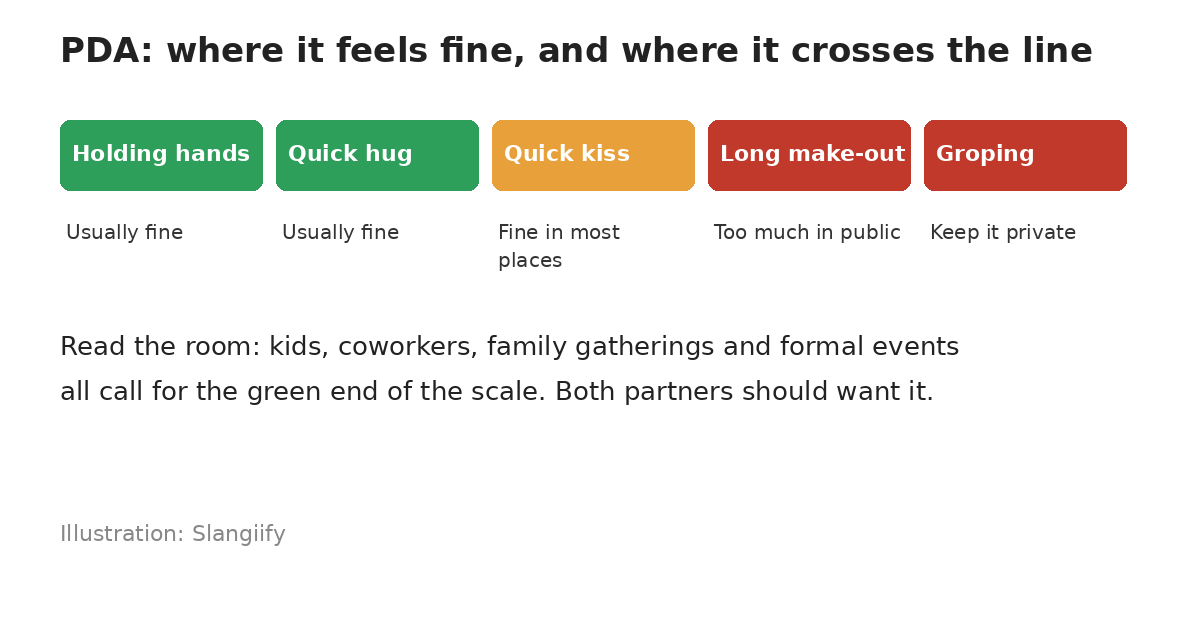
There is no official rulebook for PDA, but there is a widely shared set of unspoken rules, and Lovepanky lays them out well in its PDA etiquette guide. Most of them come down to one idea: keep it clean, keep it brief, and read the room.
Keep it soft and short
Hand-holding, a quick hug, an arm around a shoulder, a short kiss. These read as sweet almost everywhere. Long make-out sessions, groping, or anything that looks like a private moment performed for an audience crosses into uncomfortable territory fast. If people around you are looking away on purpose, you have gone too far.
Check who is watching
Kids, coworkers, grandparents, strangers in a quiet waiting room: the audience changes what is appropriate. A quick kiss at a party is one thing. The same kiss at a funeral, a work event, or a family gathering with small children is another. Lovepanky puts it plainly in its etiquette guide: if the people around you look uncomfortable, it is time to stop, because the display is for you but the discomfort belongs to everyone else.
Make sure both people want it
This is the rule people forget most often. PDA should be consensual. If one partner loves public affection and the other shrinks from it, the enthusiastic one is not being romantic, they are ignoring a boundary. A quick check-in solves most of it: “Are you okay with holding hands here?” takes two seconds and prevents a real argument later.
Keep the heavy stuff private
Biting, licking, groping, and anything meant for the bedroom stays in the bedroom. Lovepanky is blunt about this in its etiquette list, and it is right. These moves do not look romantic in public. They look like a performance nobody asked to see, and they can embarrass your partner more than they flatter them.
Do not use PDA to make someone jealous
Kissing one person in front of another to provoke a reaction is a game, not affection. It puts your partner in the middle of a performance and usually backfires. If the goal is to get someone’s attention, say so directly instead of using your partner as a prop.
When PDA Crosses the Line
PDA crosses the line when it stops being about the couple and starts being about the audience, willing or not. The clearest test is the reaction of the people around you. If they are shifting in their seats, staring at their phones, or moving away, the line has been crossed, even if nobody says a word.
At work
Romantic PDA at work is the most common complaint. A quick hug between partners who work together is usually fine. Kissing, sitting on laps, or anything more in an office makes coworkers uncomfortable and can look unprofessional, even if no rule is written down. Many workplaces handle it informally: nobody reports it, everyone just thinks less of the people doing it.
At school
Schools are the classic PDA battleground. Holding hands in the hallway is normal in most schools. Extended kissing between classes is where teachers step in, and most schools have rules about it. Teenagers test the line constantly, which is exactly why the rules exist.
Around family and at formal events
Family gatherings, religious ceremonies, funerals, and formal dinners all call for restraint. A brief kiss hello is fine in most families. Anything more can feel disrespectful to the occasion, and older relatives are the least likely to hide their opinion about it. When in doubt, keep it to a hug.
When it becomes a legal issue
In most Western countries, mild PDA is perfectly legal. But public indecency laws exist everywhere, and in some countries even a kiss in public can lead to fines or arrest. Travelers should check local norms before assuming the rules from home apply. Lovepanky flags this in its guide too, with a reminder that groping in public is illegal in some places and that local law always wins over personal habit.
PDA vs Similar Terms
PDA gets mixed up with several nearby words, but each one means something different. This table sorts them out.
| Term | Meaning | How it differs from PDA | Typical context |
|---|---|---|---|
| PDA | Romantic affection shown in public | The baseline term, public by definition | Relationships, social media, texting |
| Affection | Showing care or love, warm feeling | Broader, can be private, applies to anyone | General use, family, friends, couples |
| Intimacy | Emotional or physical closeness | Deeper and usually private, not a display | Personal relationships |
| Romance | Romantic feelings and gestures overall | Much wider, includes dates, gifts, words | Relationships, dating culture |
| Couple goals | A couple admired as an ideal | About how others see them, not the act itself | Social media, captions, comments |
| Physical touch | Touch as a way of connecting | A love language, includes private touch too | Relationship advice, psychology |
Myths About PDA People Still Believe
A few stubborn myths follow PDA around, and they cause more confusion than the term itself.
Myth: PDA means a couple is showing off
Sometimes it does. Often it does not. Many couples hold hands in public without thinking about it at all, the same way they reach for a glass of water. Assuming every public kiss is a performance says more about the watcher than the couple.
Myth: Lots of PDA means a strong relationship
There is no reliable link between how much affection a couple shows in public and how healthy their relationship is. Some of the most solid couples keep affection private, and some couples who perform constantly for an audience are struggling behind closed doors. Public affection is a style, not a score.
Myth: PDA is always inappropriate
This one usually comes from a specific cultural or family background, and it is understandable, but it is not universal. A quick kiss goodbye at a train station is normal in many places and rude in almost none. The question is never whether PDA itself is okay. It is always how much, where, and in front of whom.
Myth: If you dislike PDA, you are cold or prudish
Disliking public affection is a preference, not a character flaw. Some people express love privately and fully, through words, time, and care at home. They are not cold. They just keep the romantic part between the two people involved, which is a reasonable choice.
How to Reply When Someone Mentions PDA
Your reply depends on the situation and on whether the comment is a compliment, a joke, or a complaint.
If someone teases you about it
Haha, they are definitely comfortable showing affection.
Light and unbothered is usually the best move. Laughing it off ends the conversation faster than defending yourself.
If you agree it was cute
Yeah, they are really cute together.
Simple agreement keeps the chat friendly and moves on.
If you dislike PDA and someone calls you out
I am happy for them, but I prefer keeping things private.
This states your preference without judging the couple, which keeps things civil.
If someone tells you to stop
Take it seriously, even if it stings. A friend saying “get a room” is usually joking, but a stranger or a coworker saying it means you have genuinely made people uncomfortable. Apologize briefly, dial it back, and move on. Arguing about it makes the moment worse for everyone.
Also Read: FUPA Meaning Slang: What It Means and How People Use It
Is PDA Actually Slang?
Technically, no. PDA is an abbreviation, a shortened form of a longer phrase, not a slang word invented by a subculture. Cambridge Dictionary defines it plainly as an abbreviation for public display of affection and tags the love sense as informal and humorous, which is about as close to slang as a dictionary gets without using the word.
In practice, though, people treat it like slang. It shows up in texts, captions, and casual speech exactly the way slang does, and most people who search “PDA meaning slang” are not asking for a grammar lesson. They want to know what it means when someone says it, and whether it is positive or negative. The honest answer is both: it is an abbreviation that behaves like slang, with a stable meaning and a tone that changes with context.
That stability is unusual for internet slang. Most slang terms shift meaning every year or two. PDA has meant the same thing for decades, and it is understood across age groups, which is why it survives while trendier terms fade.
Other Meanings of PDA
Public Display of Affection is the dominant meaning in everyday conversation, but PDA has another well-known meaning from the tech world.
Personal Digital Assistant
Before smartphones took over, a PDA was a Personal Digital Assistant: a small handheld computer used for notes, calendars, contacts, and simple tasks. Cambridge Dictionary still lists this as the first sense of PDA, under computers. Devices like the Palm Pilot were the classic example. The meaning is mostly historical now, since phones absorbed the whole job, but it still appears in tech history articles and old manuals.
Other technical uses
In specialized fields, PDA can stand for other terms too, and the surrounding topic usually makes the meaning clear. These uses are rare in casual conversation, and if you see PDA in a text about dating or social media, it is almost certainly about affection, not technology.
Also Read: Puerto Rican Slang Meanings and Everyday Boricua Phrases
Quick Answers About PDA
What does PDA mean in slang?
PDA means Public Display of Affection. People often search for it as slang, but it is technically an abbreviation used in casual conversation about couples showing romantic affection in public, like holding hands, hugging, or kissing.
What does PDA mean in texting?
In texting, PDA usually refers to romantic affection shown publicly. Someone might write “too much PDA” to criticize a couple, or “I am not into PDA” to describe their own preference. Tone decides whether it sounds positive or negative.
Is PDA a bad thing?
No, PDA is not automatically good or bad. A quick kiss or holding hands is normal in most places. It becomes a problem only when it is excessive, non-consensual, or in a setting where it makes other people uncomfortable.
Is PDA appropriate at work?
Small gestures like a brief hug are usually fine, but romantic PDA at work can make coworkers uncomfortable and look unprofessional. Most people keep romantic affection out of the workplace, even when both partners work in the same office.
Why do people show PDA?
People show PDA to signal their relationship status, to feel close to their partner, to boost their social image, or simply because it feels natural. Research cited by Lovepanky, including a University of Kansas study published in The Journal of Sex Research, links PDA to image enhancement and relationship signaling.
What does PDA stand for besides relationships?
PDA can also mean Personal Digital Assistant, a handheld computer popular before smartphones. Cambridge Dictionary lists both senses, with the tech meaning now mostly historical.
How do you pronounce PDA?
PDA is pronounced by saying each letter separately: pee-dee-ay. Cambridge Dictionary gives the pronunciation as /ˌpiː.diːˈeɪ/ in both British and American English.
Sources & Further Reading
- Cambridge Dictionary: PDA: defines PDA as an abbreviation for public display of affection (informal, humorous) and for personal digital assistant, with pronunciation /ˌpiː.diːˈeɪ/.
- Lovepanky: Public Display of Affection, PDA Etiquette & Must-Knows: psychology of PDA, the University of Kansas study in The Journal of Sex Research, cultural differences, etiquette rules, and when PDA crosses the line.
- Longman Dictionary of Contemporary English: PDA: lists both the public display of affection sense and the personal digital assistant sense.
The short version: PDA means Public Display of Affection, and it covers everything from holding hands to kissing in front of other people. The letters are neutral. The setting, the amount, and the comfort of everyone involved decide whether it reads as sweet, normal, or too much. Keep it soft, keep it consensual, read the room, and save the heavy stuff for private.


Pingback: Florida Slang Words and Meanings: A Guide to Local Expressions
Pingback: Aussie Slang: Common Australian Words, Meanings & Uses
Pingback: Mid Meaning Slang: What “Mid” Means in Text and Online
Pingback: Calloway Meaning Slang: What It Means and How It’s Used
Pingback: 304 Slang Meaning: What Does 304 Mean in Text and Online?
Pingback: DSL Meaning Slang: What It Means in Text and Online