
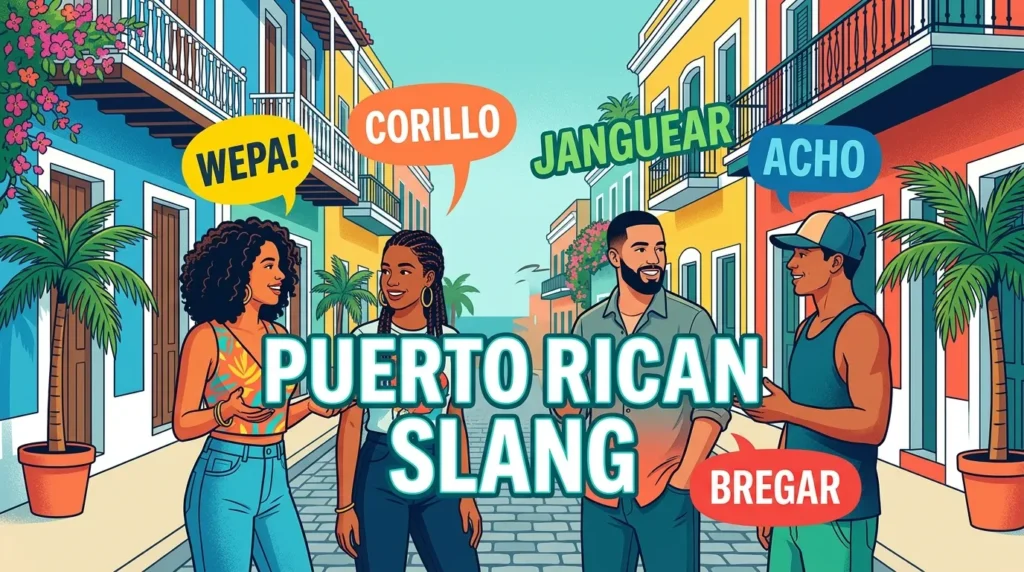

Puerto Rican slang is the informal vocabulary used in Puerto Rican Spanish, including expressions such as wepa, janguear, corillo, acho, bregar, and al garete. Some terms are strongly associated with Puerto Rico, while others are shared across the Caribbean or have spread through music and social media.
The meaning can change with tone, age, location, and the relationship between speakers. Puerto Rican Spanish also includes regional vocabulary that is not technically slang, plus English-influenced words that have become completely natural in everyday conversation.
| Quick Answer | Details |
|---|---|
| Language variety | Puerto Rican Spanish, a Caribbean Spanish variety |
| Common examples | Wepa, acho, corillo, janguear, bregar, revolú |
| Typical context | Friends, family, texting, music, parties, everyday conversation |
| Tone | Usually casual, expressive, playful, or familiar |
| Formality | Mostly informal |
| Important warning | Some expressions are vulgar or change meaning outside Puerto Rico |
What Is Puerto Rican Slang?
Puerto Rican slang refers to informal words, expressions, and meanings associated with Spanish spoken in Puerto Rico and Puerto Rican communities elsewhere.
It is important to separate slang from Puerto Rican Spanish as a whole. A word such as corillo is clearly informal, while a word such as guagua for “bus” may simply function as normal regional vocabulary. Both can sound distinctly Puerto Rican to someone who learned another variety of Spanish.
Puerto Rican Spanish belongs to the wider Caribbean Spanish family. Its vocabulary reflects centuries of contact involving Spanish, Indigenous Taíno heritage, African linguistic and cultural influence, and later sustained contact with English.
That mixture helps explain why a Puerto Rican conversation may contain traditional Spanish vocabulary, Caribbean expressions, local meanings, shortened words, and adapted English terms within the same exchange.
Quick List of Popular Puerto Rican Slang Terms
| Slang Term | Simple Meaning | Tone | Usage Warning |
|---|---|---|---|
| Wepa | Woo! Yeah! Let’s go! | Excited | Very informal |
| Acho / Chacho | Man, dude, come on | Expressive | Meaning depends on tone |
| Mano | Bro | Friendly | Informal |
| Pana | Close friend, buddy | Friendly | Used beyond Puerto Rico too |
| Corillo | Crew, friend group | Friendly | Casual |
| Ay bendito | Oh dear, poor thing, come on | Sympathetic or frustrated | Tone changes meaning |
| Brutal | Amazing, awesome | Positive | Can have literal meaning elsewhere |
| Nítido | Great, excellent, perfect | Positive | Wider regional use exists |
| Janguear | To hang out | Casual | English-influenced |
| Bregar | To deal with, handle, work on | Neutral | Very context-dependent |
| Pichear | Ignore, brush off | Casual | Also a baseball verb |
| Revolú | Mess, chaos | Negative or playful | Not exclusive to Puerto Rico |
| Al garete | Out of control, aimless | Negative or playful | Meaning depends on situation |
| Chavos | Money | Neutral | Usually plural in this meaning |
| Guagua | Bus | Neutral | Means something different elsewhere |
| Zafacón | Trash can | Neutral | Regional vocabulary |
| China | Orange | Neutral | Meaning changes by country |
| Bochinche | Gossip, noisy commotion | Playful or negative | Several regional meanings |
| Guille | Arrogance, showing off | Critical or playful | Highly informal |
| Perreo | Reggaeton dancing | Party or sexual | Can be suggestive |
Popular Puerto Rican Slang Words and Meanings
Wepa
Wepa is an energetic exclamation of celebration, excitement, approval, or encouragement.
It can work like:
- “Woo!”
- “Yeah!”
- “Let’s go!”
- “All right!”
Example:
¡Wepa! Ganamos.
“Yeah! We won.”
You may hear it at parties, celebrations, concerts, sporting events, or whenever someone reacts enthusiastically.
Because it is an exclamation rather than a precise dictionary-style statement, its translation changes with the moment.
Acho and Chacho
Acho and chacho are closely connected to muchacho. In casual speech, they can function like “man,” “dude,” “come on,” or simply an emotional filler.
Example:
Acho, no puedo ir hoy.
“Man, I can’t go today.”
Acho is especially dependent on delivery. A speaker may use it to show disbelief, disappointment, frustration, or emphasis rather than to address a particular person. The shortened form is documented as a Puerto Rican interjection.
Mano
Mano commonly means “bro” or “man” in familiar Puerto Rican speech.
It is generally understood as a shortened form associated with hermano, meaning “brother.”
Example:
Mano, ¿qué pasó?
“Bro, what happened?”
It normally signals familiarity, so it sounds more natural between friends than in a formal conversation with a stranger.
Also Read: ATP Meaning Slang: What It Means in Text and TikTok
Pana
A pana is a friend, buddy, or close companion.
Example:
Ese es mi pana desde la escuela.
“That’s been my buddy since school.”
The word is not unique to Puerto Rico. It appears in several Spanish-speaking regions, so calling every use of pana exclusively Puerto Rican would be misleading. In Puerto Rican conversation, however, it fits naturally into everyday informal speech.
Corillo
A corillo is a group of friends or a crew.
Example:
Voy a salir con el corillo.
“I’m going out with the crew.”
The word usually suggests a familiar social group rather than a random collection of people. It is especially useful when talking about the friends someone regularly hangs out with.
Ay Bendito
Ay bendito is one of those expressions that cannot be translated with one fixed English phrase.
Depending on tone, it can communicate:
- sympathy
- frustration
- disbelief
- affection
- mild annoyance
- “oh, poor thing”
- “oh dear”
- “come on”
Example:
Ay bendito, se cayó el nene.
“Oh, poor thing, the kid fell.”
But with an irritated tone:
Ay bendito, otra vez con lo mismo.
“Oh, come on, not this again.”
Context matters more than the literal meaning.
Brutal
In Puerto Rican informal speech, brutal can be strongly positive.
Example:
El concierto estuvo brutal.
“The concert was amazing.”
Someone unfamiliar with the local use might interpret brutal only as “violent,” “harsh,” or “brutal” in the English sense. In casual Caribbean speech, however, positive meanings such as “awesome” or “incredible” are common.
Nítido
Nítido can mean “great,” “excellent,” “nice,” or “perfect” in informal Puerto Rican Spanish.
Example:
Todo quedó nítido.
“Everything came out perfect.”
The ordinary Spanish meaning relates to something being clear or distinct, but regional conversational use extends it to things that are excellent, well done, attractive, or in very good condition.
Friends, Plans, and Everyday Life
Janguear
Janguear means “to hang out.”
Example:
Vamos a janguear después del trabajo.
“Let’s hang out after work.”
It developed through contact with English hang out and has been adapted to Spanish spelling, pronunciation, and verb patterns.
You can conjugate it like another Spanish -ar verb:
- yo jangueo
- tú jangueas
- vamos a janguear
The term has become deeply established in Puerto Rican informal speech and has also spread internationally through Puerto Rican music and popular culture.
Bregar
Bregar is one of the harder Puerto Rican expressions to translate because its meaning changes dramatically with context.
It may mean:
- deal with something
- handle something
- try to do something
- work something out
- help someone with something
- manage a difficult situation
Example:
Estoy bregando con el carro.
“I’m dealing with the car.”
Example:
Brega con eso y me dices.
“Handle that and let me know.”
The word can cover so many situations that translating it word for word often sounds unnatural. In Puerto Rican usage, documented meanings include trying to accomplish something and helping someone with something.
Pichear
In informal Puerto Rican conversation, pichear can mean to ignore, dismiss, or pay no attention to someone or something.
Example:
Pichea eso.
“Forget about that.”
Or:
Me está picheando.
“He/she is ignoring me.”
The same verb also exists in baseball for “to pitch,” which shows why context is essential.
Revolú
A revolú is a mess, confusing situation, commotion, or disorder.
Example:
Hay un revolú en la oficina.
“There’s a mess in the office.”
It can describe physical disorder, social confusion, arguments, complicated plans, or any situation where too many things are happening at once.
The word also appears outside Puerto Rico, including elsewhere in the Caribbean and Latin America.
Al Garete
Al garete describes something that is out of control, disorganized, uncontrolled, or moving without a clear direction.
Example:
La fiesta se fue al garete.
“The party got completely out of control.”
The expression can sound negative, humorous, or even approving when people are describing an especially wild party.
It originally has a much more literal idea connected with being adrift or without controlled direction, which makes its figurative use easy to picture.
Chavos
Chavos means money.
Example:
No tengo chavos para salir hoy.
“I don’t have money to go out today.”
The money sense is especially common in the plural. Historically, chavo is connected with ochavo, the name of an old coin.
Guagua
In Puerto Rico, guagua means a bus and can also refer to certain larger passenger vehicles.
Example:
Vamos en guagua.
“We’re going by bus.”
This is an important regional-difference word. In countries such as Chile, guagua commonly means a baby instead.
So:
La guagua llegó.
In Puerto Rico, you are probably talking about transportation. In another country, the exact same sentence could be understood very differently. The bus meaning is also shared with places such as Cuba and the Dominican Republic.
Also Read: Tuff Meaning Slang: What Tuff Means in Text & Online
Zafacón
A zafacón is a trash can, garbage container, or wastebasket.
Example:
Bótalo en el zafacón.
“Throw it in the trash can.”
The word is normal regional vocabulary rather than edgy youth slang. It is used in Puerto Rico and several other Caribbean-connected communities.
China
In Puerto Rican Spanish, china can simply mean an orange.
Example:
Quiero jugo de china.
“I want orange juice.”
This can surprise Spanish learners because naranja is the word they may have been taught.
Puerto Rico shares this meaning with the Dominican Republic, while china has completely different meanings in other Spanish-speaking regions.
Bochinche
Bochinche can describe gossip, rumor, a noisy gathering, or general social commotion.
Example:
¿Cuál es el bochinche?
“What’s the gossip?”
The exact meaning depends on what is happening. Someone discussing other people’s business may be talking about gossip, while a loud gathering can also be described with the same word.
Guille
Guille is associated with arrogance, putting on airs, or acting as though you are more important or impressive than you really are.
Example:
Él tiene un guille brutal.
“He really thinks he’s something.”
It can be genuinely critical or playful teasing among friends.
The phrase tener guille often carries the idea of having an attitude, showing off, or acting overly confident.
Puerto Rican Slang in Reggaeton and Social Media
Puerto Rican urban music has carried many local expressions far beyond the island. A term may begin as regional speech, become common in reggaeton lyrics, spread through TikTok or Instagram, and eventually become recognizable to Spanish speakers who never use it in normal conversation.
That does not mean every Puerto Rican speaks like a reggaeton song.
Music vocabulary often exaggerates nightlife, sexuality, confidence, status, conflict, and relationships. Everyday family conversation may sound very different.
Perreo
Perreo refers to a style of dancing strongly associated with reggaeton.
It usually involves close, rhythmic hip movement and may carry a sexual tone.
Example:
La canción es buena para perreo.
“The song is good for reggaeton dancing.”
It is common in music and nightlife contexts but does not belong in most formal settings.
Fronteo
Fronteo refers to showing off, presenting status, acting tough, or displaying confidence and success.
In urban music, it can involve money, style, reputation, cars, jewelry, romantic attention, or dominance.
Its English equivalents depend on context: “flexing,” “fronting,” and “showing off” may all fit.
Tiraera
A tiraera is a lyrical attack or diss aimed at another performer or rival.
The term is strongly associated with rap, reggaeton, and urban music competition.
It can also be used more loosely for direct or indirect verbal attacks between people.
Bellaco, Bellaca, and Bellaqueo
In Puerto Rican urban slang, bellaco or bellaca can describe someone who is sexually aroused or strongly sexually motivated.
Bellaqueo refers to sexual energy, sexually charged interaction, provocative dancing, or a sexual party mood.
These words have become internationally recognizable through reggaeton, but they remain sexually explicit or suggestive and should not be treated like neutral words for “attractive” or “romantic.” The Puerto Rican sexual meaning is specifically documented as vulgar or taboo in some uses.
Bichote
Bichote can refer to a powerful person, especially a high-ranking drug dealer in its more specific criminal meaning.
Music sometimes broadens the term toward ideas such as “boss,” “big shot,” or someone with major influence.
Because of those associations, it is not simply a harmless synonym for “successful person.”
Also Read: Jit Slang Meaning, Definition, Examples, Origin & Usage
Puerto Rican Slang Words You Should Use Carefully
Understanding slang is not the same as knowing when you should personally use it.
Several Puerto Rican words become much stronger than learners expect.
Bicho
This is a major false-friend warning.
In general Spanish, bicho may mean a bug, insect, or little creature. In Puerto Rican vulgar usage, however, it can refer to the penis.
That means a harmless sentence learned elsewhere can sound sexual or funny in Puerto Rico.
For language learners, this is often a word worth recognizing before actively using.
Puñeta
Puñeta can function as a vulgar exclamation expressing anger, frustration, surprise, or intensity.
Depending on context, English equivalents might include “damn,” “hell,” or a stronger profanity.
It also has sexual meanings in Spanish, so it is unsuitable for formal situations, professional conversations, and casual use around people you do not know well.
Cabrón
Cabrón is used across many Spanish-speaking regions and is not specifically Puerto Rican.
Its tone ranges from serious insult to rough joking between very close friends. In the wrong relationship, it can sound aggressive or disrespectful.
A learner should never assume that hearing friends call one another cabrón means it is safe to use with everyone.
How Tone Changes Puerto Rican Slang
One of the biggest mistakes learners make is treating slang as a simple translation list.
Consider acho:
Acho, qué bueno.
“Man, that’s great.”
Acho, no puedo más.
“Man, I can’t take this anymore.”
Achoooo…
“Come on…”
The dictionary meaning does not change much. The emotional message does.
The same happens with ay bendito. It can signal real sympathy, playful pity, frustration, or disbelief.
Puerto Rican slang often works through tone + context + relationship, not vocabulary alone.
Real Puerto Rican Slang Conversations
1. Making Plans
Luis: ¿Qué vas a hacer esta noche?
Ana: Voy a janguear con el corillo.
English:
Luis: “What are you doing tonight?”
Ana: “I’m hanging out with the crew.”
2. Traffic Problems
Ana: Voy tarde. Hay un tapón horrible.
Luis: Acho, otra vez.
English:
Ana: “I’m running late. Traffic is terrible.”
Luis: “Man, again?”
3. A Great Event
Luis: ¿Cómo estuvo el concierto?
Ana: Brutal. Estuvo a fuego.
English:
Luis: “How was the concert?”
Ana: “Amazing. It was awesome.”
4. Ignoring Drama
Ana: ¿Viste lo que escribió?
Luis: Sí, pero pichea eso.
English:
Ana: “Did you see what they wrote?”
Luis: “Yeah, but ignore it.”
5. A Messy Situation
Luis: ¿Qué pasó aquí?
Ana: Mano, esto es un revolú.
English:
Luis: “What happened here?”
Ana: “Bro, this is a mess.”
6. No Money
Ana: ¿Vamos a comer afuera?
Luis: No puedo. Estoy sin chavos.
English:
Ana: “Want to eat out?”
Luis: “I can’t. I’m out of money.”
7. Sympathy
Luis: Perdí el teléfono otra vez.
Ana: Ay bendito, Luis.
English:
Luis: “I lost my phone again.”
Ana: “Oh, Luis…”
Depending on her tone, Ana could be sympathetic, amused, or slightly annoyed.
Formal Versus Informal Puerto Rican Spanish
Some regional Puerto Rican words are safe almost anywhere, while others clearly belong to familiar conversation.
Usually Easy to Understand in Everyday Situations
Words such as:
- guagua
- zafacón
- china
- chavos
may function as everyday regional vocabulary rather than rebellious slang.
Better With Friends and Casual Groups
Expressions such as:
- acho
- mano
- corillo
- janguear
- pichear
- guille
- wepa
sound much more casual.
Better to Recognize Than Immediately Copy
Use extra caution with:
- bicho
- puñeta
- bellaco
- sexually charged reggaeton slang
- insulting uses of cabrón
A word that sounds funny in a song may sound insulting when directed at a stranger.
Similar Terms and Regional Differences
| Term | Meaning in Puerto Rico | What Makes It Tricky |
|---|---|---|
| Pana | Friend | Also used in other countries |
| Corillo | Crew or friend group | Refers to a group, not usually one friend |
| Mano | Bro | Highly familiar |
| Guagua | Bus | Can mean “baby” elsewhere |
| China | Orange | Has unrelated meanings in other countries |
| Bicho | Vulgar sexual meaning | Often means “bug” elsewhere |
| Revolú | Mess or confusion | Also appears outside Puerto Rico |
| Bregar | Deal with or handle | Translation changes by sentence |
Pana vs. Corillo
A pana is normally one friend.
A corillo is your group.
Voy con mi pana.
“I’m going with my buddy.”
Voy con el corillo.
“I’m going with the crew.”
Revolú vs. Al Garete
A revolú is the mess itself.
Al garete often describes the condition of something being uncontrolled, badly organized, or off course.
La casa es un revolú.
“The house is a mess.”
Todo se fue al garete.
“Everything went off the rails.”
Slang vs. Accent
Puerto Rican slang should not be confused with Puerto Rican pronunciation.
Pronouncing words differently does not make those words slang. Puerto Rican Spanish also has recognizable Caribbean pronunciation patterns, but pronunciation, grammar, vocabulary, and slang are separate parts of a dialect.
Also Read: DTF Meaning Slang: What It Means in Text and Dating
Where Puerto Rican Slang Comes From
There is no single origin for Puerto Rican slang.
Puerto Rican Spanish developed through layers of language contact and social history. Spanish brought to the Caribbean formed the main linguistic base. Indigenous Taíno heritage remains visible in Puerto Rican place names and vocabulary, while African cultures contributed to the island’s broader linguistic and cultural development.
Contact with English later added another major layer.
This influence does not mean Puerto Rican Spanish is simply “Spanish mixed with English.” English-derived terms can be reshaped into fully functional Spanish words.
Janguear is a good example.
Once adapted, it behaves like a Spanish verb:
jangueo, jangueas, jangueamos.
This is more than randomly inserting an English word into a sentence. The borrowed element has been fitted into Spanish grammar.
Puerto Rican Slang in the Diaspora
Puerto Rican communities outside the island continue to use and reshape Puerto Rican vocabulary.
A person raised in San Juan may not use every expression in the same way as someone raised in New York, Orlando, Philadelphia, or another Puerto Rican community.
Diaspora speech may also involve more English-Spanish code-switching.
Because of this, there is no single vocabulary list that represents every Puerto Rican speaker.
Age matters too.
Some slang remains stable across generations, while other expressions become associated with younger speakers, urban music, internet culture, or particular social groups.
Respectful Usage and Cultural Sensitivity
You do not need to imitate every local expression to communicate well with Puerto Rican speakers.
Listening first usually works better.
A few practical rules help:
- Use casual slang when the relationship is casual.
- Do not copy insults simply because friends use them with each other.
- Treat sexual slang carefully.
- Remember that music language can be stronger than ordinary conversation.
- Do not exaggerate pronunciation to imitate an accent.
- Do not assume every Puerto Rican uses the same slang.
- Expect vocabulary to differ by age, social group, location, and family.
Knowing what a phrase means is often more useful than forcing it into your own speech.
Frequently Asked Questions
What are the most common Puerto Rican slang words?
Widely recognizable examples include wepa, acho, mano, pana, corillo, janguear, bregar, pichear, revolú, al garete, chavos, and ay bendito. Usage still varies by generation, location, and social group, so no list represents every Puerto Rican speaker.
What does wepa mean in Puerto Rican slang?
Wepa is an enthusiastic exclamation. Depending on the moment, it can mean something close to “yeah,” “woo,” “let’s go,” or “all right.” It is especially natural in celebrations, music, parties, and excited reactions rather than formal conversation.
What do Puerto Ricans call their friends?
Pana commonly means a friend or buddy, while mano can work like “bro.” A group of close friends may be called a corillo. These expressions show different levels of familiarity, so they sound most natural in casual conversation.
What does Puerto Rican slang sound like in texting?
Texting usually keeps the same meanings found in spoken conversation. Someone might write acho, wepa, pichea, mano, or brutal in messages and comments. Spelling can become more relaxed online, but slang does not automatically gain a completely different “TikTok meaning” or “Snapchat meaning.”
Is Puerto Rican slang different from Dominican or Cuban slang?
Yes, although the varieties overlap because all three belong to the Caribbean Spanish world. Words such as guagua are shared, while other expressions, meanings, preferences, and pronunciation patterns differ. It is better to think of them as related regional varieties rather than one single Caribbean slang system.
Is Puerto Rican slang appropriate at work or school?
It depends on the expression. Regional everyday words such as guagua or zafacón are usually unremarkable. Highly casual words such as corillo or acho may sound too relaxed in formal writing, while vulgar expressions such as puñeta or sexual uses of bicho should generally be avoided in professional settings.
Why does Puerto Rican Spanish contain English-sounding words?
Puerto Rico has experienced long-term Spanish-English contact, so English loanwords and adapted forms naturally appear in the local variety. Some are integrated into Spanish grammar rather than used as unchanged English words. Janguear, meaning “to hang out,” is one clear example.
Conclusion
Puerto Rican slang is best understood as part of a living regional variety of Spanish, not as a fixed list of funny expressions. Words such as wepa, corillo, janguear, bregar, and revolú can make Puerto Rican conversations much easier to follow, while terms such as bicho or puñeta show why regional context matters.
The most useful approach is to learn meaning, tone, and situation together. Notice who is speaking, how well the speakers know one another, and whether the setting is a family conversation, group chat, workplace, party, or reggaeton song. That context tells you far more than a direct English translation alone.



Pingback: SSA Meaning Slang: What It Means on TikTok & Text
Pingback: FUPA Meaning Slang: What It Means and How People Use It
Pingback: Chicago Slang: Popular Words, Meanings, and Local Expressions