


ATP most commonly means “at this point” in slang and texting. People use it when they sum up how they feel, what they have decided, or where a situation stands after everything that has happened so far. It can also mean “answer the phone,” usually right after someone has tried calling. The sentence around ATP almost always tells you which one it is.
ATP is one of those abbreviations that does a surprising amount of work for three letters. It is short, it fits in a caption or a comment, and it carries a whole mood with it. I have seen it end arguments, start jokes, and stand in for a full paragraph of feelings. This guide sorts out both meanings, shows you the quick test that tells them apart, and covers the tone, the origin, and the places where you should not use it.
Table of Contents
- Quick Answer
- The 30-Second Test: Which ATP Is It?
- “At This Point”: The Main Meaning
- “Answer the Phone”: The Second Meaning
- ATP on TikTok, Snapchat, Instagram and X
- ATP vs RN, ATM and Similar Shortcuts
- The Tone Map: What ATP Really Signals
- Where ATP Came From
- When NOT to Use ATP
- Myths vs Facts About ATP
- How to Reply When Someone Sends ATP
- ATP Outside Slang
- Quick Answers About ATP
- Sources and Further Reading
Quick Answer
| Detail | Explanation |
|---|---|
| Most common slang meaning | At this point |
| Other slang meaning | Answer the phone |
| Typical platforms | Texts, DMs, TikTok comments, Instagram captions, Snapchat, X, group chats |
| Tone | Frustrated, resigned, decisive, playful, or neutral, depending on the sentence |
| Formality level | Very informal |
| Offensive status | Not vulgar or a slur, but it can sound impatient or demanding |
| Pronunciation | Said letter by letter: “A-T-P” |
| Full form | At This Point (or Answer The Phone) |
The 30-Second Test: Which ATP Is It?
ATP has two live meanings, and mixing them up is the most common mistake people make with it. The good news is that a three-question test sorts out almost every case in seconds. First, was there a phone call just before the message? If someone called twice and then texted “ATP!”, they almost certainly mean “answer the phone.” Second, does the sentence describe a feeling, a decision, or a situation? “ATP I am done explaining” is clearly “at this point.” Third, is ATP standing alone with an exclamation mark? A lone “ATP!!” after missed calls is a poke to pick up, while ATP tucked inside a longer sentence is almost always “at this point.”
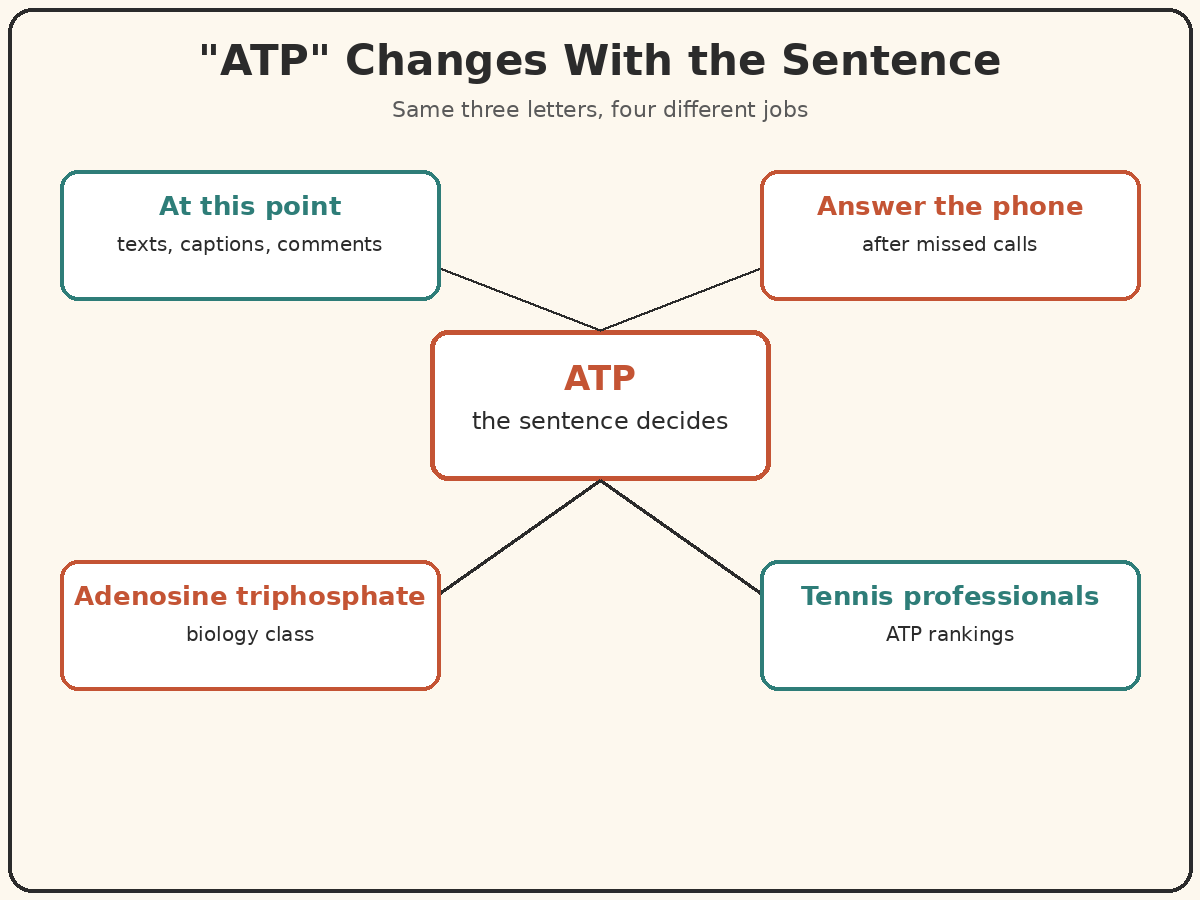
Illustration: Slangiify
Here is the test in action. “ATP I am just going home” passes question two, so it means “at this point.” “Bro ATP, I have called you four times” passes question one, so it means “answer the phone.” “ATP is produced during cellular respiration” fails both, because that sentence belongs to biology, not texting. If you are still unsure after the test, ask. “Do you mean at this point, or do you need me to call?” is a normal question, and nobody thinks it is strange.
“At This Point”: The Main Meaning
When someone writes ATP in a text or a comment, they usually mean “at this point.” It is a shortcut for describing where things stand right now, after everything that has already happened. It works as a bridge between the backstory and the conclusion, and that is why it shows up so often at the start of a sentence.
Look at how it behaves in real messages. “ATP I do not even care who wins” means the speaker has watched enough and reached a verdict. “ATP we should probably leave” means the waiting has gone on long enough and a decision is due. “ATP my dog basically owns the house” is a joke, but the structure is the same: a long-running situation, summed up in three letters.
The important thing to notice is that ATP is not really about clock time. If it were only a timestamp, people would write “right now” or “currently” instead. ATP carries an emotional stance. It says, in effect, “after all of this, here is where I landed.” That is also why it pairs so naturally with feelings like tiredness, acceptance, and dry humor. The words after ATP usually tell you more about the speaker’s mood than the abbreviation itself.
Why People Shorten It at All
Texting rewards brevity, and “at this point” is a phrase people type constantly. Shortening it to ATP saves keystrokes, fits captions and comments with tight character limits, and signals that the writer is fluent in casual online language. The full phrase is completely standard English and works in essays, reports, and speeches. The abbreviation lives almost entirely in casual texting and social captions, and swapping one for the other in the wrong setting changes how the message lands.
ATP at the Start, Middle, or End of a Sentence
ATP usually opens a sentence, because it frames what follows: “ATP I might just cancel.” It can also sit at the end, almost as an afterthought: “I honestly do not care ATP.” Either way, it points backward at the conversation so far. The sender does not need to repeat the whole backstory, because ATP quietly references it. That is the whole appeal, and also the whole risk: if the reader missed the backstory, ATP can feel cryptic.
“Answer the Phone”: The Second Meaning
The second slang meaning of ATP is “answer the phone.” It is less common than “at this point,” and it shows up in a much narrower set of situations: almost always in a private, one-on-one chat, right after someone has tried calling and gotten no response.
Picture it. You call a friend twice, they do not pick up, so you send a quick text: “ATP!” That is not a reflection on your mood. It is a short, urgent request to pick up the phone. The exclamation mark does a lot of the work here. “ATP, I need to tell you something” reads as a command, not a status update. In group chats and public comments, this meaning almost never appears, because you would not ask a whole group to answer your call.
How to Spot the “Answer the Phone” Meaning
Look for call-related clues in the conversation around it. Missed calls, repeated calls, words like “call me” or “pick up,” and a sense of urgency all point to this meaning. A message sent as a short standalone text, especially right after a call, is another strong signal. If the chat history shows a normal conversation with no calls at all, “answer the phone” is very unlikely. When in doubt, the safest move is to call back or ask, because guessing wrong here can genuinely confuse the other person.
ATP on TikTok, Snapchat, Instagram and X
ATP keeps the same core meaning across platforms, but each app gives it a slightly different flavor. On TikTok, it often shows up in captions as a punchline or a vibe check. A creator might post a chaotic morning routine with the caption “ATP this is just my personality,” using three letters to sum up a whole situation. TikTok captions reward brevity and a bit of self-aware humor, and ATP fits that perfectly.
On Instagram, ATP leans similar: short, relatable lines under photos and stories, or quick reactions in comment sections, like “ATP just eat the whole cake, who cares.” On Snapchat, where messages are quick and disposable between close friends, ATP works more like real-time commentary, narrating your current state to someone who already knows the backstory. On X, it fits the platform’s appetite for quick reaction posts. Character limits reward short phrases that pack in tone, and ATP turns a full thought into something that reads like a live reaction.
WhatsApp is the one place where the second meaning shows up more often, simply because WhatsApp is used for direct calls as well as texts. If a call does not connect, “ATP” as a follow-up text makes practical sense there. Even so, “at this point” is still the default reading unless call clues are present. If you want a deeper look at how short slang travels across apps, our guide to tuff meaning slang shows the same pattern with a very different word.
ATP vs RN, ATM and Similar Shortcuts
ATP belongs to a family of short texting abbreviations that work as tone and emphasis markers rather than strict information. Knowing how it differs from its closest cousins keeps you from using the wrong one.
| Term | Full form | What it signals | Typical example |
|---|---|---|---|
| ATP | At this point | A conclusion reached after a buildup | “ATP I am leaving.” |
| RN | Right now | Immediacy, the present moment only | “I am busy RN.” |
| ATM | At the moment | What is happening currently, fairly neutral | “Cannot talk ATM.” |
| NGL | Not gonna lie | An honest opinion is coming | “NGL that was funny.” |
| TBH | To be honest | Candor or a blunt take | “TBH I did not like it.” |
| IDK | I do not know | Uncertainty or indecision | “IDK what to do.” |
The difference between ATP and RN is subtle but real. RN simply marks the present moment: “I am tired RN” says the person is tired right now. ATP implies a journey: “ATP I am too tired to keep going” says the person has reached that conclusion after whatever has been happening. ATM sits closer to RN. It is fairly neutral and just states what is currently happening, without much emotional weight. ATP, by contrast, almost always carries some attitude, whether that is frustration, humor, or resignation. For a closer look at a near-twin, see our guide to ATM meaning slang.
ATP vs “At This Point” in Full
Same meaning, different register. The full phrase works anywhere, including formal writing. The abbreviation only works in casual, informal conversation. If your reader might not know internet slang, write the phrase out. It costs you nine extra characters and saves you a misunderstanding.
The Tone Map: What ATP Really Signals
ATP does not carry one fixed emotion. The same three letters can sound exhausted, funny, decisive, or completely neutral, and the rest of the sentence does most of the emotional work. Here is how the main tones break down.
| Tone | Example | What the speaker means |
|---|---|---|
| Frustrated | “ATP I am tired of asking.” | The speaker has reached their limit. |
| Resigned | “ATP it is what it is.” | They have accepted something they may not like. |
| Decisive | “ATP we are leaving.” | A decision has been made. |
| Playful | “ATP my cat should start paying rent.” | Nothing serious is happening, it is a joke. |
| Motivated | “ATP I just need to finish this assignment.” | Determination mixed with fatigue. |
| Neutral | “ATP Tuesday works best for everyone.” | Based on where things currently stand. |
This distinction matters because people sometimes assume ATP automatically signals anger. It does not. Linguists describe this kind of abbreviation as a discourse marker: it signals the speaker’s emotional stance rather than adding factual information. As linguist Dr. Lauren Squires, who studies online communication at Ohio State University, puts it, abbreviations like ATP are part of “digital linguistic efficiency,” saying more with less. That is exactly what ATP does. It compresses a full emotional arc into three letters and lets the reader fill in the tone.
Where ATP Came From
Unlike some slang terms that can be traced to a single viral tweet or TikTok sound, ATP does not have one clean origin story. It is simply a clipped version of the standard English phrase “at this point,” trimmed down the same way texting culture has shortened countless other phrases over the years. Texting abbreviations like “brb,” “idk,” and “tbh” all followed a similar path: a common phrase gets used so often in casual writing that people start shortening it, and eventually the short form becomes its own recognizable piece of social media slang.
It is worth being upfront here. There is no well-documented first use of ATP the way there sometimes is for internet phrases tied to a specific meme or creator. If you see a blog post claiming ATP started on a specific date or with a specific influencer, take it with a grain of salt. The honest answer is that its origin is organic, not a single traceable moment. Its popularity grew noticeably around 2021, alongside the rise of quick, emotion-heavy responses in digital dialogue, and it has stayed in heavy rotation on TikTok, X, and Instagram ever since. The phrase “at this point” itself existed long before anyone shortened it, which is part of why ATP felt instantly readable the first time people saw it.
When NOT to Use ATP
ATP is a useful shortcut, but it has clear boundaries. Skip it in formal emails, reports, client messages, job applications, and academic writing. The biggest problem is not offensiveness, it is ambiguity. Someone unfamiliar with slang may read ATP as a technical or industry-specific abbreviation, and in a work email that confusion can cost you.
Do not use it when the reader does not share the backstory. ATP points backward at the conversation so far, so if the other person missed that context, your message will read as cryptic. Do not use the “answer the phone” version in a group chat, where nobody knows who is supposed to pick up. And do not use ATP in every other sentence. Overusing any slang makes you sound forced rather than fluent, and ATP is no exception. One ATP per conversation is usually plenty. When clarity matters more than speed, write the full phrase.
Myths vs Facts About ATP
| Myth | Fact |
|---|---|
| ATP always means someone is angry. | Frustration is common, but ATP also expresses acceptance, humor, decisions, and plain updates. |
| ATP is brand-new TikTok slang. | It is a shortened form of a long-standing English phrase, and its use grew noticeably around 2021 rather than starting then. |
| ATP only means “at this point.” | “Answer the phone” is a genuine second meaning, most likely after missed calls. |
| Capital letters change the meaning. | Both ATP and atp appear in casual messages. Capitalization reflects typing style, not a different definition. |
| ATP and RN mean the same thing. | RN marks the present moment. ATP implies a buildup and a conclusion reached over time. |
| ATP started with one viral post. | There is no documented single origin. It spread gradually, like brb, idk, and tbh. |
How to Reply When Someone Sends ATP
There is no special response required for ATP. Reply to what the person is actually saying, not to the abbreviation. If someone texts “ATP I am staying home,” a natural reply is “Yeah, probably a good idea.” If they say “ATP I am done dealing with this,” a supportive answer could be “I get why you are frustrated.” If ATP means “answer the phone,” the right response is simply to call back, or explain why you missed the call.
The tone matters more than the letters. A frustrated ATP calls for empathy: “Hang in there, you are closer than you think.” A playful ATP calls for humor back: “ATP, that is basically my life motto.” A decisive ATP calls for acknowledgment: “Fair enough, let us go with that.” And when you are unsure which meaning applies, asking is perfectly natural. “Do you mean at this point, or do you need me to call?” clears it up in one message. If you enjoy decoding short-form slang, our guide to chopped meaning slang is a good next read, since that word also flips meaning with context.
ATP Outside Slang
ATP can represent several established terms outside internet slang, and these are worth knowing because they are the reason context matters so much.
Adenosine Triphosphate
In biology and biochemistry, ATP stands for adenosine triphosphate, a molecule cells use to transfer and supply usable energy. It is often called the energy currency of the body. If the conversation involves cells, metabolism, mitochondria, or biology class, ATP almost certainly has its scientific meaning.
Association of Tennis Professionals
In professional men’s tennis, ATP refers to the Association of Tennis Professionals, the governing body for the men’s tour. Terms such as “ATP rankings,” “ATP Tour,” or an ATP player’s ranking have nothing to do with texting slang.
Other Technical Meanings
In business and supply chains, ATP can mean “available to promise,” referring to inventory that can be committed to customers. In rail transit, it means Automatic Train Protection, a safety system that brakes a train if its speed exceeds what is permitted. In technology, it can refer to the AT Protocol, an open protocol used for decentralized social networking. Same three letters, completely different worlds, which is why the words around ATP matter more than the letters themselves.
Quick Answers About ATP
What does ATP mean in slang?
ATP most commonly means “at this point” in slang. People use it to describe their current opinion, feeling, or decision after something has happened or continued for some time. For example, “ATP I am going home” means “At this point, I am going home.”
What does ATP mean in text from a girl or guy?
The meaning does not depend on whether a girl or guy sends it. ATP usually means “at this point.” Look at the surrounding sentence rather than the sender’s gender. If the message comes after repeated phone calls, ATP could instead mean “answer the phone.”
What does ATP mean on TikTok?
On TikTok, ATP usually means “at this point.” It often appears in captions and comments before someone’s reaction, opinion, joke, or decision, such as “ATP just give them the trophy.” TikTok does not give ATP a completely separate meaning from ordinary texting slang.
Does ATP mean “answer the phone”?
Yes. “Answer the phone” is a genuine secondary meaning of ATP. It is most likely when someone has recently called, mentions missed calls, needs to speak urgently, or sends ATP as a command. Without call-related clues, “at this point” is usually the more natural interpretation.
Is ATP rude?
ATP is not inherently rude or offensive. Its tone depends on the surrounding message. “ATP we should probably leave” sounds neutral, while “ATP leave me alone” can sound frustrated. When ATP means “answer the phone,” it may sound demanding if someone writes it aggressively.
Does ATP always mean someone is frustrated?
No. Frustration is common, but ATP can also express acceptance, humor, a decision, or a simple update. “ATP we should book the earlier flight” is not necessarily emotional. The phrase mainly describes the speaker’s position based on the situation so far.
Should ATP be capitalized?
No special capitalization rule applies to slang ATP. Both ATP and atp are common in informal digital writing. Lowercase does not create a different definition. Context, especially the words around the abbreviation and whether phone calls are involved, is much more useful for identifying its meaning.
Sources and Further Reading
- MeaningLoops: ATP Meaning in Text Explained: the organic origin of ATP, platform-by-platform usage, and the common mistakes people make with it.
- SpeakAwesomely: ATP Meaning in Texts and Its Best Responses: the Dr. Lauren Squires “digital linguistic efficiency” quote, the 2021 popularity rise, and ATP as a discourse marker.



Pingback: YOLO Meaning Slang: What It Means and How to Use It
Pingback: Puerto Rican Slang Meanings and Everyday Boricua Phrases
Pingback: FUPA Meaning Slang: What It Means and How People Use It
Pingback: Ate Slang Meaning: What It Means and How to Use It
Pingback: ATM Meaning Slang: What Does "ATM" Mean in Text and Online?
Pingback: Corn Slang Meaning: What Does "Corn" Mean on TikTok and Beyond? - Slangiify — Slang Meanings & Definitions
Pingback: Cracked Meaning Slang: What Does Cracked Mean in Gaming?
Pingback: PDA Meaning Slang: What It Means in Text and Conversations
Pingback: NTM Meaning Slang: What It Means in Text and Chat