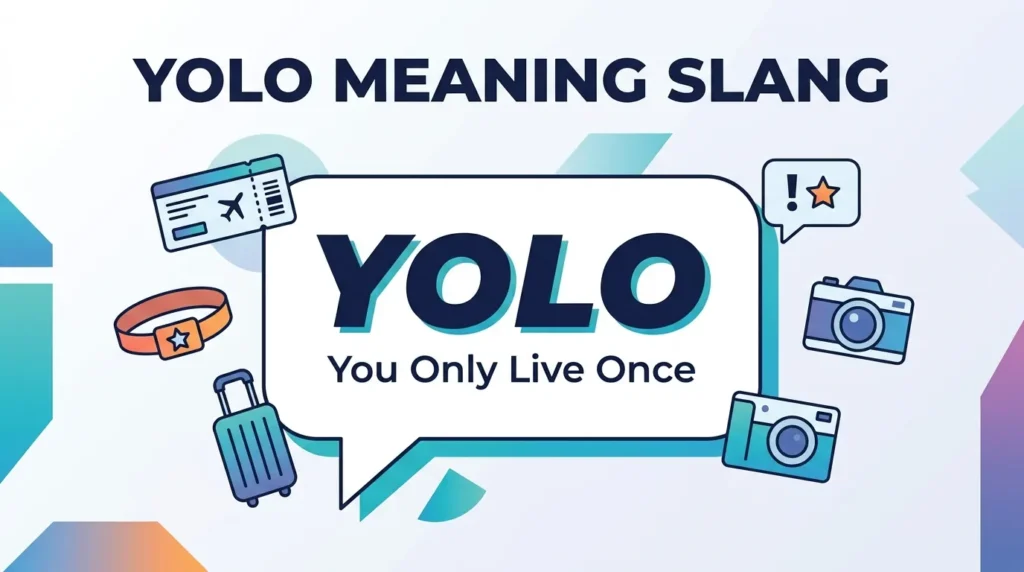

YOLO means “you only live once.” In slangiify, people use it to encourage a bold, fun, spontaneous, or slightly risky choice because life is short. It can be sincere, as in taking a once-in-a-lifetime trip, or playful, as in ordering dessert when you planned not to.
YOLO is common in casual speech, texts, captions, memes, and social media. The basic meaning usually stays the same across platforms, but the tone can change. Sometimes it means “go for it,” while other times it humorously admits, “This may not be my smartest decision.”
| Quick Answer | Meaning |
|---|---|
| Full form | You Only Live Once |
| Slang meaning | Enjoy the opportunity or take the chance because life is short |
| Typical context | Texting, social media, conversations, captions |
| Tone | Playful, encouraging, spontaneous, ironic |
| Formality | Very informal |
| Pronunciation | “YO-loh” |
| Offensive? | No, but context matters |
| Current status | Widely understood; sometimes used humorously or nostalgically |
What Does YOLO Mean in Slang?
YOLO is a short way of saying “you only live once.” People normally use it before or after doing something they consider exciting, unusual, impulsive, or outside their normal routine.
For example:
“I booked the last-minute flight. YOLO.”
The speaker knows the decision is spontaneous but is choosing the experience instead of overthinking it.
YOLO can also encourage another person:
“You’ve wanted to try surfing for years. YOLO, just do it.”
Here, it works more like “take the chance” or “go for it.”
The expression can sometimes be associated with reckless behavior, but it does not automatically mean doing something dangerous. Modern usage can cover anything from trying a new food to making a major life decision.
What Does YOLO Really Signal in a Conversation?
The literal words are simple, but YOLO often communicates more than “you only live once.”
It can signal that someone has decided to stop overthinking. A person may know there are reasons to hesitate but choose to act anyway.
“Should I finally ask her out?”
“YOLO.”
In that conversation, YOLO means something close to “You might as well try.”
It can also be a playful excuse for a small indulgence:
“I already had coffee, but I’m getting another one. YOLO.”
Nobody is seriously making a life philosophy out of a second coffee. The exaggerated use is part of the joke.
That distinction matters. YOLO can describe a genuine life-changing decision, but it is just as likely to appear after an ordinary choice that has been made to sound dramatic.
Quick Meaning of YOLO by Context
| Context | Likely Meaning | Example | Usage |
|---|---|---|---|
| Friends | Go for it | “Take the trip. YOLO.” | Very common |
| Text message | Stop overthinking | “I sent the message. YOLO.” | Common |
| Social caption | Enjoy the moment | “Last-minute road trip #YOLO” | Common |
| Shopping | Playful justification | “Bought the shoes. YOLO.” | Common |
| Risky decision | Accepting possible consequences | “I’m doing it anyway. YOLO.” | Context-dependent |
| Joke | Deliberately dramatic excuse | “Added extra cheese. YOLO.” | Common |
| Workplace | Casual risk-taking attitude | “We’re trying the new idea. YOLO.” | Informal |
The important clue is usually what the person is doing, not the word YOLO itself.
What Does YOLO Mean in Texting?
In a text, YOLO normally means one of three things:
“Go for it.”
“I’m doing it anyway.”
“This might be questionable, but it will be fun.”
For example:
Alex: “There are still concert tickets for tonight.”
Sam: “Buy them. YOLO.”
The reply encourages a spontaneous decision.
Another example:
Alex: “I just sent my crush that message.”
Sam: “No way 😭”
Alex: “YOLO.”
Here, YOLO is not advice. It is Alex jokingly accepting whatever happens next.
Emojis can make the tone clearer. “YOLO 😂” usually sounds more self-aware or humorous than a serious statement about taking a major life opportunity.
Also Read: PTSO Meaning Slang: What It Means in Text and TikTok
What Does YOLO Mean on TikTok, Instagram, Snapchat, and Other Apps?
YOLO generally keeps the same meaning across TikTok, Instagram, Snapchat, WhatsApp, Facebook, X, Reddit, Discord, and similar platforms.
The platform usually changes the format, not the definition.
On Instagram, someone might caption a spontaneous vacation photo:
“Booked it two days ago. YOLO.”
On TikTok, YOLO might appear in a video about making an impulsive decision, changing your appearance, traveling somewhere unexpected, or agreeing to an unusual experience.
On Snapchat or WhatsApp, it may simply be a one-word response:
“Should we go?”
“YOLO.”
Some younger internet users now use phrases such as “do it for the plot” in situations that older internet culture might have described as YOLO. The ideas overlap: both can encourage doing something memorable, unexpected, or outside your comfort zone. YOLO, however, remains widely recognizable even though it is strongly associated with early-2010s internet culture.
How Context Changes the Meaning of YOLO
YOLO does not have several completely different slang definitions. Instead, context changes the attitude behind the same basic idea.
YOLO as encouragement
“Apply for the job. YOLO.”
Meaning: You have an opportunity, so take your chance.
YOLO as self-justification
“I booked the expensive hotel. YOLO.”
Meaning: I know this choice may be unnecessary, but I decided the experience was worth it.
YOLO as humor
“I put hot sauce on my breakfast. YOLO.”
Meaning: The choice is so minor that using a dramatic life motto makes it funny.
YOLO as acceptance
“I already hit send. YOLO.”
Meaning: The decision cannot easily be undone, so I am accepting whatever happens.
YOLO as reckless reasoning
“Forget the rules. YOLO.”
Here the phrase can sound less harmless. YOLO does not remove real consequences, and the surrounding situation determines whether it sounds adventurous or irresponsible.
What Tone Does YOLO Have?
YOLO is usually casual and energetic, but its emotional tone varies.
It can sound encouraging when someone is nervous about trying something positive:
“You’ve always wanted to perform. YOLO.”
It can sound playful when used for a small indulgence:
“Ordered the large fries. YOLO.”
It can sound ironic when someone clearly knows their reasoning is weak:
“Stayed up until 3 a.m. watching videos. YOLO, I guess.”
It can even sound sarcastic if someone uses it to mock unnecessary risk-taking.
The literal meaning rarely changes. What changes is whether the speaker truly believes the philosophy or is using it as a joke.
Real Conversation Examples of YOLO
1. Trying something new
Mia: “I’ve never tried karaoke.”
Zoe: “YOLO. Pick a song.”
Here, YOLO means “give it a shot.”
2. Making a spontaneous plan
Chris: “Flights are cheap tonight.”
Jordan: “Book it. YOLO.”
It encourages spontaneity.
3. Sending a risky message
Nina: “I finally texted him first.”
Lena: “Bold.”
Nina: “YOLO 😂”
The term shows confidence mixed with nervous humor.
4. Spending money
Ryan: “Did you actually buy those sneakers?”
Ben: “Yep. YOLO.”
Ben is jokingly defending an unnecessary purchase.
5. Food
Emma: “You’re getting dessert too?”
Ava: “Absolutely. YOLO.”
This is deliberately low-stakes and playful.
6. Taking an opportunity
Leo: “I’m thinking about studying abroad for a semester.”
Max: “Do it. YOLO.”
Here, the expression has a more sincere “make the most of life” meaning.
7. Accepting a questionable choice
Kai: “I have work early tomorrow, but everyone is going out.”
Noah: “What are you doing?”
Kai: “Going. YOLO.”
The speaker recognizes that the decision has a downside.
Also Read: DTF Meaning Slang: What It Means in Text and Dating
How Is YOLO Pronounced?
YOLO is normally pronounced “YO-loh,” with two syllables.
People generally say it as a word rather than spelling out each letter.
The common American pronunciation sounds roughly like:
YOH-loh
Both YOLO and yolo can appear online. Uppercase is traditional because the word comes from the first letters of “You Only Live Once,” but lowercase is completely understandable in casual messages.
Is YOLO an Acronym?
Yes. YOLO is commonly treated as an acronym formed from “You Only Live Once.”
Unlike abbreviations such as “IDK,” which people commonly pronounce letter by letter, YOLO is normally spoken as a single word.
Its grammar is flexible in casual English.
It can work as an exclamation:
“YOLO!”
It can describe an attitude:
“That was a very YOLO decision.”
People may also jokingly turn it into forms such as:
“We were YOLOing all weekend.”
These playful forms are informal and are much more suitable for conversations or social media than formal writing.
How Should You Reply When Someone Says YOLO?
Your response depends on what the person is suggesting.
If the idea sounds fun and harmless, you could reply:
“Let’s do it.”
“I’m in.”
“Why not?”
“Okay, you convinced me.”
If someone says YOLO after already doing something:
“Fair enough 😂”
“No turning back now.”
“Respect the commitment.”
If the decision has serious consequences, you do not need to match their YOLO attitude. A better reply might be:
“Maybe think that one through first.”
YOLO is an expression, not an obligation to agree with somebody.
YOLO vs. Similar Slang and Expressions
| Term | Meaning | Main Difference |
|---|---|---|
| YOLO | You only live once | Encourages enjoying an opportunity or taking a chance |
| Do it for the plot | Do something interesting for the life experience | Newer internet framing that treats life like a story |
| FOMO | Fear of missing out | Describes anxiety about missing an experience |
| No regrets | Accept a decision without dwelling on it | Focuses more on what happens after the choice |
| Carpe diem | Seize the day | Older, more philosophical expression about making use of the present |
YOLO vs. “do it for the plot”
These are probably the closest modern equivalents.
“YOLO” focuses on the idea that you have one life.
“Do it for the plot” frames your life like a story and suggests that an unusual experience could make the story more interesting.
For example:
“Should I take a solo trip?”
Someone could answer either:
“YOLO.”
or
“Do it for the plot.”
The advice is similar even though the cultural framing is different.
YOLO vs. FOMO
YOLO and FOMO sometimes lead to similar behavior, but they describe different ideas.
YOLO: “I want to experience this while I can.”
FOMO: “I’m worried everyone else will experience this without me.”
YOLO is usually about opportunity. FOMO is about fear of missing an opportunity.
Who Uses YOLO?
YOLO became deeply connected with internet and youth culture during the early 2010s. It spread through music, hashtags, memes, social posts, everyday conversations, and merchandise.
It is still easy for English speakers across age groups to recognize, but it no longer feels like brand-new youth slang. Depending on the speaker, using YOLO today can sound completely natural, intentionally retro, nostalgic, or slightly ironic.
Newer expressions may fill a similar role among younger social-media users, but that has not changed YOLO’s established meaning. Contemporary usage still includes both sincere and humorous examples.
Also Read: Cyberpunk Slang Explained: Choom, Gonk, Preem and More
Where Did YOLO Come From?
The idea behind “you only live once” existed long before internet slang. The shortened form YOLO also appeared before it became a major pop-culture catchphrase.
Its huge rise in mainstream popularity is strongly connected with the early 2010s, especially Drake’s 2011 song “The Motto,” which helped turn YOLO into a widely recognized expression and internet catchphrase. The term quickly became associated with hashtags, memes, spontaneous behavior, and jokes about questionable decisions.
This distinction is important: Drake helped popularize YOLO, but the underlying phrase and even earlier uses of the shortened form existed before the song.
Over time, YOLO became flexible enough to work both sincerely and sarcastically. Someone could use it before taking a meaningful opportunity or simply while eating another slice of pizza.
Is YOLO Still Used Today?
Yes, YOLO is still understood and used, but its cultural position has changed.
During its peak, it felt like a defining piece of internet slang. Today it is more established. Some people use it normally, while others use it because its early-2010s vibe makes the sentence funnier.
For example:
“I’m buying the concert ticket. YOLO.”
could be completely sincere.
But:
“I used the fancy shampoo on a Tuesday. YOLO.”
is obviously playing with the dramatic reputation of the expression.
That ability to work both seriously and ironically has helped YOLO remain understandable even as newer slang has appeared.
Is YOLO Offensive or Rude?
YOLO itself is not a swear word, slur, insult, or offensive expression.
It is generally safe in ordinary casual conversation.
However, context can make it inappropriate.
Telling someone “YOLO” when they are discussing a dangerous activity can sound like you are dismissing legitimate safety concerns.
It can also feel insensitive in serious conversations involving death, grief, illness, financial trouble, or other situations where “you only live once” may sound careless.
In a workplace, YOLO is usually acceptable only when the culture is casual. It is less suitable for formal reports, legal documents, academic writing, or professional communication where precise language is expected.
Does YOLO Have Another Meaning Outside Slang?
Yes. There is one major alternate meaning that can cause confusion.
In computer vision and artificial intelligence, YOLO can mean “You Only Look Once.” It refers to a family of real-time object-detection approaches used to identify objects in images or video.
That meaning has nothing to do with the slang expression “you only live once.”
Context makes the difference obvious:
“YOLO, I booked the trip.”
Slang: You only live once.
“We trained a YOLO model to detect vehicles.”
Technology: You Only Look Once.
If the conversation involves machine learning, cameras, object detection, or AI models, the technical meaning is more likely.
What YOLO Means in Real-World Communication
YOLO often works less like a definition and more like a permission slip.
When someone says it, they may be giving themselves permission to stop analyzing every possible outcome and make a choice.
That is why it works for both serious opportunities and silly decisions. The situation may change, but the communication pattern remains similar:
There is a reason to hesitate → the person chooses action → “YOLO” explains the attitude.
The useful question is therefore not simply “What does YOLO stand for?” It is also “What choice is the speaker trying to justify or encourage?”
That context usually tells you whether YOLO is sincere motivation, harmless humor, irony, or genuinely reckless reasoning.
Frequently Asked Questions
What does YOLO mean in a text?
YOLO means “you only live once.” In a text, it usually encourages someone to take a chance, try something new, or stop overthinking. It can also be used after an impulsive decision as a humorous way of saying, “I already did it, so I’ll accept what happens.”
What does YOLO mean from a girl or guy?
The meaning does not change based on whether a girl or guy says it. YOLO still means “you only live once.” Look at the surrounding conversation instead. It could be encouragement, flirting, joking, or simply someone explaining why they decided to do something spontaneous.
What does YOLO mean on Snapchat?
On Snapchat, YOLO normally has the same slang meaning: “you only live once.” Someone may use it in a Snap, caption, or chat to describe a spontaneous activity or encourage a friend to do something fun. There is no separate standard Snapchat definition of the slang word.
Is YOLO positive or negative?
YOLO can be either. It can positively encourage someone to take a meaningful opportunity, travel, try something new, or stop letting unnecessary fear control a decision. It can become negative when used to excuse dangerous, irresponsible, or harmful behavior. The situation matters more than the expression itself.
Is YOLO outdated slang?
YOLO is no longer new slang, and it is strongly associated with early-2010s internet culture. However, it remains widely recognizable and still appears in casual conversation. Modern uses can be sincere, humorous, ironic, or intentionally nostalgic rather than an attempt to sound trendy.
What is the modern version of YOLO?
There is no exact official replacement, but “do it for the plot” often expresses a similar idea in newer internet slang. Both can encourage someone to take an interesting chance. YOLO emphasizes having one life, while “do it for the plot” treats unusual experiences as part of your personal story.
Does YOLO always mean doing something reckless?
No. YOLO can describe risky behavior, but it can also encourage harmless or positive opportunities. Someone might say YOLO before taking a dream vacation, trying karaoke, applying for a new job, or ordering dessert. The phrase itself does not specify how serious the risk is.
Conclusion
YOLO means “you only live once.” In slang, it usually encourages a person to enjoy an opportunity, try something spontaneous, take a chance, or stop overthinking. It can also jokingly justify a questionable or completely ordinary choice.
The key is tone. “YOLO” can express genuine confidence, playful impulsiveness, irony, or a slightly reckless attitude depending on what is happening around it. It means essentially the same thing in texts and across major social platforms. Although it is closely tied to early-2010s internet culture, it remains widely understood today.
Related Slang Terms
Explore more slang meanings from our dictionary:



Pingback: Truffle Butter Slang Meaning: Definition, Origin & Use
Pingback: British Slang Insults: 25 UK Insults and Meanings
Pingback: ASF Meaning Slang: What Does "ASF" Mean in Text and Online?