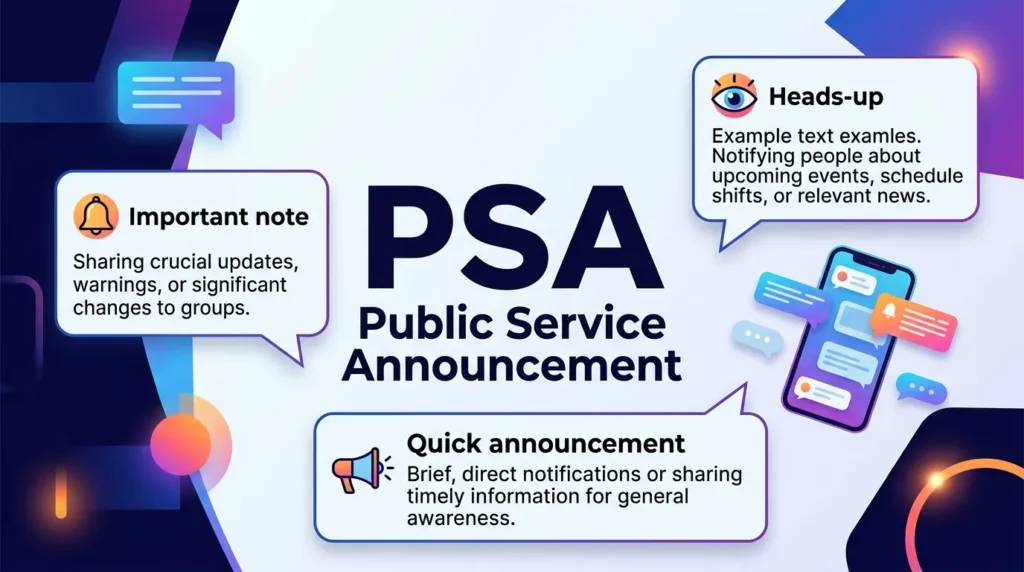

PSA most commonly stands for “Public Service Announcement.” In texting, group chats, and social media, people often use it more casually to introduce something they think others should know. In that setting, “PSA:” can mean something like “important note,” “heads-up,” or “everyone should know this.”
PSA is not limited to internet slang. It can still refer to a genuine public service announcement, while completely different meanings appear in medical and collectibles contexts. The words around PSA usually make the intended meaning easy to identify.
| Quick Answer | Meaning |
|---|---|
| Most common slang meaning | An important announcement, reminder, warning, or heads-up |
| Full form | Public Service Announcement |
| Common contexts | Texting, group chats, social media, forums, workplace chats |
| Tone | Serious, helpful, humorous, sarcastic, or dramatic |
| Formality | Usually informal when used as internet slang |
| Offensive? | No |
| Pronunciation | “P-S-A,” said letter by letter |
| Other meanings | Prostate-specific antigen; a grading/authentication name in collectibles contexts |
What Does PSA Mean in Slang?
In slang, PSA means “Public Service Announcement,” but people usually are not referring to an actual official announcement.
Instead, they put “PSA:” before a statement to make it sound important or worth everyone’s attention.
For example:
“PSA: The coffee shop closes at 6 tonight.”
The speaker is not broadcasting an official public announcement. They are simply saying:
“Heads-up, everyone. This is useful information.”
This casual use keeps the basic idea behind a public service announcement—sharing something people should know—but applies it to ordinary situations.
People may use PSA for:
- Warnings
- Helpful reminders
- Schedule changes
- Advice
- Recommendations
- Complaints
- Strong opinions
- Funny observations
- Rules they think others should follow
For example:
“PSA: Put your phone on silent before the movie starts.”
Here, PSA adds emphasis. The same sentence without PSA would sound like an ordinary instruction. Adding it makes the speaker sound as though they are addressing everyone.
Quick Meaning by Context
| Context | Likely Meaning | Example | Usage Level |
|---|---|---|---|
| Text message | Important note or heads-up | “PSA: Roads are icy tonight.” | Common |
| Group chat | Announcement for everyone | “PSA: We’re leaving at 8.” | Common |
| Social media | Advice, warning, opinion, or announcement | “PSA: Back up your photos.” | Common |
| Workplace chat | Group reminder or useful information | “PSA: The deadline moved to Friday.” | Context-dependent |
| Formal media | Public Service Announcement | “The station aired a safety PSA.” | Standard meaning |
| Medical discussion | Prostate-specific antigen | “His doctor discussed his PSA level.” | Medical |
| Trading cards | PSA grading/authentication context | “The card received a PSA 10.” | Collectibles-specific |
The surrounding topic is usually enough to distinguish the meanings.
What Does PSA Mean in Text Messages?
In texting, PSA usually signals:
“Pay attention to this because I think it is important.”
It can function much like heads-up, although PSA often sounds more public or dramatic.
Consider these examples:
“PSA: The parking lot behind the building is closed.”
This is practical information.
“PSA: Never order fries if you aren’t planning to share.”
This is probably playful rather than genuinely important.
“PSA: Please stop sending spoilers in the group chat.”
This sounds more serious and possibly annoyed.
The actual expansion remains Public Service Announcement, but the conversational function depends on tone.
What Does PSA Mean on Social Media?
On social media, PSA commonly introduces a message the poster wants many people to notice.
For example:
“PSA: Save your work before installing the update.”
“PSA: You do not need an expensive outfit to look good.”
“PSA: If you borrow something, return it.”
Online PSA posts can range from genuine safety reminders to opinions that are intentionally presented as if they were universal rules.
That exaggerated style is part of what makes PSA useful online. A person can make a completely ordinary opinion sound like an official announcement.
TikTok, Instagram, X, Facebook, and Similar Platforms
There is no strong reason to assign PSA a completely different slang definition on each major social platform. Its basic function remains largely the same: it introduces something the person considers worth announcing publicly.
The tone may change with the content.
A short video might say:
“PSA for anyone traveling this weekend…”
A humorous post might say:
“PSA: If I say I don’t want dessert, I am lying.”
A frustrated post could begin:
“PSA: Your headphones should not be audible from across the room.”
Same acronym, different emotional effect.
Also Read: FOMO Meaning in Text, Social Media, and Everyday Slang
How Context Changes the Meaning of PSA
PSA is easy to understand once you look at what comes after it.
1. Practical Information
“PSA: The store moved to the other side of the mall.”
Meaning: Useful information you should know.
2. Warning
“PSA: That road floods quickly during heavy rain.”
Meaning: Pay attention because this could affect you.
3. Reminder
“PSA: Applications close tonight.”
Meaning: Do not forget this.
4. Personal Opinion
“PSA: Pineapple absolutely belongs on pizza.”
Meaning: Here is my opinion, presented dramatically.
The statement is not actually a matter of public safety.
5. Frustrated Request
“PSA: Clean up after yourself in the kitchen.”
Meaning: I am annoyed and want people to change their behavior.
This is where PSA can sound passive-aggressive even though the acronym itself is harmless.
Tone and Emotional Meaning of PSA
PSA does not have one emotional tone.
Helpful
“PSA: Student discounts are available at the front desk.”
The sender simply wants to help.
Serious
“PSA: Do not drive through flooded roads.”
Here, PSA emphasizes a warning.
Playful
“PSA: Homemade cookies count as breakfast.”
Nobody is expected to interpret this as an official announcement.
Sarcastic
“PSA: Apparently turning your alarm off means you will not wake up.”
The speaker is joking about something obvious.
Annoyed
“PSA: Your coworkers can hear videos playing from your phone.”
The literal message may be useful, but its tone can imply criticism.
The important distinction is that PSA itself is neutral. The sentence following it creates the attitude.
Real Conversation Examples
Friends
Maya: PSA: We need to leave by 7 if we want good seats.
Chris: Got it. I’ll be ready.
Here, PSA means heads-up.
Family Group Chat
Dad: PSA: Grandma’s dinner starts at 5, not 6.
Emma: Thanks for telling us.
It introduces an important correction.
School
Jordan: PSA for everyone in biology: the assignment is due tonight.
Sam: I completely forgot. Thanks.
The meaning is a helpful reminder.
Work
Alex: PSA: The client meeting moved to Conference Room B.
Taylor: Thanks!
This is informal workplace usage.
Social Media
Post: PSA: Take pictures of your apartment before moving in.
The person is presenting practical advice as something many people should know.
Humor
Friend: PSA: Never trust me when I say I’m only taking one slice of pizza.
You: We learned that years ago.
Here, PSA makes a joke sound more dramatic.
Mild Frustration
Roommate: PSA: Empty milk cartons do not belong back in the fridge.
The sender is clearly making a point rather than simply sharing information.
Grammar and Language Role
PSA is an initialism, meaning each letter is normally pronounced separately:
P-S-A
It stands for Public Service Announcement in its standard and slang-derived use.
In online writing, it often appears at the beginning of a sentence followed by a colon:
“PSA: Check the weather before you leave.”
Uppercase PSA is the clearest spelling, although lowercase psa can appear in casual messages.
It usually functions as a short introductory label rather than as a complete reply.
For example:
Natural: “PSA: The restaurant is cash only.”
Less natural:
“Are you coming tonight?”
“PSA.”
Without additional context, PSA alone usually does not communicate enough information.
Also Read: Snow Bunny Meaning: Dating, Skiing, and Slang Explained
How to Reply to a PSA
You normally respond to the message itself rather than to the acronym.
For Helpful Information
- “Thanks for the heads-up.”
- “Good to know.”
- “Thanks for letting me know.”
- “I didn’t know that.”
For a Reminder
- “Thanks, I almost forgot.”
- “Got it.”
- “Already on it.”
For Advice
- “That’s actually a good tip.”
- “I’ll keep that in mind.”
- “Good point.”
For a Funny PSA
- “Important information 😂”
- “Finally, someone said it.”
- “This PSA was necessary.”
For a Workplace Announcement
Keep the response straightforward:
- “Thanks for the update.”
- “Received.”
- “I’ll make the change.”
- “Thanks, I’ve updated my calendar.”
PSA vs. Similar Terms
| Term | Meaning | Main Difference | Typical Context |
|---|---|---|---|
| PSA | Important announcement or heads-up | Sounds like a message meant for everyone | Social posts, groups, chats |
| FYI | For your information | More neutral and often directed at specific people | Texting and work |
| PS | Postscript | Adds something after the main message | Emails and writing |
| BTW | By the way | Introduces an extra or side point | Casual conversation |
| ICYMI | In case you missed it | Repeats or highlights previously available information | Social media |
| Heads-up | Advance warning or notice | More conversational and personal | Everyday speech and texting |
PSA vs. FYI
FYI simply tells someone information.
PSA tends to make that information sound broader or more important.
Compare:
“FYI, the library closes early today.”
This sounds like information being given to one person.
“PSA: The library closes early today.”
This sounds more like an announcement for everyone who might be affected.
PSA vs. PS
These abbreviations are easy to confuse visually but mean completely different things.
PSA = Public Service Announcement
PS = Postscript
A PS usually appears at the end of a letter, email, or message to add one more thought.
Who Uses PSA?
PSA is widely understandable in American English because its standard meaning existed before its casual internet use.
Online, it is especially useful in public posts, group conversations, forums, community spaces, and other situations where someone wants to address several people at once.
It is not exclusively tied to one generation or one social network. The style of the message matters more than the user’s age.
Where Did PSA Come From?
The casual internet use grows naturally from the established phrase public service announcement, which refers to a message intended to provide information in the public interest. The abbreviation was already associated with announcements on television, radio, and later online media before people began using it more loosely in everyday digital communication.
Online speakers then extended the idea.
Instead of requiring an actual public-awareness campaign, someone could write:
“PSA: Do not microwave fish in the office.”
The humor comes partly from treating a small everyday complaint like an important public announcement.
That broader conversational use remains easy to understand because it preserves the original concept: one person announcing something they believe everyone should hear.
Also Read: What Does POS Mean in Slang, Texting, and Social Media?
Is PSA Offensive, Rude, or Inappropriate?
PSA is not inherently offensive, vulgar, or rude.
You can generally use it safely in everyday conversation.
However, the statement after PSA can make the message sound:
- Bossy
- Sarcastic
- Judgmental
- Passive-aggressive
- Condescending
For example:
“PSA: People need to learn how to drive.”
This clearly sounds irritated.
At work, PSA is usually best reserved for casual internal communication. In a formal report, policy, client letter, or official announcement, writing out the actual message normally sounds more professional.
Other Genuine Meanings of PSA
The slang meaning is not the only meaning you may encounter.
PSA as an Actual Public Service Announcement
The original expansion is Public Service Announcement.
A real PSA is a message intended to inform the public about an issue, often involving public awareness, health, safety, or socially useful information.
Example:
“The station aired a PSA about emergency preparedness.”
This is the literal meaning rather than slang.
PSA in Medical Contexts
In medicine, PSA means prostate-specific antigen, a protein associated with the prostate. A PSA blood test measures the level of this antigen in the blood and may be discussed in relation to prostate health and prostate cancer screening or monitoring.
Example:
“My doctor discussed my PSA test results.”
If you see words such as blood test, prostate, doctor, level, screening, or lab results, the medical meaning is much more likely than internet slang.
A PSA result should be interpreted in its medical context rather than treated as a slang abbreviation.
PSA in Trading Cards and Collectibles
In card collecting, PSA can refer to a professional authentication and grading system. You may therefore see expressions such as PSA 10, which indicates a top-grade collectible under that grading scale.
Example:
“He bought a PSA 10 version of the card.”
In this sentence, PSA has nothing to do with an announcement.
Words such as card, grade, slab, collectible, mint, Pokémon, sports card, or a number after PSA usually signal the collectibles meaning.
Does PSA Mean “Personal Self Advice”?
You may occasionally encounter claims that PSA can expand to phrases such as “personal self advice.” That interpretation is not a broadly established meaning and should not be assumed when reading ordinary texts or social media posts. The overwhelmingly clearer interpretation in casual online communication remains the announcement-style use derived from Public Service Announcement.
Real-World Interpretation
The most useful way to understand PSA online is to treat it as an attention signal, not merely an acronym.
When someone begins with:
“PSA:”
they are telling the audience:
“I want everyone to pay attention to what comes next.”
Whether the following message is truly important, mildly useful, sarcastic, or completely ridiculous depends on the speaker.
That is why translating PSA simply as “Public Service Announcement” sometimes misses the social meaning. In conversation, “heads-up for everyone” often captures the intended effect better.
Also Read: What Does Huzz Mean in Slang? Meaning, Use & Examples
Frequently Asked Questions
What does PSA mean in slang?
PSA stands for Public Service Announcement. In slang and online conversation, people use it before an important note, reminder, warning, opinion, or piece of advice. It often functions like saying “heads-up, everyone” rather than referring to an actual official announcement.
What does PSA mean in a text message?
In a text, PSA usually means that the sender wants you or a group to pay attention to the next statement. For example, “PSA: We’re meeting at 7 instead of 8” simply means there is an important update everyone should know.
Does PSA mean something different on TikTok or Instagram?
Usually not. On major social platforms, PSA generally keeps the same announcement-style meaning. A creator may use it for advice, warnings, opinions, reminders, or humor. The tone and subject change, but there is no need to assume a separate definition for every platform.
Is PSA rude?
PSA itself is not rude or offensive. However, it can introduce a rude, sarcastic, or passive-aggressive statement. “PSA: The event starts at 8” is neutral, while “PSA: Learn some manners” sounds confrontational because of the words following the acronym.
Is PSA the same as FYI?
Not exactly. FYI means “for your information” and usually sounds neutral. PSA often has more emphasis and can make the message sound like an announcement intended for a larger audience. Both can introduce useful information, but PSA tends to attract more attention.
What does PSA mean medically?
In medical contexts, PSA stands for prostate-specific antigen. A PSA test measures its level in the blood and may be used as part of prostate-health evaluation. Medical PSA should not be confused with the internet slang meaning.
What does PSA 10 mean?
In trading-card and collectibles discussions, PSA 10 refers to the highest grade on that particular professional grading scale and is associated with a virtually perfect or Gem Mint collectible. This usage is unrelated to “Public Service Announcement.”
Conclusion
The most common PSA meaning in slang is “Public Service Announcement,” but online it usually works as a casual signal for “important note,” “heads-up,” or “everyone should know this.” People can use it seriously for warnings and reminders or jokingly to make an ordinary opinion sound official.
Context makes the meaning clear. If PSA introduces a social post or group message, the announcement meaning is usually intended. If the conversation involves blood tests or prostate health, it is medical. If it involves graded trading cards, it belongs to the collectibles world.


Pingback: DSL Meaning Slang: What It Means in Text and Online
Pingback: 90s Slang: Popular Words and Phrases From the 1990s
Pingback: Bop Slang Meaning: Song, Person, and Text Uses