
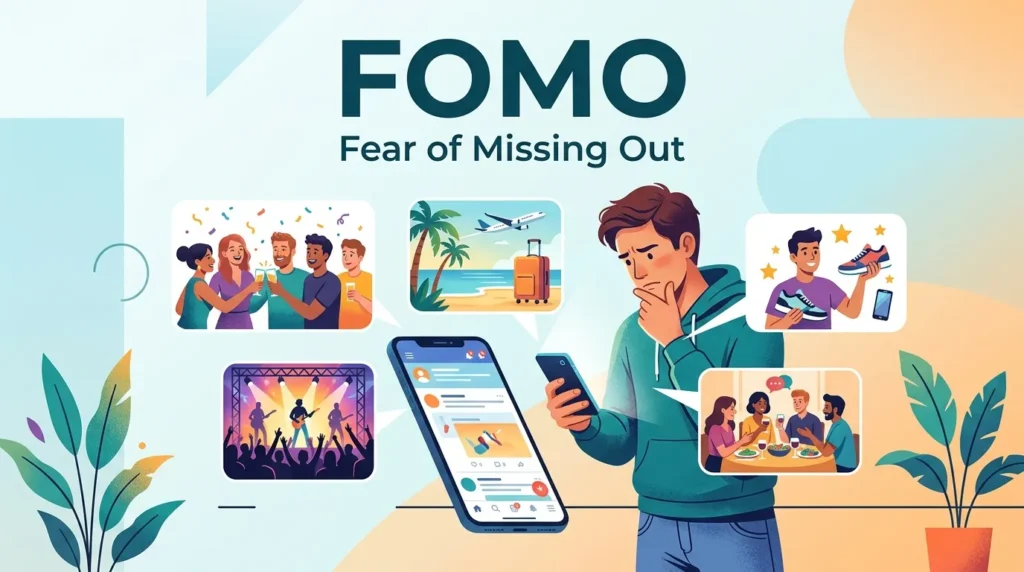

FOMO stands for “fear of missing out.” In slang, texting, and everyday conversation, it describes the uneasy feeling that other people are doing something fun, exciting, valuable, or important without you. Someone might say they have FOMO after seeing friends at a party, a popular event, or an experience they could not join.
The meaning stays mostly the same across text messages and social platforms. Context can change what someone fears missing, however. FOMO can involve social plans, trends, travel, purchases, opportunities, gaming, or even investments. In most cases, there is no special TikTok, Snapchat, Instagram, or WhatsApp definition.
Quick Answer
| Question | Answer |
|---|---|
| FOMO full form | Fear of missing out |
| Simple meaning | Worry that others are enjoying or gaining something you are missing |
| Typical context | Texting, social media, conversations, events, shopping, trends |
| Tone | Usually casual; can be playful or genuinely anxious |
| Formality | Informal |
| Pronunciation | “FOH-moh” |
| Offensive? | No |
| Common spelling | FOMO, sometimes fomo or FoMO |
| Part of speech | Usually a noun |
What Does FOMO Mean?
FOMO means fear of missing out, particularly the feeling that something desirable is happening elsewhere and you are not part of it. It often involves comparing your current situation with what other people appear to be experiencing.
For example:
“Everyone is going to the concert tonight, and now I have major FOMO.”
The person is not literally afraid of the concert. They feel uncomfortable because their friends will share an experience without them.
FOMO can be serious, but people also use the word casually. Someone may say “the FOMO is real” simply because photos of a restaurant, vacation, game, or party look especially appealing.
FOMO Usually Describes a Feeling, Not an Event
This distinction makes the slang easier to understand.
The event itself is not FOMO. Your reaction to possibly missing the event is FOMO.
For example:
“That festival is giving me FOMO.”
The festival creates the feeling.
“I have FOMO because I skipped the festival.”
The speaker is describing the feeling directly.
Quick FOMO Meaning by Context
| Context | What FOMO Usually Means | Example | Usage Level |
|---|---|---|---|
| Text messages | Feeling left out or afraid of missing something | “You guys are giving me FOMO.” | Very common |
| Social media | Feeling that others are having better experiences | “These vacation posts are giving me FOMO.” | Very common |
| Parties and events | Regretting not attending | “I almost stayed home, but FOMO won.” | Common |
| Trends | Wanting to participate before a trend passes | “I bought one because of FOMO.” | Common |
| Shopping | Feeling pressure to buy before an item or deal disappears | “That limited drop creates serious FOMO.” | Common |
| Gaming | Worrying about missing rewards, events, updates, or activities | “I logged in because of FOMO.” | Common |
| Investing | Feeling pressure to buy because others appear to be profiting | “He bought after the price jumped because of FOMO.” | Common |
In investing, the acronym still means fear of missing out. It does not have a separate financial expansion. The difference is simply what someone fears missing: instead of a social experience, it may be a possible profit or rapidly rising investment. Acting purely from this pressure can encourage impulsive decisions.
What Does FOMO Mean in Text?
In a text message, FOMO almost always means “fear of missing out.”
Someone may use it because they:
- feel left out
- regret declining an invitation
- want to join a group activity
- are tempted by something friends are doing
- feel pressure to participate before an opportunity disappears
Examples include:
“Send pictures, but you’re definitely giving me FOMO 😭.”
“I wasn’t going to go, but the FOMO got me.”
“Seeing everyone there is giving me serious FOMO.”
The exact emotion depends on the conversation. The first message may be playful, while the third could express genuine disappointment.
Also Read: Mexican Slang: Common Words, Meanings, and How to Use Them
What Does FOMO Mean on Social Media?
FOMO has essentially the same meaning on TikTok, Instagram, Snapchat, Facebook, X, Reddit, Discord, and similar platforms: fear that you are missing an enjoyable, rewarding, interesting, or important experience. Social media is especially associated with the concept because people can constantly see selected moments from other people’s lives.
A person might see:
- friends at an event
- vacation photos
- a viral restaurant
- concert clips
- a trending product
- a limited release
- people participating in a challenge
and respond:
“This is giving me FOMO.”
That does not mean the platform has changed the acronym. The platform simply provides the situation that produces the feeling.
How Context Changes the Feeling Behind FOMO
The definition of FOMO is unusually consistent. What changes is its intensity and emotional purpose.
Playful FOMO
“Stop posting food pics. The FOMO is killing me 😂.”
This is usually exaggeration. The person probably finds the situation tempting rather than genuinely distressing.
Social FOMO
“I should’ve gone with you guys. I have FOMO now.”
Here, the speaker regrets missing a shared experience.
Trend FOMO
“I don’t even need it, but everyone has one and the FOMO is getting me.”
The person feels pressure to participate because something appears popular.
Opportunity FOMO
“I don’t want to say yes just because of FOMO.”
Here, the speaker recognizes that fear of missing an opportunity may be affecting their judgment.
Investing FOMO
“The price kept rising, so people started buying from FOMO.”
In market conversations, FOMO often describes emotional pressure to join a rapidly moving trend because others appear to be benefiting from it. The underlying meaning remains fear of missing out.
Tone and Emotional Meaning of FOMO
FOMO does not automatically mean someone is extremely anxious.
In everyday language, its emotional strength ranges from mild temptation to genuine worry.
Playful:
“Those pizza pictures are giving me FOMO.”
Regretful:
“I can’t believe I skipped that trip. Serious FOMO.”
Excited:
“Everyone’s going, and my FOMO is telling me to buy a ticket.”
Self-aware:
“I think I only want it because of FOMO.”
Concerned:
“I keep checking what everyone is doing because I hate feeling like I’m missing something.”
The surrounding sentence usually tells you whether the person is joking or describing a stronger emotion.
Real Conversation Examples of FOMO
Friends
Maya: “We’re all going downtown tonight.”
Alex: “I was planning to stay home, but now I have FOMO.”
Alex is reconsidering because everyone else is going.
Social Media
Chris: “Did you see everyone’s beach pictures?”
Jordan: “Yes. Instant FOMO.”
Jordan wishes they were having a similar experience.
Dating
Sam: “Why did you agree to another date if you’re unsure about them?”
Taylor: “Maybe FOMO. I keep wondering if I’ll regret not giving it another chance.”
Here, FOMO involves potentially missing an opportunity rather than an event.
Shopping
Jamie: “Do you actually want those shoes?”
Morgan: “I don’t know. They’re almost sold out, so it might just be FOMO.”
Scarcity is creating pressure to buy.
Gaming
Eli: “Why are you logging in every day?”
Noah: “There’s a limited event. FOMO got me.”
The player does not want to miss temporary content or rewards.
Work
Priya: “You don’t have to join every optional meeting.”
Ben: “I know. I get FOMO when decisions are being discussed.”
Here, the word is still informal, but the concern involves missing useful information.
Also Read: New York Slang: 30 NYC Words and Phrases Explained
Grammar, Pronunciation, and Capitalization
FOMO is an acronym formed from fear of missing out. In ordinary English, it functions mainly as a noun. Current dictionary usage classifies it as informal and pronounces it approximately “FOH-moh.”
Common constructions include:
“I have FOMO.”
“That gives me FOMO.”
“My FOMO kicked in.”
“FOMO made me go.”
“I bought it because of FOMO.”
Uppercase FOMO is the clearest and most conventional spelling, although lowercase fomo appears naturally in casual digital communication. FoMO may also appear, particularly when writers visually distinguish the words “fear” and “missing out.”
You normally say the acronym as a word rather than pronouncing each letter separately.
How to Reply When Someone Says They Have FOMO
Your response should match the seriousness of the conversation.
Friendly
“Come with us next time!”
“We definitely missed you.”
Reassuring
“Don’t worry, there’ll be another chance.”
“It looked fun, but you didn’t miss your only opportunity.”
Playful
“The FOMO worked. See you there 😂.”
“That’s exactly why you should’ve come!”
When Someone Feels Pressured
“Don’t do it only because everyone else is.”
“If you actually want to go, go. If it’s just FOMO, you can skip it.”
The most natural reply depends less on the acronym and more on why the person feels they are missing out.
Similar and Commonly Confused Terms
| Term | Meaning | Main Difference | Typical Context |
|---|---|---|---|
| FOMO | Fear of missing out | Worry about missing an experience or opportunity | Social life, trends, shopping, investing |
| JOMO | Joy of missing out | Enjoying the choice not to participate | Digital well-being, lifestyle |
| FOBO | Fear of a better option | Difficulty choosing because something better might appear | Decisions, careers, relationships |
| YOLO | You only live once | Encouragement to take a chance or enjoy an experience | Casual conversation, risk-taking |
| Jealousy | Concern or resentment involving something valued | Broader emotion that does not require missing out | Relationships, possessions, status |
| Envy | Wanting something another person has | Focuses on another person’s advantage | Success, possessions, experiences |
FOMO vs. JOMO
JOMO, or “joy of missing out,” is commonly used as the opposite idea.
FOMO says:
“Everyone is going. Maybe I’m missing something.”
JOMO says:
“Everyone is going, but I’m perfectly happy staying home.”
FOMO vs. YOLO
The two can influence the same decision, but they mean different things.
FOMO focuses on what you might miss.
YOLO focuses on the idea that life is limited, so you might as well do something.
Someone could even say:
“FOMO got me thinking about the trip, then YOLO made me book it.”
FOMO vs. Jealousy
They can overlap, but FOMO is more specific.
You can envy someone’s new car without wanting to participate in anything.
FOMO usually involves the feeling that you are outside an experience, opportunity, trend, or activity that others are enjoying.
Who Uses the Term FOMO?
FOMO is widely understood beyond any single age group or social platform. Although it became strongly associated with internet and social-media culture, it now appears in ordinary conversations about entertainment, travel, shopping, work, technology, gaming, and investing.
That makes FOMO different from slang that belongs mainly to one platform or generation. It can appear in a teenager’s group chat, an adult conversation about travel plans, a marketing discussion, or a conversation about investing without changing its basic definition.
Also Read: Snow Bunny Meaning: Dating, Skiing, and Slang Explained
Origin and Evolution of FOMO
The acronym FOMO is commonly traced to a 2004 business-school article in which it was used for “fear of missing out.” The expression later became much more widespread as online communication and social media made it increasingly easy to see what other people were doing in real time.
The concept itself is broader than social media. People could obviously worry about missing events or opportunities before smartphones existed. What digital culture helped popularize was a short, memorable label for that feeling.
Today, FOMO is no longer limited to social situations. People apply it to products, entertainment, travel, career opportunities, games, investments, and other situations where perceived scarcity or other people’s participation creates pressure to act.
Is FOMO Offensive, Rude, or Inappropriate?
No. FOMO is not a swear word, insult, slur, or inherently offensive expression.
It is generally safe to use around friends, family, classmates, and coworkers.
The main issue is formality, not offensiveness.
In a casual work message, a sentence such as:
“I joined because I had a little FOMO.”
can sound perfectly natural.
In highly formal writing, spelling out fear of missing out the first time may be clearer.
It can also be insensitive to dismiss someone’s genuine emotional distress by saying they are “just having FOMO.” The word itself is harmless, but tone still matters.
Is FOMO a Mental Health Diagnosis?
No. In everyday slang, FOMO describes a feeling or experience rather than serving as a clinical diagnosis. The concept has also been studied in psychology, particularly in connection with the desire to remain connected to what other people are doing, but casual use of “I have FOMO” does not by itself indicate a mental health condition.
Someone saying:
“I have FOMO because my friends went out tonight.”
is normally just describing how they feel.
Real-World Interpretation: FOMO Often Explains the Reason Behind a Choice
One useful thing about FOMO is that people often use it not merely to name an emotion, but to explain why they acted.
Compare:
“I wanted the tickets.”
with:
“I bought the tickets because of FOMO.”
The second sentence suggests the person’s decision was influenced by seeing other people participate, worrying about scarcity, or imagining future regret.
That makes FOMO especially useful when discussing impulsive decisions. It communicates both the desire for something and the social or emotional pressure surrounding that desire.
Also Read: Goyim Slang Meaning: What Does Goyim Mean?
Frequently Asked Questions
What does FOMO stand for in slang?
FOMO stands for fear of missing out. It describes the feeling that other people may be enjoying an experience, opportunity, trend, or activity that you are not part of. People commonly use it in texts, social media posts, and casual conversations.
What does FOMO mean in texting?
In texting, FOMO means fear of missing out. Someone may say “I have FOMO” when they regret skipping an event, wish they were with friends, or feel tempted to participate because everyone else seems to be doing something interesting.
What does FOMO mean on TikTok or Instagram?
It normally has the standard meaning: fear of missing out. A person might experience FOMO after seeing videos or photos of parties, trips, concerts, trends, restaurants, products, or other experiences. There is no major separate TikTok or Instagram expansion of the acronym.
Is FOMO positive or negative?
FOMO usually describes an uncomfortable feeling, so its basic emotional meaning is negative. However, people frequently use the word humorously or lightly. “Those vacation pictures are giving me FOMO” may simply mean the vacation looks appealing rather than that the speaker is seriously upset.
Is FOMO a Gen Z slang term?
FOMO is common in modern digital conversation, including among younger users, but it is not exclusive to Gen Z. The acronym appeared before today’s major social-media culture developed and has become widely understood across age groups and contexts.
What is the opposite of FOMO?
A common opposite expression is JOMO, meaning “joy of missing out.” JOMO describes feeling comfortable or happy about choosing not to participate instead of worrying that other people are having a better experience.
Can FOMO be used about money or investing?
Yes. In investing, FOMO still means fear of missing out. It usually describes the urge to buy or follow a rapidly rising investment because someone worries that other people will profit while they miss the opportunity. Financial regulators specifically warn against allowing this kind of pressure to replace careful decision-making.
How do you use FOMO in a sentence?
Natural examples include “I have FOMO,” “Those pictures are giving me FOMO,” “I went because of FOMO,” and “Don’t buy it just because you have FOMO.” The term normally functions as a noun describing the feeling or motivation behind someone’s reaction.
Conclusion
FOMO means “fear of missing out.” In slang, texting, and social media, it describes the uncomfortable or tempting feeling that other people are experiencing something enjoyable, valuable, or important without you. The definition remains largely consistent across platforms, although the situation can range from parties and vacations to shopping, gaming, work, and investing.
FOMO is informal but not offensive, and people use it both seriously and jokingly. When you see the term in a message, look at what the person thinks they may be missing. That context usually tells you exactly how strongly they mean it.


Pingback: PSA Meaning Slang: What Does PSA Mean in Text and Online?
Pingback: 90s Slang: Popular Words and Phrases From the 1990s
Pingback: Tweaking Meaning Slang: Definition, Uses & Examples
Pingback: ATM Meaning Slang: What Does "ATM" Mean in Text and Online?