
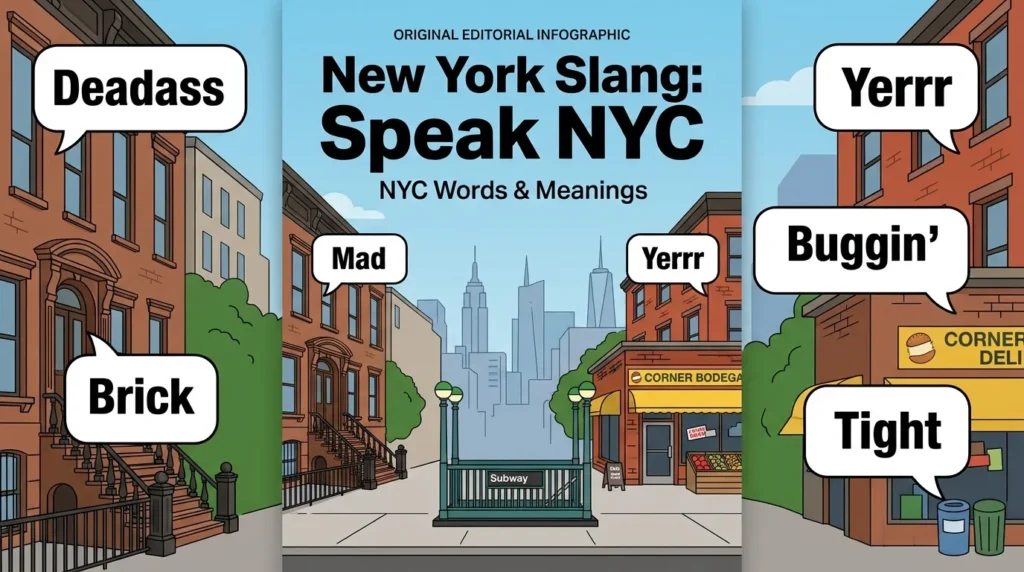

New York slang usually refers to informal words and expressions associated with New York City, especially terms such as deadass, brick, mad, yerrr, tight, and buggin’. Some are strongly associated with NYC, while others have spread into mainstream American speech, hip-hop, and internet culture.
There is no single vocabulary spoken by every New Yorker. Age, borough, community, social group, and situation all matter. Some expressions commonly placed on “NYC slang” lists—such as bodega, stoop, and hero—are better understood as local vocabulary rather than slang. That distinction helps you sound more natural and avoid treating New York speech like a costume.
| Quick Answer | Details |
|---|---|
| What is New York slang? | Informal vocabulary strongly associated with NYC speech and culture |
| Classic examples | deadass, mad, brick, tight, buggin’, yerrr |
| Typical context | Friends, casual conversation, music, social media, street conversation |
| Tone | Casual, expressive, playful, emphatic, or confrontational depending on context |
| Formality | Mostly informal |
| Is it offensive? | Most terms are not inherently offensive, but tone and familiarity matter |
| Does everyone in New York use it? | No. Usage varies by age, community, neighborhood, and social setting |
| Is all NYC vocabulary slang? | No. Words such as bodega and stoop are local vocabulary rather than pure slang |
What Is New York Slang?
New York slang is informal vocabulary associated with everyday speech in New York City and the surrounding metropolitan culture. It should not be confused with the entire New York accent or with one single dialect.
New York City contains many overlapping ways of speaking. Regional New York English exists alongside African American English, New York Latino English, immigrant-language influences, hip-hop vocabulary, and other community-based speech patterns. As a result, what sounds completely normal in one group may sound old-fashioned, unfamiliar, or forced in another.
The phrase “New York slang” also usually means NYC slang, not expressions used uniformly throughout New York State. Upstate New York has its own regional speech patterns and should not automatically be treated as linguistically identical to the five boroughs.
Quick List of Popular New York Slang Terms
| Slang Term | Simple Meaning | Tone | Usage Warning |
|---|---|---|---|
| Deadass | Seriously; for real | Emphatic | Very informal |
| Mad | Very; extremely | Neutral/casual | Meaning depends on placement |
| Brick | Extremely cold | Casual | Usually refers to weather |
| Buggin’ | Acting irrationally or doing too much | Critical/playful | Can sound confrontational |
| Tight | Angry or upset | Casual | Has several other English meanings |
| Yerr / Yurrr | Hey; what’s up | Energetic | Strongly casual |
| Word / Word up | True; agreed; really? | Casual | Meaning depends on intonation |
| Facts | I agree; that’s true | Affirming | Now widespread beyond NYC |
| Bet | Okay; agreed; sure | Casual | Widespread American slang |
| OD / Odee | Excessive; extremely; doing too much | Emphatic | Context-sensitive |
| Jacking | Supporting, liking, accepting, or claiming | Casual | NYC meaning may confuse outsiders |
| Dub | Reject, cancel, skip, or dismiss | Casual | Elsewhere dub can mean a win |
| Brolic | Very muscular or physically imposing | Descriptive | Informal |
| Son | Friend, guy, or familiar form of address | Familiar | Can sound strange from outsiders |
| B | Familiar way to address someone | Familiar | Tone can make it friendly or aggressive |
| Wack | Bad, lame, or low quality | Negative | Broader than NYC |
| Cop | Get or buy something | Casual | Broader hip-hop slang |
| Whip | Car | Casual | Widespread slang |
| Bag | Get or secure something | Casual | Meaning varies widely |
| On deck | Ready, available, or coming next | Casual | Meaning changes by context |
| Bodega | Neighborhood convenience store | Neutral | Local vocabulary, not strictly slang |
| Stoop | Front steps of a building | Neutral | Local/regional vocabulary |
| Hero | Long sandwich | Neutral | Regional food term |
| Schmear | Spread, especially cream cheese | Casual | Strong food association |
| Schlep | Carry something or make a tiring trip | Casual | Not uniquely NYC |
| Schvitz | Sweat | Playful/casual | Older cultural flavor |
| The City | Often Manhattan in local conversation | Neutral | Depends on speaker and context |
| The train | The subway in everyday NYC context | Neutral | Local shorthand |
| Chopped cheese | NYC-style chopped beef-and-cheese sandwich | Neutral | Food term, not true slang |
| Bridge-and-tunnel | Dismissive label for people coming into Manhattan from elsewhere | Negative/dated | Can sound snobbish |
The strongest NYC associations on this list are not equally strong. Deadass, brick, brolic, yerrr, the local sense of tight, and uses of OD are especially useful for understanding NYC speech, while expressions such as bet, wack, facts, and whip are now much broader American slang.
Also Read: Spanish Slang: Common Words, Meanings, and Regional Differences
Popular New York Slang Words and Meanings
Deadass
Meaning: Seriously, genuinely, honestly, or “for real.”
Deadass is one of the clearest examples of slang strongly associated with modern New York speech. It can strengthen a statement or work as a question.
Example:
“Deadass, I thought the train was never coming.”
That means:
“Seriously, I thought the train was never coming.”
You can also ask:
“You deadass?”
That usually means:
“Are you serious?”
The term has spread well beyond New York, so hearing it today does not automatically mean the speaker is a New Yorker. Its strong NYC association remains, however.
Mad
Meaning: Very, extremely, or a lot.
In New York-style usage, mad often works as an intensifier rather than meaning “angry.”
Examples:
“That pizza was mad good.”
= That pizza was really good.
“It’s mad crowded.”
= It’s extremely crowded.
“He got mad respect.”
= He gets a lot of respect.
The sentence structure usually tells you which meaning applies.
“I’m mad at him” means angry.
“That place is mad expensive” means very expensive.
Brick
Meaning: Extremely cold, especially outside.
Example:
“Yo, it’s brick outside.”
That simply means the weather is freezing.
You may also hear:
“It’s mad brick.”
Here, mad intensifies brick, producing something close to “It’s seriously freezing.”
Brick is particularly recognizable as New York-area slang for cold weather.
Buggin’
Meaning: Acting irrationally, overreacting, being unreasonable, or doing something ridiculous.
Example:
“You want me to walk twenty blocks in this weather? You buggin’.”
The speaker is essentially saying:
“That idea is ridiculous.”
Tone matters. Between friends, it can be playful. During an argument, it can sound much sharper.
The expression has existed outside New York as well and has become increasingly familiar in broader American slang.
Tight
Meaning in common NYC slang: Angry, irritated, disappointed, or upset.
Example:
“I missed the last train. I’m tight.”
Here, tight does not mean physically snug.
It means the person is annoyed about what happened.
You might also hear:
“That got me tight.”
Meaning:
“That made me mad.”
English already gives tight several unrelated meanings, including close friendship and limited money, so context is essential.
Yerr / Yurrr / Yerrr
Meaning: A greeting, attention-getter, acknowledgment, or energetic version of “what’s up?”
Example:
Person A: “Yerrrr!”
Person B: “Yerrrr!”
It often functions more through energy and social interaction than through a precise dictionary-style meaning.
Spelling varies because the expression represents a sound. Forms such as yerr, yerrr, and yurrr all appear.
Word
Meaning: I agree, I understand, that’s true, or sometimes “really?”
Example 1:
“The food there is actually good.”
“Word.”
Here it means:
“I agree.”
Example 2:
“He quit yesterday.”
“Word?”
With questioning intonation, it means something closer to:
“Really?”
Word up is a related expression of agreement or acknowledgment.
Facts
Meaning: That’s true; I strongly agree.
Example:
“The subway is always packed at this hour.”
“Facts.”
This use is no longer particularly New York-specific, but it fits naturally within casual NYC conversation.
Bet
Meaning: Okay, sure, agreed, or understood.
Example:
“Meet me outside at seven.”
“Bet.”
Depending on tone, it can also carry a challenging sense similar to “Fine, we’ll see.”
Bet is now widespread American slang rather than uniquely New York vocabulary.
OD / Odee
Meaning: Excessively, extremely, over-the-top, or doing too much.
The spelling odee represents the spoken pronunciation of the letters OD.
Examples:
“That price is OD.”
= That price is excessive.
“He was OD loud.”
= He was extremely loud.
“You odeeing.”
= You’re doing too much.
The exact grammatical role changes because speakers use the expression flexibly.
Jacking / Jackin’
In NYC slang, jacking can mean supporting, liking, accepting, associating with, or claiming something.
Example:
“I’m not jacking that idea.”
That can mean:
“I’m not supporting that.”
“I’m not going along with that.”
“I don’t like that.”
A sentence such as:
“You jacking this song?”
can mean:
“Do you like this song?”
Because jack already has several unrelated meanings in English, this is highly context-dependent.
Dub
One New York slang use of dub means to reject, cancel, dismiss, or decide against something.
Examples:
“I was going out, but I dubbed it.”
= I decided not to go.
“That plan is a dub.”
= Forget that plan.
This is particularly important for learners because dub can mean something completely different elsewhere. In sports and gaming, the dub commonly means the W, or a win.
So:
“That’s a dub.”
could mean either:
“That’s rejected.”
or:
“That’s a win.”
The topic and speaker usually make the intended meaning clear.
Also Read: Snow Bunny Meaning: Dating, Skiing, and Slang Explained
Brolic
Meaning: Very muscular, powerful-looking, or physically imposing.
Example:
“He got brolic after he started training.”
The word has especially strong New York roots and became associated with hip-hop and later gym culture. It can sometimes describe general physical strength rather than bodybuilding alone.
Son
Meaning: A familiar way of addressing a friend, acquaintance, or another person.
Example:
“Son, what are you doing?”
It does not necessarily describe someone’s actual child.
The tone may communicate friendship, frustration, disbelief, or emphasis.
B
Meaning: A familiar form of address.
Example:
“Yo, B, you good?”
Depending on the relationship and tone, it can feel friendly, neutral, or confrontational.
This is a good example of slang that visitors should understand before automatically copying. Familiar forms of address usually sound most natural within an established social relationship.
Wack
Meaning: Bad, ridiculous, uncool, unfair, or poor quality.
Example:
“They charged you extra for that? That’s wack.”
Although strongly connected with hip-hop vocabulary, wack is now understood well beyond New York.
Cop
Meaning: Buy, obtain, or get.
Example:
“I’m trying to cop those sneakers.”
That means:
“I’m trying to buy those sneakers.”
This meaning of cop has become broader American slang and is not restricted to New York.
Whip
Meaning: A car.
Example:
“Where’d you park the whip?”
The expression is widespread enough that it should be considered general modern slang rather than exclusively New York slang.
Bag
Bag has several slang meanings.
It can mean obtaining or securing something:
“He bagged the job.”
In dating contexts, it can refer to successfully attracting someone.
It can also appear in phrases such as get the bag, where bag refers to money or financial success.
Because its meaning changes significantly with context, it is better to learn the full phrase than treat bag as having one fixed slang definition.
On Deck
Meaning: Ready, available, waiting, or coming next.
Example:
“We got another order on deck.”
That means another order is ready or coming up.
Sports use of on deck is older and more literal, but the expression has expanded into casual speech.
NYC Words That Aren’t Really Slang
One of the biggest problems with New York slang lists is that they often mix slang, regional vocabulary, food names, and ordinary local shorthand.
Understanding that difference is more useful than memorizing a giant list.
Bodega
A bodega is a small neighborhood grocery or convenience store, often selling drinks, snacks, household basics, sandwiches, and other everyday items.
The word has a particularly strong cultural association with New York City, but calling it “slang” is imprecise. It functions as an ordinary local noun.
Example:
“I’m going to the bodega. You want anything?”
Stoop
A stoop is the set of exterior steps or small raised entrance area leading to a building.
Example:
“They were sitting on the stoop.”
Again, this is regional urban vocabulary rather than trendy youth slang.
Hero
In New York food vocabulary, a hero is a long sandwich similar to what other parts of the United States may call a sub, hoagie, or grinder.
Example:
“Get me a chicken cutlet hero.”
Schmear
A schmear is a spread, especially a serving of cream cheese on a bagel.
Example:
“Everything bagel with scallion schmear.”
The word comes from Yiddish-influenced vocabulary and has become strongly connected with New York food culture.
Schlep
To schlep means to carry something awkwardly or make a tiring trip.
Example:
“I’m not schlepping all the way across town for that.”
The word is not unique to New York, but its Yiddish heritage fits naturally into the city’s linguistic history.
Schvitz
To schvitz means to sweat.
Example:
“It’s so humid I’m schvitzing already.”
It may sound more playful, cultural, or old-school than newer youth slang.
The City
In many local conversations, the City can refer specifically to Manhattan.
Someone outside Manhattan might say:
“I’m heading into the City tonight.”
The meaning is not universal in every conversation, so context remains important.
The Train
New Yorkers commonly use the train when referring to the subway.
“Take the train downtown.”
The speaker generally does not need to say “subway train” because the local context makes the meaning obvious.
Chopped Cheese
A chopped cheese is a sandwich made with chopped ground beef, melted cheese, and commonly additional toppings on a roll or hero.
It is a New York food term—not a slang expression.
Bridge-and-Tunnel
Bridge-and-tunnel is an older, often dismissive expression for people coming into Manhattan from outer areas, particularly for nightlife or entertainment.
Because it can carry social and class-based judgment, it is better understood than casually applied to people.
Also Read: What Does POS Mean in Slang, Texting, and Social Media?
New York Slang on Social Media and Messaging Apps
New York slang no longer stays in New York.
Music, online video, memes, group chats, gaming communities, and everyday social media have helped geographically specific expressions circulate nationally and internationally. That makes it increasingly difficult to assume someone is from NYC simply because they type deadass, bet, facts, or buggin’.
The meaning usually remains similar across TikTok, Instagram, X, Snapchat, Discord, and text messages.
For example:
“Deadass?”
= Are you serious?
“You buggin 💀”
= What you just said or did is ridiculous.
“Bet.”
= Okay.
“Facts.”
= I agree completely.
“That’s OD.”
= That is excessive.
There usually is not a separate “TikTok meaning” and “Snapchat meaning” for these expressions. Creating different definitions for every platform would make the language seem more complicated than it really is.
What does change online is audience. A term once associated mainly with a particular region or community may spread so widely that younger speakers elsewhere start using it without thinking of New York at all.
Real New York Slang Conversations
1. Talking About the Weather
A: “You walking over there?”
B: “Nah, it’s brick outside.”
A: “Deadass. I’m taking the train.”
Meaning: It is extremely cold, and the second speaker strongly agrees.
2. Reacting to a Bad Idea
A: “Let’s walk twenty blocks.”
B: “In this weather? You buggin’.”
Meaning: The suggestion sounds ridiculous.
3. Agreeing With a Friend
A: “That spot has the best sandwiches.”
B: “Facts.”
Meaning: Strong agreement.
4. Making Plans
A: “Meet me downstairs at eight.”
B: “Bet.”
Meaning: Okay, agreed.
5. Being Annoyed
A: “They canceled after we already got there.”
B: “I’d be tight.”
Meaning: I would be upset or annoyed.
6. Rejecting Something
A: “We still going to that party?”
B: “Nah, that’s a dub.”
Meaning: No. Forget that plan.
7. Asking for an Opinion
A: “You jacking these sneakers?”
B: “Yeah, they mad clean.”
Meaning:
“Do you like these sneakers?”
“Yes, they look really good.”
Formal Versus Informal New York Slang
Most true New York slang belongs in casual conversation.
You probably would not write:
“Deadass, the quarterly numbers are mad good.”
in a formal business report.
You might naturally say the same thing to a close coworker in a casual conversation, depending on your relationship.
Terms such as deadass, yerrr, buggin’, OD, dub, B, son, and jacking are highly informal.
Words such as bodega, stoop, hero, and schmear are different. They can appear naturally in ordinary conversation without necessarily sounding like slang.
Usually Fine Among Friends
- mad
- brick
- word
- bet
- facts
- wack
- buggin’
More Dependent on Familiarity
- B
- son
- yerrr
- jacking
- OD
- deadass
Usually Avoid in Formal Writing
- deadass
- buggin’
- tight meaning angry
- OD
- dub meaning reject
- brolic
- yerrr
The main issue is not whether these expressions are grammatically “wrong.” It is whether they fit the social setting.
Similar Terms and Regional Differences
| New York Term | Similar Expression | Main Difference |
|---|---|---|
| Deadass | for real / no cap | Deadass has especially strong NYC associations |
| Mad | very / extremely | Often used directly before an adjective |
| Brick | freezing | Brick specifically gives the statement a stronger NYC flavor |
| Tight | angry / annoyed | Ordinary tight has several unrelated meanings |
| Yerrr | hey / what’s up | More expressive and call-and-response oriented |
| Dub | reject / cancel | Elsewhere dub often means a win |
| Hero | sub / hoagie / grinder | Regional sandwich vocabulary |
| Bodega | corner store | Strong NYC cultural association |
Deadass vs. No Cap
Both can emphasize truthfulness.
“Deadass, I saw him there.”
“No cap, I saw him there.”
The practical meaning is similar: “I’m serious.”
However, deadass has a much stronger historical association with New York City, while no cap spread through broader hip-hop and internet slang.
Mad vs. Very
“Mad expensive” simply means “very expensive.”
The difference is social tone. Mad sounds much more casual.
It can also combine with other slang:
“That’s mad wack.”
= That’s really bad.
Brick vs. Tight
These two terms are not interchangeable.
“It’s brick.”
= It is very cold.
“I’m tight.”
= I am upset.
A learner who knows both instantly understands two common NYC-style sentences that make little sense from their standard dictionary definitions.
Dub vs. W
This is one of the most useful context distinctions.
In wider online and gaming language:
“Take the dub.”
usually means:
“Get the win.”
But in some New York conversation:
“That’s a dub.”
can mean:
“No. Forget that.”
Always interpret the surrounding conversation rather than assuming one universal definition.
Also Read: Millenial Slang: Meanings, Examples, and Cultural Context
Also Read: What Does Torta Mean in Slang, Texts, and Spanish?
Cultural Origin and Evolution of New York Slang
New York slang did not develop from a single neighborhood, ethnicity, generation, or social group.
The city’s language reflects contact among many communities, including Black New Yorkers, Latino New Yorkers, Caribbean communities, Jewish communities, immigrant populations, and speakers of different varieties of American English. Hip-hop culture also carried many expressions far beyond the neighborhoods where particular forms of speech were already established.
This matters because African American English, Latino English, regional New York English, and slang are not interchangeable concepts. A full dialect includes pronunciation and grammatical patterns as well as vocabulary. Calling every feature of a dialect “slang” oversimplifies how language actually works.
Individual words also have different histories.
Deadass became strongly identified with New York usage before spreading nationally. Brolic has clear NYC roots and strong connections with New York hip-hop. Meanwhile, expressions such as bet, facts, and wack are now so widespread that presenting them as exclusively New York words would be misleading.
Other vocabulary reflects older cultural layers. Words such as schlep, schmear, and schvitz reflect Yiddish influence, while bodega entered English through Spanish and became especially embedded in New York neighborhood life.
The safest approach is therefore to talk about association, not automatically claim that every popular expression “originated in New York.”
Respectful Usage and Cultural Sensitivity
Understanding New York slang is easier than performing it naturally.
A visitor can say:
“It’s brick outside.”
without much difficulty because the expression describes the weather.
Calling a stranger:
“B”
or:
“son”
is different. Those words communicate social familiarity as well as literal meaning.
The same applies to exaggerated accents. Writing fuhgeddaboudit to imitate a stereotypical New York accent may be recognizable as a pop-culture joke, but it should not be treated as a realistic representation of how millions of New Yorkers speak.
It is also worth remembering that some vocabulary popularly marketed online as “Gen Z slang” has deeper relationships with Black American speech, hip-hop, regional communities, or other cultural traditions. Internet popularity does not erase those histories.
For non-New Yorkers, the most natural approach is simple: understand widely, use selectively.
You do not need to stack five slang terms into one sentence to sound knowledgeable.
“You buggin’, it’s mad brick, deadass, son.”
may contain recognizable words, but forcing them together can sound like an imitation.
Natural speakers choose slang according to context, relationship, rhythm, and emphasis.
Frequently Asked Questions
What does New York slang mean?
New York slang usually refers to informal vocabulary associated with New York City speech and culture. Common examples include deadass, brick, mad, tight, buggin’, yerrr, OD, and dub. Not every New Yorker uses the same terms, and many expressions have spread beyond NYC.
What does deadass mean in New York slang?
Deadass means seriously, genuinely, or for real. Someone might say, “Deadass, I waited an hour,” to emphasize that they are telling the truth. “You deadass?” means “Are you serious?” Although the term is now used throughout the United States, it remains strongly associated with New York speech.
What does brick mean in NYC?
In NYC slang, brick means extremely cold, usually when describing the weather. “It’s brick outside” means “It’s freezing outside.” You may also hear mad brick, where mad acts as an intensifier meaning “very.”
What does mad mean in New York slang?
Mad often means very, extremely, or a lot. “Mad expensive” means “very expensive,” while “mad people” means “a lot of people.” This is different from standard phrases such as “mad at someone,” where mad means angry.
What does tight mean in New York slang?
Tight commonly means angry, frustrated, disappointed, or annoyed in NYC slang. If someone says, “I’m tight they canceled the game,” they mean they are upset about the cancellation. Context matters because tight has several unrelated meanings in standard English.
What does yerrr mean in New York?
Yerrr, also written yerr, yurrr, or with additional letters for emphasis, is an energetic greeting or attention-getter similar to “yo,” “hey,” or “what’s up?” It often functions as a social call-and-response rather than having one precise literal definition.
Is New York slang the same on TikTok and in text messages?
Usually, yes. Expressions such as deadass, brick, buggin’, OD, and yerrr generally do not acquire completely different meanings just because they appear on TikTok, Instagram, Snapchat, or in a text. The larger difference is that social media has helped regional expressions spread beyond New York.
Can non-New Yorkers use NYC slang?
Yes, but context and familiarity matter. Widely understood expressions such as brick, mad, or bet are relatively easy to use naturally. Familiar forms of address such as B, son, or highly stylized NYC expressions can sound forced when copied without understanding the social context.
Conclusion
New York slang is less about memorizing a giant list and more about understanding context, tone, and community. Expressions such as deadass, brick, mad, tight, buggin’, yerrr, OD, and dub can reveal a distinctly NYC style of informal communication, but not every term is exclusive to New York.
It is equally useful to recognize the difference between real slang and local vocabulary such as bodega, stoop, hero, and schmear. Listen to how a word functions in a sentence, notice the relationship between speakers, and avoid forcing expressions simply to sound local. That is the most reliable way to understand New York slang as real
language rather than a collection of stereotypes.
Related Slang Terms
Explore more slang meanings from our dictionary:

Pingback: Mexican Slang: Common Words, Meanings, and How to Use Them
Pingback: FOMO Meaning Slang: What It Means in Text and Online
Pingback: Goyim Slang Meaning: Definition, Usage, Tone, and Context
Pingback: 90s Slang: Popular Words and Phrases From the 1990s