
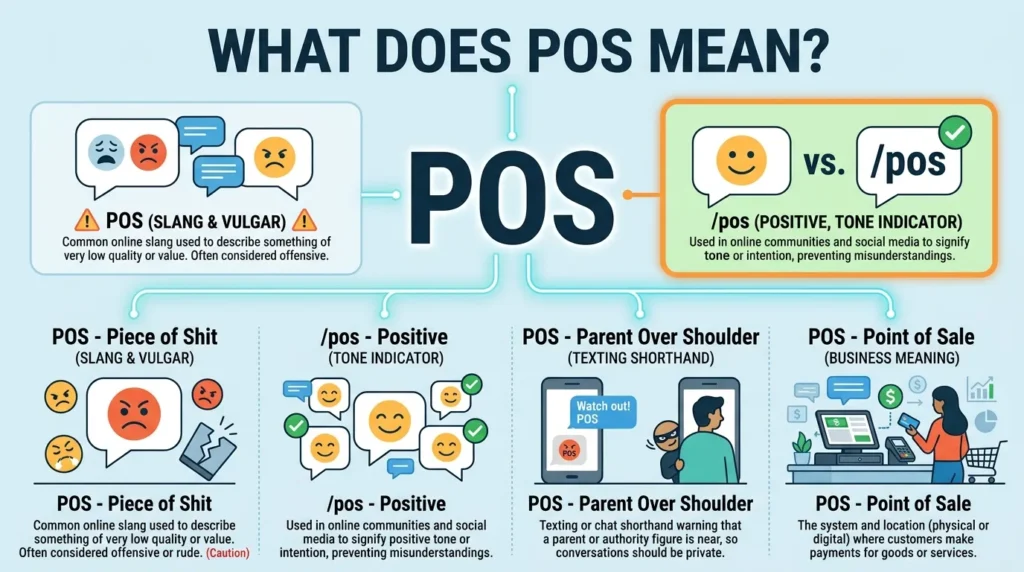

POS most commonly means “piece of shit” in slang. It is a vulgar abbreviation used to describe a person, object, product, or situation that someone considers terrible, worthless, unreliable, or extremely unpleasant. In texts and casual online conversations, this is usually the first meaning to consider.
However, context can completely change the interpretation. POS can also mean “parent over shoulder” in certain chat situations or “point of sale” in retail and business. Meanwhile, /pos with a slash is different: it is an online tone indicator meaning “positive” or “positive connotation.”
Quick Answer
| Field | Meaning |
|---|---|
| Most common slang meaning | Piece of shit |
| Meaning | A terrible, unpleasant, low-quality, or contemptible person or thing |
| Other possible meaning | Parent over shoulder |
| Business meaning | Point of sale |
| /pos meaning | Positive or positive connotation |
| Typical context | Texting, social media, casual conversation |
| Tone | Negative, angry, insulting, frustrated, or joking between close friends |
| Formality | Very informal |
| Offensive? | Usually yes; it represents profanity |
What Does POS Mean in Slang?
In slang, POS is an initialism for “piece of shit.” The expression can target either a person or a thing and usually communicates strong disapproval.
For example:
“My laptop crashed again. This POS is barely two months old.”
Here, POS describes a low-quality or unreliable object.
If someone writes:
“He lied to everyone and then blamed her. What a POS.”
the abbreviation refers to a person the speaker strongly dislikes or considers morally objectionable.
The emotional force depends partly on what POS describes. Calling a broken printer a POS may simply express frustration. Calling a person a POS is much more personal and insulting because it attacks that person’s character rather than criticizing an object.
Quick Meaning of POS by Context
| Context | Likely Meaning | Example | Usage Level |
|---|---|---|---|
| Angry personal message | Piece of shit | “That guy is a POS.” | Very common slang |
| Complaint about an object | Piece of shit | “This POS car won’t start.” | Common |
| Casual joking between friends | Piece of shit | “You lucky POS 😂” | Context-dependent |
| Older/private chat shorthand | Parent over shoulder | “POS, talk later.” | Less common/context-dependent |
| Retail or restaurant work | Point of sale | “Restart the POS terminal.” | Common professional meaning |
| Grammar or linguistics | Part of speech | “The POS tag identifies the word as a verb.” | Technical |
Message ending in /pos | Positive connotation | “You’re impossible /pos” | Online tone indicator |
POS is therefore one of those abbreviations that should never be interpreted from the letters alone. The topic and surrounding words usually reveal the intended meaning.
POS and /pos Do Not Mean the Same Thing
One of the most useful distinctions is also one of the easiest to miss:
POS = usually “piece of shit” in slang.
/pos = positive or positive connotation.
The slash matters. /pos belongs to a group of written tone indicators that help clarify how a message should be interpreted when the wording might otherwise sound negative, sarcastic, hostile, or ambiguous.
Compare these examples:
“You’re such a disaster, POS.”
This would most naturally read as an insult.
“You’re such a disaster /pos.”
Here, /pos signals that the statement is intended affectionately or positively rather than as an attack.
That difference is particularly important in short online messages because readers cannot hear the writer’s voice or see their facial expression.
Also Read: Millenial Slang: Meanings, Examples, and Cultural Context
Other Genuine Meanings of POS
Parent Over Shoulder
POS can mean “parent over shoulder” in texting or online chat. It functions as a warning that a parent is nearby or may be able to see the conversation.
Example:
A: “Did you tell them what happened last night?”
B: “POS. Later.”
Here, interpreting POS as an insult makes little sense. The short warning followed by “later” suggests that someone is watching the screen.
This meaning has been associated with older internet and teen-chat shorthand and should not automatically be assumed whenever POS appears today. Context is essential.
Point of Sale
In retail, restaurants, ecommerce, and business technology, POS means “point of sale.” It refers to the place or system where a commercial transaction is processed.
Examples include:
“Is the POS system working?”
“The payment isn’t appearing in the POS.”
“Enter the discount through the POS terminal.”
These statements are professional and have nothing to do with slang or insults.
Part of Speech
In grammar, linguistics, and language technology, POS can stand for “part of speech.” It refers to grammatical categories such as nouns, verbs, adjectives, and adverbs.
For example:
“The software predicts the POS of each word.”
This interpretation is especially likely when the surrounding discussion involves grammar, writing, language models, text analysis, or natural language processing.
What Does POS Mean in Text Messages?
In an ordinary personal text, POS usually means “piece of shit” when it describes a disliked person, broken object, bad product, or frustrating situation.
Consider:
“My neighbor damaged my fence and denied it. Total POS.”
The meaning is clearly an insult.
But:
“POS, can’t talk about that now.”
may mean “parent over shoulder,” particularly if the conversation suddenly becomes cautious or private.
And:
“The POS isn’t connecting to the card reader.”
almost certainly means “point of sale.”
The words around the abbreviation matter more than the platform where it appears.
What Does POS Mean on TikTok, Instagram, Snapchat, Discord, and Reddit?
There is no reliable reason to assign POS a completely different definition for every major social platform. In ordinary casual posts, comments, private messages, and discussions, POS can retain its slang meaning of “piece of shit.” When the term appears as /pos, however, the slash signals the separate “positive connotation” tone indicator.
This is why searching for “POS meaning on TikTok” and “POS meaning on Snapchat” may ultimately lead to the same answer.
Instead of focusing only on the app, check:
- Whether POS has a slash before it
- Whether it describes a person or object
- Whether the conversation involves payments or retail
- Whether someone suddenly becomes cautious about what they type
- Whether the surrounding sentence sounds angry, humorous, technical, or affectionate
Those clues usually provide a stronger answer than the platform name alone.
Also Read: Australian Slang: Popular Aussie Words and Phrases Explained
How Context Changes the Meaning of POS
1. Look at what POS describes
“That POS broke again.”
A broken device, car, appliance, or other object strongly suggests “piece of shit.”
2. Look for anger or criticism
“He stole from his own friend. POS.”
The negative judgment points toward the insult.
3. Look for retail vocabulary
“The POS isn’t processing credit cards.”
Words involving payments, registers, transactions, terminals, orders, or customers point toward “point of sale.”
4. Look for sudden secrecy
“POS. Delete that message.”
When someone abruptly warns another person to stop or change the conversation, “parent over shoulder” may fit.
5. Check for the slash
“That was ridiculously cute /pos.”
The slash changes the interpretation. /pos means the message has a positive intention or connotation rather than serving as the insult POS.
What Tone Does POS Have?
When POS means “piece of shit,” its basic tone is strongly negative because the underlying phrase contains profanity.
Still, delivery changes its emotional effect.
Angry:
“That scammer is a POS.”
This is a direct insult.
Frustrated:
“This POS printer jams every morning.”
The anger is aimed at an object.
Joking:
“You won again, you lucky POS 😂”
Among close friends, the wording may be playful rather than genuinely hostile. That does not remove the profanity; it simply changes the social intent.
Dismissive:
“Throw that POS away.”
The speaker considers the object extremely poor quality.
Because tone is easy to misread in writing, joking uses are safest when the relationship between the people already supports that kind of language.
Real Conversation Examples
Complaining About a Car
Alex: “Are you driving tonight?”
Jordan: “Not unless this POS finally starts.”
Meaning: Piece of shit; Jordan is frustrated with the car.
Describing Someone’s Behavior
Mia: “He blamed the whole mistake on his coworker.”
Chris: “What a POS.”
Meaning: A harsh personal insult.
Warning During a Chat
Sam: “Tell me what your parents said.”
Taylor: “POS. I’ll message you later.”
Meaning: Parent over shoulder is plausible because Taylor immediately postpones the conversation.
At Work
Manager: “Why is the line moving so slowly?”
Employee: “One POS terminal is offline.”
Meaning: Point of sale.
Using a Tone Indicator
Jamie: “You’re way too obsessed with this show /pos.”
Meaning: The comment is intended positively or affectionately.
Friendly Teasing
Evan: “I got upgraded to first class for free.”
Noah: “You lucky POS 😂”
Meaning: Piece of shit, but used jokingly between friends.
Is POS an Acronym or an Initialism?
When POS means “piece of shit,” “point of sale,” “parent over shoulder,” or “part of speech,” it is more precisely an initialism because each letter represents the beginning of a separate word.
In everyday conversation, however, people often use “acronym” loosely for abbreviations of this kind.
POS is usually written in capitals, although lowercase pos also appears informally online. Capitalization alone does not reliably identify the meaning.
The more meaningful visual distinction is often:
POS → abbreviation requiring context
/pos → positive-connotation tone indicator
How Should You Reply to POS?
Your response should depend on what the sender means.
If someone is complaining about an object:
“Yeah, sounds like it’s time to replace it.”
If they are angry about another person’s behavior:
“What happened?”
If POS means parent over shoulder:
“Got it. We’ll talk later.”
If they are teasing you:
“Jealous? 😂”
If you are unsure:
“What do you mean by POS here?”
That last response is often the safest choice. Three letters can represent completely unrelated ideas, so asking for clarification is better than reacting to the wrong interpretation.
Also Read: What Does Huzz Mean in Slang? Meaning, Use & Examples
Similar and Commonly Confused Terms
| Term | Meaning | Main Difference | Typical Context |
|---|---|---|---|
| POS | Piece of shit | Strong negative slang | Texting, comments, conversation |
| /pos | Positive connotation | Tone indicator, not an insult | Online communication |
| POS | Parent over shoulder | Privacy warning | Chat/texting |
| POS | Point of sale | Business term | Retail, restaurants, payments |
| POS | Part of speech | Grammar term | Language and linguistics |
| POMS | Parents over my shoulder | More explicit privacy warning | Online chat |
| PIR | Parent/person in room | Warns that someone is nearby | Private messaging |
The biggest mistake is treating POS and /pos as interchangeable. They can communicate nearly opposite emotional signals.
The second common mistake is assuming every occurrence of POS in a text must be slang. A coworker discussing a register, payment terminal, or checkout system almost certainly means point of sale.
Who Uses POS?
The slang version can appear anywhere informal English profanity is acceptable between participants, particularly in texts, comments, group chats, forums, gaming conversations, and casual social posts.
“Parent over shoulder” belongs to a more specialized privacy-warning style of chat shorthand and appears less predictably.
Professional uses have entirely different audiences. Retail employees may use POS for point-of-sale equipment, while writers, teachers, linguists, and language-technology professionals may use POS for part of speech.
This variety explains why the surrounding topic matters so much.
Is POS Offensive, Rude, or Inappropriate?
POS is generally offensive when it means “piece of shit.” The abbreviation hides the full spelling, but it still carries the meaning of a vulgar English insult.
Calling an object a POS is usually less personally offensive:
“This POS phone keeps freezing.”
Calling a person a POS is significantly harsher:
“You’re a POS.”
That directly insults the person.
For that reason, the slang meaning is usually unsuitable for professional emails, formal writing, workplace communication, classroom assignments, or conversations where profanity would be inappropriate.
The abbreviation does not automatically make the expression polite.
Of course, none of this applies when POS clearly means point of sale, part of speech, or another neutral professional abbreviation.
Real-World Interpretation: The Missing Symbol Can Matter More Than the Letters
POS demonstrates an important feature of online language: punctuation can carry meaning.
The difference between:
POS
and:
/pos
is only one slash, yet the likely interpretation can move from a harsh insult to a signal of positive intent.
That means readers should not expand internet abbreviations mechanically. Format, surrounding vocabulary, relationship, topic, and emotional tone all contribute to meaning.
When a three-letter abbreviation seems completely inconsistent with the sentence, the best interpretation may be one of its less obvious meanings.
Also Read: Eiffel Tower Slang Meaning: What Does “Eiffel Tower” Mean?
Frequently Asked Questions
What does POS mean in slang?
POS most commonly means “piece of shit” in slang. It is a vulgar abbreviation used to describe a person or thing as terrible, unpleasant, unreliable, low-quality, or contemptible. Calling a broken machine a POS usually expresses frustration, while calling a person a POS functions as a much stronger personal insult.
What does POS mean in a text?
In casual texting, POS often means “piece of shit,” but context matters. It can also mean “parent over shoulder” when someone is warning that a parent may see the conversation. If the message involves stores, payments, or registers, POS probably means “point of sale.”
Does POS mean “parent over shoulder”?
Yes. Parent over shoulder is a genuine alternative meaning of POS in online chat and texting shorthand. It warns the recipient that a parent is nearby or may be watching the conversation. However, it should not automatically be treated as the dominant meaning every time POS appears.
What does /pos mean?
/pos means positive or positive connotation. It is a tone indicator placed alongside a message to show that the statement should be interpreted positively, particularly when the wording could otherwise sound negative or ambiguous. The slash is important: /pos should not automatically be read as the slang insult POS.
Is POS a bad word?
POS itself is an abbreviation, but when it stands for “piece of shit,” it represents a vulgar phrase. Using the initials may visually soften the profanity, but it does not remove the insulting meaning. Whether it feels extremely offensive or merely playful depends on who or what is being described and the relationship between the speakers.
Is POS appropriate for work?
Not when it means “piece of shit.” That use is vulgar and can easily sound disrespectful or hostile. However, POS is perfectly normal professional terminology when it means “point of sale” in business or “part of speech” in language-related work. Context determines whether the abbreviation is inappropriate or completely neutral.
Does POS mean the same thing on every social media platform?
Not necessarily, but the app itself usually does not create a separate meaning. Plain POS may represent the insult or another context-specific abbreviation, while /pos commonly functions as a positive tone indicator. Look at the surrounding sentence, topic, punctuation, and relationship between the people rather than relying only on the platform name.
Conclusion
POS most commonly means “piece of shit” in slang, making it a strong and usually negative abbreviation for a person or thing someone considers terrible. But it is highly context-dependent. POS can also mean “parent over shoulder,” while business conversations commonly use it for “point of sale” and language discussions may use it for “part of speech.”
Pay special attention to /pos. The slash creates an important distinction because /pos signals positive connotation rather than the vulgar insult. When the meaning is unclear, surrounding words, topic, tone, and punctuation usually provide the answer.



Pingback: NSFW Meaning Slang: What It Means and How to Use It
Pingback: New York Slang Words: Meanings, Examples, and Usage