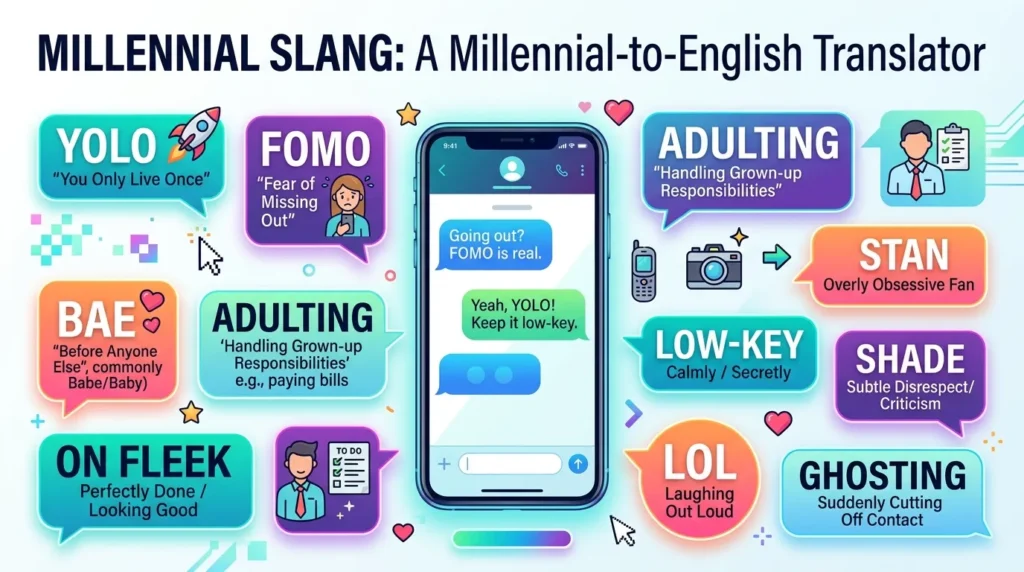

Millenial slang refers to informal words, abbreviations, catchphrases, and internet expressions strongly associated with Millennials and the online culture they grew up with. The standard spelling is millennial slang. Common examples include YOLO, FOMO, bae, adulting, on fleek, basic, and stan.
The label does not mean Millennials invented every expression they used. Many terms came from earlier internet communities, hip-hop, African American English, LGBTQ+ communities, gaming, music, and youth culture before spreading into mainstream social media. That history matters when understanding how the slang developed and how respectfully to use it.
| Quick Answer | Meaning |
|---|---|
| Most common meaning | Informal language associated with Millennials and 2000s–2010s internet culture |
| Other possible meaning | Nostalgic shorthand for slang popular during Millennial teen and young-adult years |
| Typical context | Texting, social media, memes, dating, pop culture, early internet communities |
| Tone | Casual, humorous, expressive, sarcastic, or playful |
| Formality | Mostly informal |
| Offensive or safe? | Most terms are safe, but some contain profanity or can sound insulting or culturally insensitive depending on use |
What Is Millenial Slang?
Millenial slang is better understood as Millennial-era slang rather than a language variety spoken exclusively by one generation.
A commonly used research definition places Millennials between 1981 and 1996, although generational boundaries are approximate rather than universal. That means older Millennials experienced childhood before social media, while younger Millennials entered adolescence as texting, instant messaging, social networks, smartphones, and meme culture expanded rapidly.
This unusual transition shaped the language associated with the generation.
Millennials encountered abbreviations such as LOL, OMG, TTYL, and IRL through chatrooms, instant messaging, forums, and texting. Later came social-media expressions such as FOMO, YOLO, bae, adulting, and on fleek.
Still, calling every popular expression from this period “Millennial slang” can erase its actual history. Words including woke, shade, and slay, for example, have cultural roots that extend beyond mainstream Millennial internet culture.
Quick List of Popular Millennial Slang
| Slang Term | Simple Meaning | Tone | Usage Warning |
|---|---|---|---|
| Adulting | Doing ordinary adult responsibilities | Humorous | Very informal |
| Bae | Romantic partner or sweetheart | Affectionate | Can sound dated |
| Basic | Predictable or very mainstream | Teasing/dismissive | Can be insulting |
| Clapback | Sharp response to criticism | Confrontational | Often directed at someone |
| Extra | Overdramatic or excessive | Teasing | May sound judgmental |
| FOMO | Fear of missing out | Neutral/humorous | Widely understood |
| Ghosting | Suddenly ending communication | Negative | Common in dating |
| Humblebrag | A disguised boast | Critical | Usually negative |
| I can’t even | I am overwhelmed or speechless | Dramatic/humorous | Very informal |
| IRL | In real life | Neutral | Internet abbreviation |
| Legit | Genuine, impressive, or seriously good | Positive | Informal |
| Lit | Exciting, excellent, or energetic | Positive | Meaning varies by context |
| LOL | Laughing out loud | Friendly | Sometimes just softens a message |
| Low-key | Quietly, moderately, or secretly | Casual | Meaning depends on sentence |
| On fleek | Perfectly styled or exactly right | Complimentary | Strongly associated with mid-2010s speech |
| Receipts | Evidence proving a claim | Confrontational | Common in online disputes |
| Salty | Irritated or resentful | Teasing/negative | Can provoke someone |
| Savage | Bold, ruthless, or impressively blunt | Admiring/critical | Depends heavily on tone |
| Shade | Subtle disrespect or criticism | Sarcastic | Can be insulting |
| Squad | Close friend group | Friendly | Casual |
| Stan | Extremely devoted fan | Enthusiastic | Originally carried a more obsessive sense |
| TBH | To be honest | Neutral | Mainly informal |
| Thirsty | Desperate for attention or attraction | Mocking | Can be demeaning |
| Turnt | Highly excited or energized | Party slang | Very informal |
| Vibe | Feeling or atmosphere | Neutral/positive | Now broadly mainstream |
| YOLO | You only live once | Playful/reckless | Often used jokingly |
| Goals | Something desirable or aspirational | Admiring | Usually social-media language |
| All the feels | Strong emotions | Playful | Deliberately informal |
| Epic fail | Major or embarrassing failure | Humorous | Can mock another person |
| AF | Intensifier meaning “extremely” | Emphatic | Contains implied profanity |
Popular Millenial Slang Words and Meanings
Everyday Reactions and Expressions
1. YOLO
YOLO stands for “you only live once.” It is used to justify something spontaneous, adventurous, expensive, silly, or potentially reckless.
Example: “I booked the last-minute trip. YOLO.”
The expression became especially recognizable during the early 2010s, although the underlying phrase existed before the acronym became internet slang.
Tone: Playful, carefree, ironic
Formality: Very informal
2. FOMO
FOMO means “fear of missing out.” It describes anxiety or discomfort caused by thinking other people are enjoying an experience without you.
Example: “Everyone’s going to the concert and my FOMO is getting bad.”
The term is recorded in its modern sense from the early 2000s and became particularly useful in an era when social media constantly displayed other people’s activities.
Tone: Neutral, self-aware, humorous
Formality: Informal but widely understood
3. Lit
When something is lit, it can mean exciting, excellent, energetic, or especially enjoyable.
Example: “That party was actually lit.”
The word can also retain older meanings relating to illumination or intoxication, so surrounding context matters.
Tone: Positive and enthusiastic
Formality: Informal
4. Legit
Legit is a shortened form of legitimate. In casual speech it often means genuine, impressive, seriously good, or trustworthy.
Example: “That little restaurant is legit.”
It can describe authenticity as well as quality.
5. On Fleek
On fleek means perfectly done, precisely styled, or looking especially good.
Example: “Your eyeliner is on fleek.”
The phrase became closely connected with mid-2010s internet culture, especially beauty and fashion conversations. Its familiar modern meaning is essentially “exactly right” or “perfectly done.”
Today it often carries a nostalgic 2010s flavor.
6. I Can’t Even
I can’t even is an intentionally unfinished expression meaning someone feels too shocked, amused, frustrated, excited, or overwhelmed to respond properly.
Example: “That ending was ridiculous. I can’t even.”
The missing conclusion is part of the joke.
7. All the Feels
All the feels means experiencing many strong emotions, especially sentimental ones.
Example: “That reunion scene gave me all the feels.”
Here, feels functions informally as a noun meaning emotional reactions.
8. Epic Fail
An epic fail is a particularly obvious, embarrassing, or funny failure.
Example: “I baked the cake without adding sugar. Epic fail.”
The expression became closely associated with meme, gaming, and early viral-video culture.
Also Read: Australian Slang: Popular Aussie Words and Phrases Explained
Also Read: What Does Huzz Mean in Slang? Meaning, Use & Examples
Relationships, Dating, and Social Life
9. Bae
Bae is an affectionate term for a sweetheart or romantic partner.
Example: “Going out for dinner with bae tonight.”
Despite a popular internet explanation claiming BAE means “before anyone else,” the slang word is generally treated as a term comparable to baby or babe, rather than needing to function as that acronym.
Its mainstream popularity became especially noticeable during the 2010s.
10. Squad
A squad is someone’s close group of friends.
Example: “The whole squad is coming tonight.”
The ordinary word existed long before Millennials used it this way. Social media helped strengthen its casual meaning of a tight friend group.
11. Goals
Calling something goals means it represents an outcome, lifestyle, friendship, appearance, or relationship someone admires.
Example: “Their friendship is goals.”
Related expressions include relationship goals, friendship goals, and career goals.
It is often complimentary but can also be exaggerated for humor.
12. Thirsty
A person described as thirsty appears overly eager for romantic, sexual, social, or online attention.
Example: “Posting ten comments under their photos is looking a little thirsty.”
It is usually negative or teasing. Calling someone thirsty can sound dismissive or embarrassing, so it should be used carefully.
13. Ghosting
Ghosting means abruptly cutting off communication without explaining why.
Example: “We went on three dates and then he completely ghosted me.”
Although strongly connected with modern dating, ghosting can also happen in friendships, recruitment, professional communication, or online communities.
14. Netflix and Chill
Netflix and chill can literally mean relaxing while watching something, but it became widely recognized as a euphemistic invitation involving romantic or sexual activity.
Example: “He asked if I wanted to Netflix and chill, and I don’t think the movie was the main point.”
Because of that second meaning, the phrase can sound suggestive even when someone intends it literally.
Personality and Social Behavior
15. Adulting
Adulting means dealing with ordinary responsibilities associated with adult life, such as paying bills, cooking, scheduling appointments, cleaning, budgeting, or handling paperwork.
Example: “I renewed my insurance and did my taxes. That’s enough adulting for one day.”
The humorous effect comes from treating routine adulthood as an activity someone temporarily performs. The modern noun is recorded from the 2010s.
16. Basic
Calling someone or something basic suggests that it is predictable, conventional, mainstream, or lacking originality.
Example: “I know pumpkin drinks are basic, but I still love them.”
People also use it self-deprecatingly.
Tone: Teasing to insulting
17. Extra
Someone who is extra is behaving in an unnecessarily dramatic, excessive, elaborate, or attention-grabbing way.
Example: “She brought a professional lighting setup for one selfie. So extra.”
It can be affectionate among friends or critical when directed at someone seriously.
18. Humblebrag
A humblebrag is a boast disguised as modesty, a complaint, or a casual observation.
Example: “I’m exhausted from getting invited to so many events” could be interpreted as a humblebrag.
The word can function as both a noun and a verb.
19. Salty
In slang, salty means irritated, bitter, resentful, or annoyed about something.
Example: “He’s still salty because his team lost.”
The slang sense is much older than Millennial culture, another reminder that slang popular with a generation is not necessarily invented by that generation.
20. Savage
Savage can describe a comment or action that is shockingly blunt, ruthless, bold, or impressive.
Example: “That comeback was savage.”
It may function as praise among friends but can sound harsh in serious situations.
Social Media, Fandom, and Online Arguments
21. Stan
A stan is an extremely enthusiastic or devoted fan. It also works as a verb.
Examples:
“I’ve been a fan for years, but she’s a serious stan.”
“I will always stan this album.”
The slang developed from the title character of Eminem’s 2000 song “Stan,” which depicts obsessive fandom. The modern term is often much lighter and may simply express strong enthusiasm.
22. Throw Shade
To throw shade means to communicate contempt, criticism, or disrespect, often indirectly.
Example: “That comment about her outfit sounded like shade.”
The expression did not originate as generic Millennial internet slang. Its history is strongly associated with Black and Latino LGBTQ+ ballroom culture before wider mainstream adoption. Treating it simply as something Millennials invented misses that cultural background.
23. Clapback
A clapback is a fast, sharp, effective response to criticism.
Example: “She posted a clapback after people criticized her outfit.”
The expression moved into mainstream internet language from hip-hop usage; the modern noun is linked to an earlier clap back expression popularized through music in the early 2000s.
A clapback is usually more pointed than an ordinary reply.
24. Receipts
In internet slang, receipts means evidence supporting a claim.
Example: “Don’t deny saying it. She has the receipts.”
Screenshots, messages, photographs, videos, or old posts may all function as “receipts.”
The expression often appears during online disagreements or celebrity discussions.
25. Low-Key
Low-key can mean quietly, moderately, discreetly, or somewhat secretly.
Example: “I low-key want to leave early.”
Its opposite, high-key, emphasizes that the feeling is obvious or strong.
Example: “I high-key love this song.”
26. Woke
Woke developed in African American English and historically referred to being alert or attentive, particularly to racial and social injustice. It entered much wider public use during the 2010s. It has since developed additional politically charged and often pejorative uses.
For that reason, woke should not be treated as a simple synonym for “cool Millennial person.”
Example of its social-awareness sense: “Stay aware of what’s happening and stay woke.”
In contemporary political discussion, the intended meaning can differ sharply depending on the speaker.
Also Read: Eiffel Tower Slang Meaning: What Does “Eiffel Tower” Mean?
Texting and Early Internet Language
27. LOL
LOL means laughing out loud.
Example: “That picture is ridiculous lol.”
In everyday texting, lol does not always signal actual laughter. It can soften a sentence, signal friendliness, reduce awkwardness, or make a comment sound less serious.
LOL predates mainstream social media, so it is better described as internet slang widely used by Millennials rather than something created specifically by Millennials.
28. OMG
OMG means oh my God and expresses surprise, excitement, disbelief, or frustration.
Example: “OMG, you actually got the tickets!”
It became particularly visible through instant messaging and texting but has a history that predates the Millennial generation.
29. TBH
TBH means to be honest.
Example: “TBH, I liked the first version better.”
It can introduce a genuine opinion, confession, compliment, criticism, or casual observation.
30. IRL
IRL means in real life, especially when contrasting physical-world interaction with online activity.
Example: “We’ve talked online for years but never met IRL.”
Its usefulness grew naturally alongside internet communities where online and offline relationships needed to be distinguished.
31. TTYL
TTYL stands for talk to you later.
Example: “I have to get back to work. TTYL.”
It strongly evokes instant messaging and early texting for many users today.
32. AF
AF is an intensifier meaning extremely or very.
Example: “I’m tired AF.”
The letters represent profanity, so the abbreviation is inappropriate for many workplaces, schools, professional publications, and formal situations even when the full phrase is not written out.
Millennial Slang on Social Media and Messaging Apps
The meaning of most Millennial slang does not fundamentally change between Instagram, TikTok, WhatsApp, Facebook, X, Reddit, or private text messages. What changes more often is tone and frequency.
On private messaging apps, terms such as LOL, TBH, bae, low-key, and FOMO can function as ordinary conversational shorthand.
On public social platforms, words such as stan, receipts, shade, clapback, and goals often perform an additional social function. They help users express allegiance, judgment, admiration, criticism, or humor in a compact form.
Some terms also became tied to particular eras of social media. On fleek, for example, strongly evokes mid-2010s viral culture, while adulting became useful for joking about ordinary responsibilities online.
TikTok did not create most classic Millennial slang. Instead, it helped revive, parody, criticize, or contrast older expressions with newer Gen Z and Gen Alpha vocabulary.
How Context Changes Millennial Slang
The same word can communicate very different attitudes depending on the sentence, relationship, and setting.
“She’s extra.”
Among close friends, this might affectionately mean she loves dramatic outfits. During an argument, it may mean she is annoying or unreasonable.
“I’m dead.”
In casual internet speech, this usually means “That was extremely funny,” not literal death.
“He’s thirsty.”
This might jokingly describe obvious flirting, but directed seriously at someone it can sound humiliating.
“That was savage.”
It can praise an exceptionally clever response or criticize unnecessarily cruel behavior.
“Stay woke.”
Its interpretation depends especially heavily on social and political context because the word has developed competing modern uses.
Readers should therefore look beyond the slang word itself. Surrounding words, emojis, speaker relationships, public versus private settings, and the subject of conversation can all change its effect.
Also Read: What Does Unc Mean? Slang, Texting, and Social Media
Real Millennial Slang Conversations
Friends
Maya: “Are you really buying concert tickets this late?”
Chris: “Yep. YOLO.”
Here, YOLO humorously justifies an impulsive decision.
Dating
Alex: “Did Jordan ever text you back?”
Sam: “Nope. Pretty sure I’ve been ghosted.”
Ghosted means communication suddenly stopped without explanation.
Family
Sister: “You made dinner and finally organized your insurance paperwork?”
Brother: “I know. Look at me adulting.”
The speaker jokingly treats ordinary responsibilities as an achievement.
Social Media
Friend: “Did you see her response to that comment?”
You: “Yeah. That clapback was savage.”
Both terms describe a particularly sharp response.
Work
Coworker: “TBH, the shorter presentation works better.”
You: “Agreed. Let’s use that version.”
TBH is informal, but it may appear in casual communication between coworkers who already have a relaxed relationship.
Fandom
Jamie: “You already bought three versions of the album?”
Taylor: “I never said I was a casual fan. I stan.”
Here, stan is self-aware and playful rather than literally obsessive.
Going Out
Nina: “I don’t really want to go, but everyone’s posting about it.”
Luis: “That’s the FOMO talking.”
The slang describes anxiety about being excluded from an enjoyable experience.
Formal Versus Informal Usage
Most Millennial slang belongs in casual conversation rather than formal writing.
Terms such as FOMO and adulting have become recognizable enough to appear in mainstream writing, but tone still matters.
Expressions such as bae, on fleek, thirsty, AF, and I can’t even normally sound too casual for academic papers, formal reports, legal writing, or traditional business correspondence.
At work, expressions such as LOL, TBH, low-key, and vibe may be acceptable in relaxed team chats but less suitable in communication with clients, executives, or unfamiliar colleagues.
School use depends on the term. Most are harmless, but slang containing implied profanity, sexual meanings, or insults may be inappropriate.
Similar and Commonly Confused Terms
| Term | Related Term | Main Difference | Typical Context |
|---|---|---|---|
| Bae | Babe | Both are affectionate; bae has stronger 2010s slang associations | Dating |
| FOMO | JOMO | FOMO is anxiety about missing out; JOMO is enjoyment of missing out | Social life |
| Stan | Fan | A stan suggests especially intense devotion | Fandom |
| Shade | Clapback | Shade can be indirect; a clapback directly answers criticism | Social media |
| Basic | Cheugy | Basic means conventional; cheugy often mocks something viewed as dated or trying too hard | Fashion/internet |
| On fleek | Ate | Both can praise excellent appearance or execution, but they come from different periods and cultural histories | Social media |
| Thirsty | Flirty | Flirty can be positive; thirsty suggests excessive eagerness | Dating/social media |
FOMO vs. JOMO
FOMO is anxiety about missing an experience. JOMO, or “joy of missing out,” describes enjoying the choice to stay away instead.
Stan vs. Fan
Every stan is a fan in the broad sense, but stan traditionally implies much greater intensity. Modern users sometimes use it lightly simply to mean “strongly support.”
Basic vs. Cheugy
Basic criticizes someone or something as predictable or overly mainstream. Cheugy became popular later as a joking label for trends considered unfashionable, dated, or stereotypically Millennial.
Cultural Origin and Evolution of Millennial Slang
Millennial slang reflects a period when communication moved rapidly from offline conversation to permanently connected digital spaces.
Older Millennials grew up around desktop computers, dial-up connections, message boards, chatrooms, and early instant messaging. Younger Millennials experienced adolescence alongside texting, social networks, video platforms, smartphones, memes, and eventually highly visual social media.
That transition encouraged short forms such as LOL, OMG, TBH, and IRL while also allowing catchphrases to spread faster than traditional spoken slang.
The 2000s and early 2010s produced several expressions strongly associated with the generation. Stan grew from a 2000 pop-culture reference, clapback spread from early-2000s hip-hop usage, FOMO is recorded from 2004, and the modern sense of adulting appears in the 2010s.
Yet the internet also accelerated the mainstream adoption of vocabulary from specific communities.
Woke developed in African American English. Shade has important connections with Black and Latino LGBTQ+ culture. Slay, in its celebratory sense, is associated with ballroom culture and later spread widely through social media.
This is why “Millennial slang” should describe a period of popular usage, not automatically claim ownership or invention.
Also Read: What Does OP Mean in Slang, Texting, and Social Media?
Also Read: FAFO Slang Meaning: What It Means and How to Use It
Is Millennial Slang Still Used?
Yes, but individual terms have aged differently.
Words such as FOMO, ghosting, vibe, salty, stan, low-key, basic, LOL, and TBH remain understandable and continue to appear in casual communication.
Others now have a stronger nostalgic or deliberately retro feeling. On fleek, YOLO, bae, squad goals, epic fail, and I can’t even can immediately evoke earlier phases of 2010s internet culture.
Some expressions have also crossed generational boundaries. Younger speakers may continue using a word while changing its frequency, tone, or meaning.
That makes generational slang labels useful for describing linguistic eras, but unreliable as strict rules about how every person of a certain age speaks.
Is Millennial Slang Offensive, Rude, or Inappropriate?
Millennial slang as a category is not inherently offensive.
Most expressions, including FOMO, YOLO, adulting, bae, squad, and vibe, are harmless in casual conversation.
However, several deserve more care.
AF represents profanity and is unsuitable in many formal environments.
Basic, thirsty, salty, savage, shade, and extra can insult someone depending on tone.
Netflix and chill can carry a sexual implication.
Woke now has politically contested meanings, so its tone cannot be assumed without context.
Cultural origin matters as well. Using expressions that developed within Black, Latino, LGBTQ+, hip-hop, or other communities is different from mocking those communities or pretending the expressions were invented by mainstream internet culture.
Respectful Usage and Cultural Sensitivity
The safest approach is to learn slang as real language with real social history rather than treating it as a costume.
Non-native English speakers can use widely understood expressions such as FOMO, LOL, vibe, ghosting, and YOLO naturally once they understand the context.
More culturally specific expressions deserve extra awareness. If a term emerged from African American English, ballroom culture, queer communities, or hip-hop, understanding that origin helps prevent misleading claims about where it came from.
It is also better to avoid exaggerated accents or caricatures when using slang.
Finally, remember that understanding a term does not require using it. If an expression sounds unnatural for your age, community, professional setting, or relationship with the listener, ordinary English will usually communicate the same idea more comfortably.
Real-World Interpretation
The most interesting feature of Millennial slang is not any individual word. It is the generation’s position between early internet shorthand and modern algorithm-driven slang.
Millennials learned digital language when online and offline communication still felt like separate spaces. Terms such as IRL literally marked that distinction. Later expressions such as FOMO, stan, adulting, and receipts reflected a world where social identity, relationships, entertainment, and everyday frustrations increasingly played out publicly online.
That transition helps explain why so much Millennial-era slang combines brevity with self-aware humor.
Frequently Asked Questions
What does millenial slang mean?
Millenial slang means informal language associated with Millennials, especially expressions popular during the 2000s and 2010s. The correct spelling is millennial slang. It includes internet abbreviations, dating vocabulary, memes, reaction phrases, and pop-culture expressions such as FOMO, YOLO, bae, adulting, and on fleek.
What are the most popular Millennial slang words?
Widely recognized examples include FOMO, YOLO, adulting, bae, basic, lit, salty, stan, ghosting, low-key, shade, clapback, squad, goals, and on fleek. However, popularity differed by age, region, community, and period, so no single vocabulary list represents every Millennial speaker.
Is LOL Millennial slang?
LOL is strongly associated with the digital communication Millennials grew up using, but it is not exclusively Millennial slang. It developed through earlier internet communication and became especially familiar through chatrooms, instant messaging, forums, texting, and later social media. Today, people from several generations use it.
What Millennial slang is considered outdated?
Expressions such as on fleek, YOLO, bae, squad goals, epic fail, and I can’t even can sound distinctly 2010s today, especially when used heavily. They are still understandable, however, and speakers sometimes use them deliberately for nostalgia, irony, or humor rather than because they have disappeared completely.
What does bae mean in Millennial slang?
Bae is a casual term of affection meaning approximately baby, babe, or sweetheart. It became highly visible in 2010s popular culture and social media. The widespread claim that BAE originally stood for “before anyone else” should not be treated as the established explanation of the slang word’s origin.
Is Millennial slang appropriate at work?
Some expressions are acceptable in relaxed workplace chats, especially LOL, TBH, vibe, or occasionally FOMO. Others, including AF, thirsty, bae, and Netflix and chill, are usually inappropriate in professional communication. Consider your workplace culture, audience, relationship, and the seriousness of the message before using slang.
Did Millennials invent words like shade and slay?
Not necessarily. Generational popularity should not be confused with linguistic origin. Expressions associated with shade and celebratory uses of slay have important histories in Black, Latino, and LGBTQ+ communities, particularly ballroom culture, before their broader social-media adoption.
What is the difference between Millennial and Gen Z slang?
Millennial slang is commonly associated with 2000s and 2010s expressions such as YOLO, adulting, FOMO, bae, and on fleek. Gen Z slang reflects later platforms and cultural trends. The boundary is not clean, though. Generations share vocabulary, and many supposedly generational expressions originated in specific communities long before becoming mainstream.
Can non-native English speakers use Millennial slang?
Yes. Widely understood terms such as FOMO, LOL, ghosting, vibe, and YOLO can be useful for understanding informal American English. The main challenge is tone rather than grammar. Learn whether a term is affectionate, insulting, sexual, culturally specific, outdated, or highly casual before using it in conversation.

Pingback: POS Meaning Slang: What It Means in Text and Online
Pingback: Spanish Slang: Common Words, Meanings, and Regional Differences
Pingback: New York Slang Words: Meanings, Examples, and Usage
Pingback: Eiffel Tower Slang Meaning: What Does It Really Mean?
Pingback: IBM Meaning Slang: What IBM Means in Text and Online
Pingback: Arch Slang Meaning: What Does 'Arch' Mean in Text?