
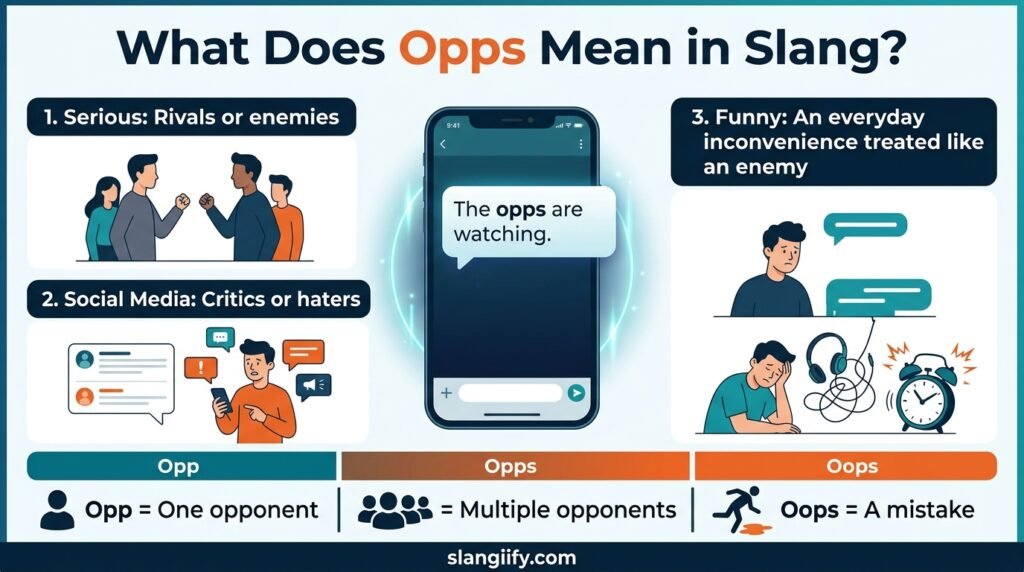

In slang, “opps” means opponents, rivals, or enemies. It is the plural form of “opp,” a shortened version of opponent or opposition. Someone might call people “opps” because they are competing with them, arguing with them, working against them, or simply acting unfriendly.
The term became widely known through hip-hop—particularly drill music—and later spread across TikTok, Instagram, X, memes, texting, and everyday conversation. Context matters because “opps” can describe serious enemies, but people also use it jokingly for rival sports fans, strict teachers, difficult coworkers, or friends who disagree with them.
| Quick fact | Meaning |
|---|---|
| Most common meaning | Opponents, rivals, enemies, or people working against someone |
| Singular form | Opp |
| Other possible meanings | Opportunities in sales; a healthcare payment system when written as OPPS; an older O.P.P. acronym associated with a song |
| Typical context | Hip-hop, social media, memes, texts, school conversations, gaming, sports |
| Tone | Serious, confrontational, competitive, sarcastic, or playful |
| Formality level | Highly informal |
| Offensive status | Not inherently a profanity, but it can sound hostile or threatening |
| Pronunciation | Usually pronounced “ahps” |
What Does Opps Mean in Slang?
The most common slang meaning of opps is people considered to be on the opposing side. Depending on the situation, these people may be enemies, personal rivals, competing groups, hostile acquaintances, or critics.
Example:
“My opps keep watching everything I post.”
Here, “opps” likely means people who dislike the speaker, criticize them, or hope they fail.
Slangiify defines opps as one’s opposition or opponents and notes that the plural form is more common than the singular opp. The term first carried a particularly serious meaning in hip-hop contexts, where it could identify people involved in active rivalries. Its use has since broadened to include humorous and exaggerated references to ordinary antagonists.
The strength of the word depends heavily on context:
- In drill lyrics, “opps” may refer to real enemies or members of a rival group.
- In a sports conversation, it may simply mean the opposing team.
- In a meme, it can mean anyone causing a minor inconvenience.
- In school, a student might jokingly call a strict teacher an “opp.”
- On social media, it can describe critics, haters, or people who repeatedly leave negative comments.
Calling someone an “opp” is usually stronger than calling that person a competitor. It suggests that the person is against you, not merely participating in the same contest.
Quick Meaning by Context
| Context or platform | Likely meaning | Example | Frequency or confidence |
|---|---|---|---|
| Hip-hop or drill music | A serious enemy, rival, or opposing group member | “He mentioned his opps in the song.” | Very common |
| TikTok, Instagram, or X | Haters, critics, rivals, or unfriendly people | “My opps viewed the story first.” | Very common |
| Text messages | Someone the speaker considers an enemy or rival | “Don’t invite him; he’s an opp.” | Common |
| Memes | A person or thing causing a minor problem | “The alarm clock is my biggest opp.” | Common and usually humorous |
| Sports | A rival team or opposing supporters | “We play the opps on Friday.” | Possible and context-dependent |
| Gaming chats | Opposing players or an enemy team | “The opps are near the objective.” | Possible, but not universal gaming terminology |
| School | A rival student, strict teacher, or someone viewed as unfriendly | “The math teacher became an opp after that test.” | Usually joking |
| Workplace slang | A difficult coworker, rival team, or unsupportive manager | “The finance department is acting like the opps today.” | Usually humorous |
| Sales or CRM discussion | Opportunities, not enemies | “We have ten open opps this quarter.” | Specialized professional shorthand |
| Healthcare documents | Hospital Outpatient Prospective Payment System | “The OPPS rule affects hospital outpatient payments.” | Formal technical acronym |
Other Genuine Meanings of Opps
Although “opponents” is the dominant slang definition, the same letters can carry unrelated meanings. Capitalization and subject matter usually reveal which interpretation is intended.
Opps as “Opportunities”
In sales, business development, customer relationship management, and revenue operations, opps may be informal shorthand for opportunities.
Example:
“The team created eight new opps this month.”
In this sentence, “opps” means potential sales deals or qualified business opportunities—not enemies. Sales professionals commonly use forms such as open opps, qualified opps, new opps, and closed opps when discussing a pipeline.
This meaning is:
- Professional but informal
- Common in internal sales conversations
- Often connected with terms such as pipeline, leads, CRM, quota, revenue, won, and lost
- Less likely in normal social-media posts
OPP as an Older Music and Cultural Acronym
The uppercase acronym O.P.P. also became widely recognized through Naughty by Nature’s 1991 song “O.P.P.” In that context, it referred to involvement with another person’s romantic or sexual partner. The song used both suggestive and more radio-friendly interpretations of the final letter.
This meaning is historically important, but it is not normally what people mean when they write lowercase opps in a modern TikTok comment or text message.
OPPS in Healthcare
In American healthcare administration, uppercase OPPS stands for the Hospital Outpatient Prospective Payment System. The Centers for Medicare & Medicaid Services uses this system to determine payment for many services provided by hospital outpatient departments.
Example:
“CMS released an update to the OPPS payment policy.”
This use is:
- Formal
- Technical
- Healthcare-specific
- Unrelated to slang
A conversation mentioning Medicare, hospitals, reimbursement, claims, medical codes, or CMS almost certainly uses this technical meaning.
Also Read: FAFO Slang Meaning: What It Means and How to Use It
What Does Opps Mean in Text Messages?
In texting, opps usually means enemies, rivals, or people the sender does not trust.
Example:
“Be careful what you tell him. He talks to the opps.”
The sender is warning that the person may communicate with people considered unfriendly or disloyal.
However, many text-message uses are exaggerated rather than literal:
Example:
“You ate the last slice? You’re officially an opp.”
Here, one friend jokingly calls another an enemy over a minor inconvenience. No real hostility is implied.
Look at the surrounding language before deciding how serious the message is. Words such as danger, beef, watch out, caught, threat, or revenge can indicate genuine conflict. Laughing emojis, absurd complaints, and minor everyday situations usually indicate humor.
What Does Opps Mean on TikTok?
On TikTok, opps normally refers to rivals, critics, haters, fake friends, or people perceived as working against the creator. Slangiify notes that the slang term predates TikTok and was popularized through hip-hop before becoming part of broader social-media language.
Common TikTok uses include:
- Calling persistent negative commenters “opps”
- Referring to people who watch someone’s content but never support it
- Describing friendship or relationship rivals
- Using the word in videos based on rap lyrics
- Joking that an animal, object, teacher, parent, or everyday inconvenience is an “opp”
Example:
“The opps are early today.”
Under a video, this might mean negative commenters arrived quickly.
TikTok does not give the word a completely separate definition. The platform mainly helped spread both its serious and humorous uses to a larger audience.
What Does Opps Mean on Instagram, Snapchat, and X?
Across Instagram, Snapchat, and X, the meaning is generally the same: opponents, enemies, haters, rivals, or unfriendly people.
On Instagram, someone might mention “opps” in a caption, Reel, Story, or comment about people secretly monitoring their account.
Example:
“Posting this so the opps know I’m doing fine.”
On Snapchat, it may appear in private messages or captions about personal disagreements:
Example:
“Why is she snapping the opps?”
On X, the term is frequently used more broadly and humorously. Someone may describe a political opponent, workplace rival, irritating neighbor, or even a malfunctioning device as an “opp.”
How Context Changes the Meaning
The most reliable way to interpret “opps” is to examine the topic, relationship, tone, and surrounding words.
1. Serious personal conflict
“My brother told me not to go there because the opps were outside.”
Meaning: People viewed as actual enemies or potential threats.
The warning and location reference suggest that the term is being used seriously.
2. Social-media criticism
“The opps keep reporting my account.”
Meaning: Critics, hostile users, or people trying to cause problems online.
3. Friendly exaggeration
“You started the show without me? You’re an opp now.”
Meaning: A friend jokingly pretends that another friend has betrayed them.
4. Workplace humor
“My manager scheduled a meeting for 7:30 a.m. She’s one of the opps.”
Meaning: The manager caused an inconvenience. The speaker probably does not consider her a real enemy.
5. Sales terminology
“We need more qualified opps before the end of the quarter.”
Meaning: Sales opportunities.
Words such as qualified, quarter, pipeline, and revenue point to the business meaning.
6. Healthcare terminology
“The proposed OPPS changes may affect outpatient reimbursement.”
Meaning: Hospital Outpatient Prospective Payment System.
The capital letters and healthcare vocabulary make the technical meaning clear.
Tone and Emotional Meaning
“Opps” can carry several tones, but they all involve some idea of opposition.
Serious or confrontational
In its strongest form, the word identifies people involved in a genuine dispute or hostile rivalry. In rap and drill contexts, this use may involve real-world group conflicts rather than ordinary competition.
Suspicious
A speaker may use “opp” for someone considered disloyal, untrustworthy, or secretly connected to an opposing group.
Example:
“He’s acting like an opp lately.”
Competitive
In sports, gaming, school, or online debates, the word can label the other side without suggesting serious danger.
Example:
“We can’t let the opps win the tournament.”
Sarcastic or funny
Modern internet usage often applies “opps” to harmless annoyances.
Example:
“The mosquitoes are my opps this summer.”
The absurd choice of enemy makes the sentence humorous.
Dismissive
Calling critics “opps” may allow the speaker to dismiss their opinions as hostility rather than genuine feedback.
Example:
“Ignore those comments. It’s just the opps.”
Also Read: RTPS Meaning: What Does RTPS Stand For?
Real Conversation Examples
Between friends
Maya: “You told everyone about my surprise party?”
Nina: “It slipped out.”
Maya: “I can’t trust you. You’re one of the opps now.”
The word is playful because the “betrayal” is minor.
At school
Student 1: “Did Mr. Harris assign another essay?”
Student 2: “Yes. He’s really moving like an opp this week.”
The teacher is being described humorously as someone working against the students.
In a serious warning
Jordan: “Why aren’t you going to that neighborhood?”
Malik: “Some of his opps might be there.”
Here, the word may refer to people involved in a real conflict. It should not automatically be treated as a joke.
On social media
Comment: “Why do the opps always watch the Story before the actual friends?”
“Opps” means critics, haters, former friends, or people who monitor someone without supporting them.
In gaming
Player 1: “Someone is behind us.”
Player 2: “The opps are pushing from the left.”
The word refers to enemy players, although many gamers would simply say enemies or the other team.
At work
Employee 1: “IT blocked the website again.”
Employee 2: “IT is the opps today.”
The statement is probably humorous rather than a serious accusation.
In a sales meeting
Manager: “How many opps are expected to close this month?”
Sales representative: “Four, assuming the contracts are approved.”
Here, “opps” means sales opportunities.
Grammar, Pronunciation, and Spelling
In its slang sense, opp functions as a countable noun.
- Singular: opp
- Plural: opps
- Pronunciation: “ahp” and “ahps”
- Typical capitalization: lowercase in casual slang
- Sentence role: usually a noun or plural noun
- Standalone use: possible, especially as a label or accusation
Singular example:
“He used to be my friend, but now he’s an opp.”
Plural example:
“Don’t give the opps any information.”
Attributive example:
“They were discussing activity in opp territory.”
The spelling opps contains two p letters. It is different from oops, the interjection used after a mistake.
People may occasionally write ops, but that spelling is more ambiguous. Depending on the context, ops can mean operations, special operations, original posters, or other specialized terms. For the plural slang word meaning enemies, opps is the clearest spelling.
How to Reply When Someone Says “Opps”
Your reply should match both the tone and the seriousness of the conversation.
Neutral replies
- “Who are you talking about?”
- “What happened between you two?”
- “Do you mean actual enemies or are you joking?”
- “Why do you consider them opps?”
These replies work when the meaning is unclear.
Friendly or humorous replies
- “Not me getting added to the opp list.”
- “Over one slice of pizza?”
- “That is a very dramatic definition of enemy.”
- “I thought we were on the same team.”
Use a humorous response only when the situation is clearly harmless.
Serious replies
- “Is there a real threat?”
- “Do you feel unsafe around them?”
- “Avoid escalating it and talk to someone you trust.”
- “What exactly happened?”
When the message mentions threats, weapons, retaliation, stalking, or a dangerous location, do not respond as though it is merely a meme.
Supportive replies
- “I understand that you’re upset, but try not to make the conflict worse.”
- “Let’s figure out a safe way to handle this.”
- “You do not need to confront them alone.”
The word itself does not prove that danger exists, but the surrounding details may justify a cautious response.
Similar and Commonly Confused Terms
| Term | Meaning | Main difference | Typical context |
|---|---|---|---|
| Opp | One opponent, rival, or enemy | Singular form | Slang, rap, social media |
| Opps | Multiple opponents, rivals, or enemies | Plural form | Slang, rap, texting, memes |
| Oops | An expression used after a mistake | Contains an extra “o” and has no enemy meaning | Everyday speech and writing |
| Ops | Often short for operations | Usually professional, military, technical, or organizational | Workplaces and technical discussions |
| OP | Original poster or overpowered | Different abbreviation with platform-specific meanings | Reddit, forums, gaming |
| Rival | A person competing for the same goal | Does not necessarily imply personal hostility | Sports, business, school |
| Enemy | A person who is actively hostile | More standard and direct than opp | General English |
| Hater | Someone who repeatedly criticizes or dislikes another person | Focuses on negative behavior or criticism | Social media |
| O.P.P. | An older acronym associated with another person’s partner | Historically tied to a 1991 song and infidelity | Music and pop-culture references |
Opps versus oops
These words look similar but have completely different pronunciations and meanings.
- Opps: enemies or opponents
- Oops: an acknowledgment of a mistake
“The opps found my account.”
The enemies or critics found the account.
“Oops, I followed the wrong account.”
The speaker made a mistake.
Opps versus rivals
A rival is simply someone competing with you. An opp is framed as someone actively against you.
A basketball player on another team is a rival. Calling that player an “opp” makes the competition sound more personal, hostile, or culturally stylized.
Opps versus haters
“Haters” criticize, dislike, or resent someone. “Opps” is broader and may include critics, enemies, rival groups, former friends, or anyone viewed as belonging to the other side.
Who Uses the Term?
“Opps” is strongly associated with Black American hip-hop language and became particularly visible through drill music. Drill developed in Chicago during the early 2010s, and its lyrics frequently addressed local rivalries using terms such as opp and opps.
The term later spread through:
- Rap and hip-hop audiences
- TikTok creators and commenters
- Instagram and X users
- Meme communities
- Teen and young-adult conversations
- Gaming and sports discussions
- Broader informal American and British online speech
It is often associated with younger online users, but it would be inaccurate to say that every teenager or member of Generation Z uses it. Usage depends on music, region, community, social group, and platform.
People outside the communities where the expression developed may understand or use it through popular music and memes. However, speakers should recognize that the original meaning can involve much more serious conflict than the harmless internet jokes it later inspired.
Also Read: NSFW Meaning Slang: Definition, Examples, and Usage
Origin and Evolution of Opps
“Opp” is generally understood as a shortening of opponent or opposition. Slangiify traces the modern slang use to hip-hop lyrics and explains that it initially referred to dangerous adversaries before broadening into a more general label for antagonists.
The term is especially connected with Chicago drill culture in the early 2010s. Drill artists used local slang to discuss rival groups, neighborhood conflicts, loyalty, and retaliation. Social media then allowed lyrics and local terminology to circulate far beyond their original communities. Pitchfork has described this process as an example of language from specific Black American communities entering a much wider cultural vocabulary through influential music.
It is difficult to identify one person who definitively invented “opp.” Shortened forms often circulate in speech before they appear in searchable songs, interviews, or publications. The more supportable conclusion is that hip-hop—and Chicago drill in particular—played a major role in popularizing the modern meaning.
As the term entered mainstream internet culture, its seriousness weakened in many contexts. People began using it for:
- Workplace annoyances
- Rival sports fans
- Strict parents or teachers
- Online critics
- Pets behaving badly
- Alarm clocks
- Insects
- Weather
- Minor inconveniences
The underlying idea remains the same: an “opp” is positioned as being against the speaker.
Is Opps Offensive, Rude, or Inappropriate?
“Opps” is not inherently a swear word or slur. The term itself does not contain profanity and is not automatically offensive.
However, it may still sound rude, accusatory, or threatening because it labels someone as an enemy.
Can it sound hostile?
Yes. Calling a person an “opp” can suggest distrust, conflict, or group rivalry. The effect becomes stronger when combined with threats, violent imagery, or statements about retaliation.
Is it suitable at school?
It may appear in casual conversations among students, but it is not suitable for formal assignments. Using it to intimidate or target another student could also create disciplinary concerns regardless of the dictionary definition.
Is it suitable at work?
Usually not in formal communication. A joking statement such as “the printer is my opp” may be harmless among familiar coworkers, but calling a colleague an “opp” could sound unprofessional or hostile.
In sales teams, opps meaning opportunities is normal internal shorthand. That professional meaning is different from the slang term.
Is it appropriate in formal writing?
No, unless the writer is quoting, defining, or analyzing the term. Use opponents, rivals, adversaries, critics, or competitors instead.
Are there cultural concerns?
The expression has strong roots in Black American hip-hop and drill culture. People can discuss and understand it without stereotyping the communities associated with it. It is also important not to assume that every use indicates gang involvement or criminal activity. Modern speakers frequently use it humorously and metaphorically.
Real-World Interpretation
“Opps” does more than identify a competitor. It divides people into sides: us and them.
That social function explains why the word can feel stronger than rival. A rival may simply want the same prize, while an “opp” is presented as someone whose goals, loyalties, or actions conflict with yours.
The term can also turn a small disagreement into a dramatic performance of conflict. When a person calls an alarm clock, teacher, coworker, or friend an “opp,” the humor comes from applying the language of serious rivalry to an ordinary inconvenience.
Because the word can move between genuine danger and harmless exaggeration, interpreting tone is more important than memorizing a single definition.
Frequently Asked Questions
What does opps mean in a text?
In a text, “opps” usually means enemies, rivals, haters, or people considered to be working against the sender. The message may refer to a serious dispute, but friends also use the word jokingly after minor disagreements. Look at the surrounding words, emojis, and relationship between the speakers before deciding how serious it is.
What does opps mean on TikTok?
On TikTok, “opps” generally means rivals, critics, fake friends, haters, or other people viewed as being against a creator. It also appears in memes where harmless people, animals, or objects are described as enemies. TikTok popularized the term for wider audiences, but the slang meaning existed before the platform.
Is opp short for opponent or opposition?
It can be understood as a shortened form of either opponent or opposition. In practice, both explanations lead to the same slang meaning: a person or group on the opposing side. The singular is opp, while the plural is opps.
Does opps always refer to gang enemies?
No. The word has important historical associations with street rivalries, hip-hop, and drill music, where it may identify serious enemies. However, its meaning has broadened. Many people now use it jokingly for critics, competitors, difficult coworkers, strict teachers, rival fans, or minor everyday problems.
Is calling someone an opp a threat?
Not necessarily. The word can be playful, competitive, sarcastic, or hostile. A sentence such as “you ate my fries, so you’re an opp” is probably a joke. A message that combines the word with threats, retaliation, weapons, stalking, or location details should be taken more seriously.
What is the difference between opps and oops?
“Opps” means opponents or enemies. “Oops” is an interjection used after a mistake or unexpected problem. They also sound different: opps is generally pronounced “ahps,” while oops rhymes with loops.
Can opps mean opportunities?
Yes. In sales and business-development conversations, “opps” can be shorthand for opportunities or potential deals. Statements about pipelines, leads, quotas, closing dates, revenue, or CRM records usually indicate this professional meaning rather than the slang meaning.
Is opps appropriate to use at work?
The slang meaning is usually too casual for formal workplace communication and could sound hostile when directed at a colleague. However, sales teams may use “opps” professionally as shorthand for sales opportunities. Context determines whether the term sounds normal, humorous, confusing, or inappropriate.
Is opps still commonly used?
Yes. The term remains visible in hip-hop, social media, memes, and informal conversation. Its use has expanded from serious rivalries to humorous everyday antagonists. However, prevalence varies by community, age group, region, music culture, and platform; it is not universal slang.
How should you reply when someone calls you an opp?
For a playful message, you could respond with “Over that?” or “I thought we were on the same team.” If the tone is unclear, ask what the person means. When the message contains a genuine threat or escalating conflict, avoid provoking the sender and focus on safety rather than trying to produce a clever reply.
Conclusion
The most common answer to what does opps mean in slang is opponents, rivals, enemies, or people viewed as being against someone. The singular form is opp, and the plural is opps. Although the word developed through hip-hop and became closely associated with drill culture, it now appears widely in texts, memes, social-media posts, school conversations, sports, and online humor.You can also read more stuff here Slangiify
Context is the essential clue. “The opps are outside” may describe a serious conflict, while “my alarm clock is an opp” is clearly exaggerated. Also watch for unrelated professional meanings: sales teams may use opps for opportunities, while healthcare documents use uppercase OPPS for a Medicare outpatient payment system.



Pingback: Chopped Meaning Slang: What It Means Online
Pingback: PMO Meaning Slang: What It Means in Text and TikTok
Pingback: ASL Meaning Slang: What It Means in Text and TikTok
Pingback: Millennial Slang Words: Meanings, Examples, and Origins