
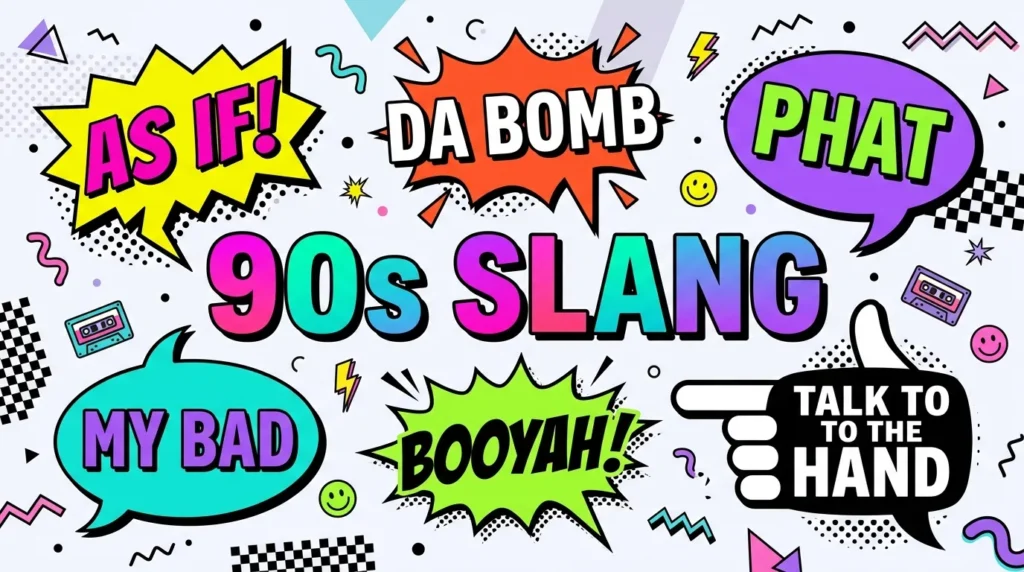

90s slang refers to informal words, catchphrases, and expressions strongly associated with American speech and pop culture during the 1990s. Think as if, da bomb, phat, talk to the hand, my bad, and all that and a bag of chips. Some started earlier but became especially recognizable during the decade.
The language of the decade was shaped by school culture, television, movies, music, regional speech, and especially hip-hop. Not every expression was used by every American, and some terms remembered as “90s slang” actually came from older African American or regional speech before reaching wider audiences.
Quick Answer: 90s Slang at a Glance
| Category | Quick Answer |
|---|---|
| Meaning of 90s slang | Informal words and phrases strongly associated with the 1990s |
| Famous examples | As if, da bomb, phat, my bad, talk to the hand |
| Typical context | Friends, school, music, movies, casual conversation |
| Tone | Playful, cool, sarcastic, confident, dismissive |
| Formality | Very informal |
| Still used today? | Some expressions survive naturally; others are mainly nostalgic |
| Important context | Many terms existed before the 1990s or came from particular communities before entering mainstream speech |
What Is 90s Slang?
90s slang is not a separate dialect or a fixed vocabulary. It is a convenient label for informal expressions that became noticeable, fashionable, memorable, or culturally important during the 1990s.
Some expressions were closely tied to the decade. Booyah, for example, is recorded in its triumphant slang sense from 1990. Others, such as dis, developed earlier within African American speech and spread far beyond their original communities over time.
That distinction matters. A phrase does not have to have been invented in the 1990s to count as 90s slang. It may simply have reached peak visibility or become strongly associated with the decade.
The best way to understand these expressions is therefore to ask three questions:
- What did it mean?
- Who was likely to use it?
- Did it actually belong mainly to the 90s, or was it older slang enjoying new popularity?
Quick List of Popular 90s Slang Terms
| Slang Term | Simple Meaning | Tone | Usage Note |
|---|---|---|---|
| As if! | Absolutely not; yeah, right | Sarcastic | Strongly associated with 90s teen culture |
| All that and a bag of chips | Extremely impressive | Playful | Often exaggerated |
| Da bomb | Excellent; amazing | Enthusiastic | Very 90s-sounding today |
| Phat | Excellent, attractive, impressive | Positive | Pronounced like “fat” |
| Talk to the hand | I don’t want to hear it | Dismissive | Can sound rude |
| My bad | My mistake | Casual | Still common today |
| Whatever | I don’t care; fine | Dismissive | Tone changes the meaning |
| Booyah! | Yes! I did it! | Triumphant | Celebration or victory |
| Buggin’ | Overreacting or acting strangely | Critical/playful | Context-dependent |
| Fly | Stylish or attractive | Positive | Older slang strongly used in hip-hop culture |
| Dope | Excellent or cool | Positive | Still widely understood |
| Fresh | Stylish, new, impressive | Positive | Often used for clothes or appearance |
| Props | Respect or credit | Positive | Usually “give props” |
| Diss / dis | Insult or disrespect | Negative | Became internationally familiar |
| Word | I agree; that’s true | Affirming | Often a short response |
| Scrub | An undesirable or unimpressive person | Insulting | Especially memorable in late-90s culture |
| No diggity | No doubt; definitely | Confident | Strongly associated with 1990s music culture |
| Bounce | Leave | Casual | “Let’s bounce” |
| Crib | Home or place where someone lives | Casual | Often associated with hip-hop speech |
| Aiight / aight | All right; okay | Casual | Highly informal |
| Sup? | What’s up? | Friendly | Still common in messages |
| Peace out | Goodbye | Friendly | More stylized than simply “bye” |
| Off the hook | Excellent or exciting | Positive | Can have other meanings |
| Getting jiggy | Dancing or getting lively | Playful | Very period-specific today |
| Bling / bling-bling | Flashy jewelry | Flashy | Late 1990s and later |
| Not! | Signals that the previous statement was sarcastic | Mocking | Usually placed after a statement |
| Psych / sike! | Just kidding; fooled you | Teasing | Older than the 90s but strongly remembered |
| Homey / homie | Close friend | Friendly | Community and context matter |
| Hater | Someone who criticizes out of dislike or jealousy | Negative | Remains common |
| Shorty / shawty | Person, often a young woman or romantic interest | Familiar | Meaning varies by context |
| Mad | Very or extremely | Emphatic | Regionally associated, especially with New York |
| Wack / whack | Bad, disappointing, uncool | Negative | Still recognizable |
| The bomb | Something excellent | Positive | Closely related to da bomb |
| Chill | Relax or calm down | Casual | Much older and still common |
| I’m Audi | I’m leaving | Playful | Highly period-specific and less universal |
Popular 90s Slang Words and Meanings
As If!
Meaning: Absolutely not, yeah right, or “that is never going to happen.”
As if works best as a sarcastic rejection.
Example:
“Would you ever go out with him?”
“As if!”
The phrase became particularly recognizable as part of 1990s teen speech and pop-culture dialogue. Today, people often use it deliberately when they want a retro or dramatic tone.
All That and a Bag of Chips
Meaning: Extremely impressive, attractive, important, or desirable.
Calling somebody “all that” was already a strong compliment. Adding “and a bag of chips” humorously suggested that the person was even better than expected. It could also be sarcastic.
Example:
“She got one compliment and now she thinks she’s all that and a bag of chips.”
Notice how the example is not really a compliment. Tone can turn the expression into playful criticism.
Da Bomb
Meaning: Excellent, amazing, or extremely impressive.
Example:
“That new game is da bomb.”
The spelling da represents an informal pronunciation of the. The expression became strongly associated with 1990s popular culture and remains one of the easiest phrases to use when deliberately imitating a 90s style.
Phat
Meaning: Excellent, impressive, attractive, or highly desirable.
It is pronounced exactly like fat.
Example:
“That beat is phat.”
Because the spelling distinguishes it from ordinary fat, writing phat signals the slang meaning immediately.
Today, it usually sounds retro rather than current.
Talk to the Hand
Meaning: I am not listening to you, or I do not want to hear what you are saying.
The phrase was often paired with an open palm held toward the other person.
Example:
“You’re going to regret doing that.”
“Talk to the hand.”
This is more dismissive than playful in many situations. Using it seriously with a teacher, manager, customer, or stranger could sound disrespectful.
My Bad
Meaning: My mistake, that was my fault, or sorry about that.
Example:
“I grabbed your notebook by accident. My bad.”
Unlike many stereotypical 90s expressions, my bad survived extremely well. The noun use of bad can refer to someone’s fault or mistake.
Today it generally sounds like ordinary casual American English rather than a retro expression.
Booyah!
Meaning: An exclamation of victory, excitement, or triumph.
Example:
“I finally beat the last level. Booyah!”
Unlike many expressions loosely placed on 90s lists, booyah has a particularly strong chronological connection to the decade: its recorded slang use meaning an expression of triumph dates to 1990.
Whatever
Meaning: Depending on tone, whatever can mean “anything is fine,” “I don’t care,” or “I reject what you’re saying.”
Example:
“You know I’m right.”
“Whatever.”
The word itself was obviously not created in the 1990s. What people associate with the decade is its exaggerated, dismissive delivery.
That tone is more important than the dictionary meaning.
Also Read: DSL Meaning Slang: What Does DSL Mean?
Not!
Meaning: Used after a statement to reveal that the statement was sarcastic.
Example:
“That haircut looks amazing… not!”
It deliberately reverses what came immediately before it.
Today this structure can sound intentionally dated, which makes it useful in jokes or 90s-themed writing.
Slang for Things That Were Cool
Dope
Meaning: Excellent, impressive, or cool.
Example:
“Those sneakers are dope.”
Dope has several unrelated meanings, including references to drugs and to a foolish person, so context matters. The positive slang meaning remains alive today.
Fly
Meaning: Stylish, attractive, fashionable, or impressive.
Example:
“You look fly in that jacket.”
The term did not suddenly appear in the 90s, but it was highly visible in music, fashion, and youth speech associated with the era.
Fresh
Meaning: Stylish, attractive, new-looking, or impressive.
Example:
“Those shoes are fresh.”
Someone could also look “fresh” if their clothes or overall appearance looked especially sharp.
Off the Hook
Meaning: In 90s-style slang, something exciting, impressive, or excellent.
Example:
“That party was off the hook.”
Be careful because off the hook can also mean being freed from responsibility or blame.
“I thought I’d have to pay, but they let me off the hook.”
The surrounding sentence makes the intended meaning obvious.
Friends, Respect, and Social Life
Props
Meaning: Respect, recognition, or credit.
Example:
“Props to Maya for organizing the whole event.”
You will often hear the structure give someone props or props to someone.
Unlike phat or talk to the hand, props can still appear naturally in modern casual speech.
Word
Meaning: I agree, that’s true, or I understand.
Example:
“We need to leave before traffic gets bad.”
“Word.”
A longer form, such as word up, could similarly signal agreement or recognition.
Diss or Dis
Meaning: To disrespect, insult, criticize, or put someone down.
Example:
“Why are you dissing my shoes?”
The word has an important cultural history. Its spread into mainstream speech followed earlier African American vernacular use, particularly among younger speakers, and its later reach became much broader than its original setting.
That makes it a good example of why “90s slang” should not be treated as something invented uniformly by an entire generation.
Homie
Meaning: A close friend, companion, or trusted person.
Example:
“That’s my homie from school.”
Its tone depends heavily on the speaker and social setting. It should not be used as a costume-like imitation of another community’s speech.
Scrub
Meaning: An unimpressive, undesirable, unsuccessful, or socially unappealing person.
Example:
“She doesn’t want to date some scrub who never makes an effort.”
The term existed before the 1990s, but its cultural association with the late 90s became especially strong.
It is insulting when applied directly to someone.
Also Read: What Does PSA Mean in Text, Chat, and Social Media?
Reactions, Attitude, and Arguments
Buggin’
Meaning: Acting irrationally, worrying excessively, overreacting, or behaving strangely.
Example:
“You think I’m paying $200 for that? You’re buggin’.”
The exact meaning depends on the situation. Someone who is “buggin’” might be anxious, unreasonable, shocked, or simply acting unusually.
Wack
Meaning: Bad, disappointing, boring, or uncool.
Example:
“That movie was wack.”
It can describe almost anything negatively: clothes, music, behavior, a party, an idea, or a situation.
Hater
Meaning: Someone who constantly criticizes or expresses negativity, often because they dislike another person’s success, style, or behavior.
Example:
“Don’t listen to the haters.”
Unlike many 90s expressions, hater has remained highly understandable in later generations.
Aiight
Meaning: An informal pronunciation and spelling of all right.
Example:
“You ready?”
“Aiight, let’s go.”
Variants include aight and a’ight.
It is strongly informal and should generally stay out of formal writing.
Leaving and Greeting People
Bounce
Meaning: Leave or go somewhere else.
Example:
“It’s getting late. Let’s bounce.”
This is still understandable today, although its use varies by speaker.
Sup?
Meaning: A shortened form of “What’s up?”
Example:
“Sup, man?”
“Not much.”
Sup eventually fit naturally into texting because it was already short and conversational.
Peace Out
Meaning: Goodbye or I’m leaving.
Example:
“I’ve got class early tomorrow. Peace out.”
The phrase normally sounds friendlier and more stylized than a simple bye.
Late-90s Expressions
Bling or Bling-Bling
Meaning: Flashy jewelry, especially jewelry displayed as a sign of wealth or status. It can also refer more broadly to expensive, flashy possessions.
Example:
“Look at all that bling.”
This term belongs near the end of a 1990s timeline rather than representing the entire decade. Its strongest mainstream cultural life also continued into the 2000s.
No Diggity
Meaning: No doubt, definitely, or certainly.
Example:
“That was the best track on the album, no diggity.”
The expression now has a distinctly retro association for many speakers.
Getting Jiggy
Meaning: Getting lively, dancing, partying, or becoming energetic.
Example:
“Everyone started getting jiggy when the music came on.”
It sounds much more period-specific today than words such as dope or my bad.
Also Read: FOMO Meaning in Text, Social Media, and Everyday Slang
90s Slang on Social Media Today
Using 90s slang on TikTok, Instagram, messaging apps, or other modern platforms usually does not create a new meaning. Instead, the old expression gains a new tone.
A person typing:
“Talk to the hand ✋”
today may be making a nostalgic joke rather than seriously rejecting someone.
Similarly:
“This playlist is da bomb.”
often sounds intentionally retro.
By contrast, phrases such as my bad, dope, props, sup, and hater can appear without sounding like deliberate 90s nostalgia because they continued circulating after the decade.
This illustrates an important feature of slang: expressions can survive while their social associations change. Meaning and community usage can evolve independently over time.
Real Conversations Using 90s Slang
1. Complimenting Something
Alex: “Did you hear Marcus’s new mix?”
Jordan: “Yeah. That beat is phat.”
Here, phat means excellent or impressive.
2. Admitting a Mistake
Mia: “You sent me the wrong file.”
Chris: “My bad. I’ll send the right one.”
This expression still sounds natural today.
3. Rejecting an Idea
Taylor: “Would you ever let him borrow your car?”
Sam: “As if!”
The reply means “absolutely not.”
4. Ending an Argument
Nina: “I told you this would happen.”
Kayla: “Whatever. Talk to the hand.”
Both expressions create a dismissive tone, so this response could easily sound rude.
5. Giving Someone Credit
Devon: “Who fixed the whole project overnight?”
Lee: “Alicia did. Props to her.”
Props communicates recognition or respect.
6. Leaving
Ryan: “It’s almost midnight.”
Jamal: “Yeah, let’s bounce.”
Here, bounce simply means leave.
7. Celebrating
Emma: “You finally passed!”
Noah: “Booyah!”
Booyah expresses victory or excitement.
Formal Versus Informal Usage
Almost all classic 90s slang belongs in casual communication.
Among friends, expressions such as these are generally easy to understand:
- My bad
- Dope
- Props
- Sup
- Chill
- Bounce
Some expressions are more obviously playful or nostalgic:
- Da bomb
- Phat
- As if
- Talk to the hand
- All that and a bag of chips
- Getting jiggy
Others can become insulting:
- Scrub
- Wack
- Hater
- Diss
- Talk to the hand
A workplace email saying “my bad” may be acceptable in a relaxed team, but “talk to the hand” directed at a colleague would usually sound disrespectful.
Formality depends not only on the word but also on your relationship with the listener.
Was All 90s Slang Used Everywhere?
No.
American slang has always varied by region, ethnicity, age, music scenes, social groups, and local communities. Language associated with teenagers in suburban California could differ from expressions used in New York, Atlanta, Chicago, or elsewhere.
Slang meanings can also vary geographically and socially rather than developing identically across every community.
Some terms that later became stereotyped as “generic 90s slang” came through African American speech and hip-hop culture. Dis is a clear example of a term that moved from African American vernacular use toward much wider recognition.
So a historically believable 90s conversation should not simply cram every famous slang expression into one sentence.
Who is speaking matters.
90s Slang That Was Actually Older
This is where many nostalgic lists become misleading.
Words such as fresh, fly, chill, psych, and dope were not necessarily creations of the 1990s. They had earlier histories but remained visible or became strongly associated with particular parts of 90s youth culture.
That does not make them “fake” 90s slang.
Think of music. A song does not need to have been written in the 1990s for people living then to have played it constantly. Slang works similarly.
There is a difference between:
Originating in the 90s
and
being popular during the 90s.
That distinction makes descriptions of the decade much more accurate.
Which 90s Slang Still Sounds Normal Today?
Several expressions aged surprisingly well.
My bad remains an easy casual way to acknowledge a mistake.
Props still means respect, credit, or recognition.
Dope continues to work as a positive adjective meaning excellent or impressive.
Bling also survived, although it is more commonly understood as a regular informal word for flashy jewelry or possessions than as a specifically 90s expression.
Expressions such as phat, da bomb, getting jiggy, and all that and a bag of chips are much more likely to sound nostalgic.
Also Read: Mexican Slang: Common Words, Meanings, and How to Use Them
Respectful Use of 90s Slang
There is nothing wrong with enjoying old slang, but context matters.
Some expressions moved into mainstream American culture after developing within particular regional or African American speech communities. Treating those expressions as exaggerated costumes, fake accents, or stereotypes can make otherwise harmless language sound mocking.
A better approach is simple:
Use expressions naturally when they fit your voice.
If you are writing historical dialogue, consider the character’s age, location, community, and personality instead of treating everyone in 1997 as if they spoke from the same slang dictionary.
That produces both more respectful and more believable language.
Why 90s Slang Sounds So Distinctive
The most memorable 90s expressions often do more than communicate information.
They perform attitude.
Compare:
“No.”
with
“As if!”
Or:
“I don’t want to listen.”
with
“Talk to the hand.”
Or:
“That is excellent.”
with
“That’s da bomb.”
The basic message remains simple, but the slang adds sarcasm, confidence, humor, exaggeration, belonging, or personality.
That emotional layer is why many expressions remain recognizable decades after they stopped sounding current.
Also Read: Toronto Slang: Popular Words, Meanings, and Examples
Frequently Asked Questions
What does 90s slang mean?
90s slang means informal words and expressions associated with speech and popular culture during the 1990s. Examples include as if, da bomb, phat, talk to the hand, my bad, and all that and a bag of chips. Not every expression originated during the decade.
What was the most popular slang in the 90s?
There is no reliable single ranking that identifies one universally most popular expression. Some of the most recognizable terms associated with the decade include as if, da bomb, phat, my bad, booyah, talk to the hand, props, and all that and a bag of chips.
What did “phat” mean in the 90s?
Phat meant excellent, attractive, impressive, or highly desirable. It was especially natural when describing things such as music, style, clothes, or something considered cool. It is pronounced like fat but uses a different spelling to signal the slang meaning.
What did “da bomb” mean?
Da bomb was a strong compliment meaning something or someone was excellent, impressive, or extremely cool. For example, saying “That new album is da bomb” meant the speaker thought the album was exceptionally good.
Is “my bad” 90s slang?
My bad became strongly associated with casual speech around the period and remains widely understandable today. It means “my mistake” or “that was my fault.” Unlike many nostalgic expressions, it no longer necessarily sounds like someone is deliberately using 90s slang.
Is “bling” a 90s slang word?
Yes, but it is better described as late-90s slang whose cultural influence continued strongly into the following decade. Bling or bling-bling refers to flashy jewelry and, more broadly, conspicuous expensive possessions.
Is 90s slang appropriate at work?
Most 90s slang is informal. Mild expressions such as my bad or props may work in relaxed workplace conversations, while expressions such as talk to the hand, scrub, or whatever can sound dismissive or insulting. Formal reports, applications, and professional correspondence normally call for standard language.
Do people still use 90s slang?
Yes, but not all expressions survived equally. My bad, dope, props, hater, and bling remain understandable and may still appear naturally. Expressions such as phat, da bomb, and getting jiggy are more likely to sound deliberately nostalgic or humorous today.
Conclusion
90s slang was less a single vocabulary than a mixture of youth speech, regional language, African American linguistic influence, music, movies, television, and everyday conversation. Expressions such as as if, da bomb, phat, talk to the hand, booyah, props, and my bad capture different parts of that culture.
The most useful thing to remember is that “90s slang” does not automatically mean “invented in the 90s.” Some expressions genuinely emerged during the decade, some became mainstream then, and others were older terms enjoying another period of popularity. Understanding that context makes the language sound much more authentic.
Related Slang Terms
Explore more slang meanings from our dictionary:

Pingback: Toronto Slang: Popular Words, Meanings, and Examples
Pingback: Cap Slang Meaning: What “Cap” and “No Cap” Really Mean
Pingback: Awesome Meaning Slang: What Does "Awesome" Mean in Text and Online?