
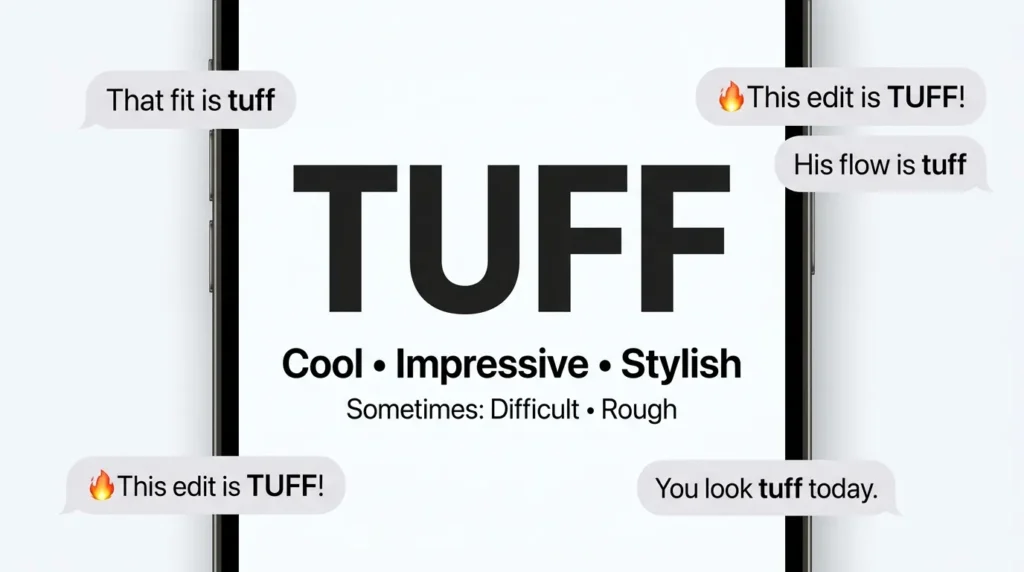

In slang, tuff usually means cool, impressive, stylish, or hard in a good way. It is an informal spelling of “tough” and often appears in texts, social media comments, gaming chats, and casual speech. Calling an outfit, song, car, edit, or performance “tuff” is usually a compliment.
Context can change the meaning. “That’s tuff” may mean “that’s rough” or “that’s unfortunate,” and it can sometimes sound sarcastic or dismissive. Tuff can also simply mean difficult, similar to standard “tough.” The spelling is especially common in casual online language rather than formal English.
| Quick Answer | Meaning |
|---|---|
| Most common meaning | Cool, impressive, stylish, excellent |
| Other meanings | Difficult, rough, unfortunate |
| Typical context | Texting, social media, gaming, fashion, music |
| Tone | Positive, admiring, playful, or sometimes sarcastic |
| Formality | Very informal |
| Pronunciation | “Tuff,” the same as “tough” |
| Offensive? | No, but certain uses can sound dismissive |
What Does Tuff Mean in Slang?
The most common slang meaning of tuff is cool, impressive, stylish, or really good.
For example:
“That jacket is tuff.”
The speaker is not saying the jacket is physically difficult or durable. They are complimenting how it looks.
You may hear the same idea with music, cars, shoes, sports plays, videos, artwork, gaming clips, hairstyles, and other things people admire.
Someone might say:
“That beat is tuff.”
Here, tuff means the beat sounds really good or impressive.
This positive meaning is especially important because simply replacing “tuff” with the standard definition of “tough” can make some online conversations confusing.
Quick Meaning of Tuff by Context
| Context | Likely Meaning | Example | Usage Level |
|---|---|---|---|
| Compliment | Cool or impressive | “Your fit is tuff.” | Very common |
| Fashion | Stylish or good-looking | “Those shoes are tuff.” | Very common |
| Music | Really good or powerful | “This track is tuff.” | Common |
| Gaming or sports | Impressive or skillful | “That play was tuff.” | Common |
| Difficult task | Hard or challenging | “That test was tuff.” | Common |
| Reaction to bad news | Rough or unfortunate | “Damn, that’s tuff.” | Common |
| Sarcastic reaction | That sucks / not my problem | “That’s tuff bro.” | Context-dependent |
| Geology | A type of volcanic rock | “The cliff contains tuff.” | Technical, non-slang |
The sentence around the word usually tells you which meaning is intended.
Does Tuff Mean Good or Bad?
Tuff can mean either good or bad, but its most recognizable modern slang use is positive.
When someone directly describes an outfit, song, car, design, video, or skill as tuff, they are usually showing approval.
Examples:
- “That car is tuff.” = That car looks amazing.
- “Your new haircut is tuff.” = Your haircut looks great.
- “That edit was tuff.” = That edit was impressive.
The meaning becomes more negative when tuff describes an experience or responds to bad news.
For example:
“That exam was tuff.”
Here, it simply means the exam was difficult.
And:
“I lost my wallet.”
“That’s tuff.”
Here, the phrase means something closer to “that’s rough” or “that’s unfortunate.”
What Does “That’s Tuff” Mean?
“That’s tuff” is more ambiguous than simply calling something tuff.
It can have several tones.
It Can Show Genuine Sympathy
Someone may use it after hearing about an unpleasant situation.
“My flight got canceled.”
“That’s tuff.”
The meaning is roughly, “That’s rough” or “That sucks.”
Also Read: Tuff Slang Meaning: What Tuff Means in Text and Online
It Can Be a Dry or Dismissive Response
Sometimes “that’s tuff” communicates very little sympathy.
For example:
“I stayed up playing games and missed my class.”
“That’s tuff.”
The second person may really mean something like, “Well, that’s your problem.”
The words themselves are not insulting. The dismissive feeling comes from the situation and tone.
It Can Still Express Approval
In another conversation:
“Look at the new design.”
“That’s tuff.”
Now it means “That looks really good.”
This is why you should not judge the phrase from the word alone.
What Does Tuff Mean in Text Messages?
In texting, tuff usually functions as a quick compliment.
A person might text:
“New shoes are tuff 🔥”
They mean the shoes are stylish or impressive.
Texting removes facial expressions and vocal tone, however, so short responses such as “tuff” or “that’s tuff” can be harder to interpret.
Look at what came immediately before the message.
If you sent a picture of your new outfit and received “tuff,” it is almost certainly praise.
If you told someone you failed an exam and they replied “tuff,” they probably mean the situation is unfortunate, although their response could also be intentionally dry.
What Does Tuff Mean on TikTok, Instagram, and Other Social Media?
Across TikTok, Instagram, X, Snapchat, Discord, and similar online spaces, tuff generally keeps the same positive slang meaning: impressive, stylish, cool, or hard in a good way.
There is usually no need to give it a completely different definition for each platform.
You might see comments such as:
- “This fit tuff.”
- “That transition was tuff.”
- “Bro this song is tuff.”
- “That build is tuff.”
- “The whole setup looks tuff.”
Fashion, music, sports, gaming, photography, edits, cars, and creative work are common contexts because tuff works naturally as a short reaction to something visually or stylistically impressive.
Online tone can also become ironic. A sad emoji, exaggerated wording, or an obviously unserious situation may turn “tuff” into a joke rather than straightforward praise.
How Context Changes the Meaning of Tuff
The easiest way to understand tuff meaning slang is to pay attention to what the word describes.
“That Outfit Is Tuff”
Meaning: stylish, cool, impressive
This is a compliment.
“That Workout Was Tuff”
Meaning: difficult or demanding
This is closer to the standard meaning of “tough.”
“Damn, That’s Tuff”
Meaning: rough, unfortunate, or disappointing
Tone determines whether the speaker is genuinely sympathetic.
“His Edit Is Actually Tuff”
Meaning: surprisingly good or impressive
Words such as “actually” can add emphasis.
“That’s Tuff Bro”
Meaning: that is unfortunate, but it may sound dismissive depending on the conversation.
A useful shortcut is:
Thing + is tuff → usually praise
Task + was tuff → usually difficult
That’s tuff + bad news → usually rough or unfortunate
That pattern will correctly explain a large share of everyday uses.
Tone and Emotional Meaning of Tuff
The literal meaning is only part of what tuff communicates. Tone matters just as much.
Admiring
This is probably the easiest meaning to recognize.
“Your setup is tuff.”
The speaker likes what they see.
Hype or Excitement
People also use tuff to emphasize that something stands out.
“That final play was tuff!”
The word carries excitement and approval.
Respectful
A person can be described as tuff because they handled something difficult well.
“She stayed calm through all of that. Tuff.”
Here, the word suggests strength or respect.
Sarcastic or Dry
A short “that’s tuff” after someone complains may communicate limited sympathy.
The same words can therefore sound caring in one conversation and dismissive in another.
Also Read: British Slang Insults: Meanings, Examples, and How Rude They Are
Real Conversation Examples of Tuff
Fashion
A: “What do you think of the jacket?”
B: “That’s tuff.”
Meaning: The jacket looks really good.
Music
A: “Listen to this beat.”
B: “Yo, this is tuff.”
Meaning: The beat sounds impressive.
Gaming
A: “I finally hit that combo.”
B: “That was tuff.”
Meaning: The move was impressive.
School
A: “How was the math exam?”
B: “Tuff. I barely finished.”
Meaning: The exam was difficult.
Bad News
A: “My phone died right before I saved the video.”
B: “Damn, that’s tuff.”
Meaning: That is unfortunate.
Friends
A: “I forgot my wallet after we already ordered.”
B: “That’s tuff bro 😭”
Meaning: The response is probably playful or teasing rather than serious sympathy.
Social Media
A: “Just finished this design.”
B: “This is actually tuff.”
Meaning: The design looks impressive.
Is Tuff an Acronym or Abbreviation?
No. Tuff is not normally an acronym, initialism, or abbreviation.
There is no standard “full form of tuff” in internet slang.
Instead, it is a stylized spelling of tough.
That distinction matters because searches for slang terms often involve abbreviations such as “LOL” or “IDK.” Tuff works differently. You pronounce the entire word normally rather than saying individual letters.
How Do You Pronounce Tuff?
Tuff is pronounced exactly like “tough.”
It rhymes with:
- stuff
- rough
- enough
Changing the spelling does not normally change the pronunciation.
The spelling mainly signals an informal or slang style when used online.
Also Read: DTF Meaning Slang: What It Means in Text and Dating
Tuff vs. Tough: What Is the Difference?
Although the words sound identical, they are not always used in exactly the same way.
Tough is the standard English spelling. It can describe someone strong, something durable, or a situation that is difficult.
Examples:
- “She is mentally tough.”
- “This material is tough.”
- “It was a tough decision.”
Tuff, when used as slang, often shifts toward praise.
Examples:
- “That outfit is tuff.”
- “This beat is tuff.”
- “Your car looks tuff.”
Writing tuff instead of tough can signal that the speaker intends the slang sense rather than ordinary formal English.
However, people sometimes use tuff simply as a casual respelling of tough, so context still matters.
Similar and Commonly Confused Slang Terms
| Term | Meaning | Main Difference | Typical Context |
|---|---|---|---|
| Tuff | Cool, impressive, stylish | Often suggests strong style or impact | Fashion, music, gaming |
| Hard | Very good or impressive | Similar positive slang meaning | Music, fashion, visuals |
| Fire | Excellent or exciting | Strong enthusiastic praise | Songs, food, outfits |
| Cold | Extremely impressive | Often praises skill or confidence | Sports, music, style |
| Tough | Strong or difficult | Standard English meaning | General conversation |
The closest slang comparison is often hard.
“That outfit is hard” and “that outfit is tuff” can communicate almost the same compliment.
“Fire” is also positive but often sounds more openly enthusiastic, while tuff can have a cooler or more understated tone.
Who Uses the Word Tuff?
Tuff is strongly associated with casual American slang, youth language, texting, social media, gaming, fashion, music, sports, and online communities.
It may appear more often among younger speakers online, but it is not limited to one generation or platform.
The slang spelling is also older than today’s short-form video apps. Variations of tuff have appeared in American informal language for decades, while social media has given the word new visibility and new meme-style uses.
Usage varies by community, so someone may see the word constantly online while another person rarely encounters it.
Where Did Tuff Slang Come From?
The exact origin of tuff as slang is difficult to reduce to one person, community, or internet moment.
What is clear is that the spelling existed in American informal language well before today’s TikTok and Instagram culture. Older youth slang used tuff in positive ways connected with being cool, sharp, strong, or impressive.
Modern internet culture did not invent the word. Instead, online communities helped revive and spread it, particularly as a short compliment for fashion, music, edits, gaming moments, and visually impressive content.
That history also explains why tuff can feel both old-school and very current at the same time.
Does Tuff Have a Non-Slang Meaning?
Yes. Tuff is also a real geological word.
In geology, tuff is a type of rock formed from volcanic material, especially compacted or cemented volcanic ash and fragments.
For example:
“The ancient structure was carved from volcanic tuff.”
This meaning has nothing to do with someone calling your outfit “tuff.”
You are unlikely to confuse the two in normal conversation because the surrounding topic makes the intended meaning obvious.
Is Tuff Offensive, Rude, or Inappropriate?
Tuff itself is not a slur, profanity, or inherently offensive word.
It is generally safe in informal conversations among friends, classmates, gaming groups, and social media users.
The main problem comes from “that’s tuff” when someone shares serious bad news.
Imagine someone says:
“My dog died yesterday.”
Responding only with:
“That’s tuff.”
could sound cold or disrespectful, even if you intended sympathy.
For serious situations, a clearer and warmer response is better.
Tuff is also very informal, so avoid it in academic essays, formal business writing, job applications, official messages, and professional documents unless you are deliberately discussing slang.
How Should You Reply When Someone Says “Tuff”?
Your response depends on what they mean.
If they are complimenting you, simple responses work:
- “Thanks!”
- “Appreciate it.”
- “Glad you like it.”
- “Good looks.”
- “I thought so too.”
If they say “that’s tuff” after you tell them something unfortunate, you usually do not need a special slang response. Continue the conversation naturally.
If their meaning is unclear, the previous message usually gives you enough information to interpret it without asking.
Common Mistakes When Using Tuff
One common mistake is assuming tuff always means difficult because it sounds like “tough.”
In modern slang, that can completely reverse the meaning of a sentence.
“Your shoes are tuff.”
does not mean the shoes are difficult. It means they look good.
Another mistake is assuming “that’s tuff” always expresses sympathy. Depending on the relationship and tone, it can be sincere, teasing, sarcastic, or dismissive.
Finally, avoid treating tuff as formal English. The slang spelling works naturally in texts and comments but can look out of place in professional writing.
Real-World Interpretation: The Sentence Pattern Gives You the Clue
The most useful thing about tuff is that you can often identify its meaning before worrying about slang trends or platforms.
When someone says “your ___ is tuff,” they are usually complimenting something.
When someone says “the ___ was tuff,” they may mean it was difficult.
When someone responds to bad news with “that’s tuff,” they usually mean “that’s rough,” although the response may carry sarcasm.
So the object being described and the position of the word often reveal more than the platform where you saw it.
Frequently Asked Questions
What does tuff mean in text?
In a text message, tuff usually means cool, impressive, stylish, or really good. For example, “Your new shoes are tuff” is a compliment. Tuff can also mean difficult when describing a task or situation, so the surrounding words help determine the intended meaning.
What does tuff mean on TikTok?
On TikTok, tuff commonly means impressive, cool, stylish, or hard in a positive sense. People may use it to praise an outfit, edit, song, sports clip, car, gaming moment, or visual style. The word can also appear in ironic comments, so emojis and context may affect the tone.
What does “that’s tuff” mean from a guy?
There is no special gender-specific meaning. A guy saying “that’s tuff” may be praising something, reacting to an unfortunate situation, or giving a dry response to bad news. Look at what you said immediately before the message rather than trying to interpret the phrase based on the speaker’s gender.
Is tuff the same as tough?
They are pronounced the same, but their usage can differ. Tough is the normal English spelling for strong, durable, or difficult. Tuff is often a deliberately informal spelling used in slang to mean cool, impressive, stylish, or excellent. Tuff is also a separate geological term for a type of volcanic rock.
Is tuff a compliment?
Usually, yes. If someone says “your outfit is tuff,” “that song is tuff,” or “your setup is tuff,” they are praising it. The word changes meaning when describing a difficult experience or when used in the phrase “that’s tuff” after bad news.
Is tuff an acronym?
No. Tuff does not have a standard full form in slang. It is usually a stylized spelling of “tough.” Unlike internet abbreviations such as LOL or IDK, you pronounce tuff as one normal word rather than saying separate letters.
Can I use tuff at work?
Tuff is best kept for casual communication. It may be fine in a relaxed conversation with coworkers who already use similar slang, but it is usually unsuitable for formal emails, reports, presentations, applications, or communication with clients. Standard words such as “impressive,” “excellent,” or “challenging” are clearer professionally.
Conclusion
Tuff most commonly means cool, impressive, stylish, or really good in modern slang. A comment such as “that fit is tuff” is normally a compliment. However, the word can also mean difficult, while “that’s tuff” may mean something is rough or unfortunate and can occasionally sound sarcastic or dismissive.
The easiest way to interpret it is to look at the sentence rather than the platform. If tuff describes something a person admires, it usually signals praise. If it describes a challenge or responds to bad news, its meaning shifts closer to “tough” or “rough.”



Pingback: Cyberpunk Slang Explained: Choom, Gonk, Preem and More
Pingback: ATP Meaning Slang: What It Means in Text and TikTok
Pingback: FUPA Meaning Slang: What It Means and How People Use It
Pingback: 90s Slang: Popular Words and Phrases From the 1990s
Pingback: ASH Meaning Slang: What Does "ASH" Mean in Text and Online?