
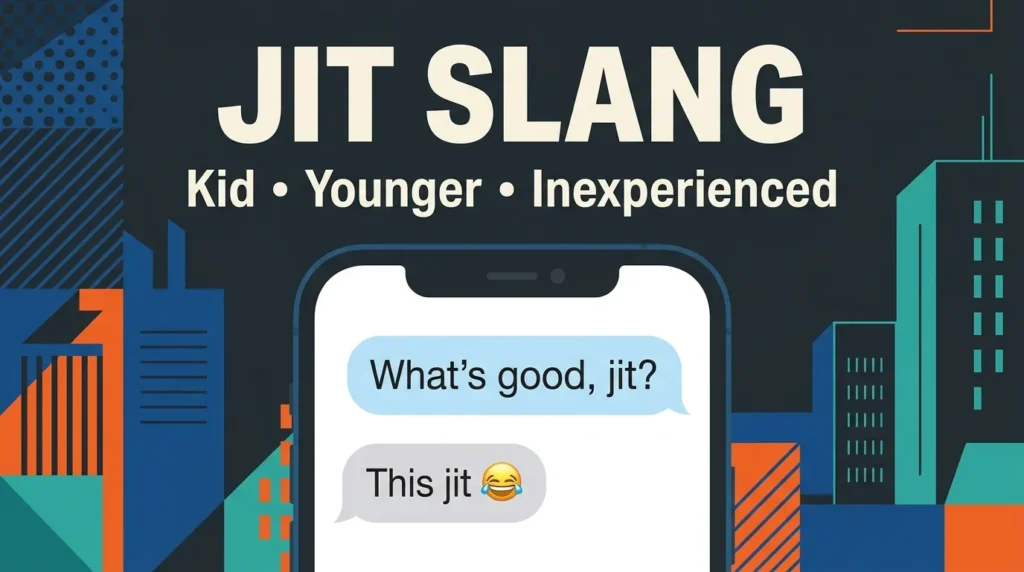

In slang, jit usually means a kid, a younger person, or someone seen as inexperienced. The term is strongly associated with Florida, particularly African American English, and it can sound neutral, playful, affectionate, teasing, or dismissive depending on the speaker and situation.
Someone might call an actual child a “jit,” but the word is not always about literal age. It can also describe a person who seems young, new, immature, or inexperienced. The same basic meaning now appears in texts, TikTok comments, Instagram posts, gaming conversations, and other casual online spaces.
| Quick Answer | Meaning |
|---|---|
| Most common meaning | Kid, young person, younger person |
| Extended meaning | Someone inexperienced, immature, or new |
| Common context | Florida slang, casual speech, social media |
| Tone | Neutral, playful, teasing, or dismissive |
| Formality | Very informal |
| Pronunciation | “Jit,” rhyming with “sit” |
| Offensive? | Not inherently, but it can sound disrespectful |
| Grammar | Usually a noun or form of address |
What Does Jit Mean in Slang?
The simplest jit slang meaning is “kid” or “young person.”
For example:
“That jit is only fifteen.”
Here, “jit” simply refers to someone young.
The word can also suggest that a person is inexperienced. An older or more experienced person might call someone a jit because they believe that person is still learning, acting immaturely, or trying to handle something beyond their experience.
For example:
“Jit thinks he knows everything already.”
The person being described might not literally be a small child. The speaker is positioning them as younger, less experienced, or less knowledgeable.
That difference is important because “jit” often communicates more than age. It can also communicate status between the speakers.
Quick Meaning of Jit by Context
| Context | Likely Meaning | Example | Usage |
|---|---|---|---|
| Florida conversation | Kid or younger person | “Come here, jit.” | Very common regionally |
| Friends joking | Younger or inexperienced friend | “Relax, jit.” | Common |
| Social media | Kid, young guy, immature person | “This jit is wild.” | Common |
| Argument | Someone being dismissed as young or inexperienced | “Sit down, jit.” | Context-dependent |
| Gaming | Younger or inexperienced player | “That jit just started playing.” | Context-dependent |
| Business or technology | Usually “just in time,” not slang | “JIT inventory” | Technical |
Does Jit Mean a Kid or an Inexperienced Person?
It can mean both.
The original idea usually centers on youth. A jit may literally be a child, teenager, or younger person.
However, speakers can extend the meaning to someone who behaves like a beginner.
Imagine two people playing basketball. One player has years of experience, while another is new. The experienced player might jokingly call the newcomer a “jit” even if their actual ages are similar.
In that situation, the word means something closer to:
- Rookie
- Newbie
- Youngster
- Little bro
- Inexperienced person
These words are not perfect synonyms. “Jit” carries its own regional and cultural flavor.
What Does Jit Mean in Text Messages?
In texting, jit normally keeps the same slang meaning it has in spoken conversation.
Someone might write:
“Where that jit at?”
This could mean:
“Where is that kid?”
Another person might text:
“Jit trippin 😂”
Here, the speaker is probably saying that the person is acting ridiculous, immature, reckless, or unreasonable.
The emoji, relationship between the people, and surrounding messages help determine whether the comment is playful or insulting.
Also Read: Tuff Slang Meaning: What Tuff Means in Text and Online
What Does Jit Mean on TikTok, Instagram, and Snapchat?
On TikTok, Instagram, Snapchat, X, and similar platforms, “jit” generally does not develop a completely different definition. It still usually refers to a young person or someone being portrayed as young, inexperienced, or immature.
Common online constructions include:
“This jit funny.”
Meaning: This kid or young guy is funny.
“What is jit doing?”
Meaning: What is this kid/person doing?
“Jit really thought that would work.”
This has a more mocking tone. The speaker is treating the person as inexperienced, foolish, or overly confident.
Social media has helped regional expressions travel far beyond their original communities, so someone using “jit” online today does not necessarily live in Florida.
How Does Context Change the Meaning of Jit?
The core definition usually remains stable, but the attitude behind the word changes considerably.
“That jit is only twelve.”
This is mainly descriptive. The speaker means a young kid.
“What’s good, jit?”
This can be friendly. The word works almost like a casual form of address.
“Sit down, jit.”
This sounds more dismissive. The speaker may be emphasizing that the other person is younger or less experienced.
“I remember doing that when I was a jit.”
Here, “jit” refers to the speaker’s younger years.
“Jit thinks he runs the whole school.”
This sounds teasing or critical. The person is being presented as young and overly confident.
The safest way to interpret the word is to consider who is speaking, who they are talking about, and what happened immediately before it.
What Tone Does Jit Have?
“Jit” does not automatically express one emotion.
It can sound affectionate when an older person casually refers to someone younger.
It can sound playful among friends who regularly tease each other.
It can also sound condescending during an argument because calling someone a jit may suggest, “You are younger than me, inexperienced, or not on my level.”
That is why translating jit simply as “kid” sometimes misses part of its meaning. The literal definition may be simple, while the social meaning depends on the relationship between the speakers.
Real Conversation Examples of Jit
Between Friends
Alex: “You really lost your keys again?”
Marcus: “Chill, jit. I found them.”
Here, “jit” is playful.
Talking About a Younger Person
“Who is that jit with your brother?”
The speaker is asking about a younger person.
During an Argument
“Jit, you don’t know what you’re talking about.”
This sounds dismissive because the speaker is using age or experience to challenge the other person.
Talking About Childhood
“I used to ride my bike everywhere when I was a jit.”
Here, jit means “when I was a kid.”
Social Media Comment
“Jit really tried to jump that fence 😂”
The tone is humorous and slightly teasing.
Gaming
“Give jit a minute. He just downloaded the game.”
Here, the word emphasizes inexperience more than age.
Also Read: British Slang Insults: Meanings, Examples, and How Rude They Are
Is Jit an Acronym?
Not reliably in its ordinary slang use.
You may encounter the explanation “juvenile in training.” That phrase has circulated as an interpretation of JIT, particularly when people connect the term with young troublemakers or street culture.
However, it should not be treated as the only proven origin of the slang word.
Older documented Florida usage connects jit with “jitterbug,” and the available history suggests that the slang existed long before many modern internet explanations of the supposed acronym became popular. The exact development of the word is not completely certain.
So it is safer to remember:
jit = kid or young/inexperienced person
rather than assuming every speaker is consciously saying an acronym.
How Do You Pronounce Jit?
“Jit” is pronounced roughly:
JIT — /dʒɪt/
It rhymes with:
- Sit
- Fit
- Hit
- Bit
It is normally pronounced as one short word rather than spelling out the individual letters J-I-T when used as slang.
Is It Jit, JIT, or Jitt?
Jit is the clearest spelling when referring to the slang word.
People may type JIT in capital letters online, but capitalization does not automatically make it an acronym.
You may also encounter informal spelling variations such as jitt, but “jit” is the standard form to use when explaining the slang meaning.
Context becomes especially important with uppercase JIT, because that abbreviation has established non-slang meanings.
Don’t Confuse Slang Jit With “Just in Time”
Outside slang, JIT commonly stands for “just in time.”
For example, businesses may discuss JIT inventory, while computing discussions may mention JIT compilation.
Those uses have nothing to do with calling someone a kid.
Compare:
“That jit is hilarious.”
Slang: young person or kid.
“The company uses JIT inventory.”
Business: just-in-time inventory.
Capitalization and the topic of the conversation usually make the difference obvious.
How Should You Reply When Someone Calls You Jit?
Your best response depends on their tone.
If a friend is joking, you can reply casually:
“Who you calling jit? 😂”
“I’m not that young.”
“Relax, old head.”
If the person sounds dismissive, you do not have to copy their tone. A simple response such as “What do you mean by that?” can clarify whether they are joking or trying to insult you.
If you genuinely do not know their meaning, asking directly is completely reasonable:
“Jit as in kid?”
Regional slang does not always translate perfectly outside the community where it developed.
Jit vs. Similar Slang Terms
| Term | Basic Meaning | Main Difference | Typical Context |
|---|---|---|---|
| Jit | Kid or inexperienced person | Strong Florida association | Casual slang |
| Youngin | Young person | Broader Southern/informal usage | Speech and social media |
| Rookie | Inexperienced person | Focuses on experience, not necessarily age | Sports, work, gaming |
| Newbie | Person new to something | Usually about being new | Internet, gaming |
| Little bro | Younger person or someone treated as junior | Often emphasizes social hierarchy | Online teasing |
| Kid | Child or young person | Standard and more widely understood | General English |
“Rookie” and “newbie” focus mostly on experience.
“Kid” focuses more directly on age.
“Jit” can communicate both ideas at once, depending on the situation.
Who Uses the Word Jit?
“Jit” has especially strong associations with Florida and African American English, and historical examples show the term being used in Florida decades before its wider internet popularity.
Florida hip-hop and wider internet culture helped introduce the expression to people outside the state. It can now appear in memes, comments, music-related conversation, gaming chats, and casual messages.
Still, not every American uses the word naturally.
Someone unfamiliar with Florida or Southern slang may have no idea what it means.
That regional history matters because copying a slang term after encountering it online does not always produce the same tone as hearing it within a community where it has been used for years.
Also Read: Truffle Butter Slang Meaning: Definition, Origin & Use
Where Did Jit Slang Come From?
The precise origin is not completely settled.
What is clear is that the word has longstanding connections to Florida African American English. Documented Florida usage exists from at least the 1990s, including examples connecting “jit” with the longer word “jitterbug.”
The term later became more visible outside Florida through music and online culture.
This makes explanations claiming that the word suddenly originated on TikTok inaccurate. Social platforms increased its visibility, but they did not create the slang.
Likewise, the popular “juvenile in training” expansion may explain how some speakers understand JIT, but it should not be presented as a universally established etymology.
Is Jit Offensive or Rude?
Jit is not inherently a slur or profanity.
Calling an actual kid a jit can be completely casual.
Among friends, the term may even sound affectionate.
However, calling another adult or teenager a jit during a disagreement can be disrespectful because it may imply:
- You are immature.
- You are inexperienced.
- You are beneath me.
- You don’t know what you’re talking about.
The word itself is therefore less important than how and why it is being used.
It is also very informal, so it generally does not belong in professional emails, academic papers, formal presentations, or situations where clear standard English is expected.
Is Jit Appropriate at Work or School?
Usually, it is better to avoid it in formal communication.
“Jit” is casual regional slang. Some coworkers, teachers, students, or clients may understand it perfectly, while others may find it confusing or overly familiar.
Instead of:
“That new jit needs training.”
Use:
“The new employee needs training.”
Instead of:
“Those jits are waiting outside.”
Use:
“Those students are waiting outside.”
You can still encounter the term casually among people who know one another, but standard wording is safer when professionalism matters.
What Does Calling Someone a Jit Really Communicate?
In real conversation, “jit” often communicates a relationship of age, experience, or status.
The speaker is not merely identifying another human being. They may also be positioning themselves as older, more experienced, or more knowledgeable.
That explains why the same word can sound warm in one sentence and patronizing in another.
Compare:
“That my jit right there.”
This can sound familiar or affectionate.
“You don’t know anything, jit.”
This creates a hierarchy. The speaker is intentionally placing the other person in the junior position.
Recognizing that social layer makes the slang much easier to interpret than memorizing “jit = kid” alone.
Frequently Asked Questions
What does jit mean in slang?
Jit usually means a kid, younger person, or someone viewed as inexperienced. It is especially associated with Florida slang. Depending on the speaker’s tone, the word can be neutral, affectionate, playful, teasing, or dismissive.
What does jit mean in text?
In texts, jit usually means the same thing as it does in speech: a kid, young person, or inexperienced person. A message such as “jit trippin” normally suggests that the person is acting foolishly, immaturely, or unusually.
What does jit mean on TikTok?
On TikTok, jit generally refers to a young person or someone portrayed as young, immature, or inexperienced. The term did not originate on TikTok; online platforms helped spread a regional slang word to a much larger audience.
Does jit stand for juvenile in training?
“Juvenile in training” is a popular explanation for JIT, but it should not be treated as the single confirmed origin. Historical Florida usage also connects “jit” with “jitterbug,” so the word’s exact etymology is better described as uncertain.
Can jit mean friend?
Sometimes a speaker may use jit directly toward someone they know in a friendly way, making it sound similar to “bro,” “little bro,” or another casual form of address. Its underlying association with youth or junior status usually remains present.
Is calling someone jit disrespectful?
Not necessarily. Among friends or when referring casually to a younger person, it may be harmless. During an argument, however, calling someone a jit can sound condescending because it may imply that the person is immature, inexperienced, or beneath the speaker.
Can an adult be called a jit?
Yes, depending on context. Although the word usually relates to youth, someone can jokingly or dismissively call an adult a jit if they think that person is acting inexperienced, immature, or like a newcomer.
Is jit still used today?
Yes. Jit remains recognizable in Florida-origin slang and continues to appear in online conversation, music-related contexts, memes, and social media. Its wider internet use has not completely erased its strong regional association.
Conclusion
Jit slang most commonly means a kid, younger person, or someone viewed as inexperienced. Its strongest cultural connection is with Florida, although music and social media have carried the term far beyond the state.
Context determines the tone. “Jit” can be a casual way to refer to someone younger, a friendly form of address, or a dismissive label suggesting that someone is immature or inexperienced. It is not inherently offensive, but it can sound patronizing in the wrong conversation.
When you encounter the word online or in a message, look at the speaker’s relationship, tone, and surrounding words. Those clues usually reveal exactly what “jit” is doing in the sentence.


Pingback: British Slang Insults: 25 UK Insults and Meanings