


DTF means “down to fuck” in slang. It is blunt adult shorthand for being open to a casual sexual encounter, common in texts and dating apps.
Table of Contents
- DTF at a Glance
- What Does DTF Mean in Slang?
- Where Did DTF Come From?
- How People Actually Use DTF: A Usage Map
- DTF in Text Messages and on Dating Apps
- DTF on Snapchat, TikTok, and Instagram
- Tone, Boundaries, and Consent: What DTF Does Not Mean
- When NOT to Use DTF
- How to Reply When Someone Sends You DTF
- DTF vs NSA vs FWB vs Hookup (and DTE)
- Other Meanings of DTF You Might Run Into
- DTF Myths vs Facts
- People Also Ask About DTF
- Sources and Further Reading
DTF at a Glance
DTF is a blunt adult acronym that means “down to fuck,” and it signals openness to a casual sexual encounter. It shows up in private texts and on dating apps, almost always between adults who already know the context. The table below gives the short version before the full guide explains each point.
| Question | Short answer |
|---|---|
| What does DTF mean? | “Down to fuck”: open to a casual sexual encounter. |
| Where do people use it? | Private texts, dating apps, and adult chats. |
| Who uses it? | Mostly adults, often on apps like Tinder. |
| What is the tone? | Direct, casual, and very blunt. |
| Is it consent? | No. Saying DTF is not consent to any act. |
| Is it offensive? | It can be, when it is sent to the wrong person or in the wrong place. |
Keep this table in mind as you read. The rest of the guide fills in the history, the settings where the term fits, the places where it does not, and the replies that work when someone sends it to you.
What Does DTF Mean in Slang?
DTF stands for “down to fuck,” and it means a person is open to a casual sexual encounter. The phrase is blunt by design, and people use it to state interest directly instead of hinting at it. It is adult slang, and it belongs in private conversation between consenting adults.
The letters work like other dating acronyms: they pack a whole sentence into three characters. “Down to” means willing or interested, and the last word names the act plainly. The result is a phrase with no soft edges, which is why it feels shocking to people who meet it for the first time and normal to people who use dating apps every day.
Context decides how the phrase lands. Sent to a partner or a match who has already shown the same interest, it reads as a direct invitation. Sent to a stranger, a coworker, or someone who never asked, it reads as rude or harassing. The words stay the same, but the relationship and the setting change everything about them.
People also use DTF as a joke or a test. A friend might text it to make someone laugh, and a match might send it to see how the other person reacts. In those cases the sender may not mean it literally, but the joke only works because everyone knows the literal meaning. If you are unsure whether it is a joke, treat it as literal and reply honestly, since guessing wrong can cause real harm.
DTF sits in a group of blunt adult terms that show up in the same chats. Our guide to bricked up slang covers another direct term from the same world, and our guide to YN meaning in slang explains a term that also comes from dating and street talk. For the wider adult category, read our guide to NSFW meaning in slang, and for a coded number term from the same scene, see our guide to 304 slang.
Where Did DTF Come From?
DTF grew out of late 1990s hip hop and early 2000s internet culture, and it spread through music, film, television, and dating apps. The phrase was already in use before the internet made it famous, and each new platform gave it a bigger audience. The timeline below follows the moments that matter most.
The earliest clear record comes from music. Big Pun used the phrase in his 1998 song “Still Not a Player,” which put the acronym in front of a wide audience. The song treated it as casual bragging, and the phrase stuck in hip hop lyrics after that. It was street slang first, and the internet picked it up later.
The first online dictionary record followed a few years later. Urban Dictionary traces its earliest DTF entry to December 12, 2002, which shows the term was already known well enough for someone to define it. The site became the reference point for slang, and the DTF entry helped fix the meaning for a whole generation of internet users.
Film gave the phrase another push. The 2007 comedy Superbad includes a well known DTF quote, and the joke landed because the audience already knew what the letters meant. The film did not invent the term, but it carried it into mainstream conversation, and people who had never heard it in music met it on screen.
Television pushed it further. Jersey Shore, which first aired in 2009, used the term often enough that it became tied to the show in the public mind, and the series helped popularise DTF with viewers who did not follow hip hop or internet slang. By the early 2010s the acronym was common knowledge, and dating apps gave it a daily use.
MeansToday notes that the term moved from music and television into texting and dating apps, where it became a standard part of how people signal interest. RizzleLineLove traces the same path and points out that the phrase kept its blunt meaning at every step, which is rare for slang that crosses from one scene to another.
Here is the timeline in short:
- 1998: Big Pun uses the phrase in “Still Not a Player.”
- December 12, 2002: The earliest Urban Dictionary DTF entry appears.
- 2007: Superbad puts a DTF quote on screen.
- 2009: Jersey Shore helps popularise the term.
- 2010s: Dating apps make DTF a daily part of texting.
The history matters because it explains the tone. DTF was never polite slang, and it was never meant for formal settings. It came from music and television that prized direct talk, and it kept that edge when it moved into texting.
How People Actually Use DTF: A Usage Map
DTF shows up in a small set of places, and each place has its own rules. It is most common in private one to one chats and on dating apps, where both people have already signalled romantic or sexual interest. It is rare in public posts, group chats, and work messages, where the same words would feel out of place or hostile.
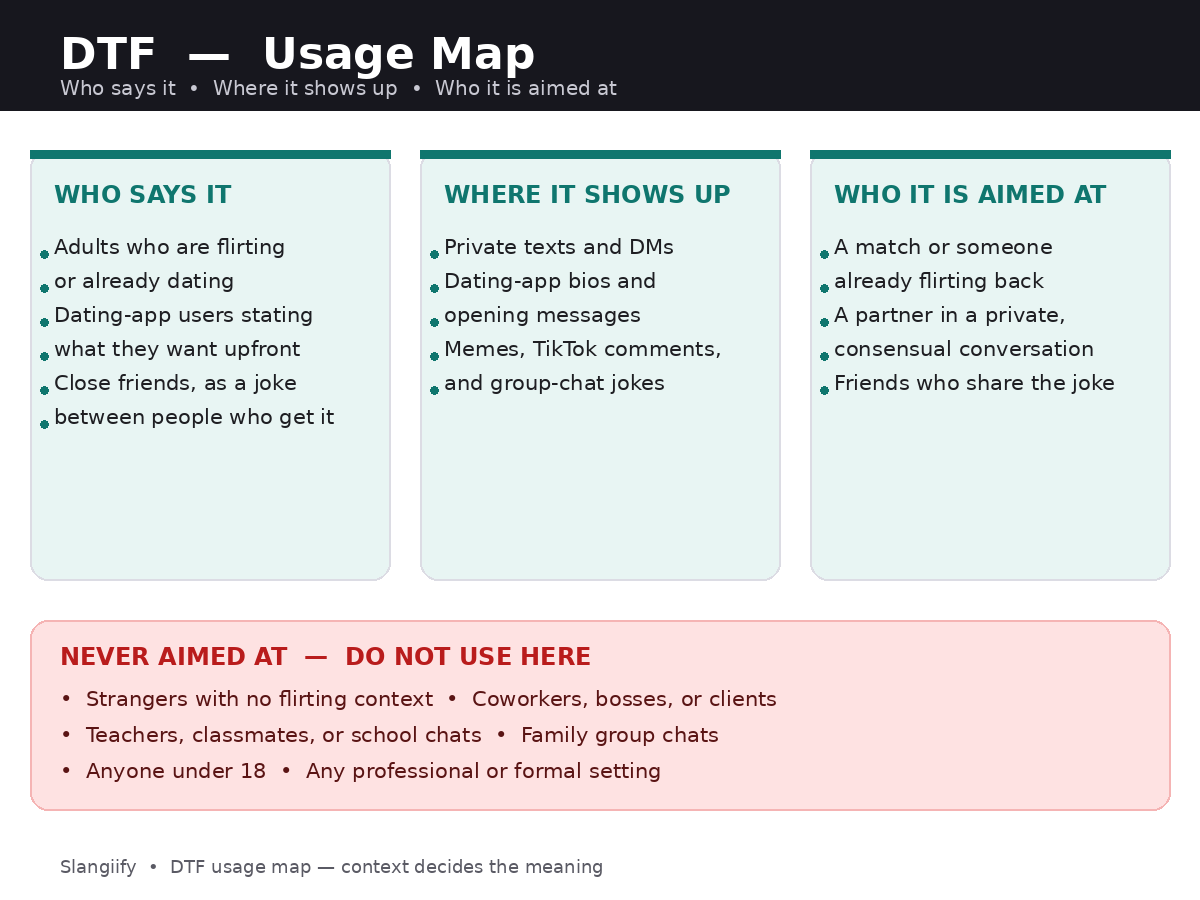
The map above sums up the pattern at a glance: adults say it, it appears in late night private chats and dating apps, it is aimed at a partner or a willing match, and it never belongs in work, school, family, or public settings. Keep that picture in mind and you will rarely misjudge the term.
Timing matters too. DTF usually appears late in a conversation, after flirting has already started, not as an opening line. A message that opens with DTF reads as lazy or aggressive, while the same message sent after a long back and forth reads as a direct next step. The words are the same, but the moment changes how they land.
Frequency is another clue. People who use dating apps see DTF often, sometimes several times a week. People who do not use those apps may go years without meeting it. That gap explains why the term feels normal to some readers and shocking to others, and why it is worth explaining plainly.
DTF in Text Messages and on Dating Apps
In text messages, DTF usually appears as a short question or a statement late at night, often after a match has moved from an app to a private chat. On dating apps, it appears in bios, opening messages, and replies, where it works as a fast filter: it tells the other person what the sender wants without a long conversation first.
On Tinder, the term is common enough that many users treat it as normal app language. A bio that says “DTF” tells visitors the person is looking for something casual, and a message that says “you DTF?” asks the same question directly. MeansToday notes that the phrase became a standard part of dating app talk, and RizzleLineLove points out that it helps people sort matches quickly, for better or worse.
The shorthand also appears in other forms. “U DTF?” is the question form, “DTF tonight?” adds a time, and “not DTF” is a clear no. Each form keeps the same blunt meaning, and each one expects a yes or no answer rather than a long discussion. That directness is the point, and it is also the risk, since a short message leaves little room for nuance.
In group chats, DTF works differently. It is usually a joke between friends, not a real invitation, and the humor comes from how blunt it sounds outside a private chat. A friend might send it to tease someone about a crush, and the group laughs because everyone knows the literal meaning. The same message sent to one person alone would read very differently.
Our guide to cyberpunk slang shows how another scene built its own shorthand for quick messages, and the pattern is the same: short terms that carry a lot of meaning for people inside the scene and little for people outside it.
DTF on Snapchat, TikTok, and Instagram
On Snapchat, DTF shows up in private snaps and chats, where disappearing messages make blunt talk feel safer. On TikTok, it appears in comments, captions, and story replies, often as a joke about a video or a creator. On Instagram, it shows up in direct messages and in close friends stories, where the audience is small and the context is clear.
The platform changes the risk. A disappearing Snapchat message still leaves a record if the other person screenshots it, and a public TikTok comment with DTF can be seen by anyone, including people who were never meant to read it. The term feels private, but the internet is not private, and a message sent in one place can travel to another.
On TikTok, the term also appears as a joke format. Creators use it in captions about dating fails, and commenters reply with it to tease a video. The joke works because the audience knows the literal meaning, and the humor comes from how direct it sounds in a public feed. The same words in a private message would not be a joke at all.
On Instagram, DTF is rarer in public posts and more common in direct messages, where it works like a text message. A reply to a story that says DTF is a direct signal, and the person who sent it usually expects a clear yes or no. If you receive it and you are not interested, a plain no is enough, and you do not owe a long explanation.
Tone, Boundaries, and Consent: What DTF Does Not Mean
DTF is a statement of interest, not consent. Saying DTF, receiving DTF, or matching with someone who wrote DTF does not agree to any specific act, and consent must be given clearly and freely for each step, and it can be taken back at any time. This is the most important point in this guide, and it applies no matter how the term was used.
The tone of DTF is blunt and casual, which can hide how serious the subject is. A short message makes a big topic sound small, and that mismatch causes real problems. A person who sends DTF may think they are being clear, while the person who receives it may feel pressured, confused, or unsafe. Clear words do not remove the need for care.
Boundaries work in both directions. If you send DTF, accept a no without arguing, and do not send it again after a no. If you receive DTF and you are not interested, a plain no is a complete answer. If you receive it and you feel unsafe, block the sender and report the message on the app. No one owes a polite reply to a message that crossed a line.
DTF also does not mean a person is available to anyone. It means they are open to a casual encounter with a specific person in a specific moment, and that openness can change. A bio that says DTF is not an open invitation to every reader, and a message that says DTF is not a promise. Treat each message as a single question, not as a contract.
The same rule applies to jokes. A friend who texts DTF as a joke is not consenting to anything, and a match who sends it to test a reaction has not agreed to anything either. Consent is a separate conversation, and it happens in plain words, not in slang.
When NOT to Use DTF
DTF has a narrow safe zone, and most of life sits outside it. Do not use it at work, at school, with strangers, with family, or with anyone under 18. Do not use it in public posts, group chats with mixed company, or any message where the reader has not already shown the same kind of interest.
At work, the term can count as sexual harassment, even if you meant it as a joke, and a single message can cost a job or a reputation. At school, it can lead to discipline and real harm to another student. With strangers, it reads as harassment, not flirting, and it can frighten the person who receives it. With family, it is simply the wrong language for the relationship.
The age rule is absolute. Never send DTF to anyone under 18, and never use it in any chat where a minor might read it. The term is adult slang for adults, and using it around minors is wrong and, in many places, unlawful. If you are not sure someone is an adult, do not use the term at all.
Do not use DTF to pressure someone either. Sending it again after a no, sending it to someone who asked you to stop, or using it to test whether a person will give in are all forms of pressure. A single clear message is enough. If the answer is no, or if there is no answer, the conversation is over.
Do not use it in public either. A public comment with DTF can embarrass the person it names, and it can follow both of you in screenshots and search results. Keep the term in private chats between consenting adults, and keep it out of every other setting.
How to Reply When Someone Sends You DTF
Your reply depends on what you want, and a short honest answer is almost always the best one. If you are interested, say so plainly and talk about what comes next in clear words. If you are not interested, a plain no is enough. If you are unsure, say that, and take the time you need before you answer.
| Situation | Reply script | When to use it |
|---|---|---|
| You are interested | “Yes, I am. Want to talk about when and where?” | You know the person and you want the same thing. |
| You are not interested | “No, I am not into that. Thanks for asking.” | Any no, to anyone, at any time. |
| You are unsure | “I am not sure yet. Can we talk a bit first?” | You need more time or more information. |
| It was a joke | “Ha, good one. Anyway, what were you saying?” | It was clearly a joke between friends. |
| It crossed a line | “Do not send me that again.” | A stranger, a coworker, or a repeat message. |
| You feel unsafe | Block and report, with no reply at all. | Any message that frightens you or feels threatening. |
A good reply is short, honest, and kind. You do not need to explain a no, and you do not need to soften it. A yes should still be followed by a real conversation about boundaries and consent, since a three letter reply is not a plan. The scripts above give you the words, and your own judgment fills in the rest.
If the message came from a stranger or from someone at work or school, save a screenshot before you block or report it. The record helps if you need to show what happened, and the apps take reports more seriously when the message is attached.
DTF vs NSA vs FWB vs Hookup (and DTE)
DTF is one of several terms for casual dating, and the differences between them are about the relationship, not just the act. DTF states interest in a single encounter, while the other terms describe ongoing setups or the encounter itself. The table below compares the five terms people confuse most often.
| Term | What it means | How it differs from DTF |
|---|---|---|
| DTF | Open to a casual sexual encounter | The blunt statement of interest itself |
| NSA | No strings attached: casual with no commitment | Describes the arrangement, not just the interest |
| FWB | Friends with benefits: friends who are also intimate | An ongoing friendship, not a single encounter |
| Hookup | A casual sexual encounter | The event itself, not the statement of interest |
| DTE | Down to explore: open to trying new things | Wider and softer, and not always about sex |
Use the table as a quick check. If someone says DTF, they are stating interest. If they say NSA, they are also setting a rule about commitment. If they say FWB, they are describing a friendship. The words overlap, but each one adds a different piece of information.
DTF vs. NSA
NSA means no strings attached, and it describes a casual arrangement with no commitment. DTF states interest in a single encounter, while NSA sets the terms for however long the arrangement lasts. A person can be DTF for one night and also want NSA, but the two words answer different questions.
DTF vs. FWB
FWB means friends with benefits, and it describes two friends who are also intimate on a regular basis. DTF can start a FWB setup, but it does not require a friendship, and it does not promise that the encounter will repeat. FWB is a relationship; DTF is a moment.
DTF vs. Hookup
A hookup is the encounter itself, while DTF is the statement that a person wants one. People say “we hooked up” after the fact, and they say “I am DTF” before it. The two words sit on opposite sides of the same event.
DTF vs. DTE
DTE means down to explore, and it is wider and softer than DTF. It can mean open to trying new things in dating, travel, or intimacy, and it does not always mean sex. DTF is direct about one thing; DTE leaves the door open to many things.
Other Meanings of DTF You Might Run Into
DTF has a few other meanings outside slang, and context tells you which one applies. In most texts and dating chats, the slang meaning is the right one. In a print shop, a lab, or a fight video, a different meaning may fit better.
Direct to Film printing
In garment printing, DTF stands for Direct to Film, a method where a design is printed on a film and then transferred to fabric with heat. Print shops use it for custom shirts and hoodies. If the conversation is about printers, ink, or shirts, this is the meaning that fits.
Down to fight
In some online arguments and fight videos, DTF means “down to fight,” as in ready for a physical fight. The tone is aggressive, and the setting is usually a comment thread or a challenge video. The slang meaning about dating does not fit there, and the fight meaning is the right read.
Deuterium-tritium fusion
In physics, DTF can stand for deuterium-tritium fusion, a reaction where two forms of hydrogen fuse and release energy. It appears in science writing about fusion power. If the page is about energy or plasma, this is the meaning, and the slang reading would be wrong.
When you are unsure, look at the setting. A dating app means the slang term, a print shop means Direct to Film, a fight video means down to fight, and a science paper means fusion. The letters stay the same, and the room decides what they mean.
DTF Myths vs Facts
A term this blunt collects plenty of wrong ideas. Here are the six myths people repeat most, and the facts that correct them.
Myth: DTF always means the person wants sex right now. Fact: it means they are open to a casual encounter, but the timing, the person, and the setting still matter. A message sent as a joke, a test, or a late night thought is not a demand, and it is not a promise.
Myth: If someone writes DTF in a bio, they consent to anything. Fact: a bio states a general interest, and consent still has to be given clearly for each step, and it can be taken back. A bio is not an agreement, and it is not an invitation to every reader.
Myth: Only men say DTF. Fact: people of all genders use the term, and dating apps show it in bios and messages from everyone. The idea that it belongs to one gender comes from old jokes, not from how the term is actually used.
Myth: DTF is the same as NSA and FWB. Fact: the terms overlap but they are not twins. DTF states interest, NSA sets a rule about commitment, and FWB describes a friendship. Each word adds a different piece of information, and mixing them up causes confusion.
Myth: DTF is always offensive. Fact: the term is blunt, but it is not always offensive. Between consenting adults who have already shown the same interest, it is a normal part of dating app talk. It becomes offensive when it is sent to the wrong person, in the wrong place, or after a no.
Myth: DTF is a new TikTok word. Fact: the term goes back to a 1998 song and a 2002 dictionary entry, and it spread through film and television before TikTok existed. The app gave it a new stage, but the word is much older than the platform.
People Also Ask About DTF
What does DTF mean in texting?
In texting, DTF means “down to fuck,” a blunt way to say a person is open to a casual sexual encounter. It usually appears in private chats between adults who already know the context.
What does DTF mean on Tinder?
On Tinder, DTF means the same thing, and it is common in bios and messages. It signals that the person is looking for something casual, and it helps matches sort each other quickly.
What does DTF mean on TikTok?
On TikTok, DTF usually appears as a joke in comments and captions about dating, and it means the same thing as in texting. The public setting makes it a joke rather than a real invitation in most cases.
Is DTF a bad word?
DTF is not a swear word in the usual sense, but it is blunt adult language. It is fine in private chats between consenting adults, and it is wrong at work, at school, with strangers, with family, and with anyone under 18.
What does DTF mean from a guy?
From a guy, DTF means the same as from anyone else: he is open to a casual sexual encounter. The meaning does not change with gender, and the reply should be based on what you want, not on who sent it.
What does DTF mean from a girl?
From a girl, DTF means the same thing: she is open to a casual sexual encounter. The term is used by people of all genders, and the meaning stays the same no matter who sends it.
How do you reply to DTF?
Reply with a short honest answer. Say yes plainly if you are interested, say no plainly if you are not, and say you need time if you are unsure. If the message crossed a line, say so, and block or report the sender if you feel unsafe.
Sources and Further Reading
- Urban Dictionary, DTF page
- MeansToday
- RizzleLineLove



Pingback: PTSO Meaning Slang: What It Means in Text and TikTok
Pingback: Truffle Butter Slang Meaning: Definition, Origin & Use
Pingback: YOLO Meaning Slang: What It Means and How to Use It
Pingback: 369 Meaning Slang: What Does "369" Mean in Text and Online?
Pingback: British Slang Insults: 25 UK Insults and Meanings
Pingback: Laced Slang Meaning: Drinks, Laced Up & Laced With
Pingback: Gooch Meaning Slang: What Does "Gooch" Mean in Text?