

In slang, 304 is a coded way to write “hoe,” a derogatory label aimed at someone, most often a woman, who is being judged for sexual behavior. The number comes from an old calculator trick: type 304, flip the calculator upside down, and the digits read as the letters h-O-E. It is not an acronym, and the digits do not stand for words. It is visual wordplay, and the code is the whole point.
Context decides everything with this number. In a comment section about dating or drama, 304 is almost certainly the insult. On a product label, in a browser’s network tab, or in a phone number, it means something completely different. This guide starts with the slang, shows exactly how the calculator trick works, clears up the phone-keypad myth, and then covers the other lives of 304, including the HTTP status code that web developers see every day.
| Quick Answer | Meaning |
|---|---|
| Most common slang meaning | A coded insult meaning “hoe” |
| Type | Numeric slang, not an acronym |
| Origin | Upside-down calculator wordplay |
| Common places seen | Text messages, comments, memes, social media |
| Tone | Usually negative, mocking, or insulting |
| Safe for professional use | No, it can be offensive |
| Other real meanings | HTTP 304 Not Modified, West Virginia area code, stainless steel grade 304 |
| Context matters | Yes, the same number has unrelated meanings |
Table of Contents
- What Does 304 Mean in Slang?
- The Calculator Trick, Digit by Digit
- The T9 Myth: Why 304 Did Not Come From Phone Keypads
- Why People Type 304 Instead of the Word
- 304 in Texts, TikTok, and Comments
- 304 in Tech: HTTP 304 Not Modified
- The Other 304s: Steel, Area Code, and Room Numbers
- 304 vs Hoe, Thot, and Player
- How to Reply When Someone Says 304
- Is 304 Offensive?
- People Also Ask About 304
- Sources and Further Reading
What Does 304 Mean in Slang?
In online slang, 304 is mainly used as a hidden way to write “hoe.” The number is not chosen because it represents a phrase or because each digit stands for a word. Instead, the meaning comes from visual wordplay: the digits look like letters when the display is turned upside down. Wikipedia notes that the calculator spelling 304 eventually entered common slang in the 2020s as a euphemism, and adds a neat detail: the traditional slang spelling “ho” has no e, so 304 more accurately spells the garden tool than the insult. The code stuck anyway.
When people use the term, they are usually making a judgment about someone’s sexual behavior or reputation. Because of that, 304 is generally considered an insulting expression rather than a neutral description. “Everyone knows she is a 304.” In this sentence, the speaker is using 304 as a negative label. The intention is usually criticism, teasing, or online drama rather than a factual statement.
Slang terms often carry social meaning beyond their literal form. Writing a number instead of a word does not automatically remove the original insult. A coded insult is still an insult, and most readers who know the code will read it that way. That is worth keeping in mind before typing it, because the number looks harmless to anyone who does not know the trick, while the meaning lands fully for anyone who does.
Is 304 an Acronym?
No. 304 is not an acronym or abbreviation where each number represents a word. Some internet terms are created from shortened phrases, such as LOL, BRB, and IDK. 304 works differently. It belongs to a style of number-based wordplay where digits are used because they visually resemble letters when viewed in a certain way. This distinction helps explain why someone unfamiliar with internet slang may see “304” and assume it is a random number.
The Calculator Trick, Digit by Digit
The slang meaning comes from the classic calculator spelling trend. Before smartphones became common, many people experimented with typing numbers into calculators and turning the screen upside down to create words. Wikipedia describes calculator spelling as an unintended characteristic of the seven-segment display traditionally used by calculators, in which the digits resemble letters of the Latin alphabet when read upside down. The letter set it can produce is sometimes called “beghilos,” from the letters B, E, G, H, I, L, O, S, and Z.
Here is the mapping that makes 304 work:
| Digit typed | Looks like when flipped |
|---|---|
| 3 | E |
| 0 | O |
| 4 | h |
There is one more step, and it is the part most explanations skip. Flipping the calculator also reverses the order of the digits. Type 304 and flip it, and the 4 appears first on the left. You read h-O-E. The same gimmick created some of the most famous calculator words ever typed:
| Number | Flipped reading | Notes |
|---|---|---|
| 07734 | hELLO | The classic harmless example |
| 5318008 | BOOBIES | The playground favorite, dating from the 1970s |
| 304 | hOE | The insult version |
| 3045 | SHOE | Harmless, and it shows the system works |
| 710 | OIL | Also harmless |
Calculator words themselves date back decades. Wikipedia traces the earliest known examples to the first handheld LED calculators in the 1970s, with 5318008 spelling “BOOBIES” as the original attributed example from that period, and 0.7734 spelling “hello” as another early one. Students experimented with calculators to discover new words, and the popularity of pagers in the 1990s gave the same idea a second life as “pager-speak.” The 304 version took longer to travel. It spread through online comments and chat apps as users looked for ways to type insults without tripping filters, and it gained speed with short-video platforms and mobile messaging in the 2020s.
The T9 Myth: Why 304 Did Not Come From Phone Keypads
Plenty of websites claim 304 comes from an old T9 phone keypad. It sounds plausible, and it is wrong. The claim falls apart under a quick test, and the test takes about ten seconds.
On a standard phone keypad, the letters map like this: H sits on the 4 key (GHI), O sits on the 6 key (MNO), and E sits on the 3 key (DEF). So spelling H-O-E on a T9 keypad produces 4-6-3, not 3-0-4. The digit 0 on a T9 keypad does not carry the letter O at all. Try it yourself on a photo of an old flip phone and you will never get 304.
Why does the myth persist? It sounds technical and nostalgic, and a lot of content sites copy each other without testing the claim. The calculator explanation matches the visual shape of the digits. The T9 explanation matches nothing. A useful rule for number slang: if an explanation of a term does not match the shapes or the keypad positions of the digits, it was probably invented.
Why People Type 304 Instead of the Word
People reach for the number instead of the word for a few clear reasons. None of them change the meaning, but they explain why the code caught on.
To Dodge Word Filters
The most practical reason is moderation. Automated filters on TikTok, Instagram, and other platforms flag the spelled-out word, so users swap letters for digits and the insult looks like a harmless number. Creators regularly report the number being used as a workaround for banned words. The code lets the insult through, at least until moderators learn it too.
To Keep Plausible Deniability
A number gives the sender a shield. “It is just a number” works as a defense, but only on people who do not know the code. Anyone who knows what 304 means hears the insult clearly. The deniability is thin, and it usually collapses the moment someone asks what the number means.
To Signal an Inside Joke
Some communities enjoy coded words because they feel like shared knowledge. Understanding the number becomes a small sign that someone belongs to the same online space. The code marks the speaker as someone who knows the reference, which is part of the appeal for meme groups and comment sections.
To Make an Insult Feel Less Direct
Using a number can make an insult appear less obvious. Some users feel that coded language sounds more playful or less aggressive, even when the meaning remains negative. That feeling is misleading. The target of the comment hears the same judgment, with or without the digits.
304 in Texts, TikTok, and Comments
In private messages, 304 usually keeps the same slang meaning. Someone may send it as a comment about another person, a joke between friends, or part of an online argument. “Bro really dated a 304.” The speaker is making a negative judgment about the person being discussed. “They called her a 304 because of that post.” Someone used the term as an insult connected to perceived behavior.
The number itself does not explain the emotion. The surrounding conversation shows whether it is being used seriously, sarcastically, or as a joke. The important point is that the number itself does not explain the emotion, so readers should look at the words around it before reacting.
| Context | Likely meaning | Example | Usage level |
|---|---|---|---|
| Social media slang | Coded insult meaning “hoe” | “They called her a 304” | Very common online |
| Text messages | Same slang meaning | “Stop acting like a 304” | Common |
| TikTok comments | Insult or joke, often to dodge filters | “304 behavior fr” | Very common |
| Manufacturing | Stainless steel grade | “304 steel bottle” | Common |
| Phone numbers | Area code | “A 304 number” | Common |
| Web and tech | HTTP 304 Not Modified | “The server returned 304” | Extremely common |
| General numbers | Code or identifier | “Room 304” | Common |
304 on TikTok
On TikTok, slang often spreads through viral videos, comment sections, memes, creator communities, and repeated jokes. Someone who does not know the meaning may see hundreds of comments containing “304” and assume it is a random trend. The meaning becomes clear when it appears near topics involving dating, relationships, arguments, gender discussions, and online jokes.
TikTok is also where the filter-dodging use is most visible. Users drop 304 under videos to insult creators, and some use it in captions as a joke. Moderation tools flag the term on and off, and creators regularly report the number being used as a workaround for banned words. The platform itself does not change the definition, but trends can make the term more visible, and the slang is not a TikTok invention. It is internet slang that rides along on every app where people type short messages.
304 on Snapchat, Instagram, and Other Platforms
The meaning usually stays the same across different platforms. A comment saying “304” on Instagram and a message containing “304” on Snapchat generally rely on the same slang understanding. The biggest difference is not the app. It is the relationship between the people using it. A joke between close friends may have a different tone from a public comment aimed at a stranger.
You will also find it in Discord servers and gaming lobbies, group texts and WhatsApp threads, and dating app bios and chats. That cross-platform spread is part of why the term feels unavoidable online. The same code pops up in different formats, and the slang travels wherever short typed messages travel.
How Context Changes the Meaning
The easiest way to understand 304 is to examine nearby words. “That girl is a 304” is likely an insult. “Why does everyone keep saying 304?” is someone asking about the slang itself. The same number can carry completely different meanings depending on the sentence, and the relationship between speakers changes how slang is received. A person joking with a close friend may use language differently from a stranger, a coworker, a public commenter, or someone during an argument. Online, people often misunderstand tone because written messages remove facial expressions and voice cues.
304 in Tech: HTTP 304 Not Modified
Now for a completely different world. If you work with websites, 304 is routine. It is also one of the most helpful numbers in the web stack, and it has nothing to do with slang.
HTTP 304 Not Modified is a status code a web server sends when the browser already holds a valid copy of a file. It tells the browser one thing: the copy you already stored is still current, so use it. The official definition lives in RFC 9110, Section 15.4.5, which describes the code as the answer to a conditional request whose condition evaluated to false. Here is the key point: a 304 is not an error. It is a success of the caching system, and it belongs to the 3xx family of HTTP response codes.
How the Exchange Works
The process uses a conditional request, which is the browser asking, “Has anything changed since I last visited?” There are three steps. First, the browser requests a file it already has in its cache and adds a validator to the request. That is either an ETag (sent back as If-None-Match) or a date (sent back as If-Modified-Since). Second, the server compares the validator with the current version. Third, if the file is unchanged, the server returns 304 with no body, and the browser reuses the cached copy. If the file changed, the server sends a full 200 OK response instead.
A 304 saves bandwidth and time, and both help website performance. Consider a 400 KB stylesheet. A normal download sends all 400 KB. A 304 response sends a few hundred bytes of headers, and the visitor sees the page faster while the server does less work. The benefits include lower bandwidth costs on high-traffic sites, faster repeat visits because the browser skips the download, reduced server load during traffic spikes, and better crawl efficiency when search engine bots support conditional requests.
304 vs Other HTTP Status Codes
| Code | Name | Meaning | Body sent? |
|---|---|---|---|
| 200 | OK | Request succeeded and content is attached | Yes |
| 301 | Moved Permanently | Resource has a new permanent URL | Usually small |
| 302 | Found | Temporary redirect | Usually small |
| 304 | Not Modified | Cached copy is still valid | No |
| 404 | Not Found | Resource does not exist at this URL | Usually an error page |
| 410 | Gone | Resource was removed on purpose | Usually an error page |
Notice the pattern. Only 304 deliberately sends nothing, and that emptiness is the whole point. Google’s crawlers handle 304 the same way a browser does: they send a conditional request with the cached validator, and if the server replies 304, Googlebot reuses its cached copy instead of downloading the full page again. Google’s documentation says a 304 tells its systems the content is the same as at the last crawl, and the code otherwise has no effect on indexing. A 304 appearing in logs or a site audit is not an error code. It means caching is doing its job. It only becomes a problem when a server keeps answering 304 after content changes, usually because the ETag did not update, and visitors keep seeing stale pages.
The Other 304s: Steel, Area Code, and Room Numbers
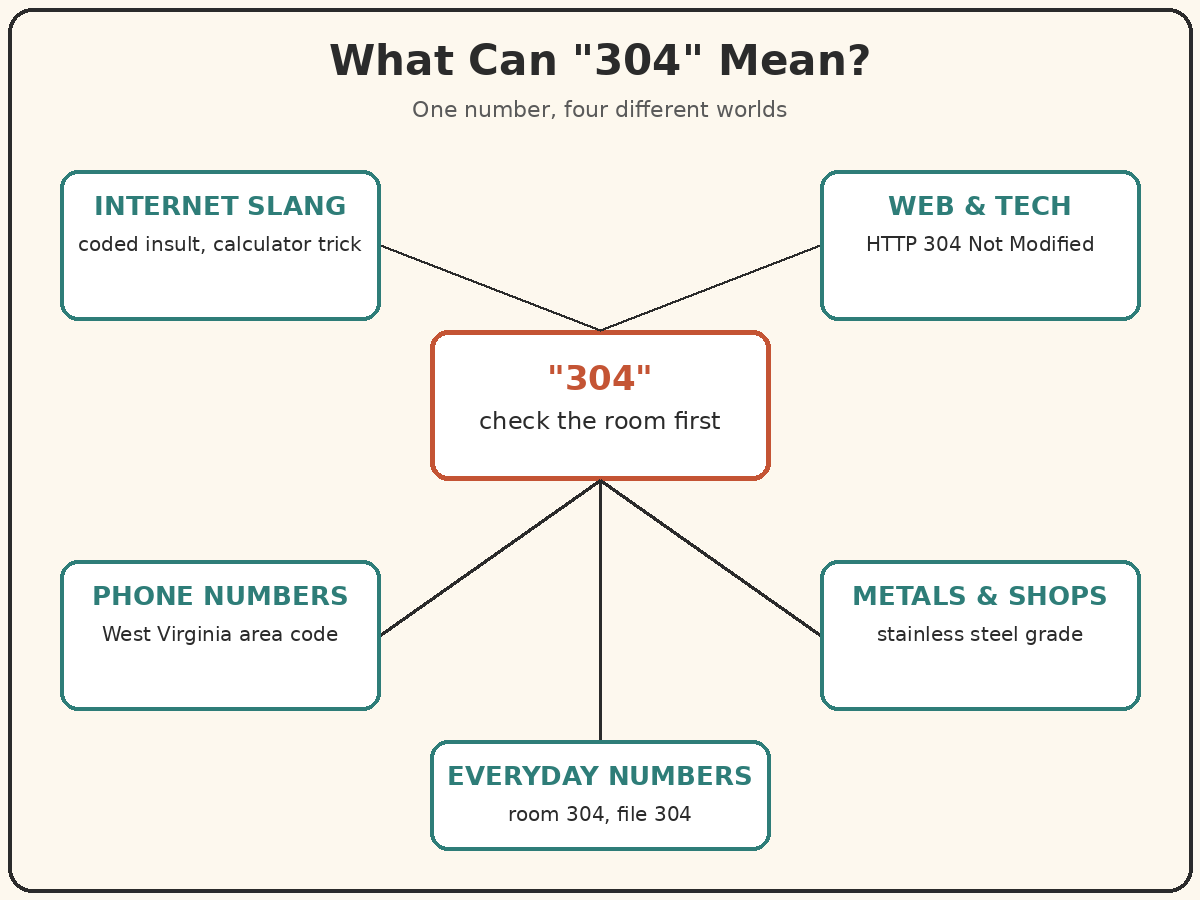
Although 304 slang has become popular online, the number itself has many meanings outside internet culture. Numbers are used in many areas, including technology, manufacturing, addresses, measurements, codes, and identification systems. The surrounding topic usually reveals whether someone is using slang or referring to something else.
304 as a Stainless Steel Grade
One common non-slang meaning of 304 is stainless steel grade 304. This refers to a type of stainless steel widely used in manufacturing, construction, kitchens, appliances, and industrial products. It is the most popular austenitic stainless steel grade, and it shows up in sinks, cookware, and food equipment. In this context, 304 has nothing to do with internet slang. Someone discussing kitchen equipment, metal products, pipes, industrial parts, or hardware is most likely talking about the material grade. “This bottle is made from 304 stainless steel” means the product uses a specific type of stainless steel known for durability and corrosion resistance.
304 as a Telephone Area Code
In the United States, 304 is also a telephone area code, and it covers every county in West Virginia. It belongs to the original set of area codes created in 1947, which makes it a piece of area code history too. For decades 304 was the only code in the state. Then phone number demand grew, as cell phones, fax lines, and second lines drained the supply. Regulators chose an overlay instead of splitting the state, and the 681 overlay code arrived in 2009, covering the exact same territory. New numbers can use either code. Someone mentioning 304 in relation to phone numbers, local businesses, or regional communication may simply be referring to this geographic code. “The company has a 304 number” means the phone number uses the 304 area code.
304 as a Location or Identifier
People may encounter 304 in apartment numbers, highway references, building numbers, classroom numbers, and business addresses. Many industries use numbers as identifiers, so a reference to 304 may represent a model number, a product code, a room number, a document number, a measurement, or a software value. “Check file 304 before tomorrow” has no connection to internet slang. “The meeting is in room 304” refers to a location. A number appearing alone does not automatically indicate online slang, and the best way to interpret 304 is to look at the conversation topic first.
304 vs Hoe, Thot, and Player
304 gets compared with a few nearby terms, and the comparisons show why the code exists at all. The table below separates them.
| Term | Meaning | Main difference | Typical context |
|---|---|---|---|
| 304 | Coded slang insult | Uses numbers as hidden spelling | Internet slang |
| Hoe | Direct insult or slang term | Written openly instead of coded | Casual speech |
| Thot | Older internet slang insult | Different slang origin, from meme culture | Online communities |
| Player | Someone seen as dating many people | Can sometimes be neutral or positive | Dating discussions |
| Promiscuous | Describes sexual behavior | More formal wording | General discussion |
304 Compared With Hoe
304 and hoe are connected because 304 is a coded version of the same insult. The main difference is presentation. Writing 304 may feel less direct, but the meaning usually remains similar. The code hides the word from filters and from people who do not know the reference. It does not soften the judgment for anyone who does know it.
304 Compared With Thot
Both terms have appeared in internet slang, but they developed through different online trends. Thot became popular earlier through meme culture, while 304 gained attention through number-based wordplay. Thot is spelled out openly, so it trips filters more easily. 304 survives as a code, which is why it still shows up in comments where thot would be removed.
304 Compared With Player
A player usually refers to someone who dates multiple people or behaves dishonestly in relationships. The term can sometimes be used casually or even positively depending on context. 304 is generally more insulting, and it is almost always aimed at women, while player is usually aimed at men. The two words judge similar behavior from opposite directions, and neither one is neutral. Other crude sexual slang sits outside this comparison entirely: bricked up describes an erection as a joke rather than judging someone’s behavior, so it works as humor instead of an insult.
How to Reply When Someone Says 304
The best response depends on the situation and your relationship with the person. The goal is usually to understand what was meant, not to repeat the insult.
Neutral Reply
If someone uses the term and you want clarification, say “What do you mean by 304?” This is useful when you are unsure whether they are referring to slang. It also works when the number might mean something else entirely, like a room number or a steel grade.
Asking for Context
You can say “Are you talking about the slang meaning?” This prevents misunderstandings, and it gives the other person a chance to explain without anyone repeating the insult.
Disagreeing With the Insult
If someone uses it negatively toward another person, say “I don’t think that label is fair.” This keeps the conversation focused without increasing conflict. You are disagreeing with the judgment, not starting a new argument about slang.
Professional Response
In workplace or formal situations, avoid using the term. If you see it in a message, focus on understanding the context rather than repeating the slang. Since 304 is commonly connected with a derogatory meaning, repeating it can unintentionally spread an insult, even when you only meant to quote someone else.
Is 304 Offensive?
Yes, 304 can be offensive depending on how it is used. The number itself is harmless. The issue comes from the meaning attached to it when used as slang. When aimed at a person, it often judges their behavior or reputation. It can be insulting, disrespectful, shaming, or harassing, and schools and workplaces generally treat it the same as the spelled-out word.
The term is not a neutral description. It is often used to judge someone’s personal choices or reputation, and because of that it can contribute to personal attacks, online harassment, public shaming, and unfair assumptions about people. A private joke between close friends may be interpreted differently from a public comment aimed at a stranger, but the original meaning remains connected to an insulting idea either way.
There is a real debate about reclamation. Some people argue that reclaiming a slur can drain its power, and linguists have documented this pattern across many groups and many words. Others point out a hard limit: reclamation works best when the targeted group leads it, and it rarely works when outsiders or bullies adopt the word. Online, you cannot verify who is speaking, so a joking message to a friend and a harassing message to a stranger look identical on the screen. The fair summary is that context and consent decide the impact.
A good rule comes from the same logic: if you would not say the spelled-out word to that person, do not type the number either. There is a difference between learning what a slang term means and choosing to use it. Someone may need to understand 304 because they saw it online, without wanting to repeat it. Knowing what a term means helps you understand conversations, but it does not mean the term is always suitable to use. People who are unfamiliar with the slang should be careful before using it, because a word that appears harmless because it is written as numbers may still carry the same social meaning as the original expression.
People Also Ask About 304
What does 304 mean in text messages?
304 usually means “hoe” in online slang. It is a coded version created from upside-down calculator-style number wordplay. In text messages, it is generally used as an insult, joke, or reference to internet culture. The meaning can change depending on the conversation, so the surrounding words are important.
Is 304 an acronym?
No, 304 is not an acronym. It does not represent a phrase where each number stands for a word. Instead, it is a numeric slang expression based on visual similarity between numbers and letters when viewed in a different orientation.
Why do people use 304 instead of writing the actual word?
People use 304 because coded language can feel like an inside joke or a less direct way to express something online. Internet communities often create alternative spellings, numbers, and symbols to communicate ideas differently. It also helps dodge automated word filters. However, changing the spelling does not remove the original meaning.
Is 304 offensive?
In many situations, yes. When used to describe another person, 304 is usually considered an insulting term because it carries a negative judgment. Whether it feels offensive can depend on the relationship between speakers and the intention behind the message.
What does 304 mean on TikTok?
On TikTok and other social platforms, 304 usually has the same slang meaning. Users may include it in comments, memes, or discussions involving relationships and online drama. The platform itself does not change the definition, but trends can make the term more visible. It is also used to bypass automated content moderation filters.
Does 304 have meanings besides slang?
Yes. Outside internet slang, 304 can refer to many unrelated things, such as HTTP 304 Not Modified, a stainless steel grade, a phone area code, a room number, or another type of identifier. The topic of the conversation determines the correct meaning.
How do you know if someone means the slang meaning of 304?
Look at the context. If the conversation involves social media, relationships, jokes, or personal criticism, the slang meaning is more likely. If the discussion involves products, locations, or technical topics, it may simply refer to the number 304.
Sources and Further Reading
Wikipedia’s entry on calculator spelling explains the seven-segment display trick, the “beghilos” letter set, and notes that the calculator spelling 304 entered common slang in the 2020s. Holy Meaning breaks down the digit mapping, debunks the T9 keypad myth, and covers the HTTP 304 status code, the West Virginia area code, and the stainless steel grade. UpGrowth’s guide to the 304 status code explains RFC 9110 Section 15.4.5, the ETag and If-None-Match exchange, and how Googlebot treats 304 responses. For the full entries, see the Wikipedia article on calculator spelling, the Holy Meaning guide to 304, and the UpGrowth guide to the 304 status code.
Also read: FOB Meaning Slang: What Does FOB Mean in Text and Conversations?, DL Meaning in Slang, PDA Meaning Slang: What Does PDA Mean in Text and Conversations?, OD Meaning Slang: What Does OD Mean in Text and Chat?, and Canadian Slang: Popular Words, Phrases, and Their Meanings.



Pingback: Slime Meaning Slang: What Does Slime Mean in Text and Online?
Pingback: FOB Meaning Slang: What Does FOB Mean in Text and Conversations?
Pingback: 2000s Slang: Popular Words, Meanings, and How People Used Them
Pingback: Mid Meaning Slang: What “Mid” Means in Text and Online
Pingback: Dodo Meaning Slang: What Does Dodo Mean in Text and Chat?
Pingback: NSFW Meaning Slang: What It Means and How to Use It
Pingback: 369 Meaning Slang: What Does "369" Mean in Text and Online?
Pingback: 41 Meaning Slang: What Does "41" Mean in Text and Online?
Pingback: Truffle Butter Slang Meaning: Definition, Origin & Use
Pingback: DTF Meaning Slang: What DTF Means in Text & Dating