
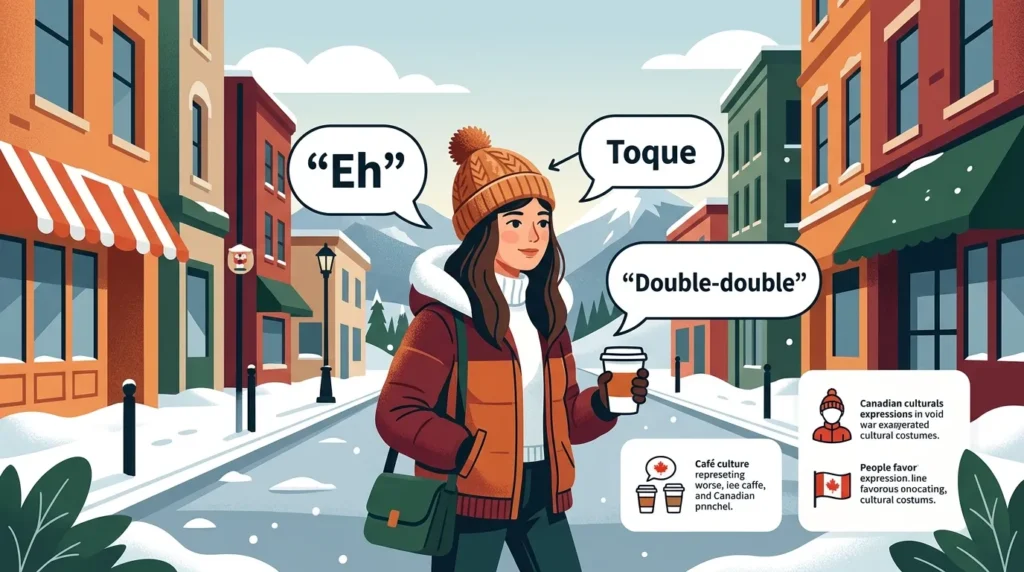

Canadian slang includes informal words and expressions used in everyday conversations across Canada. Common examples include “eh,” “loonie,” “toonie,” “double-double,” and “hang a Larry,” although usage changes by region, age group, and social setting.
Canadian slang is influenced by English, French, Indigenous languages, immigration, sports, weather, and local culture. Some expressions are used across the country, while others are strongly connected to specific provinces or communities.
Quick-Answer Box
| Category | Answer |
|---|---|
| Most common Canadian slang | Eh, loonie, toonie, double-double, toque |
| Meaning of “eh” | A conversational word used to seek agreement or confirmation |
| Where slang is used | Casual conversations, friends, social media, and local communities |
| Tone | Usually friendly and informal |
| Formality | Not suitable for most professional writing |
| Regional differences | Some expressions vary between provinces |
What Is Canadian Slang?
Canadian slang refers to informal words, phrases, and expressions commonly used by people in Canada. These terms are usually heard in casual conversations rather than formal situations.
Canadian slang is not one single style of speaking. The country is large, and language changes between provinces, cities, generations, and cultural groups.
A person from Vancouver may use different expressions from someone in Newfoundland, Quebec, or Toronto. Some words are recognized nationwide, while others are mainly local.
Canadian slang often reflects everyday Canadian life, including cold weather, hockey, food, money, transportation, and social habits.
Popular Canadian Slang Words and Meanings
1. Eh
Meaning: A word added at the end of a sentence to ask for agreement or confirmation.
Example:
“Nice weather today, eh?”
It is one of the most recognizable Canadian expressions. However, not every Canadian uses it frequently. Some people use it naturally, while others rarely say it.
Tone: Friendly, casual
Common usage: Everyday conversations
2. Loonie
Meaning: The Canadian one-dollar coin.
The nickname comes from the image of a loon, a Canadian bird, that appears on the coin.
Example:
“I only have a loonie left for the vending machine.”
Tone: Casual
3. Toonie
Meaning: The Canadian two-dollar coin.
The name combines “two” and “loonie.”
Example:
“The parking meter only needs a toonie.”
Tone: Casual
4. Toque
Meaning: A warm knitted winter hat.
A toque is especially common because cold winters are a major part of Canadian life.
Example:
“Don’t forget your toque. It’s freezing outside.”
Tone: Everyday
5. Double-Double
Meaning: A coffee with two creams and two sugars.
The phrase is strongly connected with Canadian coffee culture.
Example:
“I’ll get a double-double before work.”
Tone: Casual
6. Timmy’s
Meaning: A casual nickname for a popular Canadian coffee chain.
Many Canadians use the shortened name when talking about getting coffee.
Example:
“Want to stop at Timmy’s?”
Tone: Informal
Also Read: Florida Slang: Words, Phrases, and Expressions Floridians Use
7. Runners
Meaning: Sneakers or running shoes.
This term is especially common in some Canadian regions.
Example:
“I need new runners for the gym.”
Tone: Casual
8. Washroom
Meaning: Bathroom or restroom.
Canadians often use “washroom” in everyday speech.
Example:
“Excuse me, where is the washroom?”
Tone: Neutral and polite
9. Pop
Meaning: Soft drink or soda.
Many Canadians say “pop” instead of “soda.”
Example:
“Do you want a pop with your meal?”
Tone: Casual
10. Klick
Meaning: Kilometer.
This shortened form is commonly used when talking about distance.
Example:
“The gas station is five klicks away.”
Tone: Informal
Canadian Slang by Category
Everyday Canadian Expressions
| Slang | Meaning | Example |
|---|---|---|
| Buddy | Friend or person (sometimes used casually for strangers) | “That buddy helped me.” |
| Give’r | Put in effort or go all out | “Just give’r and finish the job.” |
| Beauty | Something excellent or impressive | “That goal was a beauty.” |
| No worries | It’s okay / don’t worry | “No worries, I can help.” |
Canadian Weather Slang
Canada’s weather has influenced many expressions.
Snowed In
Meaning: Unable to leave because of heavy snow.
Example:
“We got snowed in last night.”
Cold Snap
Meaning: A short period of unusually cold weather.
Example:
“We’re having a cold snap this week.”
Hockey Weather
Meaning: Very cold conditions suitable for winter activities.
Example:
“It’s hockey weather outside.”
Regional Canadian Slang Differences
Canadian slang changes depending on location.
Ontario Slang
Ontario has many expressions influenced by city life and multicultural communities.
Common examples:
- T.O. — Toronto nickname
- The 6ix — Toronto reference used especially in music and online culture
- Double-double — coffee expression widely recognized here
Quebec Slang
Quebec has a unique mix of French and English expressions.
French Canadian slang can differ greatly from English Canadian slang.
Examples include:
- Salut — casual hello
- C’est correct — that’s okay
Some expressions are specific to French-speaking communities and may not be understood everywhere in Canada.
Newfoundland Slang
Newfoundland has some of the most distinctive expressions in Canada.
Examples:
- B’y — friend or person
- Yes b’y — an expression showing agreement or excitement
These terms are strongly connected with local identity and culture.
Also Read: PDA Meaning Slang: What Does PDA Mean in Text and Conversations?
Western Canada Slang
Places such as Alberta and British Columbia have expressions influenced by farming, outdoor activities, and regional lifestyles.
Examples:
- Bud — friend
- Chinook — warm winter wind
Canadian Slang on Social Media and Online Conversations
Canadian slang has spread through:
- Social media
- Music
- Sports communities
- Streaming platforms
- Gaming groups
- Online conversations
Some expressions that were once mainly regional are now recognized internationally.
However, online popularity does not always mean every Canadian uses the term in daily speech.
A phrase may become popular because of entertainment, memes, or internet culture while remaining uncommon in normal conversations.
Real Canadian Slang Conversations
Conversation 1: Friends
Person A: “Want to grab a coffee?”
Person B: “Sure, let’s go to Timmy’s.”
Meaning: They want to get coffee casually.
Conversation 2: Weather
Person A: “It’s freezing today.”
Person B: “Yeah, better grab your toque.”
Meaning: Wear a warm winter hat.
Conversation 3: Asking Agreement
Person A: “That was a great game, eh?”
Person B: “Absolutely.”
Meaning: The speaker wants confirmation.
Also Read: OD Meaning Slang: What Does OD Mean in Text and Chat?
Conversation 4: Money
Person A: “Do you have change?”
Person B: “Only a loonie.”
Meaning: Only a one-dollar coin.
Conversation 5: Encouragement
Person A: “The project is almost finished.”
Person B: “Give’r!”
Meaning: Keep working hard or give maximum effort.
Formal Versus Informal Use of Canadian Slang
Canadian slang is usually friendly, but it is not appropriate for every situation.
Casual Situations
Slang works well in:
- Conversations with friends
- Social media posts
- Text messages
- Informal chats
Example:
“Grab a toque before heading outside.”
Professional Situations
In workplaces, schools, or formal writing, standard language is usually better.
Instead of:
“I need a couple klicks more.”
Use:
“I need a few more kilometers.”
Talking With Canadians as a Visitor
Visitors can use some common expressions naturally, but forcing slang can sound unnatural.
Using a few simple words correctly is better than trying to imitate a Canadian accent or overusing expressions.
Similar Terms and Related Expressions
| Term | Meaning | Difference |
|---|---|---|
| Soda | Soft drink | Common in many countries |
| Pop | Soft drink | Common Canadian preference |
| Beanie | Winter hat | General international term |
| Toque | Winter hat | Common Canadian term |
| Friend | Companion | Standard word |
| Buddy | Casual person/friend reference | More informal |
How Canadian Slang Changes With Age
Language changes between generations.
Older generations may use traditional expressions connected with local communities.
Younger Canadians may use more internet-based language influenced by:
- Social media
- Global entertainment
- Gaming culture
- Music trends
Some older slang remains popular because it is strongly connected with Canadian identity.
Is Canadian Slang Different From American Slang?
Yes, although there is overlap.
Canada and the United States share many English words, but some everyday expressions differ.
Examples:
| Canadian Term | Common American Equivalent |
|---|---|
| Toque | Beanie |
| Washroom | Bathroom |
| Pop | Soda |
| Loonie | One-dollar coin |
The differences are usually small, but they can reveal regional language habits.
Respectful Use of Canadian Slang
Canadian slang is generally casual and friendly, but context matters.
Keep these points in mind:
- Some expressions are region-specific.
- Some words may sound outdated depending on the audience.
- Local phrases should be used naturally.
- Avoid exaggerating Canadian stereotypes.
Understanding slang is often more valuable than trying to copy it.
Real-World Meaning of Canadian Slang
Canadian slang shows how language develops from daily life. Weather, geography, culture, food, and communities all influence the way people speak.
The most useful Canadian expressions are not just words to memorize. They are clues about social situations, relationships, and local identity.
Also Read: FUPA Meaning Slang: What It Means and How People Use It
Frequently Asked Questions
What is the most famous Canadian slang word?
“Eh” is probably the most internationally recognized Canadian expression. It is used to invite agreement or confirmation, although not every Canadian uses it regularly.
Do all Canadians say “eh”?
No. “Eh” is recognized across Canada, but usage depends on personality, region, and personal speaking style. Some Canadians use it often, while others rarely use it.
What does “toque” mean in Canadian slang?
A toque is a knitted winter hat. It is one of the most common Canadian clothing-related words because of the country’s cold climate.
What does “double-double” mean in Canada?
A double-double means a coffee with two creams and two sugars. It is a casual phrase commonly used when ordering coffee.
Is Canadian slang the same everywhere in Canada?
No. Canadian slang changes between provinces and communities. Some expressions are national, while others are strongly regional.
Can foreigners use Canadian slang?
Yes, but it is best to use expressions naturally. Learning the meaning and context is more important than trying to sound Canadian.
Is Canadian slang considered informal?
Most Canadian slang is informal. It is common in conversations but usually avoided in formal documents, academic writing, and professional communication.
Conclusion
Canadian slang reflects the country’s history, geography, and diverse communities. Words like “eh,” “toque,” “loonie,” and “double-double” are widely recognized, while many other expressions depend on region and culture.
The best way to understand Canadian slang is to focus on context. A phrase may sound different depending on who says it, where they live, and the situation. Learning these expressions helps people communicate more naturally and better understand Canadian culture.


Pingback: FOB Meaning Slang: What Does FOB Mean in Text and Conversations?
Pingback: 304 Slang Meaning: What Does 304 Mean in Text and Online?