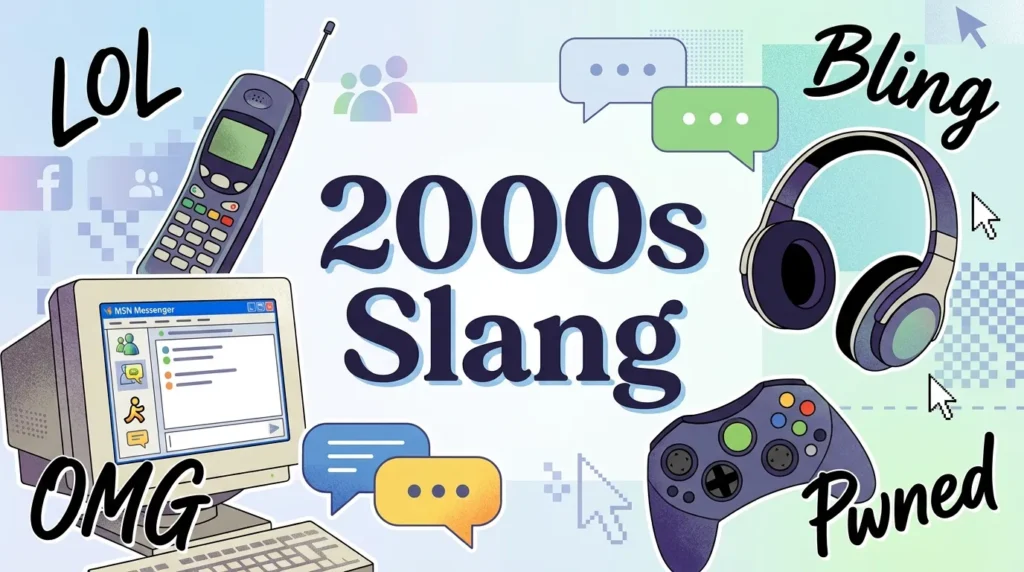

2000s slang refers to the informal words, phrases, and expressions popular during the 2000s, especially among teenagers and young adults influenced by pop culture, music, television, early social media, texting, and internet communities. Common examples include “bling,” “crunk,” “tight,” “sick,” “pwned,” and “OMG,” with meanings that depended heavily on context and social group.
The decade’s slang blended older street expressions, hip-hop culture, gaming language, instant messaging shortcuts, and early online communication. Some 2000s slang remains common today, while other terms feel nostalgic or strongly connected to that era. Understanding the context behind these expressions explains not only what they meant but also how people communicated during the rise of digital culture.
Quick Meaning of 2000s Slang
| Category | Explanation |
|---|---|
| Most common meaning | Informal words and phrases used during the 2000s |
| Main influences | Music, television, movies, gaming, texting, forums, and early social platforms |
| Typical users | Teenagers, young adults, online communities, and pop culture audiences |
| Tone | Usually casual, playful, expressive, or humorous |
| Current status | Some terms remain active; others are mostly nostalgic |
| Context importance | Meaning often changes depending on who says it and where it appears |
What Does 2000s Slang Mean?
2000s slang describes the informal vocabulary that became popular during the decade from 2000 to 2009. These expressions were not a single official language style but a collection of words shaped by different communities, including music fans, gamers, teenagers, online users, and regional groups.
The 2000s were a unique period because communication was changing quickly. People still used traditional conversations, but texting, instant messaging, online forums, and early social networks created new ways to shorten words, create jokes, and express identity.
A phrase that became popular in one community could spread quickly through music videos, television shows, movies, or internet culture.
For example:
- Someone might say “That outfit is sick” to mean the outfit looks impressive.
- Someone might say “You got pwned” after winning a gaming match.
- Someone might say “That’s tight” to describe something exciting or impressive.
The meaning depended less on the literal dictionary definition and more on the social setting.
Why Did 2000s Slang Become So Influential?
The 2000s introduced a major shift in how slang spread. Before this period, many expressions traveled mainly through local communities, music scenes, and television. During the decade, digital communication accelerated the process.
Several cultural forces shaped 2000s slang.
The Rise of Text Messaging
Texting changed everyday language because phones had limited keyboards and slower typing systems. People began shortening phrases to communicate faster.
Examples include:
- LOL — laughing out loud
- OMG — expressing surprise or excitement
- BRB — be right back
- TTYL — talk to you later
Some texting abbreviations existed before the 2000s, but the decade helped make them part of everyday communication.
Texting also influenced spelling styles, including:
- Shortened words
- Missing vowels
- Creative abbreviations
- Intentional misspellings
The Influence of Music Culture
Music played a major role in spreading slang during the 2000s.
Hip-hop, pop, rock, and electronic music all contributed expressions that entered everyday conversations.
Terms connected with music culture included:
- Bling — expensive-looking jewelry or flashy style
- Crunk — energetic, excited, or wild
- Holla — contact someone or say hello
- Fo’ shizzle — a playful variation meaning “for sure”
Many music-related expressions moved from specific communities into mainstream entertainment.
Early Internet Culture and Online Language
The early internet created a new type of slang. Forums, chat rooms, gaming communities, and message boards developed their own vocabulary.
Examples:
- Noob / n00b — a beginner, often used teasingly
- Pwned — completely defeated or outperformed
- Epic fail — a major mistake
- Owned — defeated or embarrassed
Online communities often created exaggerated humor and inside jokes that later became widely recognized.
Popular 2000s Slang Words and Meanings
Bling
Meaning: Flashy jewelry or expensive-looking style.
Example:
“His new chain is covered in bling.”
Usage:
Commonly associated with hip-hop culture and the image of luxury or status.
Today, “bling” is often understood as a nostalgic 2000s term.
Also Read: Slime Meaning Slang: What Does Slime Mean in Text and Online?
Crunk
Meaning: Extremely energetic, excited, or wild.
Example:
“The party was getting crunk.”
Usage:
Originally connected strongly with a music style, then expanded into general slang.
The word usually described high energy rather than simply being happy.
Tight
Meaning: Cool, impressive, excellent, or stylish.
Example:
“That new game is tight.”
Usage:
Popular among young people during the 2000s.
Although “tight” has other meanings in English, slang usage depended entirely on context.
Sick
Meaning: Amazing, impressive, or excellent.
Example:
“That skateboard trick was sick.”
Usage:
This is an example of slang reversing the normal meaning of a word. Instead of describing illness, it expressed admiration.
Sweet
Meaning: Great, awesome, or satisfying.
Example:
“You got concert tickets? Sweet!”
Usage:
This expression existed before the 2000s but remained very common during the decade.
Awesome
Meaning: Very good, impressive, or exciting.
Example:
“That movie was awesome.”
Usage:
A mainstream casual expression that remained popular through the 2000s.
Chill
Meaning: Relax, calm down, or spend time casually.
Example:
“We’re just chilling at home.”
Usage:
Still widely used today.
Hook Up
Meaning: Depending on context, connect, meet, arrange something, or begin a romantic/sexual interaction.
Example:
“Let’s hook up later” could mean different things depending on the speakers.
Usage:
One of the most context-dependent expressions from the era.
Sketchy
Meaning: Suspicious, questionable, or unsafe.
Example:
“That website looks sketchy.”
Usage:
Still commonly used today.
Random
Meaning: Unexpected, unusual, or unrelated.
Example:
“That was such a random comment.”
Usage:
The word became especially common in casual internet conversations.
Epic Fail
Meaning: A dramatic or embarrassing mistake.
Example:
“Missing the deadline was an epic fail.”
Usage:
Strongly associated with early internet humor.
Pwned
Meaning: Completely defeated, especially in gaming.
Example:
“I got pwned in the final round.”
Usage:
A famous example of gaming-related internet slang.
The spelling came from online gaming culture and became a recognizable marker of early internet language.
Noob
Meaning: A beginner or inexperienced person.
Example:
“I’m still a noob at this game.”
Usage:
Could be playful or insulting depending on tone.
OMG
Meaning: Oh my God / Oh my gosh.
Example:
“OMG, that was amazing!”
Usage:
Became extremely common through texting and online messaging.
LOL
Meaning: Laughing out loud.
Example:
“LOL, that was hilarious.”
Usage:
One of the most recognizable internet expressions from the era.
TMI
Meaning: Too much information.
Example:
“TMI, I didn’t need to know that.”
Usage:
Usually playful but can sometimes sound dismissive.
How 2000s Slang Changed Across Different Contexts
2000s slang was strongly influenced by where and how people communicated. The same word could sound natural among friends but feel outdated, confusing, or inappropriate in another setting.
A major reason some 2000s expressions survived while others disappeared is flexibility. Words that adapted to new conversations remained useful, while expressions tied closely to a specific trend often became nostalgic.
2000s Slang in Texting and Instant Messaging
Text messaging and instant messaging were among the biggest drivers of 2000s slang. People wanted faster ways to communicate, especially when typing on early mobile phones or chatting online.
Common expressions included:
| Term | Meaning | Example |
|---|---|---|
| LOL | Laughing out loud | “LOL, that movie was crazy.” |
| BRB | Be right back | “BRB, getting food.” |
| TTYL | Talk to you later | “I have to go. TTYL.” |
| OMG | Expressing surprise | “OMG, no way!” |
| IDK | I don’t know | “IDK what happened.” |
These shortcuts were not only about saving time. They also created a shared digital style among people who spent more time communicating online.
Also Read: 304 Slang Meaning: What Does 304 Mean in Text and Online?
2000s Slang in Gaming Communities
Gaming communities developed some of the most recognizable internet slang of the decade.
Online multiplayer games encouraged quick communication, competition, and humor. Players created expressions that spread beyond gaming.
Examples include:
Pwned
Used when someone was completely defeated.
Example:
“You got pwned in that match.”
The word became strongly connected with gaming culture and early internet humor.
Noob
Used to describe an inexperienced player.
Example:
“I’m a noob at this game, so be patient.”
Depending on tone, it could be friendly teasing or an insult.
Owned
Similar to “pwned,” meaning someone was defeated or embarrassed.
Example:
“He got owned during the debate.”
Gaming slang from the 2000s helped shape modern online communication.
2000s Slang in Social Media
The 2000s saw the growth of early social platforms where users created personal profiles, shared updates, and communicated publicly.
Slang in these spaces often focused on:
- Expressing emotions quickly
- Showing personality
- Creating humor
- Building online identity
Examples included:
- OMG
- LOL
- Epic fail
- Random
- Bestie
- BFF
Many expressions from this era were designed to feel informal and conversational.
2000s Slang in Pop Culture
Television shows, movies, celebrities, and music had a major impact on everyday language.
A phrase could become popular because people heard it repeatedly in entertainment and began using it with friends.
Examples:
- Catchphrases from comedy shows
- Expressions from reality television
- Lyrics from popular songs
- Phrases used by celebrities
This created a cycle where entertainment influenced slang, and slang helped define the culture of the decade.
How to Understand the Meaning of 2000s Slang
Because slang changes quickly, understanding context is more important than memorizing definitions.
A single word can communicate different ideas depending on:
- Who says it
- Who receives it
- The relationship between speakers
- The conversation topic
- The tone
- The platform where it appears
Look at the Surrounding Words
The words around slang often reveal the intended meaning.
Example:
“That party was sick.”
Usually means:
“The party was amazing.”
But:
“He called in sick.”
Uses the standard meaning of the word.
Consider the Relationship Between Speakers
Friends often use slang casually because they share similar communication styles.
Example:
“That’s tight!”
Between friends:
A compliment.
In a formal workplace:
It may sound too casual.
Pay Attention to Tone
Tone can completely change the meaning.
Example:
“You’re crazy.”
Possible meanings:
- Friendly joke
- Genuine criticism
- Expression of surprise
The same words can communicate different emotions.
Also Read: FOB Meaning Slang: What Does FOB Mean in Text and Conversations?
Consider Whether the Term Is Serious or Playful
Many 2000s expressions were exaggerated for humor.
Examples:
- “Epic fail”
- “OMG”
- “That’s insane”
- “You got owned”
Often these were not meant literally. They added emotion or humor to everyday conversations.
Real Conversation Examples Using 2000s Slang
Conversation 1: Complimenting Something
A: “Did you see my new sneakers?”
B: “Yeah, those are sick.”
Meaning:
The sneakers look impressive.
Conversation 2: Text Messaging
A: “OMG, I passed my exam!”
B: “LOL, I knew you would.”
Meaning:
The speakers are expressing excitement and encouragement.
Conversation 3: Gaming
A: “I almost won that match.”
B: “Nah, you got pwned.”
Meaning:
A playful comment about losing badly.
Conversation 4: Making Plans
A: “What are you doing tonight?”
B: “Just chilling with friends.”
Meaning:
Relaxing or spending casual time together.
Conversation 5: Reacting to a Mistake
A: “I sent the message to the wrong person.”
B: “That’s an epic fail.”
Meaning:
A humorous way to describe an embarrassing mistake.
Conversation 6: Expressing Surprise
A: “I got free tickets.”
B: “OMG, seriously?”
Meaning:
Showing excitement or disbelief.
Grammar and Language Role of 2000s Slang
2000s slang included many different types of language.
Some expressions were:
- Abbreviations
- Acronyms
- Adjectives
- Verbs
- Nouns
- Internet expressions
- Reaction phrases
Slang as Adjectives
Many 2000s slang words described something positively.
Examples:
- Sick
- Tight
- Sweet
- Awesome
- Legit
Example:
“That movie was legit.”
Meaning:
The movie was impressive or genuinely good.
Slang as Actions
Some expressions described actions.
Example:
“Chill.”
Meaning:
Relax.
Example:
“Hook up.”
Meaning:
Can mean meet, connect, or have a romantic interaction depending on context.
Capitalization and Spelling Variations
Online communication created many spelling variations.
Examples:
- LOL
- lol
- LoL
The meaning remained similar, but capitalization sometimes reflected tone.
All-caps versions often appeared more energetic.
Example:
“OMG!!!”
Usually feels more emotional than:
“omg.”
How to Reply When Someone Uses 2000s Slang
The best response depends on the relationship and situation.
Casual Reply
If a friend uses nostalgic slang:
Example:
“That song is still sick.”
Possible reply:
“Seriously, it brings back memories.”
Humorous Reply
If someone intentionally uses outdated slang:
Example:
“That party was totally rad.”
Possible reply:
“Did we just travel back to 2005?”
Neutral Reply
If you are unsure what someone means:
“Wait, what do you mean by that?”
Context is usually enough to clarify slang.
Professional Reply
Most 2000s slang should be avoided in formal communication unless you are discussing culture, marketing, entertainment, or language.
A workplace message usually benefits from clearer wording.
Also Read: Florida Slang: Words, Phrases, and Expressions Floridians Use
Similar and Commonly Confused Terms
2000s slang overlaps with many other types of informal language. Some expressions from the decade are still used today, while others are mainly recognized as nostalgic references.
| Term | Meaning | Main Difference | Typical Context |
|---|---|---|---|
| 2000s slang | Informal expressions popular during the 2000s | Refers specifically to a decade of language | Pop culture, texting, internet, music |
| Millennial slang | Casual language associated with a generation | Covers a broader time period | Everyday conversations |
| Internet slang | Words created or spread online | Focuses on digital communities | Forums, gaming, social media |
| Gen Z slang | Newer expressions from younger internet users | Developed after the 2000s | Modern social platforms |
2000s Slang vs Internet Slang
These categories overlap but are not identical.
Internet slang includes expressions from many different eras. Some 2000s internet terms became permanent parts of online communication, while others disappeared as platforms changed.
For example:
- LOL remains widely recognized.
- Pwned is strongly connected to early online gaming culture.
- Some early chat abbreviations feel outdated today.
2000s Slang vs Modern Social Media Slang
Modern slang often spreads faster because platforms allow trends to move globally within hours.
Compared with 2000s slang, newer internet language often:
- Changes more quickly
- Depends more on memes
- Uses shorter trends
- Spreads through video platforms
However, the 2000s created many of the communication habits that shaped modern online language.
Who Used 2000s Slang?
2000s slang was used by many groups, but certain communities helped spread specific expressions.
Teenagers and Young Adults
Teenagers were among the biggest users of 2000s slang because schools, friendships, music, and entertainment helped create shared language.
Common spaces included:
- Text messages
- School conversations
- Online chats
- Personal blogs
- Social networking profiles
Online Communities
Gaming groups, forums, and chat communities developed their own vocabulary.
These communities often created terms that later became mainstream.
Examples:
- Pwned
- Noob
- Owned
- Epic fail
Music and Entertainment Audiences
Fans often adopted phrases from:
- Songs
- Movies
- Television shows
- Celebrity culture
Entertainment helped turn local expressions into widely recognized slang.
Regional Differences
Not every 2000s slang term was used everywhere.
Some expressions were stronger in certain regions, cities, or communities.
Usage depended on:
- Local culture
- Age group
- Media influence
- Social circles
A phrase popular among one group might sound unfamiliar to another.
Origin and Evolution of 2000s Slang
The 2000s were a bridge between traditional slang and modern digital communication.
Language during this period developed through several overlapping influences.
The Transition From Offline to Online Communication
Before widespread social media, slang often spread through:
- Friends
- Music
- Television
- Movies
- Local communities
During the 2000s, online spaces became major sources of language change.
People could now create and share expressions with strangers across different locations.
The Growth of Digital Identity
The internet allowed people to create different styles of self-expression.
Screen names, profiles, online communities, and chat conversations encouraged playful language.
Slang became a way to show:
- Personality
- Humor
- Interests
- Group belonging
The Influence of Memes
Early internet humor helped popularize exaggerated expressions.
Terms such as:
- Epic fail
- Owned
- Pwned
became memorable because they were connected with jokes, videos, and online communities.
Also Read: PDA Meaning Slang: What Does PDA Mean in Text and Conversations?
Why Some 2000s Slang Survived
Some words survived because they were useful beyond the decade.
Examples:
- Chill
- Random
- Legit
- LOL
These expressions adapted to new communication styles.
Other phrases faded because they were strongly tied to specific trends.
Is 2000s Slang Offensive, Rude, or Inappropriate?
Most 2000s slang is not automatically offensive. However, meaning depends on the specific expression, speaker, and situation.
A casual phrase between friends may sound inappropriate in a professional setting.
Context Can Change the Tone
Example:
“That’s crazy.”
Among friends:
A reaction showing surprise.
In a serious conversation:
Could sound dismissive.
Some Expressions Can Sound Outdated
Certain slang terms may now feel:
- Nostalgic
- Artificial
- Humorous when used intentionally
- Out of place
Using old slang today is often a style choice rather than normal everyday communication.
Professional and School Settings
Many casual expressions are better avoided in:
- Business emails
- Formal presentations
- Academic writing
Clear communication is usually more important than sounding trendy.
Cultural Awareness Matters
Some expressions came from specific communities or cultural movements.
Understanding where a phrase came from helps avoid using it without understanding its meaning or context.
Real-World Interpretation of 2000s Slang
2000s slang represents more than a collection of funny words. It reflects a major moment when language moved from primarily local communication into a connected digital world.
The decade’s expressions show how people used language to create identity.
Someone using phrases like “LOL,” “OMG,” or “pwned” was not only sharing information. They were also signaling familiarity with a particular generation, technology, or community.
Today, many 2000s slang terms are used nostalgically. They can create a feeling of connection among people who experienced the era of early social networks, instant messaging, and changing digital culture.
Frequently Asked Questions
What is the most popular 2000s slang?
Some of the most recognizable 2000s slang includes LOL, OMG, bling, sick, tight, chill, legit, epic fail, pwned, and noob. Popularity varied by region, age group, and community, so there was no single official list of the decade’s slang.
Is 2000s slang still used today?
Yes, some 2000s slang remains common. Words like “chill,” “random,” “legit,” and “LOL” continue to appear in everyday communication. Other terms are mainly used for nostalgia, humor, or references to early internet culture.
Why did 2000s slang become popular?
2000s slang spread through a combination of music, television, movies, texting, gaming, and early online communities. Digital communication made it easier for expressions to move quickly between different groups.
What texting slang was popular in the 2000s?
Popular texting slang included LOL, OMG, BRB, TTYL, IDK, and TMI. These abbreviations helped people communicate faster, especially when mobile typing was slower than modern smartphone messaging.
What gaming slang came from the 2000s?
Gaming communities popularized terms such as pwned, owned, and noob. These expressions were often used during competitive online games and later became recognized outside gaming spaces.
Is 2000s slang the same as Gen Z slang?
No. 2000s slang developed during a different stage of internet culture. Gen Z slang emerged later through newer platforms, memes, and digital communities. Some older expressions remain popular, but the styles are different.
Why do people use 2000s slang today?
People often use 2000s slang today for nostalgia, humor, or to reference the culture of that era. It can create a connection with people who remember early internet culture, music, and entertainment from the decade.
Conclusion
2000s slang captured a period when everyday language was changing through texting, music, gaming, and the rise of online communities. Expressions like LOL, bling, sick, tight, and pwned reflected the humor, creativity, and digital culture of the decade.
Some terms became permanent parts of casual communication, while others remain reminders of a specific era. The most important thing to understand about 2000s slang is that meaning always depends on context, audience, and tone. A phrase that sounded natural among friends might feel outdated or unusual today.

Pingback: Calloway Meaning Slang: What It Means and How It’s Used