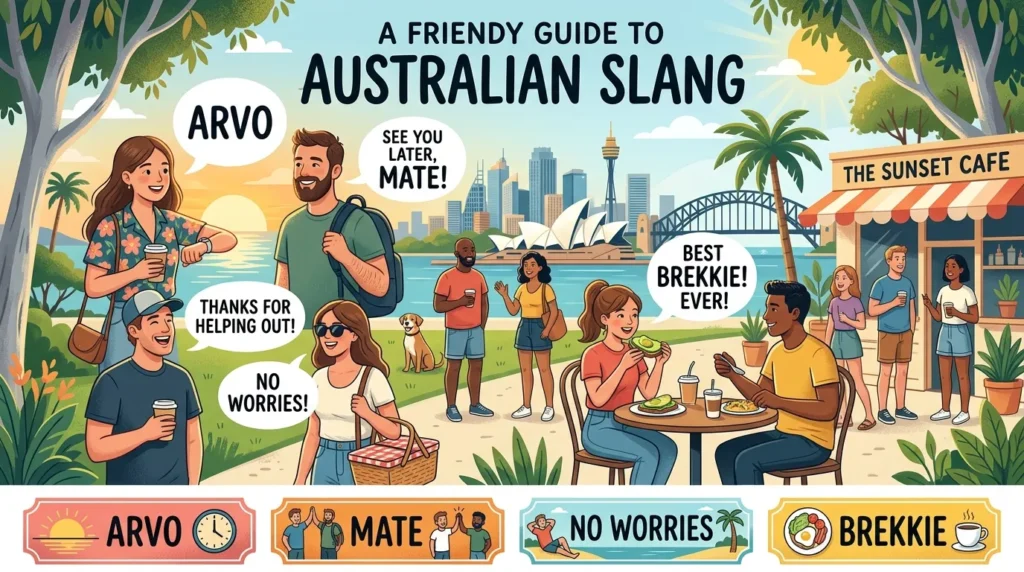

Aussie slang means the informal words and expressions used in Australian English. It includes shortened words like “arvo” for afternoon, friendly expressions like “no worries,” and phrases that carry cultural meaning beyond their literal definitions. It is mostly used in casual conversations, friendships, workplaces, sports, and everyday Australian life.
Aussie slang is not one fixed list of words. It changes depending on region, age, personality, and situation. Some expressions are used across Australia, while others are strongly associated with certain communities or generations. Understanding the tone behind a phrase is often just as important as knowing its dictionary meaning.
Quick-answer box
| Category | Meaning |
|---|---|
| Most common meaning | Informal Australian English words and expressions |
| Common examples | Mate, arvo, brekkie, barbie, no worries |
| Typical context | Casual conversations, social situations, media, workplaces |
| Tone | Usually friendly, relaxed, humorous, or informal |
| Formality | Usually unsuitable for formal writing |
| Main challenge | Literal meaning does not always match conversational meaning |
What Is Aussie Slang?
Aussie slang is the casual vocabulary and expressions associated with Australian English. It includes shortened forms of everyday words, playful nicknames, local expressions, humorous phrases, and culturally specific ways of speaking.
Australian slang is often recognized by a relaxed communication style. Many words are shortened to create a more casual sound. For example:
- Afternoon becomes arvo
- Breakfast becomes brekkie
- Barbecue becomes barbie
- Service station becomes servo
- Football becomes footy in many contexts
These shortened forms are not simply abbreviations. They often create a feeling of familiarity and friendliness.
A person saying “See ya this arvo” is not just shortening a word. They are using a casual style that signals comfort and informality.
Why Does Australian English Have So Much Slang?
Australian slang developed from many influences, including everyday conversation, working communities, local humor, migration, sport, and popular culture.
A major feature of Aussie slang is making language feel less formal. Australians often use humor, understatement, and playful exaggeration in conversation.
For example:
- “That’s not bad” may actually mean something is excellent.
- “No worries” can mean thank you, you’re welcome, or everything is fine.
- “She’ll be right” usually means a person believes a problem will work itself out.
The meaning often comes from tone and situation rather than the words alone.
Popular Aussie Slang Words and Their Meanings
Mate
Meaning: Friend, person, or casual form of address.
“Mate” is one of the most recognizable Australian expressions. It can show friendliness, but the tone changes everything.
Examples:
- “Thanks, mate.” → Friendly appreciation
- “Listen, mate…” → Could sound serious depending on tone
It does not always mean someone is a close friend. Australians may use it with strangers, coworkers, or people they have just met.
Arvo
Meaning: Afternoon.
Example:
“I’ll meet you this arvo.”
This is a common example of Australian word shortening.
Brekkie
Meaning: Breakfast.
Example:
“Want to grab brekkie before work?”
It is casual and usually used in everyday speech.
Also Read: PDA Meaning Slang: What Does PDA Mean in Text and Conversations?
Barbie
Meaning: Barbecue.
Example:
“We’re having a barbie on Saturday.”
A “barbie” refers to the event or the barbecue itself, depending on context.
Servo
Meaning: Service station or petrol station.
Example:
“I’m stopping at the servo.”
This is commonly understood in Australia but may confuse people unfamiliar with Australian English.
Macca’s
Meaning: McDonald’s.
Example:
“Let’s get Macca’s after the movie.”
It is a widely recognized Australian nickname for the fast-food chain.
No worries
Meaning: It’s okay, no problem, you’re welcome, or don’t stress.
Examples:
- “Thanks for helping.”
- “No worries.”
It is one of the most common expressions associated with Australian friendliness.
Fair dinkum
Meaning: Genuine, true, or seriously.
Examples:
- “Are you fair dinkum?”
- “That’s a fair dinkum story.”
It can express surprise, disbelief, or a question about honesty.
She’ll be right
Meaning: Everything will probably be okay.
Example:
“Don’t stress about the small problem. She’ll be right.”
This phrase reflects a relaxed attitude, although it may not always be appropriate when a serious issue needs immediate action.
Aussie Slang Shortening Patterns
One reason Aussie slang feels distinctive is that many words follow recognizable patterns.
The “-o” Ending
Some words are shortened by adding an “o” sound.
Examples:
- Afternoon → arvo
- Service station → servo
- Bottle shop → bottle-o
The “-ie” or “-y” Ending
Other words become shorter and more informal by adding these endings.
Examples:
- Breakfast → brekkie
- Present → pressie
- Australian → Aussie
These patterns help explain why many Australian slang words sound familiar even when you hear them for the first time.
Aussie Slang in Texting and Social Media
Aussie slang appears in online conversations the same way it appears in spoken language. People often use it in messages, comments, gaming chats, and casual online communities.
Common examples include:
- “Cheers” for thanks
- “Mate” as a friendly address
- “No worries” as reassurance
- “Legend” as praise
However, online communication removes some clues. Without voice tone or facial expression, a phrase can sometimes sound different from how it was intended.
For example:
“Good one, mate.”
Depending on context, this can mean:
- Genuine praise
- Friendly teasing
- Sarcasm
The surrounding conversation matters.
Also Read: OD Meaning Slang: What Does OD Mean in Text and Chat?
How Context Changes Aussie Slang Meaning
Aussie slang often depends on:
- Relationship between speakers
- Tone of voice
- Situation
- Location
- Age group
- Whether the conversation is serious or playful
A phrase that sounds rude to an outsider may be friendly between close friends.
For example, Australians may use teasing language as a sign of familiarity. However, visitors should avoid copying strong expressions until they understand how they are used.
Real Conversation Examples
Casual greeting
Person 1: “G’day, mate. How ya going?”
Meaning: Hello, how are you?
Making plans
Person 1: “Want to grab a coffee this arvo?”
Meaning: Want to get coffee this afternoon?
Saying something is fine
Person 1: “Sorry I’m late.”
Person 2: “No worries.”
Meaning: That’s okay.
Showing excitement
Person 1: “We won tickets!”
Person 2: “That’s unreal!”
Meaning: That’s amazing.
Ending a conversation
Person 1: “Catch ya later.”
Meaning: See you later.
Formal vs Informal Use of Aussie Slang
Aussie slang is usually best for casual communication.
Good situations for slang
- Talking with friends
- Casual workplace conversations
- Social events
- Travel situations
- Informal messages
Situations requiring caution
- Academic writing
- Legal documents
- Professional reports
- Formal presentations
- Communication with unfamiliar audiences
Using a few natural expressions can help visitors connect with Australians, but forcing slang can sound unnatural.
Common Mistakes Visitors Make With Aussie Slang
Using too much slang at once
A person who adds many slang words to every sentence may sound like they are copying a stereotype rather than speaking naturally.
Assuming every Australian uses the same expressions
Australia has regional differences. A phrase common in one area may be less familiar somewhere else.
Ignoring tone
Some expressions can be friendly, sarcastic, or insulting depending on delivery.
Treating slang as a replacement for standard English
Aussie slang is part of Australian English, not a separate language.
Are Aussie Slang Words Offensive?
Most Aussie slang is not offensive. Many expressions are simply casual alternatives to standard English.
However, some words require caution because they may:
- Be insulting depending on tone
- Be acceptable among friends but inappropriate with strangers
- Carry cultural or social meanings
- Sound stronger outside Australia
The safest approach is to understand a term before using it.
A phrase being common does not automatically mean it is suitable in every situation.
Also Read: FUPA Meaning Slang: What It Means and How People Use It
Who Uses Aussie Slang?
Aussie slang is used by many Australians, but usage varies.
Factors that influence slang include:
- Age
- Region
- Social group
- Workplace
- Family background
- Online communities
Some traditional expressions remain common, while newer slang appears through internet culture, entertainment, and youth conversations.
There is no single “Australian way” of speaking.
Aussie Slang and Australian Identity
Slangiify is closely connected to Australian communication style. Many expressions reflect humor, friendliness, and a preference for relaxed conversation.
Australian slang often uses:
- Humor instead of formality
- Understatement instead of exaggeration
- Nicknames instead of official terms
- Casual expressions to build connection
This does not mean every Australian communicates casually all the time. Context always matters.
Similar Terms and Related Expressions
| Term | Meaning | Difference | Context |
|---|---|---|---|
| Aussie English | Australian variety of English | Broader than slang | Language style overall |
| Colloquial English | Informal everyday language | Exists in many countries | Casual speech |
| Dialect | A regional language variety | Includes pronunciation and grammar | Regional communication |
| Slang | Informal vocabulary | Focuses on words and phrases | Casual groups and communities |
Frequently Asked Questions
What does Aussie slang mean?
Aussie slang means informal Australian English words and phrases used in everyday communication. It includes shortened words, expressions, jokes, and casual terms that may have meanings different from standard English.
Is Aussie slang still used today?
Yes. Aussie slang remains part of everyday Australian communication, although specific words become more or less common over time. Some expressions are widely recognized, while others are strongly connected to particular groups or generations.
What are the most common Aussie slang words?
Common examples include mate, arvo, brekkie, barbie, servo, no worries, cheers, and fair dinkum. The most useful words depend on the situation.
Can foreigners use Aussie slang?
Yes, but it is best to use it naturally. Learning a few common expressions is helpful, but using too many slang words without understanding tone can sound forced.
Is “mate” only used for friends?
No. “Mate” can refer to friends, strangers, coworkers, or even someone in a disagreement. The meaning depends heavily on tone and context.
Is Aussie slang the same everywhere in Australia?
No. Australian slang varies by region, community, age, and social setting. Some expressions are nationally recognized, while others are more local.
Is Aussie slang appropriate at work?
It depends on the workplace. Many casual workplaces use slang naturally, but formal communication should usually use standard English.
Conclusion
Aussie slang is more than a collection of unusual words. It is a way Australians create friendliness, humor, and familiarity in everyday communication. Expressions like “mate,” “no worries,” and “arvo” are easy to recognize, but their real meaning often depends on context and tone.
The best way to understand Aussie slang is to listen to how people use it naturally. Learning the words is useful, but understanding the attitude behind them is what makes Australian English easier to follow.