
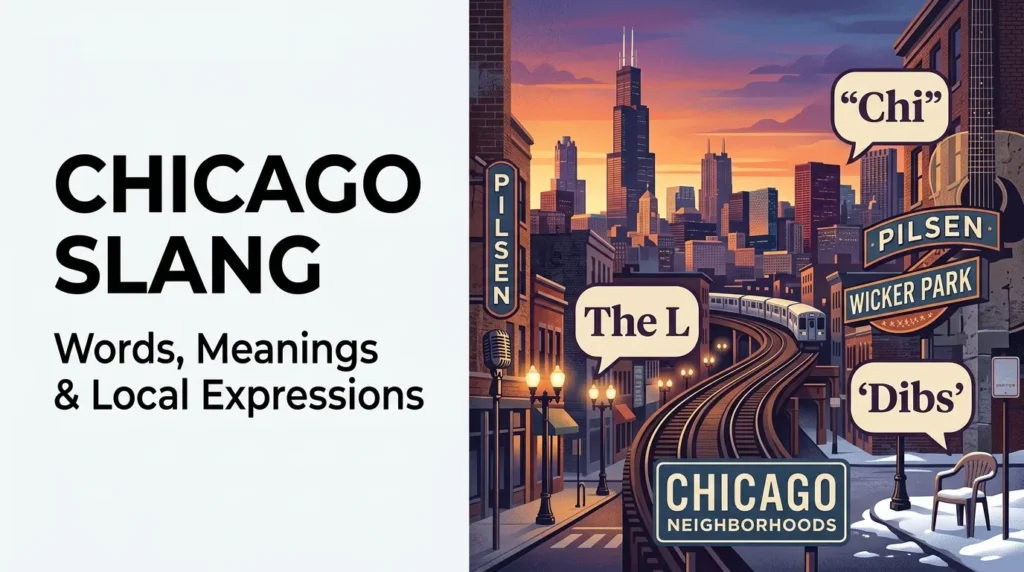

Chicago slang refers to the unique words, phrases, and expressions shaped by the city’s neighborhoods, history, music, sports culture, and everyday conversations. Some terms are widely recognized across Chicago, while others are tied to specific communities, generations, or local experiences.
The meaning of Chicago slang often depends on context. A phrase that sounds unfamiliar to outsiders may simply be a casual greeting, a neighborhood reference, or a way locals show familiarity. Understanding the tone behind the words matters just as much as knowing the dictionary meaning.
Quick Answer Box
| Category | Details |
|---|---|
| What is Chicago slang? | Informal words and expressions used in Chicago conversations |
| Common examples | Chi, The City, The L, pop, gym shoes, dibs |
| Where it comes from | Neighborhood culture, migration, music, sports, and local traditions |
| Tone | Usually casual, friendly, humorous, or community-based |
| Used by | Chicago residents, local communities, and people familiar with the city |
| Important note | Meaning can change depending on neighborhood, age, and situation |
What Is Chicago Slang?
Chicago slang is the collection of informal expressions, phrases, and local vocabulary associated with Chicago, Illinois. It reflects the city’s diverse neighborhoods, long history, and mix of cultural influences.
Unlike a separate language or dialect, Chicago slang is part of everyday communication. Some expressions are used by almost everyone in the city, while others may belong to certain neighborhoods, age groups, or communities.
A visitor might recognize a few famous terms, but many Chicago expressions are understood through experience. The way someone says a word, the situation, and the relationship between speakers often reveal the real meaning.
For example, calling Chicago “Chi” is a common casual reference to the city. Saying someone is “from the city” may also carry local meaning depending on the conversation.
Why Chicago Slang Is Different From Other Regional Slang
Chicago slang developed through a combination of influences. The city has historically been home to many different communities, each contributing words, pronunciation patterns, and expressions.
Several factors shaped local speech:
- Neighborhood identity
- Family traditions
- Music scenes
- Sports culture
- Immigration patterns
- Workplace conversations
- Youth language
- Online communication
This creates a style of speech that can feel familiar to locals but unique to outsiders.
A person from another city may understand the basic words but miss the cultural meaning behind them.
Popular Chicago Slang Words and Meanings
Chicago slang includes everyday words, shortened expressions, and phrases that represent local life. Some are strongly connected with Chicago, while others are common in parts of the Midwest but have a recognizable Chicago connection.
| Chicago Slang Term | Meaning | Typical Use |
|---|---|---|
| Chi / Chi-Town | Short references to Chicago | Talking about the city casually |
| The L | Chicago’s elevated train system | Transportation conversations |
| Pop | Carbonated drink | Ordering or discussing soda |
| Gym shoes | Sneakers | Everyday footwear conversations |
| Dibs | Claiming a parking spot after clearing snow | Winter parking tradition |
| The City | Chicago, especially for locals | Referring to Chicago itself |
| Frunchroom | Front room of a house | Older Chicago household term |
| Jeet? | Did you eat? | Casual conversation |
| Youse guys | You all / you people | Informal group reference |
| Da Bears | The Bears (Chicago football team) | Sports culture reference |
Chicago Slang Words You Hear in Everyday Conversations
Chi
“Chi” is one of the simplest and most recognizable shortened references for Chicago.
People may use it when talking about the city, their hometown, or local pride.
Examples:
- “I’m heading back to Chi this weekend.”
- “Chi has some of the best food in the country.”
The expression is casual and usually carries a sense of connection to the city.
Also Read: FUPA Meaning Slang: What It Means and How People Use It
The L
“The L” refers to Chicago’s elevated train system.
Visitors may hear this phrase when locals talk about transportation.
Examples:
- “I took the L downtown.”
- “The L is packed during rush hour.”
It is not just a transportation term. For many residents, the system is part of daily Chicago life.
Pop
One of the most noticeable Chicago vocabulary differences is calling a carbonated drink “pop” instead of “soda.”
Examples:
- “Do you want a pop with your meal?”
- “Grab me a can of pop.”
This word choice is common across much of the Midwest, but it is strongly associated with Chicago speech patterns.
Gym Shoes
In many parts of the country, people say “sneakers” or “tennis shoes.” In Chicago, “gym shoes” is a familiar everyday term.
Examples:
- “I need new gym shoes.”
- “Those gym shoes look comfortable.”
The phrase feels completely normal to many Chicago residents.
Chicago Slang Related to Neighborhood Life
Chicago is known for strong neighborhood identities. Many expressions make more sense when you understand how locals connect with different parts of the city.
Neighborhood language can communicate:
- Where someone grew up
- Local pride
- Familiarity
- Community connections
- Shared experiences
A person’s choice of words may reveal their background without them directly explaining it.
Dibs: A Famous Chicago Winter Expression
One of the most discussed Chicago traditions is dibs.
Dibs refers to the practice of saving a shoveled parking space after a major snowfall by placing objects such as chairs, cones, or other items in the spot.
Example:
“I shoveled that space, so I’m calling dibs.”
The practice is closely connected to harsh Chicago winters and neighborhood relationships.
For some residents, dibs represents fairness after difficult snow removal. For others, it creates disagreements because public parking spaces are technically shared.
The meaning is not just about a parking spot. It represents a larger conversation about neighborhood respect, effort, and unwritten rules.
How Chicago Slang Changes by Generation
Chicago slang is not exactly the same for everyone living in the city.
Older generations may use expressions connected to traditional neighborhood life, while younger speakers may use language influenced by:
- Hip-hop
- Social media
- Internet culture
- Gaming communities
- National youth trends
Some words remain strongly connected to Chicago for decades. Others appear quickly and disappear as communication habits change.
A teenager in Chicago today may not use the same expressions as someone who grew up there 40 years ago.
Chicago Slang From Music, Sports, and Pop Culture
Chicago slang has been heavily influenced by the city’s creative scenes. Music, especially hip hop, has helped spread many Chicago expressions beyond Illinois. Sports culture has also played a major role because teams and local traditions are deeply connected with everyday conversations.
However, not every phrase heard in Chicago music represents normal daily speech. Some expressions belong to specific neighborhoods, artists, or communities. A word that appears frequently in songs may not be something every Chicago resident uses.
Understanding the difference between popular culture language and everyday local speech helps avoid misunderstandings.
Chicago Slang in Hip Hop Culture
Chicago’s hip hop scene introduced many local expressions to a wider audience. Younger generations often mix traditional Chicago vocabulary with newer internet and music-related language.
Some common influences include:
- Neighborhood references
- Shortened words
- Personal greetings
- Street expressions
- Creative word combinations
- Local pronunciation styles
Music can preserve older expressions while also creating new ones.
For example, a phrase may begin in one neighborhood, become popular through music, and eventually be recognized by people who have never visited Chicago.
Also Read: Puerto Rican Slang Meanings and Everyday Boricua Phrases
Sports Expressions in Chicago Conversations
Sports are a major part of Chicago identity. Conversations about teams often include local phrases, jokes, and references that outsiders may not immediately understand.
Common examples include:
- Talking about “Da Bears” when discussing the Chicago Bears
- Using team names as part of casual conversation
- Sharing jokes connected to famous games or seasons
Sports language often works as a social connection. A simple comment about a team can start a conversation between strangers.
Common Chicago Expressions Explained
Beyond individual slang words, Chicago has many phrases that carry local meaning.
“The City”
In many conversations, locals may simply say “the city” when referring to Chicago.
Example:
“I’m going into the city later.”
The exact meaning depends on where the speaker lives. Someone in a nearby suburb may use it differently from someone living within Chicago neighborhoods.
The phrase shows how strongly Chicago functions as the central point of the region.
“Jeet?”
“Jeet?” is a shortened casual pronunciation of:
“Did you eat?”
It is an example of how everyday speech becomes faster and more relaxed.
Example:
“Jeet yet?”
Meaning:
“Did you eat yet?”
This type of shortening is common in informal conversations where speakers already know each other.
“Youse Guys”
“Youse guys” means “you all” or “you people.”
Example:
“Are youse guys coming tonight?”
The phrase is informal and often associated with older regional speech patterns.
It is not used by every Chicago resident, but many people recognize it as part of the city’s traditional speech style.
“Frunchroom”
“Frunchroom” is a traditional Chicago pronunciation of “front room.”
Historically, it referred to the front room of a home, especially in older Chicago households.
Example:
“Grandma kept the furniture in the frunchroom.”
This word represents how pronunciation differences can become part of local identity.
How Context Changes Chicago Slang Meaning
Chicago slang is often easy to misunderstand because the same word can feel different depending on the situation.
Context clues include:
- Who is speaking
- Where the conversation happens
- The speaker’s age
- The relationship between people
- The tone of voice
- Whether the phrase is serious or joking
A word used between close friends may sound completely different when used by a stranger.
Example of Context Changing Meaning
Someone saying:
“Welcome to Chi.”
may simply mean:
“Welcome to Chicago.”
But the same phrase from a lifelong resident might also express pride and connection to the city.
Similarly, saying:
“That’s Chicago.”
could describe:
- A local tradition
- A difficult situation
- A joke about city life
- A familiar experience
The surrounding conversation determines the meaning.
Real Chicago Slang Conversations
Conversation 1: Transportation
Person 1: How are you getting downtown?
Person 2: I’m taking the L.
Meaning:
The person is using Chicago’s train system.
Conversation 2: Food and Drinks
Person 1: Want anything to drink?
Person 2: Yeah, grab me a pop.
Meaning:
The person wants a soda.
Conversation 3: Winter Parking
Person 1: Why is there a chair in that parking spot?
Person 2: They called dibs after shoveling.
Meaning:
Someone is saving the parking space after clearing snow.
Also Read: 304 Slang Meaning: What Does 304 Mean in Text and Online?
Conversation 4: Casual Greeting
Person 1: You been around Chi lately?
Person 2: Yeah, I was downtown yesterday.
Meaning:
The conversation is about Chicago.
Conversation 5: Food Question
Person 1: Jeet already?
Person 2: Not yet, I’m grabbing something soon.
Meaning:
The person is asking if someone has eaten.
Is Chicago Slang Different From Other Midwest Slang?
Yes, but the differences are not always dramatic.
Chicago shares some vocabulary with nearby areas because of geography and regional culture. Words like “pop” are common throughout much of the Midwest.
What makes Chicago speech stand out is the combination of:
- City history
- Neighborhood identity
- Cultural diversity
- Local traditions
- Unique pronunciation patterns
The strongest Chicago identity often comes from how words are used rather than from completely different vocabulary.
Chicago Slang vs New York Slang
Chicago and New York both have strong regional speech styles, but their slang developed from different environments.
Chicago slang often reflects:
- Neighborhood culture
- Midwest influences
- Sports traditions
- Local history
New York slang often reflects:
- Different borough identities
- Faster urban speech patterns
- Different cultural influences
Neither style is better. They simply represent different city experiences.
Chicago Slang vs General American Slang
Some Chicago expressions eventually become nationally recognized.
Others remain mostly local.
A term may move through different stages:
- Used by a small local group
- Becomes popular through music or media
- Gets recognized nationally
- Loses some local connection
This happens with many regional expressions across the United States.
How Visitors Should Use Chicago Slang
Visitors can appreciate Chicago slang without forcing it into every conversation.
A few practical tips:
Listen Before Using It
Pay attention to how locals use expressions naturally.
Some words feel normal when used by residents but may sound unnatural from outsiders.
Understand the Meaning First
Do not use a phrase only because it sounds interesting.
Knowing the cultural background makes communication more respectful.
Avoid Fake Accents
Trying to imitate a Chicago accent or exaggerating pronunciation can come across as making fun of local speech.
Use Common Expressions Naturally
Simple words like “The L,” “pop,” or “Chi” are easier for visitors to understand and use appropriately.
Is Chicago Slang Offensive or Rude?
Most Chicago slang is casual rather than offensive.
However, like any regional language, some expressions can become inappropriate depending on:
- The speaker
- The audience
- The relationship
- The situation
- The tone
A phrase that works among close friends may not fit a workplace conversation.
Slang and Respectful Communication
Chicago has many communities with their own language styles. Some expressions are closely connected to specific groups and experiences.
Visitors should avoid using:
- Insults they do not fully understand
- Community-specific phrases without context
- Words copied only from entertainment
- Expressions that may carry sensitive meanings
Understanding a phrase is different from having the cultural background to use it naturally.
Chicago Slang in Professional Settings
Most Chicago slang belongs in casual conversations.
In professional situations, it is usually better to use standard language.
For example:
Casual:
“I’m taking the L downtown.”
Professional:
“I’ll use public transportation to get downtown.”
The right choice depends on the audience.
Chicago Slang and Social Media
Social media has changed how Chicago expressions spread.
Platforms such as short-form video apps, music platforms, and online communities allow local phrases to travel quickly.
A Chicago expression can become familiar worldwide within a short time.
However, online popularity does not always mean a phrase is commonly used by every Chicago resident.
Internet language often exaggerates certain expressions because they are entertaining or memorable.
Also Read: 2000s Slang: Popular Words, Meanings, and How People Used Them
The Real Meaning Behind Chicago Slang
Chicago slang is more than a list of words.
It represents:
- Local pride
- Neighborhood connections
- Shared experiences
- Humor
- City traditions
- Generational differences
The same phrase can carry different feelings depending on who says it and why.
A local expression is often a small piece of a larger cultural story.
Frequently Asked Questions
What Is The Most Famous Chicago Slang Word?
One of the most recognized Chicago expressions is “Chi” or “Chi-Town,” which refers casually to Chicago. Other well-known local terms include “The L,” “pop,” and “dibs.”
Why Do Chicago People Say Pop Instead Of Soda?
Many Chicago residents use “pop” because it is common throughout much of the Midwest. It refers to carbonated drinks and is a normal everyday word in the region.
What Does Chi Mean In Chicago Slang?
“Chi” is a shortened casual name for Chicago. People often use it when talking about the city, their hometown, or local pride.
What Does Dibs Mean In Chicago?
Dibs refers to claiming a parking space after removing snow from it. The tradition is connected to Chicago winters and often creates discussions about fairness and neighborhood respect.
Do People Still Use Chicago Slang?
Yes, but usage changes between generations and communities. Some traditional expressions remain common, while younger speakers often mix local words with modern internet and music language.
Is Chicago Slang A Different Language?
No. Chicago slang is a collection of informal expressions within American English. It reflects local culture but is not a separate language.
Can Outsiders Use Chicago Slang?
Yes, but it is best to use common expressions naturally and understand their meaning first. Copying phrases without context can sound forced.
Conclusion
Chicago slang reflects the city’s history, neighborhoods, traditions, and everyday conversations. Expressions like “Chi,” “The L,” “pop,” and “dibs” are more than simple words because they connect with local experiences.
The most important part of understanding Chicago slang is context. A phrase may change meaning depending on who says it, where it is used, and the situation around it. Learning these expressions is not only about vocabulary but also about understanding the culture behind the words.

Pingback: Calloway Meaning Slang: What It Means and How It’s Used
Pingback: Aussie Slang: Common Australian Words, Meanings & Uses