
In slang, DMV means DC, Maryland, and Virginia: the Washington metro area treated as one place, one culture, and one identity. If you see it in a TikTok bio, a hashtag, or a rap lyric, it almost never means the government office where you renew a license. It means the person, the sound, or the story comes from the capital region, and locals will know exactly what that claim carries with it.
I have lost count of how many times I have seen someone outside the East Coast read “DMV” and picture a waiting room with numbered tickets. Inside the region, the same three letters spark a completely different picture: Metro rides, go-go beats, mambo sauce on carryout wings, and arguments about which county makes the best food. That gap between the two readings is exactly why this term confuses people, and why it is worth a full explanation instead of a one-line definition.
This guide covers both meanings, the boundary lines locals actually argue about, the music and radio history behind the name, the slang words that travel with it, and the mistakes outsiders make when they use it. By the end, you will be able to read “DMV” in any bio, caption, or lyric and know which meaning fits.
Contents
- What Does DMV Mean in Slang?
- DMV vs. the Department of Motor Vehicles
- Where Does the DMV Name Come From?
- What Counts as the DMV, and What Does Not
- DMV Slang Words You Will Hear Next to It
- How People Use DMV on TikTok, Instagram, and in Bios
- DMV vs. Other Regional Nicknames
- When NOT to Use DMV
- How to Reply When Someone Says They Are From the DMV
- Myth vs. Fact About the DMV
- FAQs About DMV Slang
- Sources
What Does DMV Mean in Slang?
As slang, DMV stands for DC, Maryland, and Virginia, and it names the Washington metropolitan area as a single cultural region. People use it to say where they are from, to tag local content, and to claim a shared identity that crosses state lines but stops well short of either whole state.
The key idea is that the DMV is not a government boundary. Nobody voted on it, and no map in a textbook draws it. It is a lived region: the District plus the suburbs close enough that people commute into the city, ride the same Metro lines, hear the same local radio, and argue about the same traffic on the Beltway. When a creator writes “DMV food” or a rapper says “best in the DMV,” they are talking about that lived region, not about three entire states.
You will also see the phrase written as “the DMV,” with the word “the” in front. That little word matters. “DMV” on its own can still mean the motor vehicle office. “The DMV” in a bio, a lyric, or a hashtag almost always means the region. If you remember one rule from this article, make it that one.
People use the term in a few everyday ways. A person might put “DMV native” in a bio to say they grew up in the area. A food creator might tag a carryout review “#DMV” so locals find it. A musician might title a track with the letters to plant a flag for the local scene. In each case, the term works as shorthand for belonging: I am from here, this is for us, and if you know, you know.
DMV vs. the Department of Motor Vehicles
The other DMV meaning is the one most Americans meet first: the Department of Motor Vehicles, the state agency that handles driver licenses, vehicle registration, and license plates. Dexerto notes the same split in its TikTok explainer, pointing out that the motor vehicle reading is the obvious one while the regional reading is the one creators actually mean on the app.
Context tells you which one is in play, and it usually tells you fast. If the sentence mentions a license, a road test, a long line, or a renewal, it is the agency. If the sentence mentions a neighborhood, a rapper, a restaurant, a sports team, or a hometown, it is the region. A post that says “spent four hours at the DMV” is a complaint about bureaucracy. A post that says “DMV stand up” is a shout of regional pride. Nobody means both at once.
There is one wrinkle worth knowing. Maryland does not even call its agency the DMV: it uses the Motor Vehicle Administration, or MVA. That is why a Marylander can say “the DMV” and never once be talking about a government office. The regional meaning has fully taken over the letters in local speech, which is part of why visitors get confused and locals get amused.
On TikTok, the confusion itself became content. Creators joke about the double meaning, film skits about the dreaded office visit, and then flip to regional pride in the same video. The joke only works because both meanings live in the same three letters, and the audience knows both.
Where Does the DMV Name Come From?
The regional name grew out of local music and radio culture in the early 2000s, when DC-area hip-hop and go-go needed a single label for a scene that crossed three jurisdictions. Artists, promoters, and radio hosts started saying “DMV” because “DC, Maryland, and Virginia” was too long for a shoutout, a mixtape title, or a radio drop. The short form stuck because it sounded like a place, not a list.
DC rapper and promoter 20Bello is often credited with pushing the term into wider use through the local music movement, and writers describing the scene have repeated that account. Treat that as a commonly told origin story rather than a proven first use: slang rarely has a single inventor with a timestamp, and the letters were already floating around as an abbreviation for the metro area. What is clear is that music did the spreading. Go-go bands, local rappers, and radio personalities carried the term into everyday speech, and from there it moved into sports talk, local news, and social media bios.
Go-go deserves a special mention here because it is the sound most tied to the region. The percussion-driven, call-and-response style grew up in DC neighborhoods, and its bands played the clubs, cookouts, and school events where a regional identity gets built. When outsiders ask what makes the DMV different from just living near DC, go-go is often the first answer locals give, right after the food.
By the time TikTok arrived, the term needed no explanation inside the region and only a short one outside it. Hashtags did the rest. A tag like #DMV collects everything from traffic rants to restaurant reviews to dance videos, and that stream of content teaches newcomers the meaning faster than any dictionary entry could.
What Counts as the DMV, and What Does Not
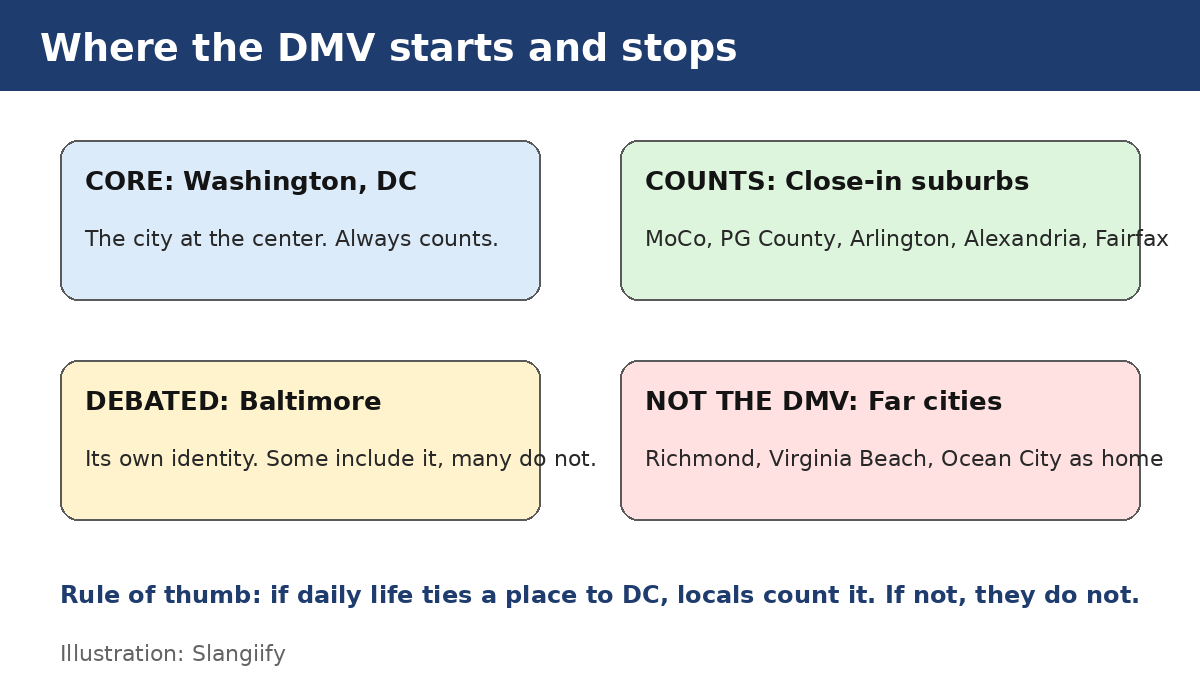
Ask ten locals where the DMV ends and you will get ten slightly different maps, but the core is not in dispute. The District of Columbia sits at the center. Around it, the close-in suburbs count: Montgomery County and Prince George’s County in Maryland, and Arlington, Alexandria, Fairfax County, and nearby parts of Northern Virginia. Those are the places tied to the city by Metro lines, commuter routes, and daily life.
The arguments start at the edges. Her Campus published a local writer’s take that draws the line at Metro access, joking that Virginia Beach is not the DMV and never will be, even if a train ever reached it. That attitude is common: distance matters less than connection. A town two hours away might sit inside the same state but feel like a different world, while a suburb twenty minutes from downtown feels like home turf.
Here is a practical way to read the boundary:
| Place | Usually counts as DMV? | Why |
|---|---|---|
| Washington, DC | Yes, always | The center of the region and the D in the name |
| Montgomery County, MD | Yes | Close-in suburb, Metro served, commuter tied to DC |
| Prince George’s County, MD | Yes | Close-in suburb, Metro served, deep local culture |
| Arlington and Alexandria, VA | Yes | Across the river, Metro served, part of daily DC life |
| Fairfax County, VA | Yes, mostly | Large county; the closer-in parts count without debate |
| Baltimore, MD | Debated | Its own city and culture; some include it, many do not |
| Richmond, VA | Usually no | Too far south, its own scene and identity |
| Virginia Beach, VA | No | Coastal city hours away, separate culture |
| Ocean City, MD | No, as home | A beach destination locals visit, not a DMV hometown |
The honest rule is that the DMV is a cultural boundary, not a legal one. If you have to ask whether a place counts, the fact that you are asking is itself the answer locals would give: the region is defined by shared daily life, and places outside that daily orbit sit outside the name, even when they share a state.
DMV Slang Words You Will Hear Next to It
The letters DMV rarely travel alone. Local speech has its own vocabulary, and hearing these words next to the term is a strong sign you are in regional territory. A few of the best known ones, drawn from local guides and a Her Campus breakdown written by a DMV native, are worth learning.
MoCo, PG County, and the District
Locals shorten county names the way they shortened the region. MoCo means Montgomery County, Maryland. PG County means Prince George’s County, Maryland. The District means DC itself, used when someone wants to separate the city from its suburbs. Hearing “MoCo” in a sentence tells you the speaker is local faster than almost any other word.
Bamma, jone, and jont
A bamma, in local use, is someone who does not know how to dress or carry themselves, a friendly insult rather than a serious one. To jone someone is to roast or tease them, and the verb shows up constantly in playful arguments. These words mark DC speech in particular, and they turn up in lyrics and comedy about the area.
Mambo sauce
Mambo sauce is the sweet, tangy sauce served at DC carryouts, poured over fried chicken, shrimp, fries, and fried rice. It is a food, but it is also a test: order from a carryout in the District and get mambo sauce, and you have had a DMV experience. Food creators tagging the region almost always mention it sooner or later.
Down the ocean, brick, and slim
Going “down the ocean” means heading to the beach, usually Ocean City, Maryland. A “brick” is a long time, as in “I haven’t been back in a brick.” Slim, mo, and bruh all work as casual ways to address a friend. None of these words are exclusive to the DMV, but together with the regional tag they paint a clear picture of local speech.
If you want to go deeper on city slang in general, our guides to Chicago slang and Philly slang show how other American cities built their own vocabularies, and the Dominican slang guide shows the same pattern in a different community. Regional slang works the same way everywhere: a few shared words, a lot of pride, and boundaries only locals can draw.
How People Use DMV on TikTok, Instagram, and in Bios
On social media, DMV works as a location tag, a pride flag, and a search filter all at once. A creator in the region puts it in a bio so local viewers find them and so brands looking for local creators know where they are based. A viewer searching the hashtag finds restaurant reviews, neighborhood jokes, traffic complaints, and dance videos from one metro area instead of from three states at random.
Here are typical uses, with the meaning spelled out:
- “DMV native” in a bio: I grew up in the DC, Maryland, Virginia area, and that shapes my content.
- “Best carryout in the DMV?”: I am asking locals to argue about food, and I expect strong opinions.
- “DMV stand up” under a music video: this artist represents our region, show support.
- “POV: you just moved to the DMV”: a joke or guide about Beltway traffic, Metro etiquette, or county rivalries.
- “DMV check” as a trend prompt: creators list local markers, from mambo sauce to go-go, to prove they are really from there.
The hashtag also does quiet work for small creators. A food review tagged for a whole country drowns. The same review tagged for the DMV reaches the exact people who can actually visit the restaurant. That practical value is a big reason the term stays popular even as other slang fades: it is useful, not just cool.
One caution applies on every platform. Because the motor vehicle meaning exists, a post about the agency can pollute the hashtag, and a post about the region can confuse an outsider. Creators solve this with context: a skyline photo, a neighborhood name, or a local reference in the first line makes the meaning obvious before anyone has to guess.
DMV vs. Other Regional Nicknames
The DMV is not the only American region with a letter nickname, and comparing it with the others shows what makes it distinct. Most regional nicknames bundle a metro area into a short label, but they differ in what they bundle and how strict the boundary feels.
| Nickname | What it bundles | How it differs from the DMV |
|---|---|---|
| DMV | DC, Maryland, Virginia metro | Built around a capital city plus two states’ suburbs |
| Tri-State Area | New York, New Jersey, Connecticut | A much larger commuter region, looser identity |
| The Bay Area | San Francisco Bay metro | Named for a bay, not for states, and covers many counties |
| SoCal | Southern California | A huge region, not one metro area |
| The 6ix | Toronto | One city, not a multi-state region |
The DMV stands out because it crosses state lines around a city that is not in any state. DC belongs to no state, so the region had to invent a name that stitched a district and two states together. That odd geography is part of the identity: the DMV exists because the map made a normal city name impossible.
It also stands out for how fiercely locals defend the boundary. People in the Tri-State Area rarely argue about whether a town counts. People in the DMV argue about it constantly, and that argument is itself a bonding ritual. Debating the boundary is one way of proving you belong inside it.
When NOT to Use DMV
Like any identity label, DMV works best when it is true and when the audience will understand it. A few situations call for a different choice.
Do not use it to claim a place you have only visited. Locals notice, and the term carries a claim of lived experience, not tourism. Saying you visited DC is honest and welcome. Saying you are from the DMV when you spent one weekend there reads as borrowing someone else’s identity, and it will get called out.
Do not use it in formal or official writing when the motor vehicle agency is the topic. A letter about a license renewal should say “Department of Motor Vehicles” in full, because the reader needs the agency, not the region. Mixing the two in official contexts creates real confusion, and it is the one place where the slang reading genuinely gets in the way.
Do not use it as a blanket label for all of Maryland or all of Virginia. Someone from the Eastern Shore or from southwest Virginia does not live in the DMV, and labeling them that way erases their own local identity. The term is specific, and its specificity is the point.
Do not use it to stereotype the region either. The DMV contains government workers, artists, immigrants from dozens of countries, college students, and lifelong locals, and no single joke about traffic or politics captures all of them. Use the term to locate something, not to sum up everyone who lives there.
How to Reply When Someone Says They Are From the DMV
If someone tells you they are from the DMV, the best reply shows you know what that means without pretending you grew up there. A simple “What part?” works well, because locals expect that question and enjoy answering it with a county or neighborhood. It also respects the boundary debate instead of flattening it.
Other replies that land well include asking about a local favorite (“Where is the best carryout near you?”), mentioning something you genuinely know about the area, or just saying “Nice, I have heard the food scene there is serious.” What falls flat is pretending expertise you do not have, or reducing the whole region to a joke about the motor vehicle office. Locals have heard that joke, and they have heard it a thousand times.
If you are the one claiming the DMV and someone asks what part, answer with specifics. A county, a neighborhood, or a Metro stop tells the listener more than the letters alone, and it signals that your claim is real. That is how regional identity works in conversation: the broad label opens the door, and the detail proves you belong.
Myth vs. Fact About the DMV
Myth: DMV means the Department of Motor Vehicles, full stop
Fact: that is one real meaning, but in slang, bios, lyrics, and hashtags, the regional meaning dominates. Context decides, and regional context is far more common online.
Myth: The DMV is all of Maryland and Virginia
Fact: it is only the Washington metro portion of both states. Most of each state sits outside it, with its own identity.
Myth: Baltimore is automatically part of the DMV
Fact: Baltimore is debated. It has its own strong identity, and many locals draw the line south of it. Some people include it, but it is not a settled fact.
Myth: The term was invented by TikTok
Fact: the term spread through local music and radio in the early 2000s, years before TikTok existed. TikTok amplified it, but it did not create it.
Myth: Saying DMV is just a trendy hashtag
Fact: for locals, it is a lived identity tied to neighborhoods, music, food, and daily commuting. The hashtag is the surface, not the whole story.
FAQs About DMV Slang
What does DMV mean in slang?
In slang, DMV means DC, Maryland, and Virginia, the Washington metropolitan area treated as one cultural region. It is used in bios, hashtags, lyrics, and conversation to say someone or something comes from that area.
Is DMV the same as Washington, DC?
No. DC is the city at the center, while the DMV includes DC plus the close-in Maryland and Virginia suburbs around it. Saying “the District” means just the city, while “the DMV” means the wider metro region.
Does DMV include Baltimore?
That is debated among locals. Baltimore has its own distinct identity, and many people draw the DMV boundary south of the city. Some include it in a wider sense, but you should not assume it counts without checking who you are talking to.
What does “DMV stand up” mean?
It is a call for people from the region to show pride and support, often used under music, sports, or local content. It works like other regional shoutouts: a way of saying this one is for us.
Why do people confuse DMV with the motor vehicle office?
Because the Department of Motor Vehicles is the older, official meaning of the same letters, and most Americans meet that meaning first. Online, context separates them: licenses and lines mean the office, neighborhoods and music mean the region.
Is it rude to say you are from the DMV if you only lived there briefly?
It can come across that way to locals, since the term signals lived experience and belonging. If you lived there a short time, saying “I lived in the DMV for a year” is honest and usually welcomed, while claiming it as your hometown may not be.
What is mambo sauce, and why does it come up with DMV slang?
Mambo sauce is a sweet, tangy sauce served at DC carryouts, usually with fried chicken, shrimp, or fries. It comes up because food is a core part of regional identity, and ordering it is a small ritual that marks someone as knowing the area.