


In internet slang, Ohio means weird, awkward, cringe, or absurd. It comes from Only in Ohio memes that treat the state as a fictional place where bizarre things happen.
Table of Contents
- The 10-Second Test: State or Slang?
- What Does ‘Ohio’ Mean in Slang?
- What Does ‘Only in Ohio’ Mean?
- ‘Ohio Rizz,’ ‘Skibidi Ohio Rizz,’ and the Brainrot Stack
- ‘Ohio Final Boss,’ ‘Ohio Core,’ and the Rest of the Ohio Family
- Where Did the Ohio Meme Come From?
- Why Ohio? Why This State Became the Joke
- Who Says ‘Ohio,’ Where, and to Whom?
- How to Use ‘Ohio’ Naturally (and How to Reply)
- Ohio vs. Similar Terms
- When NOT to Use ‘Ohio’
- Myths vs. Facts About Ohio Slang
- Is ‘Ohio’ Still Used in 2026?
- The Short Version
- Quick Answers: Ohio Slang FAQs
- Sources and Further Reading
The 10-Second Test: State or Slang?
If you see ‘Ohio’ in a comment and nobody is talking about the state, it is almost always slang. The word works as a quick label for something weird, awkward, or absurd. The test is simple: check the subject. A map, a city, or a sports team points to the real state, while a video, a haircut, or a pickup line points to the meme.
Context gives the answer in seconds. A post that says ‘Driving through Ohio today’ is about travel. A comment that says ‘Bro, that haircut is so Ohio’ is about the haircut, and the joke is that it looks strange. Nobody in the second example cares where the haircut happened. The state name has become a stand-in for a feeling, and that feeling is usually a mix of confusion and secondhand embarrassment.
Try these four quick questions when you are unsure:
- Is the subject a place, a trip, or a team? Then it is the state.
- Is the subject a person, a video, an outfit, or a situation? Then it is probably slang.
- Does the sentence still make sense if you swap in ‘weird’? If yes, it is slang.
- Is there a skull emoji, a laugh, or a meme caption nearby? That is another strong clue.
The swap test is the most reliable one. ‘Only in Ohio’ becomes ‘only in a weird place like this,’ and ‘that fit is Ohio’ becomes ‘that fit is weird.’ If the swap keeps the joke intact, you have found the slang meaning. If the swap breaks the sentence, the writer meant the state.
What Does ‘Ohio’ Mean in Slang?
In slang, ‘Ohio’ means weird, awkward, cringe, absurd, or strangely bad. It works as an adjective even though it started as a proper noun, so people use it to describe videos, outfits, behavior, and situations. The exact shade of meaning comes from context, and ‘weird’ is the safest translation in most cases.
The slang does not have one fixed dictionary definition. It covers a small family of related ideas, and the speaker picks the one that fits the moment. A distorted image can be ‘Ohio’ because it looks bizarre. A failed joke can be ‘Ohio’ because it lands awkwardly. A surreal video can be ‘Ohio’ because nothing in it follows normal logic. In each case the word signals that something is off, and the humor comes from how far off it is.
Here are three everyday examples:
‘Bro, that haircut is Ohio.’ This means the haircut looks weird or badly done, and the speaker is joking about it rather than giving a serious review.
‘What kind of Ohio video is this?’ This means something close to ‘Why is this video so bizarre?’ The speaker is reacting to content that feels random or unreal.
‘He put ketchup on his pancakes. That man is Ohio.’ This means his choice was strange enough to deserve a joke label. It is playful teasing between people who know each other, not a serious insult.
Capitalization stays inconsistent online. You will see both ‘Ohio’ and ‘ohio’ in comments and captions. The capital O remains the standard spelling because the slang grew out of a place name, and most writers keep it. The lowercase form shows up in fast typing and in meme captions where everything is lowercase anyway.
One more point matters: ‘Ohio’ is usually negative, but the negativity is often light. Calling a funny situation ‘Ohio’ is normally harmless meme language. Calling a person ‘Ohio’ again and again about their looks is a different matter, and it can feel like bullying even when the word itself is mild. The word does not tell you the speaker’s intent. The relationship and the tone do.
What Does ‘Only in Ohio’ Mean?
‘Only in Ohio’ is the catchphrase behind the whole meme. It means that something is so strange it could only happen in a made-up version of Ohio, a place where the normal rules do not apply. The phrase works as a caption, a reaction, or a punchline, and it often appears under videos of bizarre or surreal moments.
The phrase works because it sounds like something people already say about real places. ‘Only in New York’ or ‘only in Florida’ are familiar jokes, and ‘Only in Ohio’ copies that shape. The difference is that Ohio became the joke on a much bigger scale, so the phrase now carries years of meme history with it. One caption can summon all of it.
People use the phrase in three main ways. As a caption, it labels a video or image: a clip of someone doing something absurd gets the text ‘Only in Ohio.’ As a comment, it reacts to someone else’s post, often with a skull or crying-laughing emoji. As a spoken joke, it lands at the end of a story about something weird, like a punchline that needs no setup.
The phrase also appears in longer forms. ‘Only in Ohio would you see that’ adds a little emphasis. ‘Bro, only in Ohio’ adds a tone of disbelief. ‘Ohio moment’ shortens the whole idea into two words. Each form keeps the same core meaning: this is strange, and the strangeness is the joke.
For a clear sense of how the phrase is defined and how it spread, Know Your Meme traces the ‘Only in Ohio’ meme through its early examples and its later waves on TikTok. MyTour also explains the phrase as a running internet joke about the state, and both sources treat it as humor about weirdness rather than a serious claim about Ohio itself.
‘Ohio Rizz,’ ‘Skibidi Ohio Rizz,’ and the Brainrot Stack
‘Ohio rizz’ means charm or flirting skill that is weird, awkward, or cringe instead of smooth. ‘Skibidi Ohio rizz’ stacks three pieces of internet slang into one phrase, and the joke is that the stack is as absurd as possible. These phrases belong to a style of humor that people call brainrot, and they work best when they sound deliberately over the top.
Each piece of the stack has its own job. ‘Skibidi’ comes from the Skibidi Toilet video series, and it now works as a nonsense word that signals chaotic internet humor. ‘Ohio’ adds the weird and cringe label. ‘Rizz’ means charm or the ability to flirt. Put them together and you get something like ‘absurd, cringe charm,’ which is funny precisely because it sounds meaningless to anyone outside the joke.
The stack appears in comments, captions, and songs. A video of a failed pickup attempt might be captioned ‘skibidi Ohio rizz,’ and a comment might say ‘that was negative Ohio rizz’ to mean the flirting went badly. The phrase ‘what does 6-7 mean in slang’ shows how the same stacking habit builds other viral phrases, and you can read our guide to what 6-7 means in slang to see the pattern in action.
Here is a quick guide to reading the stack:
- Rizz on its own: charm or flirting skill, usually used as a compliment.
- Ohio rizz: charm that is weird or awkward, used as a joke or a light insult.
- Skibidi Ohio rizz: the full stack, used when the speaker wants maximum absurdity.
- Negative rizz: charm so bad it pushes people away, the opposite of rizz.
The stack also shows how fast slang combines. A single word becomes a pair, the pair becomes a trio, and the trio becomes a meme format that people remix for weeks. The meaning stays loose because the point is the sound and the chaos, not a precise definition. If you can spot ‘Ohio’ and ‘rizz’ in the same sentence, you have found the joke, even if the exact wording changes.
‘Ohio Final Boss,’ ‘Ohio Core,’ and the Rest of the Ohio Family
‘Ohio final boss’ means the most extreme or most absurd version of something, like the last and hardest enemy in a video game. ‘Ohio core’ means a style, image, or video that captures the strange feeling of the meme in pure form. Both phrases build on the same joke, and both treat ‘Ohio’ as a level of weirdness that can be ranked.
The ‘final boss’ label usually appears under images of odd characters or surreal scenes. A distorted photo, a strange statue, or a bizarre costume might be captioned ‘Ohio final boss,’ which means the image is the peak of the joke. The game reference matters because it tells the reader that this is the hardest, strangest version, and nothing beyond it would top it.
‘Ohio core’ works in a similar way, but it points to a style rather than a single image. Core labels spread across the internet for all kinds of looks, from cottagecore to goblincore, and ‘Ohio core’ follows the same pattern. It collects images that feel like the meme: strange, low-quality, slightly unsettling, and funny because they refuse to make sense.
Other members of the family include ‘Ohio moment,’ ‘Ohio behavior,’ and ‘certified Ohio.’ An ‘Ohio moment’ is a single event that earns the label. ‘Ohio behavior’ describes a pattern, like a friend who keeps making strange choices. ‘Certified Ohio’ is a playful stamp of approval, as if a panel of judges confirmed the weirdness. The family keeps growing because the template is simple: take any word, add ‘Ohio,’ and the joke writes itself.
None of these phrases needs a precise definition to work. Their meaning comes from the shared joke, and readers who know the meme understand them at once. Readers who do not know the meme can still guess the meaning from context, which is why the family spreads so easily. The words are simple, the pattern is clear, and the humor is instant.
Where Did the Ohio Meme Come From?
The Ohio meme did not appear in a single day. It grew from a chain of jokes that stretched across more than a decade, and each link in the chain added a new layer. Know Your Meme traces that chain from early jokes about the state through the ‘Only in Ohio’ wave, and the timeline below follows the same path with the dates that matter most.
The earliest link came from music. In 2010, Lil B released the song ‘Swag Like Ohio,’ which praised the state and its style. The song was not a meme at the time, but it connected the name Ohio with online culture, and later meme makers picked it up as part of the joke. It was the first sign that Ohio had a place in internet humor.
The next link came in 2016, when a meme about a bus-stop sign began to spread. The joke was that Ohio was a strange or cursed place, and the image gave that idea a visual form. Wikipedia describes this period as part of the meme’s early history, and the bus-stop joke set the tone for what followed: Ohio as a place where odd things happen for no clear reason.
In 2019, an astronaut meme added another layer. The joke showed an astronaut looking at Ohio from space and reacting with fear or confusion, which turned the state into something alien or unreal. The format was flexible, so people reused it for other places and ideas, but Ohio stayed the most famous example.
The biggest wave arrived in August 2022, when TikTok users began posting videos captioned ‘Only in Ohio.’ The videos showed bizarre or surreal scenes, from strange animals to odd behavior, and the caption turned each one into an example of the joke. The format was easy to copy, so it spread fast, and within weeks the phrase was everywhere on the platform.
By 2023, ‘Ohio’ had become a slang label in its own right, used by younger users as a shorthand for weird or cringe. The word no longer needed the full phrase to work, and it started appearing in comments, songs, and other memes. In 2024, Oxford University Press named ‘brain rot’ its Word of the Year, which captured the style of humor that the Ohio meme belongs to: fast, absurd, and built for short video feeds.
Here is the timeline in short:
- 2010: Lil B releases ‘Swag Like Ohio.’
- 2016: The bus-stop sign meme spreads.
- 2019: The astronaut meme treats Ohio as an alien place.
- August 2022: The ‘Only in Ohio’ wave takes over TikTok.
- 2023: ‘Ohio’ becomes a slang label for weird or cringe.
- 2024: Oxford names ‘brain rot’ its Word of the Year.
The chain matters because it explains why the joke feels so deep. A person who meets the meme in 2026 is seeing the latest layer of a joke that has been building for years. Each wave added new phrases and new images, and the word ‘Ohio’ now carries all of them at once.
Why Ohio? Why This State Became the Joke
Ohio became the joke for a mix of reasons, and none of them is about the real state being bad. The name sounds plain, the state sits in the middle of the map, and it already appeared in jokes about being boring or average. That made it the perfect blank canvas for a meme about weirdness, because the contrast between the ordinary name and the absurd joke is funny on its own.
Randomness also played a part. Internet jokes often pick a target for no deep reason, and once a target starts winning, the crowd keeps it. Ohio won because the early memes were funny, the phrase was easy to copy, and the state name was short enough to fit in any caption. Other states had similar jokes, but Ohio had the best timing and the best format.
There is also a social reason. Calling something ‘Ohio’ is a soft joke, not a harsh insult, so people use it with friends and in public comments without much risk. The word carries no strong insult on its own, which lets it travel across platforms and age groups. A joke that offends no one spreads further than a joke that does.
Finally, the meme feeds itself. Every new video captioned ‘Only in Ohio’ reminds people of the joke, and every reminder makes the next video funnier. That loop is why a joke from 2022 can still be understood in 2026. The state did not change. The internet just kept the joke alive.
Who Says ‘Ohio,’ Where, and to Whom?
‘Ohio’ is used most by teens and young adults, especially Gen Alpha and younger Gen Z users who grew up with short video feeds. It appears on TikTok, YouTube Shorts, Instagram Reels, Discord, and in group chats, and it is rare in work emails, news writing, or formal settings. The word belongs to casual online speech, and that is where it sounds natural.
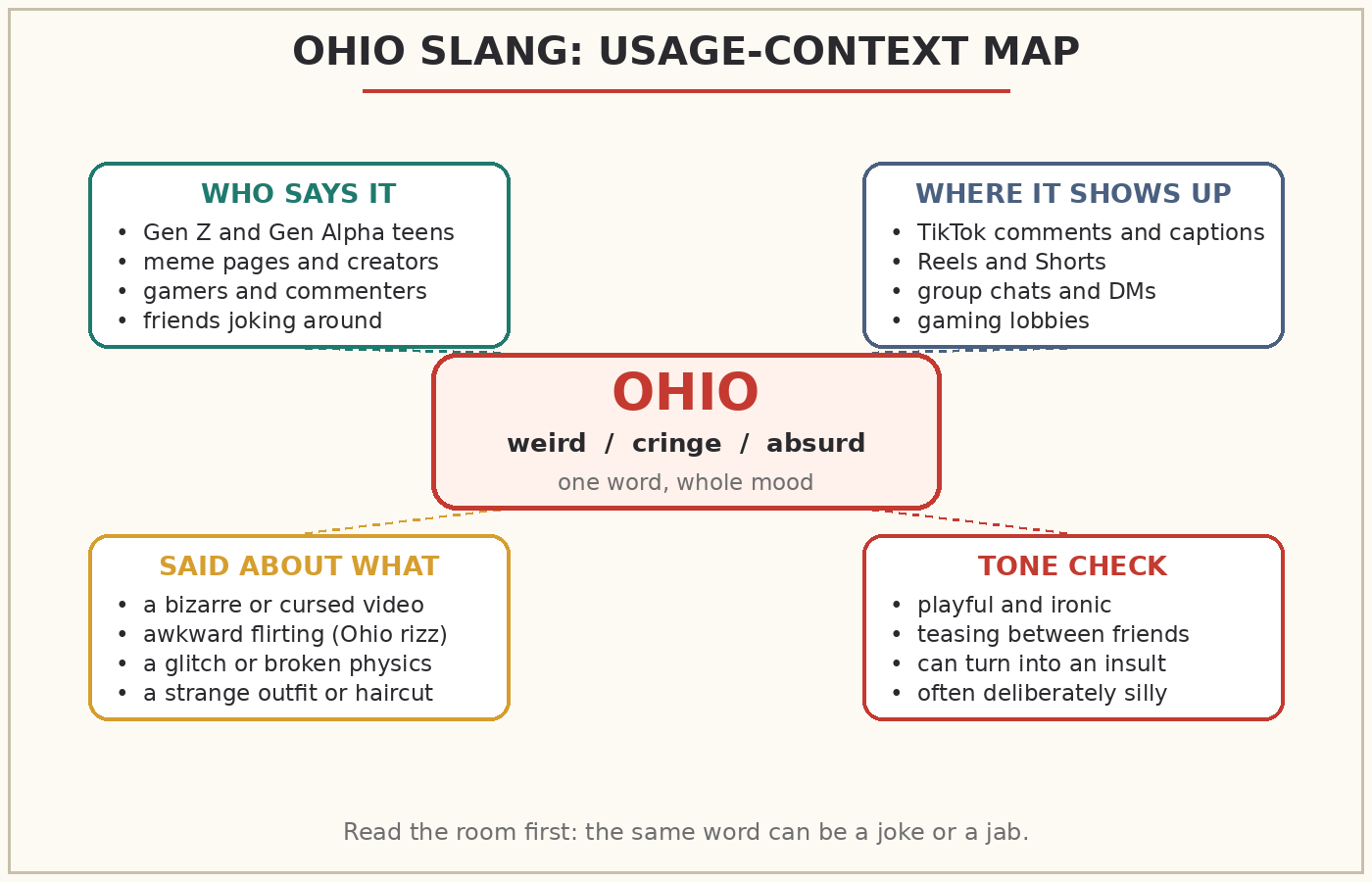
The map above sums up the usage context at a glance: the speakers are mostly young, the places are short video apps and group chats, the targets are videos, outfits, and behavior, and the tone is joking rather than serious. Keep that picture in mind, and you will rarely misread the word.
Age matters more than place. A teenager in any country can use ‘Ohio’ in a comment, and the joke lands because the audience shares the same feeds. A person who does not use TikTok or short video apps may never meet the word, which is why parents and teachers often hear it first from their kids. Slangwise notes that the term is popular with younger users who trade memes daily, and FlashGet Kids describes it as a word parents keep hearing from children who learned it online.
The audience also shapes the tone. Between close friends, ‘Ohio’ is playful teasing. In a public comment under a stranger’s video, it can feel like mockery, even when the writer meant it as a joke. In a classroom or a family chat, it can confuse people who do not know the meme. The safe rule is simple: use it with people who know the joke, and skip it with people who do not.
The word also crosses into speech. Teens say it out loud when reacting to something weird, often with a laugh or a groan. That jump from screen to speech is a sign that the slang has settled in. Words that stay only in text tend to fade fast, while words that people say aloud tend to stick around.


Pingback: What Does Cooked Mean in Slang, Texting, and TikTok?
Pingback: Chud Meaning Slang: Definition, Origin & Online Use
Pingback: Opp Meaning Slang: What “Opp” Means in Text and Online
Pingback: Spanish Slang: Common Words, Meanings, and Regional Differences
Pingback: New York Slang Words: Meanings, Examples, and Usage
Pingback: Bougie Slang Meaning: What It Means and How to Use It
Pingback: Philly Slang: 25 Words and Phrases Locals Actually Use
Pingback: AI Meaning Slang: What Does "AI" Mean in Text and Online?
Pingback: Mid Meaning Slang: What “Mid” Means in Text and Online
Pingback: Jit Slang Meaning: Definition, Examples, Origin & Usage