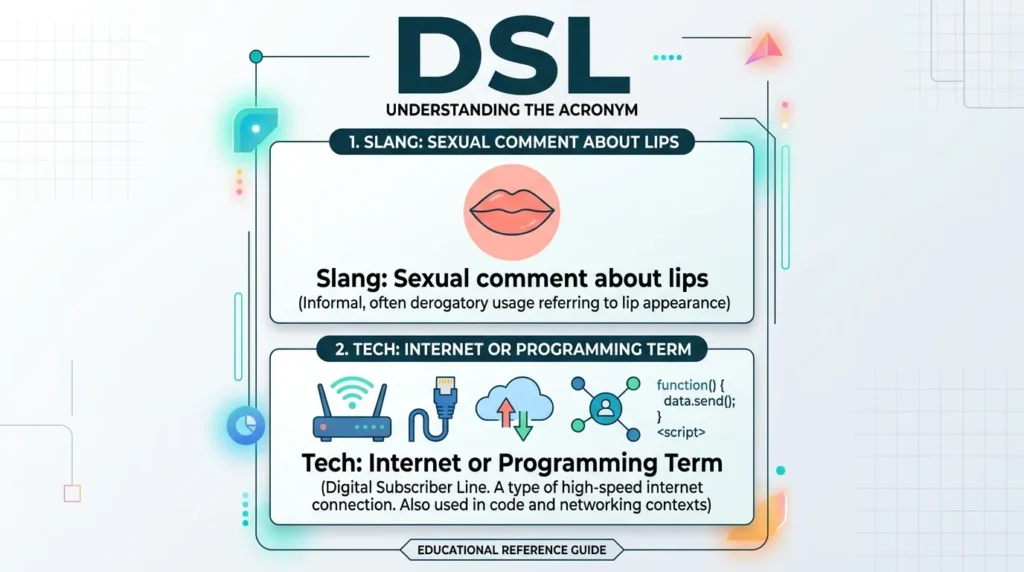

In slang, DSL most commonly stands for dick-sucking lips. It is a vulgar, sexual comment about a person with full or attractive lips, and it shows up in texts, private messages, comments, memes, and casual posts online. The three letters look harmless on their own, and that is part of why they cause confusion. A reader who knows the slang reads a sexual remark, while a reader who does not know it may read a harmless abbreviation and miss the point completely.
DSL does not always mean that. In tech talk it can mean Digital Subscriber Line, a type of internet connection, and in programming it can mean domain-specific language, a small language built for one kind of task. Context decides which one you are looking at, and this guide walks through that context in plain terms, with real examples, the history of the slang, and clear lines for when it is fine to use and when it is not.
If you only need the short version, the table below gives it to you in one glance. If you want the full picture, keep reading. You will find a quick test for telling the meanings apart, a timeline that runs from 2005 to the TikTok comeback, a map of who says it and where, and answers to the questions people ask most.
| Quick Answer | Details |
|---|---|
| Most common slang meaning | Dick-sucking lips |
| What it describes | Full or attractive lips in a sexualized way |
| Typical context | Texting, social media, jokes, flirting |
| Tone | Sexual, vulgar, teasing, or flirtatious |
| Formality | Very informal |
| Work/school appropriate | Usually no |
| Other common meaning | Digital Subscriber Line |
| Programming meaning | Domain-specific language |
| Pronunciation | D-S-L |
Table of Contents
- The 10-Second Test: Which DSL Did You Just See?
- What DSL Means in Slang
- DSL Through the Years: From a 2005 Dictionary Entry to a TikTok Comeback
- Usage-Context Map: Who Says DSL, Where, and to Whom
- DSL in Texting and on TikTok, Snapchat, and Instagram
- DSL Slang vs Digital Subscriber Line vs Domain-Specific Language vs French DSL
- Tone: Flirty, Teasing, Crude, or Objectifying, and the Consent Line
- When NOT to Use DSL
- How to Reply When Someone Says DSL
- Myth vs Fact About DSL
- Frequently Asked Questions About DSL
- Sources and Further Reading
The 10-Second Test: Which DSL Did You Just See?
You do not need a dictionary to work out DSL in most cases. Three quick questions will settle it in about ten seconds, and they work for texts, comments, captions, and work chats alike. Start with the topic of the conversation, not with the letters themselves, because the letters stay the same while the topic changes everything.
1. Is the conversation about someone’s appearance or lips? If the message sits under a selfie, next to a comment about lipstick, or in a chat about how someone looks, the slang meaning is almost certainly the right one. Phrases like “she has DSL,” “those DSLs,” or “that lipstick gives you DSL” all point the same way. The speaker is talking about lips, and the comment is sexual, even when it is dressed up as a joke or a compliment.
2. Is the conversation about internet service, routers, or a home connection? If you see words like router, modem, broadband, connection, download speed, or telephone line, DSL means Digital Subscriber Line. A sentence like “our house still runs on DSL” has nothing to do with lips or flirting. It is a plain statement about how a home gets online, and it is the meaning you will meet most often in a support chat, a bill, or a discussion about moving house.
3. Is the conversation about code? If the people talking are developers, and the words around DSL include language, syntax, config, parser, or workflow, DSL means domain-specific language. A sentence like “we built a small DSL for our config files” is a technical statement about a tool the team made for one job. No one in that chat is talking about anyone’s lips.
When none of those three questions gives you a clear answer, look at the other clues in the message. A winking face, a tongue emoji, or a string of laughing faces next to DSL pushes the reading toward the slang. A price, a speed in megabits, or a mention of a provider pushes it toward internet service. A mention of code, a repository, or a build pushes it toward programming. In a mixed case, ask the sender what they meant. A short question now is better than a wrong guess that turns a tech chat awkward or a flirty chat into a misunderstanding.
The test also helps you avoid the most common mistake with this term, which is to assume that the slang meaning is the only meaning. DSL has lived a long life in tech, and it still does. People who work with networks or code may use it every week without ever thinking of the slang. People who spend their time on TikTok or Instagram may meet the slang first and never meet the tech meaning at all. Both groups are right about the DSL they know, and the ten-second test is what keeps those two worlds from colliding.
What DSL Means in Slang
In slang, DSL is short for dick-sucking lips. It is used to describe lips that look full, soft, or shaped in a way the speaker finds sexually attractive. The phrase is blunt, and that bluntness is part of the point. It does not dress the idea up in polite words, and it does not leave much room for doubt about what the speaker is thinking. When someone says it, they are talking about appearance, and they are doing so in sexual terms.
The term is most often aimed at women, and it is most often said by men, but that is not a rule. Anyone can use it, and anyone can be the subject of it. What stays the same is the focus: the lips. A person with DSL, in this sense, is a person whose lips draw that kind of comment. The lips may be naturally full, they may be shaped by lipstick or lip liner, or they may simply catch the light in a photo in a way that makes them stand out. The comment says more about the speaker’s reaction than it does about any choice the person in the photo made.
It helps to be clear about what DSL does and does not say about a person. It describes how the speaker sees the lips. It says nothing about the person’s behavior, history, or experience. It does not say that the person is sexually active, that they are interested in the speaker, or that they want that kind of attention. Assuming more than that is a mistake, and it is a mistake that causes real harm when it is made in public comments or shared around a group chat.
That gap between what the words mean and what some readers take them to mean is where most of the trouble with DSL starts. A person who reads “she has DSL” as a simple compliment about full lips is missing the sexual charge in the phrase. A person who reads it as a claim about what someone has done or would do is adding a meaning that the phrase never had. The honest reading sits in the middle: it is a sexualized comment about a physical feature, nothing more and nothing less.
The word “lips” in the full form is doing a lot of work here. DSL is not a general comment about being attractive, and it is not a comment about a whole face or a whole person. It is narrow. It picks out one feature and ties it to one sexual act. That narrow focus is why it can feel so pointed when it lands in a comment under a photo. The person in the photo may have posted about their makeup, their outfit, or their day, and the comment pulls the whole post back to one body part.
People also use DSL as a joke between friends, as a teasing line in a private chat, and as a way to test a reaction. In those cases the tone matters more than the dictionary meaning. A close friend who says it with a laugh, in a chat where that kind of humor is normal, is using it in a very different way from a stranger who drops it under a public photo. The words are the same, but the relationship, the setting, and the welcome the comment gets are not. That is why the same three letters can read as playful in one place and as crude in another, and why this guide spends time on tone and consent later on.
If you are learning slang and you meet DSL for the first time, treat it as a term to understand before you use it. Know what it means, know who it is aimed at, and know that it will be read as sexual by almost everyone who knows it. That knowledge will keep you from using it by accident in a place where it does not belong, and it will help you read it correctly when someone else uses it. The rest of this guide gives you the history, the settings where it shows up, and the replies that work when it comes your way.
DSL Through the Years: From a 2005 Dictionary Entry to a TikTok Comeback
DSL is not a new word, even though it feels new to a lot of TikTok users. It has been in circulation for more than twenty years, and its path runs through slang dictionaries, forums, celebrity posts, and short video apps. The timeline below follows that path, step by step, so you can see how a niche slang term from the mid-2000s became a word that a new group of users discovered all over again in 2023.
Know Your Meme records the first Urban Dictionary entry as March 23, 2005, when user Tray added DSL with the meaning dick-sucking lips. That entry used Missy Elliott as the example, and it went on to pick up nearly 8,000 likes in 18 years. That is a long life for a slang entry, and it shows that the term had a clear meaning and a clear audience from the start. It was not a word that needed a lot of explaining, and it was not a word that faded after a few months.
Through the 2000s and into the 2010s, the term spread through slang sites that collected and defined online language. Slang.com, NetLingo, and Acronym.io each defined DSL during that period, and each of them carried the same sexual meaning. Those sites were the places people went when they met a term in a chat room or a forum and wanted to know what it meant, and their entries helped DSL move from a word used in small groups to a word that a wider online audience could look up and understand.
On May 13, 2010, the term made a visible jump into mainstream social media. Redditor Texacer posted a picture of Angelina Jolie to the subreddit /r/pics with the single-word title “DSL.” The post worked because the readers already knew what the letters meant, and because Jolie was widely known for her full lips. The title did not need an explanation, and the joke landed in the space between the photo and the one word above it. That post is still cited as a marker for how far the slang had traveled by 2010, from dictionary entries to a photo site with a large, general audience.
Five years later, on the same date, the term showed up in celebrity culture. On May 13, 2015, Khloe Kardashian joked about having “DSL” in an Instagram video, and the clip picked up over 294,000 likes. The joke worked for the same reason the Reddit post worked: the audience knew the meaning, and the speaker was playing with it rather than explaining it. When a public figure uses a slang term in that way, it tells the audience that the term is common enough to be understood without a gloss, and it gives the term a push into feeds that had never met it before.
Between those public moments, DSL kept circulating in private chats, comments, and captions. It never really went away, but it did not have a single moment that pushed it back into the center of online talk until TikTok gave it one. The comeback came in late 2022 and early 2023, and it came in the form of discovery. TikTokers were not using DSL as a fresh invention. They were posting about just learning what it meant, and their videos spread because other users had the same experience.
One early sign of that wave came on December 23, 2021, when TikToker @viluong posted about a girl saying she had “DSL” when she was 14. The video touched a nerve because it showed how young some users were when they first met the term, and how little context they had for it at the time. A word that adults had used as a joke for years was reaching teenagers in comments and chats, and many of them were left to work out the meaning on their own.
The wave picked up speed in early 2023. On February 5, 2023, TikToker @gimmeyogf posted that she had just discovered what DSL meant after seeing it in her comments. That format, a user learning a term in real time and sharing the moment, is one of the ways TikTok spreads slang fastest. One video leads to more videos, each one with its own comments, and the term moves from one feed to the next in a matter of days. For many viewers, that was the first time they had heard DSL at all, even though the term had been in Urban Dictionary for almost eighteen years by then.
That gap between the term’s age and its new audience explains a lot of the confusion around DSL today. A user who met it on TikTok in 2023 may think it is a brand-new word, while a user who met it on a forum in 2008 knows it as an old one. Both of them are describing the same term, and both of them are right about the version of it they met first. The timeline matters because it clears up that confusion, and because it shows that DSL did not appear out of nowhere. It had a long, steady life before TikTok, and TikTok gave it a new audience rather than a new meaning.
Usage-Context Map: Who Says DSL, Where, and to Whom
DSL changes its feel depending on who says it, where it is said, and who it is said to. A word that is playful between two people who know each other well can be rude when it is aimed at a stranger, and a word that is normal in a tech chat can be a shock in a school group. The map below lays out the most common settings so you can see, at a glance, how the intent shifts from one setting to the next.
| Who says it | Where | To whom | Likely intent |
|---|---|---|---|
| Friends texting about appearance | Private texts and group chats | A friend, or about a celebrity or a photo | Joking, teasing, or giving a blunt compliment |
| Social media users | TikTok and Instagram comments | A creator, often a stranger | Reacting to a photo or video, often with little thought for how it will land |
| People flirting or dating | Private messages and dating apps | A crush, a date, or a partner | Flirting, or testing whether a sexual joke is welcome |
| Internet users and support staff | Tech chats, forums, and bills | A customer, a provider, or a forum reader | Talking about Digital Subscriber Line internet service |
| Developers and engineers | Code reviews, docs, and team chats | Other developers | Talking about a domain-specific language |
| Anyone in a professional setting | Work email, school chat, or a formal post | A colleague, a teacher, or a client | Usually a mistake, because the slang reading will be heard first |
The first three rows in that table share the slang meaning, but they do not share the same risk. A private joke between friends who have already set that kind of tone is a low-risk use, because both sides know what is meant and both sides have shown that they are fine with it. A public comment under a creator’s video is a higher-risk use, because the creator did not ask for a sexual comment, the audience is large, and the comment stays visible long after the moment has passed. Flirting sits in the middle. It can be welcome when the other person has shown that they like that kind of talk, and it can be unwelcome when they have not.
The last three rows show the other side of the map. In a tech chat, DSL is plain and safe, because everyone in the room shares the tech meaning. In a work or school setting, the same letters are risky for the opposite reason: most readers will hear the slang first, even if the writer meant the tech term. That is why it pays to spell out Digital Subscriber Line in a formal message, or to write “domain-specific language” in full the first time you use it in a document. A few extra words remove the doubt, and they cost you nothing.
Age matters here too. Teenagers meet DSL on TikTok and in group chats, often before they have a clear sense of what it means or how it will be read. Adults meet it in the same places, but they may also meet it at work, where the tech meaning is common. When a younger user and an older user read the same three letters, they may be reading two different words. Keeping the setting in mind, and asking when you are not sure, is the simplest way to close that gap.
DSL in Texting and on TikTok, Snapchat, and Instagram
Texting is where most people meet DSL today, and the way it shows up there tells you a lot about how slang works. It rarely appears in a long, careful sentence. It appears as a short reaction, a reply to a photo, or a line in a joke between friends. A text that says “okay DSL” under a selfie, a message that says “you and those DSLs,” or a reply that just says “DSL” with a laughing face all carry the same core meaning, and the short form is part of the joke. The sender does not need to spell it out, because the receiver is expected to know it already.
On TikTok, DSL shows up in two ways. The first is the comment, where a user drops it under a video of someone with full lips, often with no other words at all. The second is the discovery video, where a creator talks about learning what DSL means, or reacts to finding it in their own comments. Those discovery videos are the reason the term spread so fast in late 2022 and early 2023. They turned a private moment of confusion into a public one, and they gave other users a reason to look the term up, share the video, and post their own version of it.
On Instagram, the pattern is close to TikTok, with one difference: the photo is often the point. A lipstick post, a close-up selfie, or a beauty reel is the kind of post that draws DSL comments, because the lips are front and center in the image. A creator who posts a makeup tutorial may get a run of DSL comments that have nothing to do with the tutorial itself. That can be flattering to some creators and tiring to others, and it is one reason many creators turn off comments on close-up photos or set filters for sexual words.
On Snapchat, DSL is more private. It shows up in direct snaps, in replies to a story, and in group chats, where the audience is small and the messages disappear. That privacy can make the term feel safer to use, because the comment does not stay public, but it can also make it feel more direct, because it lands in a one-to-one chat. A DSL comment in a private snap is a message to one person, not a joke for a crowd, and the person who gets it will read it that way. If you are not sure whether that kind of message is welcome, it is better not to send it.
Across all four platforms, the same rule holds: the shorter the message, the more the context has to do. A single word, “DSL,” can be a joke, a compliment, or a crude remark, and only the photo, the chat, and the relationship tell you which one it is. If you are the person sending it, add that context yourself. If you are the person reading it, use the context you have before you react. And if you want to learn more slang that shows up in the same chats, read our guide to what PSA means in slang, which covers another abbreviation that changes meaning with context.
What does DSLs mean?
DSLs is the plural form of DSL, and it means the same thing, with one small shift. Where DSL is often used as a label, as in “she has DSL,” DSLs is often used to point at the lips themselves, as in “look at those DSLs” or “those DSLs are unreal.” The plural makes the comment more direct, because it turns the focus from a trait a person has to a body part you can see in the photo. It is also the form you are most likely to see in a comment under a close-up, where the lips are the clear subject of the image.
People also use DSLs in a joking, self-aware way, as in “my DSLs are doing the work today” under a lipstick post. That use is still sexual, but the speaker is the one making the joke about themselves, which changes how it lands. A self-directed joke is not the same as a comment aimed at someone else, and readers tend to treat it that way. Even so, the meaning stays the same, and a reader who does not know the term will still need the same explanation.
Is DSL lips redundant?
Yes, in a strict sense, saying “DSL lips” is redundant, because the L in DSL already stands for lips. The full form is dick-sucking lips, so “DSL lips” reads as “dick-sucking lips lips” if you expand it all the way out. People still say it, though, and they say it for a simple reason: it sounds natural in a sentence, and it makes the subject clear to a listener who may not know the abbreviation.
Redundancy like this is common in slang. People say “ATM machine,” “PIN number,” and “chai tea” for the same reason, because the repeated word helps the listener follow the sentence even when they do not know the full form. With DSL, the extra word also softens the phrase a little, because it puts the focus on the lips rather than on the first two words of the expansion. That does not change the meaning, and it does not make the phrase polite, but it does explain why you will hear “DSL lips” in comments and captions even from people who know what the letters stand for.
DSL Slang vs Digital Subscriber Line vs Domain-Specific Language vs French DSL
DSL is a good example of why you should never trust an abbreviation on its own. The same three letters can mean four different things, and each one belongs to a different world. The table below puts those meanings side by side, so you can see how the tone, the setting, and the example sentence change with each one.
| Meaning | Tone | Where you see it | Example |
|---|---|---|---|
| DSL slang: dick-sucking lips | Sexual, vulgar, teasing, or flirtatious | Texts, TikTok, Instagram, and Snapchat comments | “She has DSL, and that lipstick makes it worse.” |
| Digital Subscriber Line: a type of internet connection | Neutral and technical | Internet bills, support chats, and tech forums | “Our house still runs on DSL, so the speed is slow.” |
| Domain-specific language: a small language built for one kind of task | Neutral and technical | Code reviews, docs, and developer chats | “We built a small DSL for our config files.” |
| French DSL: short for désolé, meaning sorry | Casual and polite | French chats, texts, and social media | “DSL, I forgot to reply to your message.” |
The French meaning deserves a closer look, because it is the one that trips up English speakers most often. In French internet slang, DSL is short for désolé, which means sorry. A French user who writes “DSL” in a chat is apologizing, not making a sexual comment, and a French reader will hear it that way at once. The letters are the same, the language is not, and the intent is the opposite of the English slang. If you are chatting with a French speaker and you see DSL, check the language of the rest of the message before you react.
The tech meanings are just as easy to mix up with the slang if you only look at the letters. A reader who knows only the slang may read a work email about a DSL connection as a joke, and a reader who knows only the tech term may read a TikTok comment as a note about internet speed. Both mistakes are easy to make, and both are easy to avoid. Look at the words around DSL, look at who is speaking, and look at where the message was posted. Those three clues will point you to the right row in the table almost every time.
It is also worth keeping in mind that the slang meaning is the one most people will think of first in a casual, English-language setting. If you use DSL in a tweet, a caption, or a comment, most readers will hear the slang, even if you meant a tech term. That is why tech writers often spell out Digital Subscriber Line or domain-specific language in full on first use. It takes a few seconds, and it removes a reading that could make a normal post look strange. The same care applies in the other direction: if you mean the slang, do not use it in a tech document and expect readers to guess which one you meant.
Tone: Flirty, Teasing, Crude, or Objectifying, and the Consent Line
DSL does not have one tone. It has at least four, and the difference between them is not in the letters. It is in the relationship, the setting, and whether the person on the receiving end has welcomed that kind of talk. The same sentence can be flirty in one chat, teasing in another, crude in a third, and objectifying in a fourth. Learning to tell those tones apart is the key to using the term well, and to reading it well when someone else uses it.
Flirty
When DSL is flirty, it is a compliment with a sexual edge, and it is aimed at someone who has already shown that they like that kind of attention. A partner who says it in a private chat, a date who says it after a long run of playful messages, or a crush who says it in a chat where both sides have been flirting for a while is using it as a way to show desire. The tone is warm, the intent is clear, and the other person has a real chance to respond in kind, laugh it off, or steer the chat in a new direction. Flirty DSL works because both people are in on it, and because the comment is part of a larger conversation, not a cold message from nowhere.
Flirty use still needs care. A flirty comment that lands well in a private chat can land badly in a public comment, where the audience is larger and the person being talked about did not ask for that kind of attention in front of strangers. Keep flirty DSL private, keep it with people who have shown that they want it, and be ready to stop if the other person does not respond the way you hoped. A good flirt reads the room, and a good flirt stops when the room goes quiet.
Teasing
When DSL is teasing, it is a joke between friends, and the humor is the point. A friend who says “okay, DSL” after a lipstick selfie, or who drops it in a group chat with a string of laughing faces, is usually trying to make the group laugh, not trying to start a sexual conversation. The tease works because the friends know each other, because they have a history of that kind of humor, and because the person being teased can tease back. In that setting, DSL is closer to a nickname than it is to a come-on, and the sexual meaning is softened by the friendship around it.
Teasing still has limits. A joke that is funny in a small group can feel like a pile-on when ten people repeat it, and a joke that is funny when a friend says it can feel different when a stranger joins in. If you are teasing a friend with DSL, watch for the response. If they laugh, the joke landed. If they go quiet, change the subject, or ask you to stop, the joke did not land, and the right move is to drop it and move on. Friends can tell the difference between a joke and a jab, and they will remember which one you chose.
Crude
When DSL is crude, the sexual meaning is the whole point, and there is little warmth or humor to soften it. A blunt comment under a stranger’s photo, a one-word reply in a public thread, or a message that reduces a person to their lips is crude because it treats the sexual comment as if it needs no context, no relationship, and no welcome. The speaker may think they are being funny or bold, but the reader will often hear something else: a person who did not stop to think about how the comment would feel to the person who got it.
Crude use is the most common form of DSL online, and it is the form that gives the term its bad name. It is easy to post, it takes no effort, and it spreads fast in comments where other users are doing the same thing. That ease is part of the problem. A comment that took two seconds to write can stay on a post for months, and it can shape how other readers see the person in the photo. If you are about to post a crude DSL comment, ask yourself whether you would say the same thing to that person face to face, in front of their friends. If the answer is no, do not post it.
Objectifying
When DSL is objectifying, it stops being about a person and starts being about a body part. The comment pulls the lips out of the photo, out of the person’s life, and out of the post they made, and it treats those lips as if they were the only thing worth talking about. A creator who posted about a trip, a job, or a piece of art may find the whole post reduced to a single sexual comment, and that reduction is what makes the comment feel so small and so tiring to the person who gets it. Objectifying DSL is not a compliment, even when the speaker meant it as one, because it does not treat the person as a whole person.
Objectifying comments also add up. One comment on its own may be easy to brush off, but a run of them under every post can make a creator dread opening their comments at all. That is why so many creators filter sexual words, limit comments to followers, or turn comments off on close-up photos. They are not being thin-skinned. They are setting a line for how they want to be talked about in public, and that line deserves respect. If you like a creator’s work, talk about the work. If you want to talk about their lips, ask yourself whether they invited that talk, and whether a public comment is the right place for it.
Relationship and consent tell you whether using DSL is appropriate, not just the definition. The meaning of the letters does not change, but the welcome for them does, and that welcome is what turns a flirty line into a crude one.
That line is the simplest test you can use before you post. Ask yourself three things: do I know this person well enough for a sexual joke, has this person shown that they welcome this kind of talk from me, and would this comment feel right if it were said to me in the same setting? If you can answer yes to all three, the comment is more likely to land as flirty or teasing. If you cannot, hold back. The term will still be there tomorrow, and a comment that you did not post is a comment you never have to explain.
When NOT to Use DSL
There are places where DSL does not belong, and the list is not short. Do not use it with strangers, in public comments, at work, at school, or with anyone who has not welcomed sexual comments from you. Do not use it in formal communication, in a message to a teacher or a boss, or in any setting where a sexual remark could cost you a job, a grade, or a relationship. The letters may look small on a screen, but the meaning is not small, and a reader in those settings will hear it at once.
Do not use DSL in comments on photos of minors, and do not use it in any chat where a minor could read it as a comment about them. That line is not a matter of taste. A sexual comment about a young person’s lips is harmful, it can be reported, and it can lead to a ban or worse. If you are not sure how old the person in a photo is, do not post a sexual comment at all. The same rule applies to any photo where the person has not asked for that kind of attention.
When in doubt, leave it out. A comment you do not post cannot be misread, screenshotted, or reported, and a joke you do not make cannot hurt a friendship. If you want to compliment someone’s lips, say that their lipstick looks good, or that their smile stands out in the photo. Those words carry the compliment without the sexual charge, and they work in almost any setting. Save DSL for a private chat with someone who has shown, in clear terms, that they want that kind of talk from you.
How to Reply When Someone Says DSL
Getting a DSL comment can leave you unsure what to do next, and the right reply depends on how you feel about it. The replies below cover the most common cases, and each one keeps the tone short and clear, so you do not have to write a long message to set a line or ask a question.
If you do not know what they mean
Ask, plainly: “What does DSL mean here?” or “I have not heard that one before, what do you mean?” Most senders will explain, and asking is better than guessing. If the sender laughs at you for not knowing, that tells you more about them than it does about you, and you do not owe them a reply to the joke.
If you are comfortable with the compliment
A short thank you works: “Thank you, that is sweet of you” or “Haha, thank you.” Keep it light, and keep it in the same chat where the comment came from. You do not need to match the sexual tone, and you do not need to send a comment back in kind.
If you want clarification
Ask what they meant by it: “Did you mean that as a compliment, or as a joke?” That question gives the sender a chance to explain, and it gives you a clear answer to work with. If the answer is vague or dodgy, treat the comment as one you did not welcome, and move on.
If the comment makes you uncomfortable
Say so, in plain words: “Please do not comment on my body like that” or “I am not comfortable with that kind of comment.” Then stop the chat, delete the comment, or block the sender if they keep going. You do not need to explain why, and you do not need to soften the line to protect the sender’s feelings. If the comment came from a stranger in public, report it and delete it.
If it appears in a professional conversation
Treat it as a mix-up first, and ask for the full term: “Do you mean Digital Subscriber Line here, or a domain-specific language?” That reply gives the sender a clean way out if they meant a tech term, and it makes the problem clear if they did not. If the comment was sexual and it came from a colleague, save the message and raise it through the right channel at work or school. For more on slang that turns up in the same kinds of chats, see our guide to what FOMO means in slang.
Myth vs Fact About DSL
A lot of what people say about DSL is wrong, and the wrong ideas spread as fast as the term itself. The table below sets the most common myths next to the facts, so you can check a claim in seconds.
| Myth | Fact |
|---|---|
| DSL says something about the person’s sexual behavior. | It only describes the lips as the speaker sees them. It says nothing about behavior or experience. |
| Some sites define it as “Daddy’s Sweet Little” or “Dream Sweet Love.” | Those are not how the term is used anywhere online. The slang meaning is dick-sucking lips. |
| It is a brand-new TikTok word. | It goes back to a 2005 Urban Dictionary entry. TikTok gave it a new audience, not a new meaning. |
| It is always a compliment. | Unsolicited, it often reads as crude or objectifying, even when the speaker meant it kindly. |
| DSL always means the slang. | In tech talk it is Digital Subscriber Line, and in programming it is domain-specific language. |
| Only men say it, and only about women. | Anyone can say it, and anyone can be the subject of it, though it is most often aimed at women. |
Frequently Asked Questions About DSL
What does DSL mean in slang?
Short answer: In slang, DSL stands for dick-sucking lips. It is a vulgar, sexual comment about a person with full or attractive lips, and it shows up in texts, comments, and posts about appearance.
What does DSL mean from a guy?
Short answer: It means the same thing, dick-sucking lips, and it is usually a sexual comment about your lips. From a guy, it is most often a compliment with a sexual edge, a tease, or a flirty line, and the welcome for it depends on your relationship with him.
What does DSL mean on TikTok?
Short answer: On TikTok, DSL means dick-sucking lips, and it shows up in comments under videos of people with full lips. It also shows up in discovery videos, where creators post about just learning what it meant after seeing it in their comments.
What does DSL mean on Snapchat?
Short answer: On Snapchat, DSL means dick-sucking lips, and it shows up in private snaps, story replies, and group chats. Because the audience is small and the messages disappear, it can feel more direct than a public comment, so treat it the same way you would treat a private sexual remark.
Is DSL a compliment?
Short answer: It can be a compliment, but only when the person who gets it welcomes that kind of talk. Between partners or close friends, it can read as flirty or teasing. From a stranger, or in public, it often reads as crude or objectifying instead.
What does DSL mean in internet terminology?
Short answer: In internet terminology, DSL means Digital Subscriber Line, a type of internet connection that runs over telephone lines. In programming, it can also mean domain-specific language, a small language built for one kind of task.
Is DSL inappropriate to say?
Short answer: Yes, DSL is inappropriate in most formal settings, at work, at school, and with strangers, because it is a vulgar sexual term. In a private chat with a partner or a close friend who welcomes that kind of talk, it can be fine. If you are not sure, do not say it. For another abbreviation that changes meaning with context, see our guide to what PDA means in slang.
Sources and Further Reading
The history and the key facts in this guide come from the sources below. They are worth a read if you want to see the original entries, the timeline, and the French meaning in more detail.


Pingback: Australian Slang: 50 Aussie Words and Phrases Explained
Pingback: 90s Slang: Popular Words and Phrases From the 1990s
Pingback: Toronto Slang: Popular Words, Meanings, and Examples
Pingback: 80s Slang: 50 Popular Words & Phrases Explained
Pingback: Bougie Meaning: Slang Definition, Examples & Pronunciation
Pingback: 4th Hole Meaning: What Does 4th Hole Mean in Slang?
Pingback: Philly Slang: 25 Words and Phrases Locals Actually Use