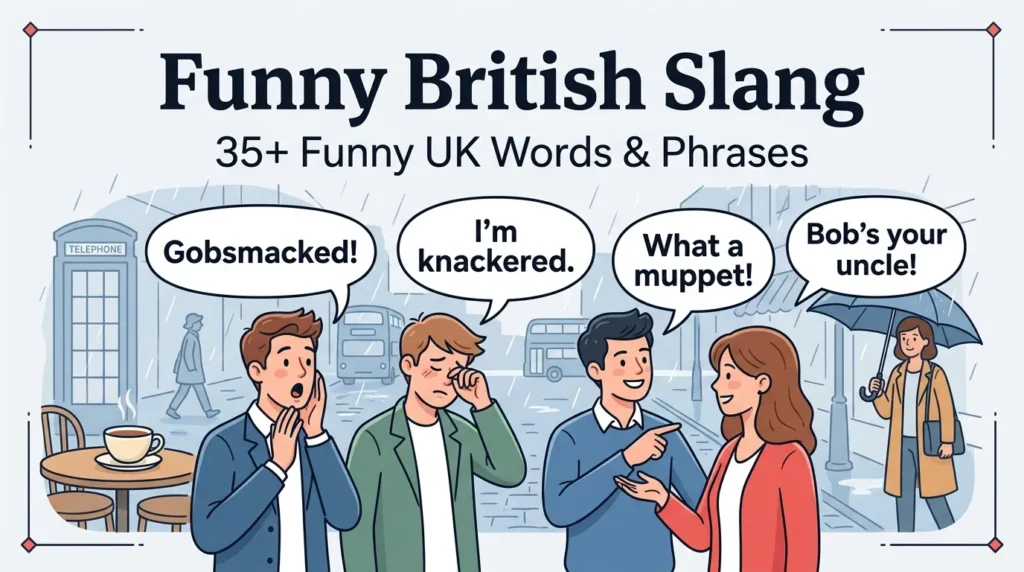

Funny British slang is a collection of informal UK words and expressions that can sound surprisingly strange, clever, or hilarious to people unfamiliar with British English. Words such as gobsmacked, knackered, muppet, cheeky, chuffed, and plonker can communicate surprise, exhaustion, affection, foolishness, or approval in ways that are much more colorful than their standard-English equivalents.
The important thing is that “funny” does not necessarily mean British people are joking whenever they use these terms. Many are ordinary informal expressions. Some are playful, some are mildly rude, some are regional, and others are strongly associated with British humor. Tone and context can completely change how an expression feels.
Quick Answer: Funny British Slang at a Glance
| Term | Meaning | Tone | Typical Use |
|---|---|---|---|
| Gobsmacked | Extremely surprised | Playful | Reactions |
| Knackered | Very tired | Casual | Everyday conversation |
| Chuffed | Very pleased | Positive | Good news |
| Gutted | Very disappointed | Casual | Bad news |
| Cheeky | Playfully mischievous | Light | Food, jokes, behavior |
| Muppet | Foolish person | Mildly insulting | Friendly teasing |
| Plonker | Fool or idiot | Mildly insulting | Banter |
| Numpty | Silly or foolish person | Playful | Casual teasing |
| Banter | Playful teasing | Casual | Friends |
| Dodgy | Suspicious or unreliable | Informal | People, things, situations |
| Kerfuffle | Small commotion | Humorous | Problems or confusion |
| Faff | Waste time doing unnecessary things | Casual | Everyday complaints |
| Chinwag | Casual chat | Friendly | Social conversations |
| Brolly | Umbrella | Casual | Everyday speech |
| Bog roll | Toilet paper | Crude/playful | Informal speech |
| Tosh | Nonsense | Mild | Dismissing an idea |
| Gobshite | Foolish or unpleasant person | Rude | Insults |
| Taking the piss | Mocking or teasing | Informal | Banter |
| Pear-shaped | Gone wrong | Humorous | Plans or situations |
| Bob’s your uncle | There you go; problem solved | Playful | Instructions |
What Makes British Slang So Funny?
British slang often gets its humor from unexpected imagery. Instead of saying that something went badly, someone might say it “went pear-shaped.” Instead of simply calling someone foolish, they might call them a “muppet” or “numpty.”
The words themselves can create part of the joke. A phrase such as “dog’s dinner” sounds like it should describe food, but it can describe something badly organized or messy. Likewise, “chinwag” has nothing to do with a literal chin moving around; it simply means a chat.
Another source of humor is understatement. British conversation can sometimes describe an extreme situation with surprisingly mild language. Someone who is extremely tired might simply say, “I’m absolutely knackered.”
That contrast between the ordinary situation and the unusual expression is one reason British slang is so entertaining to language learners.
Funny British Slang Words for People
Some of the most recognizable funny British slang describes people. These expressions range from affectionate teasing to genuine insults, so knowing the tone is important.
Muppet
A muppet is a foolish, clumsy, or incompetent person.
It is often much softer than a serious insult, especially when friends use it jokingly.
Example:
“I locked my keys in the car again. I’m such a muppet.”
Calling someone a muppet can sound humorous because the word has a cartoonish feel. However, it is still technically an insult, so the relationship between the speakers matters.
Plonker
A plonker is a foolish or stupid person.
The word is strongly associated with British popular culture and has a distinctly comic sound.
Example:
“You absolute plonker—you left the shopping in the car.”
Among friends, this can be playful rather than genuinely hostile.
Numpty
A numpty is someone who has behaved foolishly or made a silly mistake.
It is especially useful when you want to criticize someone’s action without making the insult sound extremely aggressive.
Example:
“I forgot the tickets. What a numpty.”
The word is particularly associated with Scottish usage but is understood more broadly in Britain.
Wally
A wally is a foolish or silly person.
It tends to sound old-fashioned or deliberately comic compared with stronger insults.
Example:
“That wally forgot his own birthday.”
Div
A div is an informal insult for someone regarded as stupid or foolish.
It can sound fairly mild in casual British speech, but it is still an insult rather than a neutral description.
Example:
“Don’t be a div. The door clearly says ‘push.’”
Gobshite
A gobshite is a rude term for someone who talks nonsense or behaves like an obnoxious fool.
This one is considerably less polite than “muppet” or “numpty.”
Example:
“Ignore him. He’s talking absolute rubbish.”
Because it contains a vulgar element, it is unsuitable for professional or formal situations.
Funny British Slang for Feelings and Reactions
British slang becomes especially expressive when describing emotions.
Gobsmacked
Gobsmacked means extremely shocked or astonished.
It is one of the most visually memorable British expressions because “gob” is an informal word for the mouth, while “smacked” suggests being struck.
Example:
“I was absolutely gobsmacked when she won.”
It usually describes genuine surprise, although it can also be used humorously for dramatic effect.
Chuffed
Chuffed means very pleased or delighted.
Example:
“I’m absolutely chuffed with the new job.”
The expression is positive and casual. It is especially useful when you want to recognize British English in conversations about good news.
Gutted
Gutted means extremely disappointed or upset about an outcome.
Example:
“I was gutted when the concert was cancelled.”
It does not literally mean that someone’s internal organs have been removed. It is an emphatic informal expression of disappointment.
Miffed
Miffed means slightly annoyed, irritated, or offended.
Compared with stronger words for anger, it often sounds understated.
Example:
“She was a bit miffed that nobody told her about the change.”
That slightly restrained quality can make the expression sound amusing to learners.
Chuffed to Bits
Chuffed to bits means extremely pleased.
Example:
“He was chuffed to bits with his birthday present.”
It is a more expressive version of “chuffed” and works naturally in enthusiastic informal conversation.
Also Read: Bop Meaning in Slang: What Does “Bop” Mean?
Funny British Slang for Being Tired, Busy, or Broke
British slang also has wonderfully compact ways to describe everyday problems.
Knackered
Knackered means extremely tired or exhausted.
Example:
“I’m absolutely knackered after that flight.”
It is informal but extremely useful for recognizing casual British speech.
Skint
Skint means having very little or no money.
Example:
“I’d love to come out, but I’m completely skint until Friday.”
It is a useful word for describing temporary financial shortage without sounding formal.
Faff
To faff means to spend time doing unnecessary, inefficient, or complicated things.
Example:
“Stop faffing about and get your coat on.”
The related phrase faffing about is particularly common in casual British English.
Leg It
To leg it means to run away or run somewhere quickly.
Example:
“We realized we were late, so we legged it to the station.”
It is highly informal and works best in casual storytelling.
Funny British Slang for Everyday Situations
Some expressions are funny because they describe ordinary situations in unexpectedly colorful ways.
Pear-Shaped
If something goes pear-shaped, it means that a plan or situation goes wrong.
Example:
“Everything was fine until the computer crashed and the whole evening went pear-shaped.”
The phrase is useful because it can describe anything from a minor problem to a complete failure.
Kerfuffle
A kerfuffle is a commotion, fuss, disagreement, or confused situation.
Example:
“There was a bit of a kerfuffle over the seating arrangements.”
The word itself sounds more dramatic than the relatively minor problem it often describes.
Dog’s Dinner
A dog’s dinner describes something that is badly organized, badly done, or messy.
Example:
“I made a real dog’s dinner of that presentation.”
The literal image is part of what makes the expression funny.
Bodge
A bodge is a quick, improvised, or poor-quality repair or solution.
Example:
“It’s not a proper repair—it’s just a bodge.”
The verb bodge can also describe doing a job badly or hastily.
Dodgy
Dodgy can mean suspicious, unreliable, dishonest, unsafe, or questionable.
Example:
“That website looks a bit dodgy.”
It can apply to people, objects, deals, websites, food, or situations.
Funny British Slang for Talking and Socializing
Chinwag
A chinwag is an informal chat or conversation.
Example:
“We had a good chinwag over coffee.”
It is friendly and usually lighthearted.
Banter
Banter means playful teasing or joking, particularly among people who know each other.
Example:
“Don’t take it seriously. We’re just having a bit of banter.”
Banter is one of the most important words to understand when interpreting British humor. However, not every insult becomes acceptable simply because someone calls it “banter.” The relationship, subject, tone, and circumstances still matter.
Have a Moan
To have a moan means to complain or grumble.
Example:
“We spent ten minutes having a moan about the weather.”
It can be humorous because complaining is presented as a casual social activity.
Waffle
To waffle means to talk at length without saying much useful.
Example:
“He spent twenty minutes waffling about the same problem.”
It can describe unnecessary talking in both casual and mildly critical contexts.
Funny British Slang for Food, Drinks, and Going Out
British slang has plenty of expressions connected to food and social life.
Cuppa
A cuppa is a cup of tea, usually referring to an everyday cup of tea rather than a formal serving.
Example:
“Fancy a cuppa?”
The phrase fancy a cuppa? is a familiar informal way to offer someone tea.
Brew
A brew can refer to a cup of tea in everyday British conversation.
Example:
“I’m making a brew. Want one?”
The exact meaning can vary by region and context, but tea is a common interpretation.
Cheeky
Cheeky can describe someone or something slightly mischievous, playful, indulgent, or unconventional.
Example:
“Fancy a cheeky dessert?”
The expression can be humorous because cheeky is sometimes attached to ordinary pleasures as though they were slightly rebellious.
Cheeky Nando’s
Cheeky Nando’s is a humorous British expression for going out for a casual meal at Nando’s.
It became a recognizable piece of British internet and pop-culture language, particularly as a playful exaggeration of an ordinary meal.
Example:
“Fancy a cheeky Nando’s after work?”
The phrase is culturally specific and should not be treated as a universal British expression used in every region or age group.
Also Read: ISO Meaning Slang: What ISO Means in Text & Online
Funny British Expressions That Sound Completely Literal
Some expressions are confusing because their literal meanings are very different from what speakers actually mean.
Bob’s Your Uncle
Bob’s your uncle is used to mean something like “there you go,” “that’s all there is to it,” or “the job is done.”
Example:
“Add the flour, stir it together, and Bob’s your uncle.”
It often appears at the end of a simple explanation.
It’s Chucking It Down
It’s chucking it down means it is raining heavily.
Example:
“Take an umbrella—it’s chucking it down outside.”
The expression is informal and vivid, making ordinary weather sound considerably more dramatic.
Bite Your Arm Off
If someone says they would bite your arm off, they mean they would accept an offer eagerly.
Example:
“If you offered me a free weekend in London, I’d bite your arm off.”
It is not intended literally.
Don’t Get Your Knickers in a Twist
This means don’t become unnecessarily upset, worried, or worked up.
Example:
“Don’t get your knickers in a twist—we’ve still got plenty of time.”
It is playful but can sound dismissive depending on how it is said.
A Sticky Wicket
A sticky wicket is a difficult or awkward situation.
The expression comes from cricket terminology and is now sometimes used more broadly.
Example:
“We’re on a bit of a sticky wicket with the deadline.”
It is more idiomatic than everyday slang and may sound deliberately British or humorous when used outside a cricket-related context.
Funny British Slang That Means Something Good
Not all funny British slang is insulting or negative.
Ace
Ace means excellent, impressive, or very good.
Example:
“That new restaurant is ace.”
It is informal and positive.
Brilliant
In British conversation, brilliant can simply mean excellent or great.
Example:
“You got the tickets? Brilliant!”
The word does not necessarily mean something is intellectually brilliant. Context determines whether it means “excellent” or its more literal sense.
The Bee’s Knees
The bee’s knees means something considered excellent or outstanding.
Example:
“That little café is the bee’s knees.”
It has an old-fashioned, playful flavor and may sound deliberately quirky in modern conversation.
The Dog’s Bollocks
The dog’s bollocks is a vulgar British expression meaning something excellent or the best.
Example:
“This new phone is the dog’s bollocks.”
Because it contains vulgar language, it should not be used in formal or professional settings.
Funny British Slang Insults
British English has an unusually large collection of comic-sounding insults, but “funny” does not mean “harmless.”
Mild and Playful Insults
Terms such as muppet, numpty, wally, plonker, and div can function as playful insults when used between friends.
For example:
“You muppet, you’ve put your shoes on the wrong feet.”
The same basic vocabulary can become genuinely insulting if delivered angrily or directed at someone who does not know the speaker.
Stronger Insults
Words such as tosser, wanker, knob, and dickhead are considerably more vulgar.
They may appear in British comedy, arguments, football banter, or informal conversations, but they are not suitable as general-purpose vocabulary for learners.
A useful rule is simple: understanding a word does not mean you should automatically use it.
British Slang That Can Confuse American English Speakers
One reason British slang is so funny to international English learners is that some words exist in both British and American English but mean different things.
Pants
In British English, pants usually means underwear.
In American English, pants usually means trousers.
Chips
In Britain, chips usually means what Americans call fries.
Thin, crispy potato snacks are generally called crisps in British English.
Biscuit
A British biscuit is generally similar to what Americans call a cookie.
American English uses biscuit for a different type of baked food.
Fanny
This word deserves particular caution.
In American English, fanny can be a mild word for someone’s backside. In British English, it can refer vulgarly to female genitalia.
Because of that difference, international speakers should not assume that an apparently harmless American expression has the same effect in Britain.
British Slang by Tone
The same expression can feel completely different depending on who says it and how.
| Tone | Examples | Typical Effect |
|---|---|---|
| Friendly | Mate, banter, cheeky | Relaxed |
| Playful | Muppet, numpty, plonker | Teasing |
| Positive | Ace, brilliant, chuffed | Approval |
| Humorous | Kerfuffle, pear-shaped, dog’s dinner | Comic description |
| Mildly critical | Miffed, dodgy, faff | Casual criticism |
| Rude | Wanker, tosser, gobshite | Strong insult |
| Vulgar | Dog’s bollocks | Strong but sometimes positive |
The relationship between speakers matters just as much as the dictionary meaning. A close friend may use “you muppet” affectionately, while the same words from a stranger could be insulting.
How to Use Funny British Slang Naturally
The easiest mistake for a learner is trying to use too much slang at once.
Instead of saying:
“I’m absolutely gobsmacked, knackered, skint, and having a proper chinwag with my cheeky mate.”
a natural speaker would normally use one or two expressions that fit the situation.
For example:
“I’m absolutely knackered. Fancy a cuppa?”
That sounds much more natural because the expressions serve a real conversational purpose.
Also Read: Goyim Slang Meaning: What Does Goyim Mean?
Match the Slang to the Relationship
Use mild expressions first when speaking with people you do not know well.
Words such as brilliant, cheeky, chuffed, knackered, and gutted are easier to understand and generally safer than vulgar insults.
Learn the Meaning Before the Joke
Some British expressions are funny precisely because their literal meaning is misleading.
If you only memorize the literal translation, you can easily misunderstand the conversation.
For example:
“It’s gone pear-shaped.”
does not mean that an object literally became shaped like a pear. It means the situation went wrong.
Don’t Assume All British Slang Is Used Everywhere
“British” covers England, Scotland, Wales, and Northern Ireland, alongside many regional varieties and local speech communities.
A phrase strongly associated with London may not sound equally natural in Glasgow, Manchester, Cardiff, or Belfast. Age and social context also influence slang use.
Real Conversation Examples
With Friends
Sam: “Fancy a pint later?”
Alex: “Absolutely. I’m knackered after work.”
Here, knackered simply means very tired.
After Good News
Jamie: “I got the job!”
Chris: “Brilliant! You must be chuffed.”
Here, chuffed expresses happiness or pride.
After a Mistake
Alex: “I sent the email to the wrong person.”
Sam: “You absolute muppet.”
This is playful if the speakers have a friendly relationship.
During a Complicated Situation
Jamie: “The train was cancelled, then the replacement bus broke down.”
Chris: “What a kerfuffle.”
Here, kerfuffle makes the frustrating situation sound lighter and more humorous.
Talking About a Suspicious Website
Sam: “This website is offering a new phone for £20.”
Alex: “That sounds dodgy.”
Here, dodgy means suspicious or unreliable.
Describing a Bad Result
Jamie: “How did your DIY project go?”
Chris: “Honestly? I made a proper dog’s dinner of it.”
The speaker means they made a mess of the project.
Is Funny British Slang Rude?
Some funny British slang is completely harmless, while other expressions are vulgar or insulting.
The safest way to understand it is to separate meaning from social impact.
A word such as knackered is informal but generally not offensive. Muppet is an insult but can be playful. Wanker is vulgar and much more socially risky. The dog’s bollocks can be positive in meaning while still containing profanity.
Context also matters. British humor frequently relies on teasing, sarcasm, understatement, and exaggeration, but that does not make every insult acceptable.
Safe for Casual Conversation
Generally lower-risk examples include:
- Brilliant
- Ace
- Chuffed
- Knackered
- Gutted
- Cheeky
- Chinwag
- Kerfuffle
- Dodgy
Use With Familiar People
Be more careful with:
- Muppet
- Plonker
- Numpty
- Wally
- Div
- Taking the piss
These depend heavily on tone and relationship.
Strong or Vulgar
Use particular caution with:
- Wanker
- Tosser
- Gobshite
- Dickhead
- Dog’s bollocks
These are not suitable for formal writing or most professional situations.
Funny British Slang vs. British Idioms
Not every funny British expression is technically slang.
Slangiify generally refers to highly informal vocabulary or expressions associated with particular groups, communities, or casual speech.
Idioms are expressions whose overall meaning cannot necessarily be predicted from their individual words.
That means a phrase such as “it’s gone pear-shaped” is better understood as an idiomatic expression, even though it is strongly associated with informal British speech.
For learners, the distinction is less important than recognizing how the expression actually works in conversation.
Also Read: What Does PSA Mean in Text, Chat, and Social Media?
Why Context Matters So Much
British slang often carries additional information beyond its literal definition.
Consider:
“You’re a right muppet.”
Depending on tone, this could be:
- affectionate teasing,
- mild criticism,
- genuine annoyance,
- or humorous exaggeration.
Similarly:
“That’s cheeky.”
could describe:
- playful behavior,
- a mischievous comment,
- an indulgent purchase,
- or something slightly bold.
The words around the expression, the relationship between speakers, and the situation usually provide the clues.
Common Mistakes When Learning British Slang
Mistake 1: Treating Every Slang Word as Funny
Some British slang is funny because it sounds unusual. Other slang is simply informal, rude, regional, or vulgar.
Mistake 2: Using Insults With Strangers
A British speaker may call a close friend a “muppet” without causing offense. A learner using the same word with a stranger may get a very different reaction.
Mistake 3: Assuming TV Language Represents Everyone
British television and comedy often exaggerate recognizable speech patterns. Real-life conversations vary by region, age, social group, and situation.
Mistake 4: Translating Literally
Expressions such as Bob’s your uncle, pear-shaped, and bite your arm off become confusing when interpreted word by word.
Mistake 5: Overusing Slang
Using one natural expression is usually more convincing than filling every sentence with British slang.
Similar Terms You May Also Hear
| Term | Meaning | Main Difference |
|---|---|---|
| Muppet | Foolish person | Usually comic and mild |
| Numpty | Foolish person | Often playful |
| Plonker | Fool or idiot | Comic, mildly insulting |
| Wally | Silly person | Often sounds old-fashioned |
| Gobshite | Foolish or obnoxious person | More vulgar |
| Wanker | Strong insult | More vulgar |
| Banter | Playful teasing | Describes interaction, not a person |
| Cheeky | Playfully mischievous | Not necessarily an insult |
The differences are mostly about tone, strength, and context, rather than completely separate meanings.
Frequently Asked Questions
What is the funniest British slang word?
There is no single objectively funniest British slang word. Words such as muppet, numpty, gobsmacked, knackered, and kerfuffle often sound funny to learners because their pronunciation or imagery is unusual. Their actual use is broader than simply being jokes.
What is a funny British word for an idiot?
Common playful choices include muppet, numpty, plonker, wally, and div. Their strength varies, and some are more regional than others. Stronger terms such as wanker or tosser are more vulgar and should not be treated as interchangeable with the milder options.
What does “muppet” mean in British slang?
In British informal speech, muppet can describe someone who has behaved foolishly, clumsily, or incompetently. Between friends, it can be affectionate teasing. In a serious argument, however, it can be a genuine insult.
What does “knackered” mean?
Knackered means extremely tired or exhausted. It is informal British English and is common in casual conversation.
Example: “I’m absolutely knackered after that journey.”
What does “gobsmacked” mean?
Gobsmacked means extremely surprised or astonished. It is commonly used when someone is so surprised that they are temporarily speechless.
Example: “I was gobsmacked when I heard the news.”
Is “cheeky” British slang?
Cheeky is strongly associated with British informal speech, although it is not exclusively British. It can describe playful, slightly mischievous, bold, or indulgent behavior.
Example: “I’m having a cheeky dessert.”
What does “taking the piss” mean?
Taking the piss means mocking, teasing, or making fun of someone or something. It is very informal and contains mild vulgarity, so it is better suited to casual conversation than professional situations.
Can Americans understand British slang?
Many common expressions are now widely recognized because of British television, films, music, social media, and international English. However, regional expressions, older slang, and vulgar terms can still cause confusion. Context is often more important than knowing a direct translation.
Conclusion
Funny British slang is less about memorizing a giant list of strange words and more about understanding how British speakers use informal language to add humor, emphasis, affection, criticism, or understatement. Words such as gobsmacked, knackered, chuffed, gutted, cheeky, muppet, and numpty are useful because they appear in recognizable conversational situations, while expressions such as pear-shaped, Bob’s your uncle, and dog’s dinner show how imaginative British idioms can be.
The biggest lesson is context. A playful insult between friends can sound rude from a stranger, and an expression that sounds hilarious when translated literally may be completely ordinary to a British speaker. Learn the meaning, notice the tone, and use slang selectively rather than trying to sound British in every sentence.

Pingback: Pineapple Meaning Slang: What Does “Pineapple” Mean?