
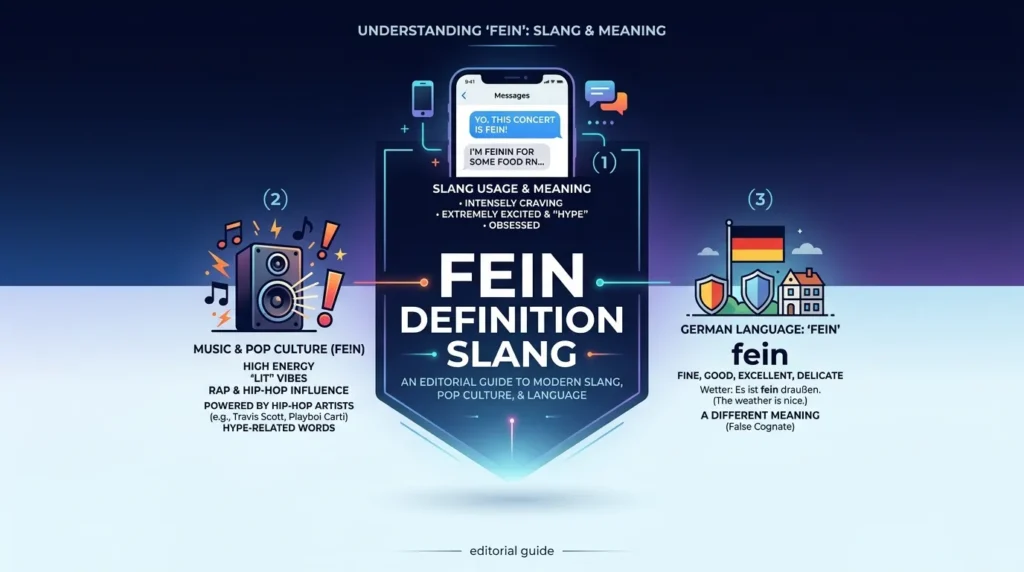

In slang, “fein” usually means someone who strongly craves, wants, or is obsessed with something. It is an informal spelling associated with “fiend” or “fiending,” and it can be used playfully for things such as food, music, attention, games, or a person. The exact tone depends on context.
You may also see “FE!N” in music and internet culture, especially as a reference to Travis Scott’s song from UTOPIA. That usage helped make the spelling highly recognizable online. But “fein” is not always slang: fein is also a genuine German word with meanings such as “fine,” “delicate,” “refined,” or “excellent.” Context is therefore essential.
Quick Answer
| Meaning | What it usually means |
|---|---|
| Most common slang meaning | Someone who strongly craves or wants something |
| Related word | Fiend / fiending |
| Typical tone | Casual, playful, teasing, or exaggerated |
| Common contexts | Texting, comments, memes, music, casual conversation |
| “FE!N” | Often a reference to Travis Scott’s song and its surrounding meme culture |
| Drug-related context | Can refer to intense substance craving, depending on the sentence |
| German “fein” | A separate word meaning fine, delicate, refined, excellent, or similar |
| Formality | Informal when used as English slang |
What Does “Fein” Mean in Slang?
The simplest fein definition slang users are usually looking for is “someone who really wants or craves something.”
The word is commonly understood as an informal spelling connected with fiend and related forms such as feen, feening, feinin, or fiending. The idea is intense desire: someone wants something so badly that the desire becomes noticeable.
For example:
“She’s a fein for iced coffee.”
This usually means:
“She really loves or craves iced coffee.”
It does not automatically mean she has an addiction. In casual conversation, people frequently exaggerate their cravings for humor.
You could similarly see:
“Bro is a fein for sneakers.”
Here, the person is being described as extremely interested in sneakers or constantly wanting new pairs.
That distinction matters because the underlying idea of fiend/fiending can also occur in much more serious contexts. When the surrounding conversation concerns drugs or another harmful substance, the word can describe an intense craving rather than a harmless preference.
The Core Idea Behind “Fein”
Think of the slang meaning as a scale:
like → really want → crave → obsess over
“Fein” generally sits toward the stronger end of that spectrum.
It can describe:
- Strong hunger for a particular food
- Obsession with a game
- Intense interest in music
- Wanting someone’s attention
- Being extremely attracted to someone
- Constantly wanting a particular product
- Being unable to stop talking about something
- Intense craving in a substance-related context
The surrounding sentence tells you how serious the expression is.
Fein Meaning by Context
| Context | Likely Meaning | Usage Level |
|---|---|---|
| Food | Someone who strongly craves a food | Common |
| Games | Someone very obsessed with gaming | Common |
| Fashion | Someone constantly wanting clothes or shoes | Common |
| Attention | Someone who desperately wants attention | Common |
| Dating | Someone intensely interested in another person | Context-dependent |
| Music | Someone obsessed with an artist or song | Common |
| Memes | Exaggerated craving or hype | Common online |
| Drug-related conversation | Intense craving for a substance | Serious/context-sensitive |
| Travis Scott content | Reference to FE!N | Common cultural reference |
| German-language conversation | “Fine,” “delicate,” “refined,” etc. | Separate meaning |
This is why translating fein with one fixed English word can be misleading. The same spelling can point to completely different meanings.
Is “Fein” the Same as “Fiend”?
Not exactly.
Fiend is the standard English spelling. Fein is commonly encountered as an informal slang spelling connected with the same idea of intense craving or excessive interest.
The standard word fiend has several meanings in English. In informal usage, it can describe someone who is extremely interested in something, while the related verb fiend/feen can express intense desire.
For example:
“He’s a coffee fiend.”
This means he is extremely fond of coffee or consumes it obsessively.
Online slang can reshape the spelling:
“He’s a coffee fein.”
The second version is informal and stylistic.
Fein vs. Fiend
| Term | Basic Meaning | Formality |
|---|---|---|
| fiend | Standard English word; can describe intense interest or craving | Standard/informal depending on use |
| fein | Informal slang spelling associated with fiend/fiending | Very informal |
| feen | Another informal spelling connected with the same slang family | Very informal |
| feening | Showing or experiencing an intense craving | Informal slang |
| fiending | Strongly craving or desiring something | Informal |
So if you are writing an essay, business email, academic paper, or formal report, “fein” is usually not the spelling you want.
What Does “Fein” Mean in Texting?
In texting, fein generally means that someone is strongly craving, wanting, or obsessing over something.
Because texting encourages shortened and playful language, the spelling does not need to follow standard formal English.
For example:
“I’m a fein for fries rn.”
The intended meaning is roughly:
“I’m really craving fries right now.”
Another example:
“You’re such a fein for that game.”
That means:
“You’re seriously obsessed with that game.”
Fein in a Text Message Can Be Playful
Most casual uses are not literal claims about addiction.
If someone texts:
“I’m a chocolate fein.”
they are probably exaggerating their love of chocolate.
Likewise:
“He’s a fein for new sneakers.”
usually means the person is extremely enthusiastic about sneakers.
The word becomes more serious when the surrounding conversation involves actual substance use or another harmful behavior.
What Does “Fein” Mean on TikTok?
On TikTok, fein can have two overlapping uses.
First, it can retain the general slang meaning of someone who craves or obsessively wants something.
Second, FE!N can be a direct pop-culture reference to Travis Scott’s song “FE!N” featuring Playboi Carti. The song appears on UTOPIA, released in 2023, and its highly repetitive title and energetic performance helped turn the word into a recognizable internet reference.
That creates an important distinction.
If someone writes:
“She’s a fein for matcha.”
they are probably using the slang meaning.
If someone comments:
“FEIN FEIN FEIN 🔥”
under a Travis Scott-related video, they may simply be referencing the song, its chorus, or the meme culture around it.
Why TikTok Can Make the Meaning Confusing
Internet slang often works through references rather than literal definitions.
A person might write FEIN because:
- They mean “craving”
- They are joking about being obsessed
- They are quoting or referencing the song
- They are participating in a meme
- They want to signal hype
- They are repeating the word because the repetition itself is recognizable
Therefore, a TikTok comment containing “fein” does not necessarily describe an actual person as addicted to something.
Also Read: Snatched Meaning Slang: Definition, Usage, Examples, and Context
What Does “FE!N” Mean?
FE!N is the stylized title of Travis Scott’s song featuring Playboi Carti. In internet conversation, people often use FE!N, fein, or repeated versions such as “fein fein” as references to the track and its high-energy cultural presence.
The punctuation matters in the title:
FE!N
is a stylized name, whereas:
fein
is commonly used online as a slang spelling.
They are closely connected in modern internet culture, but they should not automatically be treated as identical grammatical forms.
“Fein Fein Fein” Meaning
When you see:
“FEIN FEIN FEIN”
there usually is not a separate three-word definition.
The repetition is generally used for:
- Emphasis
- Hype
- Humor
- Meme recognition
- A reference to the song
- Mimicking the repeated vocal style associated with the track
In other words, repeating the word does not necessarily create a new dictionary meaning.
Does “Fein” Mean Addicted?
Sometimes the word can suggest addiction, but not every use means literal addiction.
This is one of the most important distinctions to understand.
The underlying slang concept is associated with intense craving, and the standard English word fiend can refer informally to someone excessively interested in something. In substance-related contexts, fiending can describe an intense craving for a drug.
But everyday slang often broadens the word.
Compare these examples:
“I’m a fein for pizza.”
Usually playful.
“He’s a fein for basketball.”
Usually means he is extremely interested in basketball.
“She’s a fein for attention.”
Usually means she strongly seeks attention.
“He was feining for another dose.”
Much more serious because the context indicates substance craving.
The spelling stays similar, but the context changes the seriousness.
How Context Changes the Meaning of “Fein”
Context is especially important with slang because informal words rarely have the same precision as formal terminology.
Look at the Object of the Craving
The words surrounding fein often tell you what the person supposedly wants.
“She’s a fein for tacos.”
Food craving.
“He’s a fein for sneakers.”
Shopping or fashion obsession.
“He’s a fein for views.”
Strong desire for online attention.
“She’s a fein for that artist.”
Extreme enthusiasm for music.
“He’s feining for another hit.”
Potentially a substance-related meaning.
The object provides an immediate clue.
Look at the Relationship Between the Speakers
Friends may use fein as playful teasing.
A stranger using the word about someone can make the statement sound more judgmental.
For example:
“You’re such a fein for that game 😂”
between friends is likely joking.
But:
“He’s a fein.”
without any context can sound more negative because the listener has no idea what the person supposedly craves.
Look at Emojis and Tone
Emojis can soften the meaning.
“You’re a fein for fries 😂”
is clearly playful.
Meanwhile:
“He’s a fein.”
has a much more ambiguous tone.
The same slang word can therefore move from affectionate teasing to criticism depending on the surrounding message.
Also Read: Ate Slang Meaning: What It Means and How to Use It
Is “Fein” Rude?
Fein is not inherently a swear word, but it can sound insulting or judgmental depending on how it is used.
Calling someone a fein suggests that they want something excessively or cannot get enough of it.
That can be funny between friends:
“You’re a fein for coffee 😂”
But it can also be negative:
“He’s a fein for attention.”
The second sentence implies undesirable behavior.
The word becomes more sensitive when it appears in a context involving drugs or addiction. In that situation, casually labeling someone a “fein” can sound stigmatizing or accusatory.
Practical Rule
If you know the person and the conversation is clearly playful, the slang can be harmless.
If you are talking about someone’s real substance use, serious personal behavior, or a professional situation, use more precise language instead of relying on slang.
Is “Fein” Appropriate at Work or School?
Generally, fein is too informal for professional or academic writing.
You might see it in a casual message between coworkers who already have a relaxed relationship:
“I’m a coffee fein today.”
But it would be unusual in:
- A formal report
- A school assignment
- A business proposal
- A professional presentation
- A job application
- A formal email
For clearer writing, replace it with a standard phrase such as:
- “really wants”
- “strongly prefers”
- “craves”
- “is obsessed with”
- “is extremely interested in”
- “has a strong interest in”
The best replacement depends on what the original sentence actually means.
How Do You Pronounce “Fein”?
When fein is being used as an English slang spelling related to fiend, speakers generally pronounce it like “feen.”
The spelling can therefore be confusing to someone seeing it for the first time.
In contrast, the German word fein is pronounced approximately like the English sound in “fine.”
This is another reason context matters.
English Slang vs. German Pronunciation
| Form | Approximate pronunciation | Meaning |
|---|---|---|
| fein as English slang | “feen” | Informal form related to fiend/fiending |
| fiend | “feend” | Standard English word |
| feen | “feen” | Informal slang spelling |
| German fein | “fine” | Fine, delicate, refined, excellent, etc. |
“Fein” Is Also a German Word
Not every appearance of fein is English slang.
In German, fein is an established word. Depending on context, it can mean:
- Fine
- Delicate
- Subtle
- Refined
- Excellent
- High-quality
- Nice
- Pleasant
- Elegant
For example, a German sentence may use fein to describe something delicate or finely made.
It can also be used in expressions where the sense is closer to good, nice, or excellent.
So if you encounter fein in German-language content, do not automatically interpret it as internet slang.
How to Tell the Difference
Ask yourself:
- Is the surrounding text English or German?
- Is the word being used to describe a craving?
- Is it connected to TikTok, memes, rap, or texting?
- Does it appear alongside words such as “for,” “craving,” or “obsessed”?
- Does the sentence otherwise look like German?
For example:
“I’m a fein for coffee.”
English slang context.
But:
“Das ist fein.”
is German and should not be interpreted as English slang.
Fein vs. Fine
One of the easiest mistakes is assuming fein is simply a creative spelling of fine.
In English slang, it usually isn’t.
Fein vs. Fine
| Word | Typical Meaning | Language/Context |
|---|---|---|
| fein | Craving, obsession, intense desire | English internet slang |
| fine | Good, satisfactory, excellent, or delicate | Standard English |
| fein | Fine, delicate, refined, excellent, etc. | German |
| fiend | Someone excessively interested or craving something; several other meanings | Standard English |
If someone says:
“I’m fein for pizza.”
they are generally not saying:
“I’m fine for pizza.”
They are expressing a strong desire for pizza.
Fein vs. Feen vs. Fiending
Several spellings can appear online because slang is not governed by one universal spelling system.
| Form | General Idea | Typical Use |
|---|---|---|
| fein | Strong craving or obsession | Informal online slang |
| feen | Similar slang form | Informal speech/text |
| fiend | Standard English form | General English |
| fiending | Strongly craving or wanting | Informal English |
| feening | Informal spelling of the same type of expression | Internet/texting |
The exact spelling someone chooses may depend on their online community, pronunciation, music influences, or personal style.
This does not mean every spelling has exactly the same grammatical history or frequency. Informal language is often inconsistent by design.
Also Read: Dodo Meaning Slang: What Does Dodo Mean in Text and Chat?
Real Conversation Examples
Example 1: Food
A: “What are you getting?”
B: “Fries. I’m a fein for them today.”
Meaning: B really wants fries.
Example 2: Gaming
A: “You said you were playing for 20 minutes.”
B: “Yeah, then I became a fein.”
Meaning: B became extremely absorbed in the game.
Example 3: Music
A: “You’ve played that album five times.”
B: “I’m a fein for this artist.”
Meaning: B is extremely enthusiastic about the artist.
Example 4: Attention
A: “Why does he keep posting?”
B: “He’s a fein for attention.”
Meaning: The speaker thinks he strongly seeks attention.
Example 5: Dating
A: “You checked her profile again?”
B: “Okay, maybe I’m a fein.”
Meaning: B is joking that they are overly interested in the person.
Example 6: Meme Reference
A: “What does everyone mean by FEIN?”
B: “Probably the Travis Scott song.”
Meaning: Here, FEIN is being treated as a pop-culture reference rather than a literal description of someone’s craving.
Example 7: Serious Context
A: “Why was he so desperate?”
B: “He was feining for the substance.”
Meaning: The wording indicates a serious craving and should not be interpreted as a joke about ordinary enthusiasm.
How to Use “Fein” Naturally
If you want to use the slang yourself, it generally works best when you are describing strong desire in an obviously casual setting.
Natural examples include:
- “I’m a fein for coffee.”
- “He’s a fein for basketball.”
- “She’s a fein for spicy food.”
- “Bro is a fein for new sneakers.”
- “I’ve been feining for that burger all day.”
- “You’re a whole fein for that game.”
The expression works particularly well when the exaggeration is obvious.
A Useful Pattern
One common construction is:
“a fein for + thing”
Examples:
“She’s a fein for chocolate.”
“He’s a fein for vintage clothes.”
Another construction is:
“feining for + thing”
Examples:
“I’m feining for tacos.”
“He’s feining for attention.”
The exact grammar can vary in informal speech because slang does not always follow formal conventions.
How to Reply When Someone Calls You a Fein
Your response depends on the tone.
Playful Reply
“And I’m not even sorry 😂”
Funny Reply
“You caught me.”
Casual Reply
“Honestly, you’re right.”
If You Disagree
“I just really like it. That’s different.”
If They Mean Something Serious
“What do you mean by that?”
That last response is useful when the context is unclear, especially if the word could imply something more serious than ordinary enthusiasm.
Who Uses “Fein”?
The slang spelling is particularly visible in online and youth-oriented communication, including social media, memes, music discussions, group chats, and casual texting.
However, it should not be treated as a universal word used by every young person or every online community.
Its appearance can depend on:
- Online community
- Music interests
- Age
- Region
- Personal vocabulary
- Meme exposure
- Conversation topic
The word also appears outside strictly youth-oriented conversations because internet slang frequently spreads between age groups.
The important point is that seeing the word online does not establish a particular speaker’s age or identity.
Why the Word Became So Recognizable Online
The modern visibility of fein is strongly connected with internet music and meme culture.
Travis Scott’s FE!N, released as part of UTOPIA, gave the spelling a highly recognizable pop-culture identity. The song’s repeated title and energetic presentation made the word particularly easy to turn into a chant, caption, joke, and meme reference.
That helped create two overlapping meanings online:
- Fein as slang: someone who craves or obsesses over something.
- FE!N as a cultural reference: the song, its repeated title, or the memes surrounding it.
This distinction explains why someone may use FEIN without actually describing a craving.
Does “Fein” Always Refer to Drugs?
No.
The word’s association with intense craving can overlap with substance-related language, but everyday slang has expanded far beyond that context.
For example:
“She’s a fein for chocolate.”
is normally a playful statement.
“He’s a gaming fein.”
is usually an exaggerated description of enthusiasm.
“They’re feining for another dose.”
is substantially more serious because the context concerns a substance.
This is an important information gap in many quick definitions: the word’s meaning is broader than its drug-related sense, but the drug-related sense should not be ignored when context clearly points toward it.
Is “Fein” a Real Word?
That depends on which fein you mean.
As an English slang spelling, fein is informal and nonstandard. It is commonly used online and in casual communication, but it should not be treated as the standard English spelling of fiend.
As a German word, fein is absolutely an established word with several meanings.
And FE!N is also a stylized music title.
So the most accurate answer is:
Yes, “fein” exists in real language, but the English slang spelling is informal and context-dependent.
What Does “Fein” Mean in Real-World Communication?
The most useful way to understand fein is to think of it as a strength-of-desire word in casual English slang.
It tells you that someone is not merely interested.
They are portrayed as wanting something a lot.
That can be sincere:
“I’m a fein for good coffee.”
It can be teasing:
“You’re a fein for attention.”
It can be exaggerated:
“I’m literally a fein for this pizza.”
Or it can be serious:
“He was feining for the substance.”
The word therefore communicates more than simple preference, but the degree and seriousness of the craving come from context.
Frequently Asked Questions
What does fein mean in slang?
In slang, fein usually means someone who strongly craves, wants, or is obsessed with something. It is an informal spelling associated with “fiend” or “fiending.” It can be playful when used for food, music, games, or other everyday interests, but it can carry a more serious meaning in substance-related contexts.
What does fein mean in text messages?
In texts, fein usually describes an intense craving or strong obsession. For example, “I’m a fein for pizza” means “I really crave pizza.” The word is informal and often exaggerates someone’s enthusiasm rather than making a literal statement about addiction.
What does fein mean on TikTok?
On TikTok, fein can mean someone who strongly wants or is obsessed with something, but it can also refer to Travis Scott’s FE!N and the memes or hype surrounding the song. The surrounding video, caption, and comments usually reveal which meaning is intended.
Does fein mean addicted?
Not necessarily. Fein can imply intense craving, and the related slang can appear in serious addiction-related contexts. However, people also use it jokingly for ordinary things such as food, games, music, or attention. Context determines whether the expression is playful or serious.
Is fein the same as fiend?
They are closely related in slang, but fiend is the standard English spelling, while fein is an informal spelling used online and in casual communication. The two can express the idea of intense desire or excessive interest, although “fiend” has additional standard English meanings.
What does FE!N mean?
FE!N is the stylized title of Travis Scott’s song featuring Playboi Carti from UTOPIA. Online, the word may therefore function as a direct reference to the song rather than as a literal description of someone’s craving.
Is fein a bad word?
Fein is not inherently a profanity. It can be harmless slang when friends use it jokingly, such as “You’re a fein for coffee.” However, it can sound judgmental when used to label someone’s behavior, and substance-related uses may carry a much more serious implication.
What is the difference between fein and the German word fein?
English slang fein is associated with intense craving or obsession, while German fein is a normal word that can mean “fine,” “delicate,” “refined,” “excellent,” or related ideas. The language and surrounding sentence make the difference clear.
Conclusion
The most common fein definition slang is someone who strongly craves, wants, or is obsessed with something. It is an informal spelling associated with fiend and related forms such as feening. In everyday online conversation, it is often playful: someone can be a fein for pizza, music, games, attention, or fashion without literally being addicted.
Context becomes more important when the conversation involves substances, because the same family of slang can describe serious craving. Meanwhile, FE!N may simply refer to the Travis Scott song, and German fein is an entirely separate established word. When you see the term, check the surrounding words before deciding what it means.


Pingback: YH Slang Meaning: What Does YH Mean in Texting?