


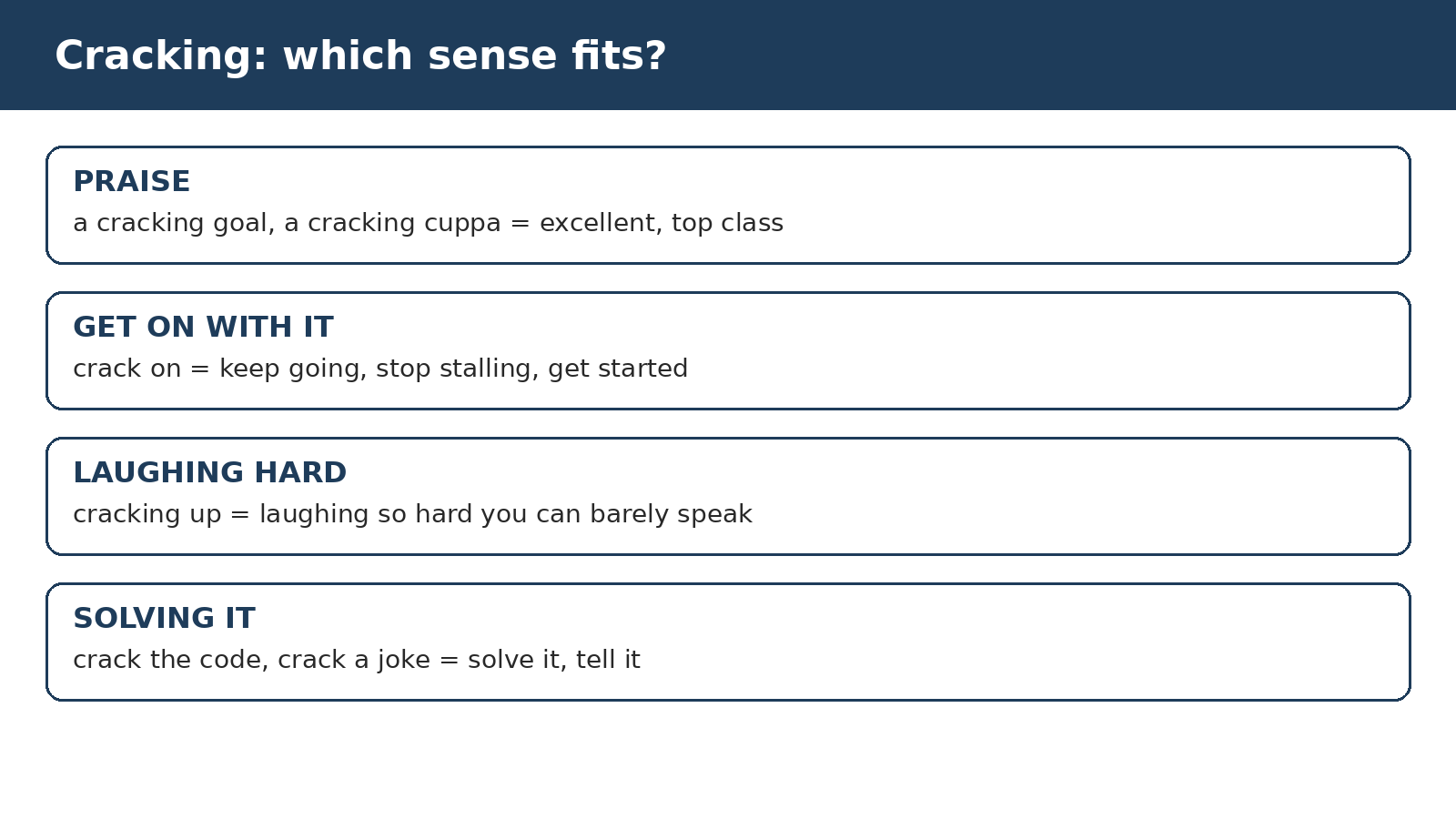
In British slang, cracking means excellent, very good, or top class.
If someone in Manchester, Leeds, Glasgow, or London tells you they had a cracking day, they are not talking about a broken window. They are telling you the day was a good one, the kind worth repeating. The word sounds warm, a little old fashioned, and very British, and that is exactly why it still works. It praises without shouting, and it fits people, meals, matches, films, and nights out with equal ease.
This guide sorts out every sense of cracking that you are likely to meet in real life. The praise sense comes first, because that is the sense most searches are after, and then the phrases that share the same root: crack on, cracking up, crack a joke, and crack the code. You will also get a usage map, a comparison with similar praise words, replies you can use, and the myths that trip learners up, including the one that confuses cracking with craic.
What Cracking Means at a Glance
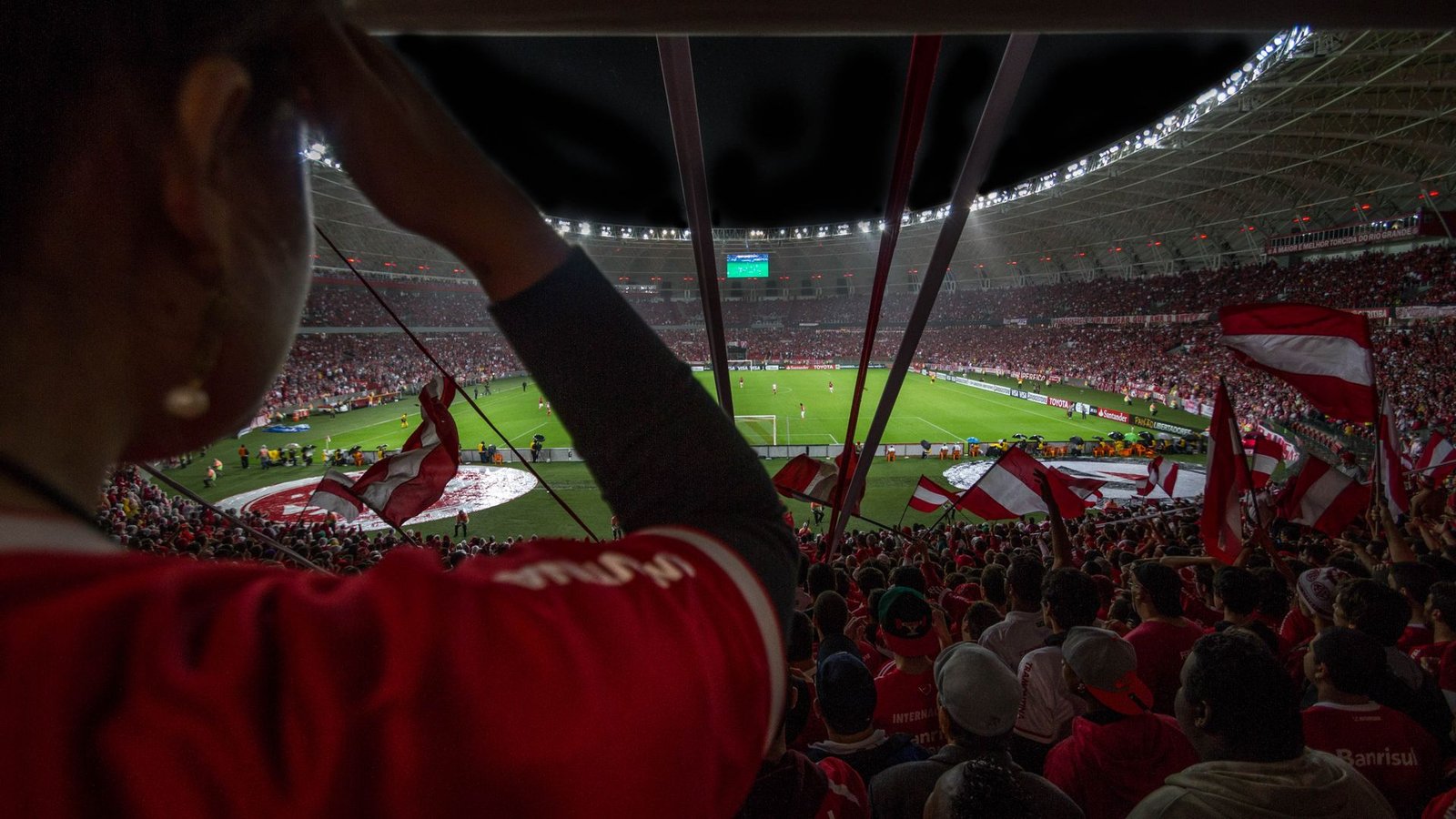
As praise, cracking means excellent or very good, and it can also work as an intensifier meaning extremely, as in a cracking good film. It is warm rather than wild, approving rather than boastful, and it suits everyday pleasures: a cracking cuppa, a cracking goal, a cracking night out, a cracking lad who helped you move house.
That one sense explains most of what you will hear. If you remember nothing else, remember this: when cracking sits in front of a noun, or stands on its own after a verb like was, it is almost always praise. “That was cracking” means that was excellent. “She scored a cracking goal” means she scored a superb goal. “We had a cracking time” means the time was genuinely good, not just passable.
Every real sense of cracking in one list
- Cracking as praise. Excellent, superb, top class. “That Sunday roast was cracking.”
- Cracking as an intensifier. Extremely, really. “It was a cracking good match.”
- Crack on. Get started, keep going, stop stalling. “Right, let’s crack on with the packing.”
- Cracking up. Laughing hard, sometimes so hard you cannot finish a sentence. “We were cracking up at his impression of the teacher.”
- Crack a joke. Tell a joke, often a quick one. “He cracked a joke and the whole room relaxed.”
- Crack the code. Solve a puzzle, a system, or a tricky problem. “She finally cracked the code for the timetable clash.”
- Crack open. Open something with energy, classically a bottle or a tin. “Let’s crack open the lemonade.”
- Cracking in its literal sense. Making a sharp breaking sound, or starting to break. “The ice was cracking under our feet.” This is standard English, not slang, but it sits in the same family and explains the sound behind the word.
The trick is that the grammar tells you the sense. Cracking before a noun is usually praise. Cracking on after a verb is a phrasal verb about getting going. Cracking up is about laughter. Once you hear the shape of the sentence, the meaning falls into place fast, and you rarely need to ask what someone meant.
Where Cracking Comes From
Cracking grew out of the verb crack, a word for a sharp, sudden break or sound, and the praise sense took hold in British speech in the late 1800s and early 1900s, when a sharp, forceful thing came to stand for something striking and impressive. The sound itself does a lot of the work: a crack is sudden, clean, and hard to miss, and a cracking performance feels the same way.
FunkyEnglish defines cracking as excellent, very good, or impressive, and notes that it can describe almost anything good, from a person to a film, a meal, or a game of football. That breadth is the point. Cracking is not a niche word for one scene. It is a general purpose pat on the back, and British speakers have kept it in circulation for well over a century because it never sounded forced.
The crack root, in plain English
Crack started as a verb for breaking with a sharp noise: crack a whip, crack an egg, crack a nut. From there it spread in every direction, and English kept the useful branches. A crack can be a joke, a try, a break in a surface, or a sharp sound. Cracking as praise borrows the force of that sound and turns it into approval. Something cracking hits you at once, the way a great goal or a perfect cup of tea does.
Why the praise sense feels old fashioned, in a good way
FunkyEnglish calls cracking a cheerful, very British word with a slightly old fashioned, friendly feel, and that description rings true in pubs, kitchens, and football grounds across the UK. It is the word a grandad uses about a grandson’s goal and the word a teenager uses about a new album, and neither sounds out of place. Newer praise words come and go fast. Cracking stays because it sounds like a person, not a trend.
The dropped g, and why you will hear crackin
Kaplan notes that English speakers usually say cracking without pronouncing the last g, and defines it simply as the best or very good. In casual speech you will hear “crackin” far more than the careful “cracking”, especially in the North of England and in Scotland. Do not let that throw you. It is the same word, said at speed, and writing it as cracking is still the safe choice in text.
Cracking On, Cracking Up, and Other Phrases That Share the Root
Most confusion about cracking comes not from the praise sense but from its cousins, because the same root powers several everyday phrases with different meanings. Learn these five and you will stop guessing. Each one has its own rhythm, its own setting, and its own reply, and none of them means excellent on its own.
Crack on: get started and keep going
Crack on is the workhorse phrase of the family. It means get on with it, make a start, and keep at it without fuss. A manager says “let’s crack on” to end a meeting and start the work. A friend says “crack on, love, you’ve got this” to cheer you through a long drive. A student says “I need to crack on with revision” and means the fun part of the day is over. The tone is practical and encouraging, never harsh, and it pairs well with a plan: crack on with the essay, crack on with dinner, crack on before the rain starts.
Cracking up: laughing hard
Cracking up means laughing hard, often at something unexpected. “We were cracking up” is a normal way to say a joke landed well. It is close to the slang sense of cracked, which in gaming and online slang can mean playing at an absurdly high level, but do not mix the two. Cracking up is about laughter. Cracked is about skill or, in other contexts, about a joke or a screen that has broken. If someone says they were cracking up at a video, they laughed. If they say a player is cracked, they mean that player is frighteningly good.
Crack a joke, crack a smile, crack the code
These three sit together because each one uses crack for a sudden release. To crack a joke is to tell one, usually quickly, to break tension. To crack a smile is to finally smile after holding a straight face. To crack the code is to solve something that resisted you, from a puzzle to a work problem to a social situation. All three are standard, friendly English, and all three work in writing as well as speech, which makes them safer than most slang when you are unsure of your audience.
Crack open and crack down
Crack open means open with a bit of ceremony: crack open a bottle, crack open the biscuits for guests, crack open a new book on holiday. Crack down is the opposite mood: an authority cracks down on something by enforcing rules strictly, as in a council cracking down on parking. Neither phrase is praise, and neither should be swapped for the praise sense. “A cracking down” is not a thing people say, and if you hear “cracking down”, the speaker means enforcement, not excellence.
Cracking vs Similar Praise Words
Cracking is not the only way to say excellent, and choosing between praise words is where learners sound most natural or most off. The table below lines cracking up against its closest neighbours, so you can pick the word that fits the room, the age group, and the level of excitement you actually feel.
| Word | Meaning | Tone | Where you hear it | Example |
|---|---|---|---|---|
| Cracking | Excellent, superb | Warm, friendly, a little old fashioned | Across the UK, all ages | “That was a cracking walk.” |
| Brilliant | Excellent, clever | Cheerful, very British | UK, everyday speech | “Brilliant, thanks for the lift.” |
| Awesome | Excellent, impressive | Big, American leaning | Everywhere, younger speakers | “That goal was awesome.” |
| Lit | Exciting, excellent | High energy, young | Online, parties, music | “That party was lit.” |
| Class | Top quality | Short, punchy, Northern | Northern England, Scotland | “That finish was pure class.” |
The difference is mostly temperature. Cracking is warm tea by the fire. Brilliant is a bright smile. Awesome is a shout from the stands. Lit is a party at full volume. Class is a nod from someone who does not hand out praise lightly. If you use cracking for a quiet pleasure, a good meal, a kind neighbour, a well played match, you will sound right. If you use it for a wild night, it still works, but lit or awesome will match the energy better.
For more on the big American praise word, see our guide to what awesome means in slang, and for the modern high energy word, see what cool means in text and online. Cracking sits happily beside both, and British speakers switch between them without thinking twice.
Who Says Cracking, Where, and to Whom
Cracking is British first and foremost, and it travels best inside the UK. You will hear it in England, Scotland, Wales, and Northern Ireland, with a strong home in the North of England, where “a cracking day” and “a cracking lad” are everyday speech. In Ireland it lives next door to craic, a different word with a different job, and the two are easy to confuse from across the water, which we untangle in the myths section below.
Outside the UK, cracking as praise is understood far more than it is used. Americans and Australians will usually get it from context, especially in a sentence like “a cracking goal”, but they are unlikely to say it themselves. Canadians and New Zealanders sit in the middle: they recognise it from British television, sport, and books, and some use it when they want a British flavour. Online, British creators carry it worldwide, so a viewer in Texas can hear it on a football podcast and repeat it the next day without ever setting foot in the UK.
Who says it to whom matters less than with most slang, because cracking is polite praise. A boss can say it to a team, a grandparent can say it to a grandchild, a friend can say it to a friend, and a stranger can say it about a meal without anyone blinking. It is not rude, not edgy, and not tied to one age group, which is rare for slang and part of why it lasts. The one setting where it can feel off is a formal report: a cracking result in a board paper will read as chatty, and brilliant or excellent will fit the page better.
A quick usage map
- Speaker: British speakers of all ages, plus fans of British sport and television worldwide.
- Place: Pubs, kitchens, football grounds, family chats, group chats, podcasts, match commentary.
- Audience: Friends, family, colleagues, teammates, anyone you would praise warmly.
- Register: Informal to neutral. Fine in speech, fine in texts, too chatty for formal writing.
- Energy: Warm and approving, not wild. Save lit and awesome for the loudest moments.
How to Use Cracking Naturally
The easiest way to use cracking well is to attach it to something specific. Vague praise sounds hollow in any language, and cracking is no exception. “That was cracking” works after a shared experience, because everyone in the room knows what that refers to. “Cracking” on its own, dropped into a chat with no context, can read as a typo or a half finished thought, so give it a noun or a moment to hold on to.
Try these patterns, each one safe in a British setting:
- Praise a thing: “That was a cracking breakfast, thank you.” “A cracking read, I finished it in one night.”
- Praise a person: “She’s a cracking player.” “He’s a cracking lad, he helped me carry the sofa up three flights.”
- Praise a moment: “What a cracking day out.” “We had a cracking night, dancing until the lights came on.”
- Intensify: “It was a cracking good film.” “They played a cracking good game, even in the rain.”
- Cheer someone on: “Crack on, you’re nearly there.” “Come on, crack on with it and we’ll celebrate after.”
Notice how the praise examples keep cracking close to the thing being praised. That closeness is the grammar of the word. Cracking is an adjective first, and it likes to sit right next to its noun. When you pull it away, as in “the film was cracking good”, the intensifier job takes over, and the sentence still works, but the classic shape is “a cracking film”. Stick to that shape while you are learning, and you will rarely go wrong.
One more habit worth copying: British speakers often pair cracking with a small, concrete detail. “A cracking cuppa, strong with two sugars” tells you more than “a cracking drink”. “A cracking goal, top corner from twenty yards” tells you why it mattered. The detail is what makes praise feel real instead of polite, and it is the difference between sounding like a phrasebook and sounding like a person.
What to Say Back When Someone Says Cracking
Replies to cracking are easy, because the word is a gift, not a test. If someone praises your cooking, your work, or your team with cracking, a simple thanks lands well. If they use crack on, they are telling you to get going, so the right reply is action, or a light joke about getting going. If they say they were cracking up, they are sharing a laugh, so laugh with them or ask what was so funny.
- To praise: “Thanks, that means a lot.” “Glad you liked it, it took all morning.” “Cheers, we were chuffed with it too.”
- To crack on: “Right, cracking on now.” “On it, give me ten minutes.” “Aye, no more faffing, let’s go.”
- To cracking up: “I know, I couldn’t stop laughing either.” “What was it? Tell me again.” “Stop, I’m cracking up just thinking about it.”
- To a joke: “Good one.” “You always crack a joke at the right moment.” “That got me, fair play.”
Avoid over replying. Cracking does not need a speech in return, and a long thank you can make a casual compliment feel heavy. Match the energy you were given: a quick “cracking” back, a smile, and a detail about what you liked keeps the chat moving. If you want to return the compliment, do it in the next breath, not five minutes later, when the moment has cooled.
Myths vs Facts About Cracking
Myth: cracking and craic are the same word
Fact: they are neighbours, not twins. Craic, pronounced crack, is an Irish word for fun, chat, and good company: “what’s the craic” means what’s happening, and “good craic” means a good time with good people. Cracking is an English adjective for excellent. They sound alike, they both praise a good time, and they both turn up in pubs, which is why learners mix them. In Ireland, say craic for the atmosphere. In England, say cracking for the thing itself. Our guide to Irish slang, from craic to grand untangles the Irish side in full.
Myth: cracking is modern internet slang
Fact: it is older than the internet by a long way. The praise sense was already established in British speech in the early 1900s, long before TikTok, and it survived because it was useful, not because it went viral. Newer praise words burn bright and fade. Cracking never burned that bright, which is why it never burned out.
Myth: cracking always means something is broken
Fact: only the literal sense means breaking, and context makes that sense obvious. “The paint is cracking” is literal. “The match was cracking” is praise. No native speaker hears a cracking match and pictures a broken stadium. If you are unsure, look at the noun: a physical surface cracking is literal, an experience described as cracking is praise.
Myth: you have to be British to use cracking
Fact: you have to be understood, not British. Non British speakers use cracking all the time, especially after time in the UK, and British listeners welcome it when it fits. What sounds off is forcing it into every sentence, or using it where a local word would be natural. One cracking in a chat about a British film or a football match sounds like a fan. Ten crackings in a chat about your local weather sounds like a costume.
Myth: cracking up means losing your temper
Fact: cracking up means laughing, and losing your temper is closer to cracking in the sense of breaking under pressure, as in “he finally cracked”. Keep the phrases apart: cracking up is laughter, cracking under pressure is giving way, and cracking on is getting going. Three phrases, three jobs, one root.
When NOT to Use Cracking
Cracking is safe slang, but safe does not mean right everywhere. Skip it in formal writing, where excellent or superb will carry the same praise without the chatty tone. Skip it when you are praising something serious in a solemn setting, such as a memorial speech, where a warm adjective can still feel too light for the room. Skip it when the thing you praise is American or Australian and your audience expects a local word: an American friend will understand a cracking burger, but an awesome burger will sound more like you.
Skip it, too, when you are not sure which sense you mean. If you write “cracking” about a cracked phone screen, readers will pause, because the praise sense fights the literal sense in that sentence. Say the screen is cracked, plain and simple, and save cracking for the praise it was made for. The same caution applies to cracking up: do not use it for anger, stress, or a breakdown, because listeners will hear laughter and miss the point entirely.
Finally, do not stack praise words. “A cracking brilliant awesome lit day” does not sound enthusiastic, it sounds unsure. Pick one praise word, give it a detail, and stop. Cracking, on its own, with a good noun beside it, is already a complete compliment.
Quick Answers About Cracking Slang
What does cracking mean in British slang?
Cracking means excellent, very good, or superb. A cracking day is a great day, a cracking goal is a superb goal, and a cracking cuppa is a very good cup of tea.
Is cracking the same as craic?
No. Craic is an Irish word for fun, chat, and good company, while cracking is an English adjective meaning excellent. They sound alike and both praise a good time, but they are different words with different jobs.
What does crack on mean?
Crack on means get started, keep going, and stop stalling. “Let’s crack on” is a friendly way to say let’s get to work, and “crack on with revision” means get on with studying.
What does cracking up mean?
Cracking up means laughing hard. If someone says they were cracking up at a video, they laughed a lot, sometimes so hard they could barely speak.
Is cracking old fashioned?
A little, in the best way. It has a friendly, slightly old fashioned feel, but British speakers of all ages still use it, from grandparents to teenagers, which keeps it current without making it trendy.
Can Americans use cracking?
Yes, and they will usually be understood, especially in a sentence about British sport, food, or television. It will sound British, which is fine when that flavour fits, but awesome or great will sound more natural in everyday American speech.
What is a cracking good film?
A cracking good film is a really good film, with cracking working as an intensifier meaning extremely. The shape is common in British speech: a cracking good match, a cracking good read, a cracking good night out.
Sources and Further Reading
- FunkyEnglish on cracking slang: defines cracking as excellent, very good, or impressive, and notes its use as an intensifier.
- Kaplan on unique British slang terms: defines cracking as the best or very good, and notes the dropped final g in speech.
- Pexels photo page: Three Women Smiling by Radomir Jordanovic: free license source of the featured image.
- Pexels photo page: Group of People Watching Soccer Game by Riccardo: free license source of the in body image.
- Crack Meaning Slang on Slangiify: the neighbouring crack family, for readers who meet crack and cracking in the same chat.
- Cracked Meaning Slang on Slangiify: how cracked differs from cracking up, in gaming and beyond.