
Slang for “cool” is any informal word that means impressive, excellent, or admirable: dope, fire, lit, and dozens more, each carrying its own era, scene, and energy level. This guide collects 25+ of them, explains what each one really means, and shows you exactly when to use each so you sound natural instead of forced.
Every generation mints its own word for the same idea. Your grandparents said groovy, your parents said rad, you might say fire, and teenagers right now are saying aura. The meaning barely moves. The flavor moves a lot. Pick the wrong flavor and the sentence still makes sense, but you sound like a tourist. Pick the right one and one word does the work of five.
This is the companion to our definition piece: if you want the full story of the word itself, start with our full breakdown of what “cool” means in slang. This article is the synonym listicle: the words, the tones, the eras, and the rules for using them well. And yes, awesome is probably the most common synonym of all, which is exactly why it gets its own guide instead of one more entry here.
What’s in This Guide
- What Counts as Slang for “Cool”?
- Slang for Cool People Actually Use Right Now
- The Tone Scale: Dope vs Lit vs Fire vs Chill
- The Millennial Shelf: 2000s and 2010s Slang for Cool
- The Vintage Vault: Old-School Words for Cool
- Who Says These Words: The Usage-Context Map
- How to Use Slang for Cool Without Sounding Forced
- Myth vs Fact: What People Get Wrong
- When NOT to Use Slang for Cool
- Quick Answers
- Sources and Further Reading
What Counts as Slang for “Cool”?
A slang synonym of “cool” is any informal word that carries its praise sense: impressive, excellent, worth admiring. That is the only sense this guide covers. “Cool” also means calm, agreeable, and socially smooth, and our full breakdown of what “cool” means in slang covers those other jobs in depth.
Why does this distinction matter? Because most of the words below only replace one “cool.” You can call a song fire, but you cannot say “fire, see you at seven” the way you say “cool, see you at seven.” The synonyms on this list are praise words. They do not do agreement, they do not do calm, and they do not end arguments. Keep that boundary in mind and you will never misuse them.
One more thing worth knowing: slang for cool has a churn cycle. A word is born in a scene, usually music or street culture, spreads to teenagers, gets picked up by brands, and then dies of overexposure. The average lifespan is a few years, which is why this list is organized by era. The current rotation is what people say now. The millennial shelf is what people said ten years ago. The vintage vault is what refuses to die.
Slang for Cool People Actually Use Right Now
Right now, the most-used slang synonyms for cool are fire, dope, lit, gas, bussin, slaps, aura, and based, with ate and W close behind. They live mainly in TikTok comments, group chats, and music talk, and each one fits a slightly different kind of praise, which is exactly what the entries below spell out.
Fire
Meaning: extremely good, exciting, the highest praise. You say it when something genuinely excites you: a song, a meal, a fit pic. “This beat is fire.” Dictionary.com’s survey of cool synonyms places fire in the 2010s and wonders whether it grew out of the older phrase “on fire,” in use since the late 1980s. One warning: flat delivery kills it. If you are not excited, do not reach for fire. It is a comment-section word, and it loves exclamation points.
Dope
Meaning: excellent, impressive, top quality. The hip-hop era classic. The Oxford English Dictionary, as reported by Mental Floss, traces the slang sense to Jimmy Spicer’s 1981 track “Money (Dollar Bill Y’all)”: “Yo, man, them boys is dope … This record is dope.” It still works everywhere: music, fashion, food, ideas. “That jacket is dope.” One caution: dope once meant narcotics, so around very formal or much older company it can raise an eyebrow. In casual conversation, nobody hears the drug sense anymore.
Sick
Meaning: unbelievably good, the classic negative-flip. Mental Floss cites a 1983 college-slang book with the example “The Fleetwood Mac concert was sick.” Best for feats and skills: a skate trick, a goal, a guitar solo. “That kickflip was sick.” Linguists call this flip amelioration, the process Dictionary.com highlights where negative words turn positive. The edge is the point: calling something sick says it was so good it almost hurt.

Lit
Meaning: exciting, full of energy, “on fire” in feeling. Peaked in the late 2010s but still alive. Dictionary.com notes lit was everywhere in 2010s hip-hop, and that it also meant “drunk” or “intoxicated” back in the early 1900s. Best for scenes and events rather than objects: “The party was lit.” It describes the atmosphere more than the thing, which is what separates it from fire.
Gas
Meaning: awesome, high-energy, undeniable. “That album is gas.” Lives in rap lyrics and sports talk: a player is gas, a verse is gas. Short, punchy, confident. Do not confuse it with fuel; context does the work. It carries more swagger than dope and less screaming than fire, which makes it the choice when you want to sound impressed without sounding breathless.
Bussin
Meaning: really, really good, originally about food. Know Your Meme traces the term to a December 2017 Urban Dictionary definition (“what you would say if something was really good”), then the fall 2020 “Gripping Food With Force” meme trend, then a November 2020 track by Doe Boy, Southside, and Lil Uzi Vert titled “Bussin,” then the March 2021 TikTok wave where users stitched food vlogger Janelle Roehner asking “Is it bussin?” Purists keep it for food: “This biryani is bussin.” Calling a sunset bussin will get you corrected in the comments.
Slaps
Meaning: excellent, but almost always about music. “This track slaps.” Born in the 2010s, and it never left the audio lane. Do not use it for a painting or a sandwich; the word wants bass. It is the audio-only member of the cool family, and using it correctly signals you know the rules.
Aura
Meaning: effortless, magnetic coolness, the vibe a person gives off. “He has so much aura.” A 2026 roundup of current slang calls aura one of the dominant terms of the moment, the word Gen Z reaches for when flat “cool” feels too weak. It describes people more than things: aura is about presence, not products. For the full story, see our guide to what “aura” means in slang.
Based
Meaning: admirably authentic, unbothered by outside opinion. “That take was based.” It grew out of internet culture into a high-value compliment: it praises the attitude, not the object. Use it for opinions and behavior, never for a sandwich. Calling a person based says you respect how little they care what anyone thinks.
Ate
Meaning: did something flawlessly. Short for “ate and left no crumbs.” “She ate that performance.” Pure Gen Z praise, huge on TikTok and in stan culture. It is about execution: someone did the thing perfectly and left nothing on the table. Use it for performances, outfits, comebacks, anything with a clear moment of delivery.
Gucci
Meaning: good, fine, all set. From the luxury brand, via late-80s and 90s slang; Dictionary.com dates the slang use to that era. “We’re gucci” means everything is fine. Lower energy than fire: it is reassurance, not hype. The fashion origin still shows. You would not call a funeral gucci, but you would call Friday plans gucci.
W
Meaning: a win, something good. “That’s a W.” The Picsart Gen Z slang roundup lists W as standard shorthand, and it has fully crossed into everyday texting. Minimal, fast, the shortest praise on this list. Its opposite, L, is how you say something flopped.
The Tone Scale: Dope vs Lit vs Fire vs Chill
Dope is steady approval, lit describes an exciting scene, fire is maximum hype, and chill is relaxed ease. They sit on one energy scale, with chill at the calm end and gas at the explosive end, so picking the wrong one usually just means mismatching the energy, not making a grammar mistake.
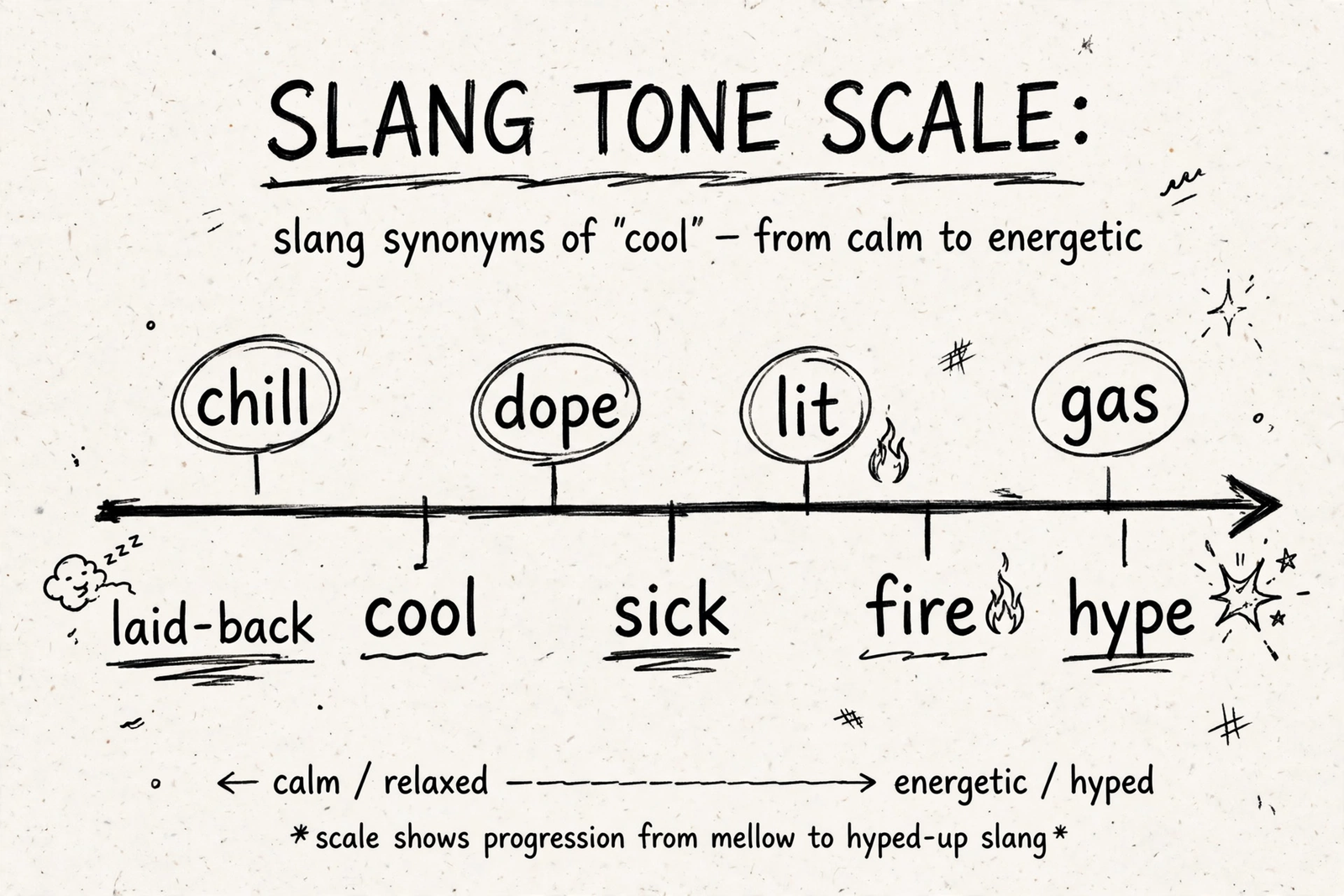
The scale above is the cheat sheet. Now the details, because tone is where people actually go wrong:
| Word | Core nuance | Tone | Where you hear it | Example |
|---|---|---|---|---|
| Chill | Relaxed, easygoing, no drama | Mellow, low-pressure | Texts about plans, personality talk | “He is chill. Nothing stresses him out.” |
| Cool | Impressive or fine; calm confidence | Neutral, safe for all ages | Everywhere: work, family, all generations | “That is a cool idea. Let us do it.” |
| Dope | Excellent, high quality | Confident, hip-hop flavored | Music, fashion, creative work | “That jacket is dope.” |
| Sick | Unbelievably good | Edgy, admiring | Sports, stunts, skill talk | “That kickflip was sick.” |
| Lit | Exciting, full of life | Energetic, social | Parties, events, nights out | “The party was lit.” |
| Fire | So good it feels explosive | Hype-heavy, emotional | Music reactions, food posts, comments | “This song is fire.” |
| Gas | Undeniably awesome | Swaggering, bold | Rap lyrics, sports talk | “That album is gas.” |
| Based | Authentically unbothered | Respectful, internet-native | Takes, opinions, online debate | “That take was based.” |
Three rules make the table work in real life. First, match the energy to the moment: do not call a quiet dinner fire, and do not call a championship win chill. Second, match the word to the subject: slaps wants music, bussin wants food, aura wants people. Third, when in doubt, go down the scale, not up. Saying dope about something amazing is safe. Saying fire about something mid is embarrassing. Understatement never gets you roasted.
The Millennial Shelf: 2000s and 2010s Slang for Cool
Millennial-era slang for cool includes legit, epic, tight, mint, baller, da bomb, bangin’, fresh, fly, and phat. Most of these peaked in the 2000s and 2010s, so they read as nostalgic now rather than current, which makes them perfect for throwback captions but risky if you are trying to sound twenty-two. Our guide to millennial slang covers the whole era vocabulary if this shelf makes you nostalgic.
Legit
Meaning: genuinely cool, the real deal. Dictionary.com lists legit as a 2010s synonym for cool, noting it earlier meant someone worthy of respect or extremely talented. “That restaurant is legit.” It vouches for quality. Saying something is legit means you have checked and you approve.
Epic
Meaning: grandly impressive, large-scale cool. Slang for more than 40 years: Mental Floss found it in a 1983 USA Today college-slang survey, and the “epic fail” era of the 2000s nearly wore it out. “Epic comeback.” Use it for scale. An epic sandwich is a joke; an epic road trip is not.
Tight
Meaning: excellent, impressive, with street credibility. Dictionary.com traces the slang to the Black community in the 1980s, while noting much older uses of the word. “That verse was tight.” It praises craft: the thing is well-made, well-executed, locked in.
Mint
Meaning: perfect, top condition, flawless. College slang for cool since the 1980s: a 1982 English Journal piece recorded students using it “as one would use the word great, terrific, or the like,” via Mental Floss. TikTok has revived it lately, sometimes with stronger adjectives attached. “That car is mint.” It comes from “mint condition,” so it fits objects best.
Baller
Meaning: lavishly excellent, big-time. From basketball and hip-hop: a baller is a star player or a lavishly successful person, and Dictionary.com notes it describes things “excellent in some spectacular way.” “Baller move.” It carries money energy. A baller apartment is expensive; a baller play is just brilliant.
Da Bomb
Meaning: the best, explosive praise. Kriss Kross released “Da Bomb” in 1993, cementing it as peak-90s, per Dictionary.com. Deliberately retro now. Saying it today is a costume choice, and everyone knows it, which is exactly why it works at a 90s party.
Bangin’
Meaning: excellent, hitting hard. Part of the 90s trio with da bomb and “off the hook.” Music bangs, food bangs, a party bangs. It is physical praise: the thing hits you. Still understood, still fun, still a little dated.
Fresh
Meaning: cool, new, clean. Grandmaster Flash and the Furious Five used it in “She’s Fresh” (1982), and Dictionary.com marks the 1980s as the decade fresh became generic approval slang. “Fresh kicks.” Of all the words on this shelf, fresh aged the best. It still sounds clean because cleanliness never goes out of style.
Fly
Meaning: stylish, attractive, cool. Older than it looks: Dictionary.com traces slang fly to at least the 1700s, citing “a fly white petticoat.” “That outfit is fly.” It is about appearance more than anything else: fly people, fly clothes, fly cars.
Phat
Meaning: excellent, impressive. A 1990s staple, spelled with a ph. Dictionary.com notes the folk theories that it stands for “pretty hips and thighs” or “pretty hot and tempting,” and flags them as unsupported. Say phat, spell it with a ph, and know the backronym theories are just theories.
The Vintage Vault: Old-School Words for Cool
Before dope and lit, cool had groovy, rad, righteous, boss, far out, fab, and the bee’s knees. These words carry real history, from 1930s jazz clubs to 1970s skate parks, and using one today is a deliberate style choice that tells people you know where the language came from.
Groovy
Meaning: excellent, fashionable, in the groove. Jazz slang from the 1930s that the 1960s made mainstream. Mental Floss, via the Oxford English Dictionary, traces it from 1800s “grooves” to jazz musicians “playing brilliantly,” with a 1948 Cosmopolitan already printing “Hey, groovy.” Today it is deliberately retro. Using it is a style choice, not an accident.
Rad
Meaning: excellent, exciting. Short for radical, from 1970s skateboarding, where only the riskiest stunts were rad. Mental Floss notes Stephen King used it in 1978’s The Stand: “‘Rad’ and ‘gnarly’ were ways of saying a thing was good.” Pure throwback energy now, and proud of it.
Righteous
Meaning: cool with integrity. Black Americans have used it as slang for cool since at least 1930, and the OED says this flavor of cool carries “implications of integrity or authenticity,” as Mental Floss reports. The most principled word on this list: righteous does not just mean good, it means good and real.
Boss
Meaning: excellent, top-tier. The “excellent” sense goes back to the mid-1800s for people great at something, and Mental Floss cites Laurence Hairston’s 1963 Freedomways line: “That’s boss, Baby.” Older than your grandparents and cooler than it has any right to be.
Far Out
Meaning: amazing, mind-blowing. Hippie-era, from the out-of-this-world feeling Dictionary.com ties to 1960s counterculture. “Far out, man” is a costume now, but the word still works as a joke, and jokes are a legitimate use case.
Fab
Meaning: fabulous, wonderful. The Beatles’ “Fab Four” nickname in the early 1960s put it on every teenager’s lips, per Dictionary.com. Short, sweet, sixties. It survives mostly in British English now, where it never really left.
The Bee’s Knees
Meaning: the best, wonderful. Early-1900s animal-anatomy slang: Dictionary.com notes the era coined the bee’s knees, the cat’s pajamas, and the eel’s hips. Pure vintage charm. Say it with a straight face and people will laugh with you, not at you.
Who Says These Words: The Usage-Context Map
Gen Z says fire, aura, and ate on TikTok and in texts; millennials reach for dope, lit, and legit; hip-hop and sports culture drive gas, slaps, and baller; and the vintage terms live on in movies, memes, and deliberate throwback humor. The map below shows who uses what, where, and with whom.
Gen Z (roughly under 25): the hype generation
Their defaults are fire, aura, ate, based, bussin, and W. The home turf is TikTok comments, Instagram captions, and group chats. Note the pattern: Gen Z praise is specific. Aura is about people, bussin is about food, ate is about performance. They do not use one word for everything, and that specificity is the tell that someone actually speaks the dialect.
Millennials (roughly 28 to 43): the steady generation
Their defaults are dope, lit, legit, and sick, with cool itself still doing heavy lifting. The home turf is texts, Twitter, and conversations with friends. Millennials use slang for cool the way their parents used “nice”: as a general approval word that fits almost anything. A millennial will call a baby dope and a tax refund lit, and neither will sound strange.
Hip-hop and sports culture: the engine room
This is where most of these words are born: gas, slaps, baller, drip-adjacent praise, and half the current rotation. The home turf is lyrics, locker rooms, barbershops, and sports commentary. Words graduate from here to the mainstream on a delay of about two to five years. If you hear a new praise word in a rap verse, expect it in marketing copy by next year.
The internet at large: the accelerator
TikTok, Twitch chat, Discord, and meme pages take scene words global in weeks. Bussin’s journey from a 2017 dictionary entry to a 2021 TikTok catchphrase is the textbook case. The internet does not invent most slang, but it decides which slang survives, and it votes with repetition.
Where each word lands best
Quick reference: texts and DMs take everything. TikTok comments want fire, aura, ate, bussin, and W. In-person hangouts want dope, sick, lit, and gas. Work Slack wants cool, legit, and mint, and nothing stronger. Family group chats want cool and awesome, full stop. Match the word to the room and you will never have to explain yourself.
How to Use Slang for Cool Without Sounding Forced
Use one slang word per sentence, match its energy to the moment, keep it casual, and never explain the joke. The full method is five simple steps, and the golden rule underneath all of them is that confidence sells slang while visible effort kills it.
Step 1: Pick one word, not three. “That is so cool, dope, fire, and lit” reads like a thesaurus exploded. One sharp word beats five vague ones. Choose the word that matches the energy and let it stand alone.
Step 2: Match the energy. Check the tone scale before you speak. A quiet compliment wants dope or mint. Genuine excitement wants fire or gas. Mismatched energy is the number one way people sound forced: screaming “fire” about lukewarm coffee tells the room you are performing.
Step 3: Match the subject. Slaps wants music. Bussin wants food. Aura wants people. Ate wants a performance. Using the right word for the right subject is what separates native speakers from tourists. When in doubt, dope fits almost anything, which is why it has survived since 1981.
Step 4: Say it once and move on. Slang works because it is casual. Repeating the word, explaining it, or asking “do the kids still say that?” destroys it instantly. Drop the word into a normal sentence and keep talking. “That set was gas. Anyway, what time is dinner?”
Step 5: Steal from your own generation first. A millennial saying “rad” sounds like a fun throwback. A millennial saying “aura” can work too, but only if it is natural, not studied. The safest slang is the slang of your own era, used with confidence. Nobody ever got mocked for sounding like themselves.
Myth vs Fact: What People Get Wrong
The biggest myths about cool synonyms are that dope is always offensive, that old slang is dead, and that stacking more slang words makes you sound cooler. None of that is true, and the corrections below will keep you out of the most common traps.
Myth: “Dope” is a bad word you should never say
Fact: As slang, dope means excellent, and it has meant that in mainstream use since the 1980s. The drug sense is real history, not current meaning, and in casual conversation nobody under sixty hears it. The only places to avoid it are formal writing and very conservative company, the same places you would avoid all slang.
Myth: Old slang is dead slang
Fact: Old slang is resting, not dead. Groovy, rad, and boss keep coming back as deliberate throwbacks, and fresh never really left. A word dies only when people forget it, and the internet never forgets. Vintage words are a style choice now, which arguably makes them more powerful than current ones: using rad on purpose says something about you.
Myth: Gen Z doesn’t say “cool” anymore
Fact: Gen Z says cool constantly, just mostly for agreement rather than hype. “Cool, see you there” is alive and well. What changed is that cool stopped being the hype word: for real enthusiasm, Gen Z reaches for fire, aura, or ate. Cool did not die. It got promoted to infrastructure.
Myth: More slang words in one sentence sounds cooler
Fact: The opposite. Stacking synonyms (“that is so fire, lit, dope, and gas”) is the fastest way to sound like you learned slang from a listicle. Native speakers use one word and move on. Restraint is the whole aesthetic: the cooler the word, the less you need around it.
When NOT to Use Slang for Cool
Skip cool synonyms in job interviews, formal writing, classrooms, and around people who will hear drug-adjacent terms literally. Slang is an in-group signal, and using it with the wrong group sends the wrong message about you, no matter how natural the word feels in your own circle.
The clear lines: job interviews, cover letters, and anything a teacher grades get standard English. “Cool” itself is usually fine in those settings, but fire, gas, and bussin are not. Around grandparents and young kids, stick to cool and awesome; dope’s history and bussin’s volume can both misfire. In customer-facing work, read the room: a sneaker store welcomes “those are fire,” a bank does not.
Age-appropriateness matters in the other direction too. An adult using every new Gen Z term correctly can sound sharp, but an adult forcing them sounds like a marketing deck. If you have to ask whether you are the right age for a word, you already know the answer. And when something is the opposite of all these words, there is vocabulary for that too: see what “chopped” means in slang before you call anything mid in public.
Quick Answers
What is the slang word for cool?
There is no single one. The most common right now are fire, dope, and lit, with aura and based rising fast among Gen Z. Pick by energy: dope for steady approval, lit for exciting scenes, fire for maximum hype. The tone scale earlier in this guide turns that choice into a reflex.
Is “dope” a bad word?
Not in the slang sense. As slang, dope means excellent or impressive and is harmless in casual conversation. The caution is its history: it once meant narcotics, so very formal settings and older listeners can still hear the old meaning. Everywhere else, it is just praise.
What do Gen Z say instead of “cool”?
Gen Z still says “cool” for casual agreement, but for real praise they reach for fire, aura, ate, and based. Flat “cool” from a Gen Z texter usually means “fine, moving on,” not “wow.” If a Gen Z friend calls your work fire, that is a much bigger deal than cool.
Is “sick” a compliment?
Yes, when the context is right. In slang, “sick” means unbelievably good, especially for skills and feats: “that goal was sick.” It is a compliment about performance, not health, and everyone under forty hears it that way. Around much older listeners, the literal meaning can still win, so read the room.
What is the difference between “lit” and “fire”?
“Lit” describes an exciting atmosphere or event: the party was lit. “Fire” is stronger personal hype about a thing: the song is fire. Lit is the scene, fire is the spark. You can have a lit party with no single fire moment, and you can call a song fire while sitting alone in a quiet room.
Why do so many slang words for cool sound negative?
Because of a process linguists call amelioration, where negative words get flipped into positive ones: sick, ill, bad, wicked, killer. The edge is the point. A word that once meant something rough carries extra punch when you turn it into praise, which is why the flip keeps happening every generation.
Sources and Further Reading
- Mental Floss: Synonyms for ‘Cool’: 21 Rad Slang Terms You Should Know: word-by-word origins with Oxford English Dictionary citations, from righteous (1930s) to amazeballs (2008).
- Dictionary.com: You’ll Be “Zooly” With This List of Synonyms and Slang for “Cool”: the era-by-era master list, from 1500s “bully” to 2010s “fire,” updated July 2025.
- Know Your Meme: Bussin: the documented origin and spread of “bussin,” from a December 2017 dictionary definition through the 2020 food-gripping meme trend to the 2021 TikTok wave.
- Citizen Daily Post: What is the current slang for really cool?: a 2026 snapshot of current terms including aura, based, ate, serving, and sigma.
- Picsart: 50 Gen Z Slang Words You Need to Know in 2025: Gen Z vocabulary roundup listing fire, lit, drippy, and slay as current words for cool, plus W as shorthand for win.