


In slang, cringe means something so awkward, embarrassing, or try hard that it makes you feel secondhand embarrassment just by watching it.
If a friend sends a video and replies “that is so cringe”, they are not saying the video is scary, and they are not saying it is bad in a technical sense. They are saying it made them wince, look away, or laugh in a pained way, because the person in the video tried too hard, missed the social cue, or shared something too earnest for the room. Cringe is a feeling first, and a judgment second, and that order matters, because the same video can be cringe to one viewer and funny, sweet, or brave to another.
This guide explains cringe as a verb, a noun, and an adjective, traces it from an old word for bending and yielding to a modern internet judgment, and shows how TikTok, Reddit, and comment sections turned a private wince into a public label. You will also get a comparison table, a usage map, replies, myths, and the places where calling something cringe does more harm than good.

What Cringe Means in Slang
Cringe means awkward or embarrassing in a way that makes the viewer feel the embarrassment too. As an adjective, “that video is cringe” means the video is awkward, embarrassing, or painfully earnest. As a noun, “that was pure cringe” means the moment itself was a full dose of secondhand embarrassment. As a verb, “I cringed so hard” means I winced, recoiled, or felt the embarrassment in my body. The slang sense is a judgment about social fit: something tried to land, and it missed, and the miss is visible to everyone watching.
The judgment is social, not technical. A video can be well made and still be cringe, if the joke lands wrong, the dance is too earnest for the room, or the caption tries too hard to be cool. A video can be rough and shaky and still not be cringe, if it is honest, funny, or shared with people who get it. Cringe lives in the gap between what a person hoped to project and what the audience actually felt, and that gap is why the same post can be cringe in one group chat and beloved in another.
Every live form of cringe in one list
- Cringe, adjective. Awkward, embarrassing, hard to watch. “That dance was so cringe, I had to look away.”
- Cringe, noun. A moment or piece of content that causes secondhand embarrassment. “That was pure cringe from start to finish.”
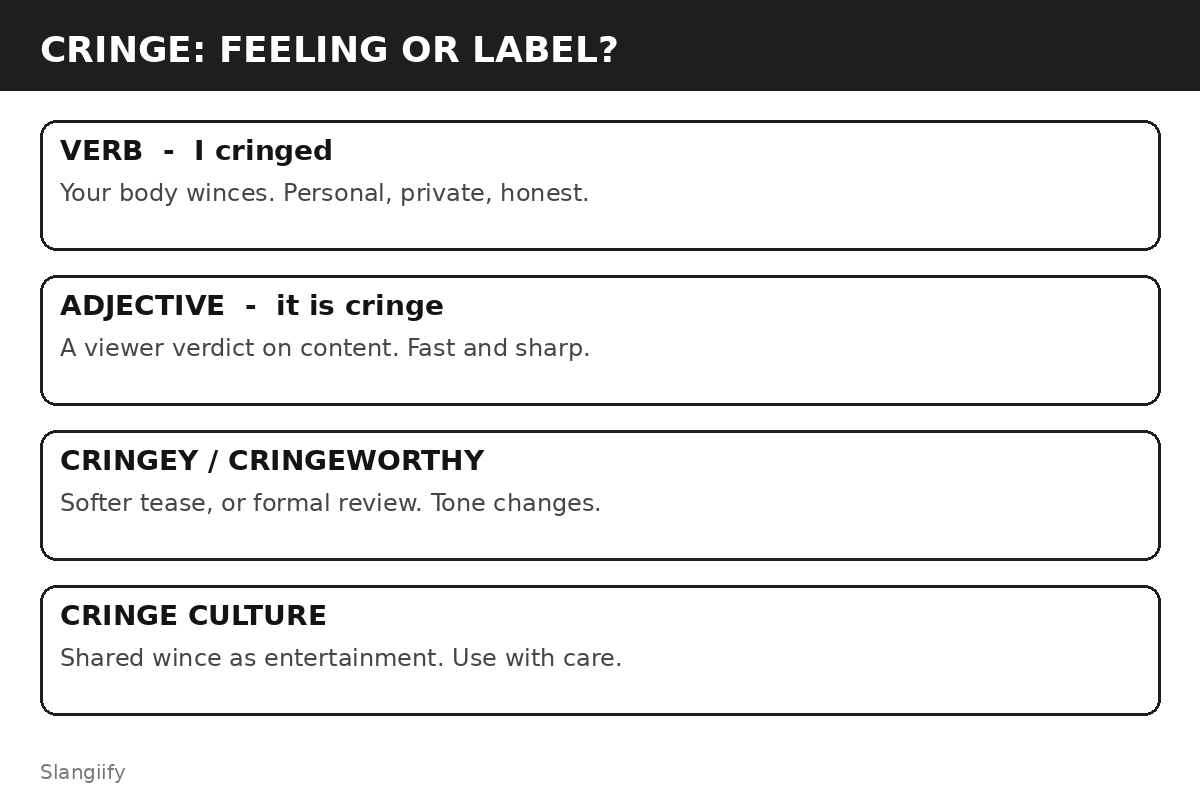
- To cringe, verb. To wince, recoil, or feel embarrassment. “I cringed when he tried the slang in front of his kids.”
- Cringey. The common adjective form, a little softer than cringe. “That joke was pretty cringey, but he meant well.”
- Cringeworthy. Worthy of a cringe, causing acute embarrassment or distaste. “That speech was cringeworthy, everyone in the room felt it.”
- Cringe moment. A single moment of embarrassment, often shared as a clip or a story. “That was a real cringe moment, I still think about it.”
- Cringe comedy. Comedy built on purpose to be awkward, where the laugh comes from the discomfort. “That show is cringe comedy, the awkwardness is the point.”
- Big cringe, major cringe. A stronger dose, used for emphasis. “Big cringe, I cannot watch that again.”
Notice how the forms slide between feeling and judgment. The verb is the feeling: I cringed. The adjective is the judgment: it is cringe. The noun is the thing itself: that was cringe. Learners who keep that slide in mind will use cringe more accurately, because they will know whether they are talking about their own reaction, the content, or the moment, and they will pick the form that matches.
Why Something Feels Cringe: Secondhand Embarrassment
Secondhand embarrassment is the engine of cringe. You watch someone else do something awkward, and you feel embarrassed for them, even though you did nothing wrong. Your face heats up, your shoulders rise, you look away, you laugh, you want to help, and you want the moment to end, all at once. The reaction is physical before it is verbal, and that is why cringe started as a body word, a word for shrinking back, before it became a slang judgment.
Three triggers do most of the work. The first is trying too hard: a person reaches for cool, funny, or impressive, and the effort shows, and the audience feels the strain. The second is a missed social cue: a person uses slang from the wrong generation, tells a joke to the wrong room, or shares a private feeling in a public feed, and the mismatch is visible. The third is earnestness in a cynical room: a person shares something sincere, sweet, or hopeful, and the room reads it as naive, and the sincerity itself becomes the awkward thing. None of these triggers means the person is bad, stupid, or unkind. They mean the fit between person, message, and audience broke down, and the break showed.
The body first, the label second
Think of cringe in two steps. Step one is the body: a wince, a recoil, a hand over the face, a look away, a laugh that is half pain. Step two is the label: “that is cringe”, typed in a comment, said in a chat, or thought in silence. The label is a shortcut for the body feeling, and shortcuts lose detail. A person who says cringe may mean “I felt embarrassed for you”, or “that was awkward”, or “please stop”, or “that was funny in a painful way”, and the listener has to guess which one, from tone and context. That guesswork is why cringe can sound cruel even when the speaker meant it lightly: the label carries the wince, but it does not carry the kindness that sometimes sits beside the wince.
Why the same thing is cringe to one person and fine to another
Cringe depends on the room. A dad dabbing at a graduation is cringe to a teen who values cool detachment, and funny to a parent who values joy. A brand using slang in an advert is cringe to a young viewer who hears the effort, and clever to a marketer who hears the reach. A sincere love poem is cringe to a reader who values irony, and moving to a reader who values honesty. The content did not change. The room changed, and the room decides the label. That is why cringe is a social word, not a fact about a video, and why a slang guide must teach the room, not just the definition.
From Bending to Blushing: Where Cringe Comes From
Cringe is an old word for a physical act: to bend, to yield, to shrink back, to crouch in fear or servility. The old sense is a body shrinking from a blow, from a superior, or from shame, and the modern slang sense keeps that body image, even when the blow is social, not physical. You cringe at an awkward video in the same way a person once cringed at a raised voice: you shrink, you pull back, you make yourself smaller, until the moment passes.
Merriam-Webster defines cringe as to recoil in distaste, to shrink in fear or servility, to behave in an excessively humble or servile way, and to draw in or contract one’s muscles involuntarily, and dates the first known verb use to the 13th century, the noun to 1592, and the adjective sense to 1983. That adjective date matters, because it shows the slang adjective is not ancient: the verb is medieval, the adjective that powers modern slang is from the 1980s, and the internet gave it a new home. Collins traces cringe to Old English cringan, to yield in battle, related to Old Norse krangr, weak, and Middle High German krenken, to weaken, and lists the informal adjective sense as causing feelings of acute embarrassment or distaste, with the example “a cringe moment”. The old root is yielding, bending, giving way, and the modern sense is a social yielding: the viewer gives way before an awkward moment, and shrinks back from it.
How a body word became a content word
The path runs through three steps. First, cringe is a verb for the body: I cringe at the noise, I cringe at the memory, the dog cringed in the corner. Second, cringe becomes a noun for the act: the cringe, a cringe, the act of shrinking back. Third, cringe becomes an adjective for the thing that causes the act: a cringe video, a cringe post, a cringe moment. The internet sped up the third step, because comment sections needed a short word for “this content made me feel that body reaction”, and cringe fit the box exactly. Reddit, TikTok, and X gave the adjective a daily workout, and the workout turned a dictionary adjective into a slang staple.
Reader’s Digest, quoting slang researcher Anne Zafarris, describes cringe as secondhand embarrassment when someone tries too hard and fails, and notes it can be a noun, an adjective, or a verb, with examples like “that was pure cringe”, “cringe behavior”, and “I cringed so hard I evaporated”. The article also traces cringe to Old English cringan, meaning to bend or to yield. That triple use, noun, adjective, verb, is the key to the modern word, and it is why learners hear cringe in so many sentence shapes: the word bends to fit the sentence, just as the body bends in the original sense.
Cringe on TikTok, Reddit, and in Comments
Online, cringe is a label, a genre, and a community, all at once. As a label, it sits in comments: “cringe”, “big cringe”, “this is so cringe”, under videos, photos, and posts. As a genre, it names content made to be awkward: cringe compilations, cringe TikToks, cringe comedy, where the awkwardness is the entertainment. As a community, it names forums and threads where people share awkward content and react together, with the shared wince as the bond. The three uses feed each other: the label creates the genre, the genre creates the community, and the community keeps the label alive.
Reddit’s r/cringe, one of the older homes of the word, helped fix the modern sense: content that makes viewers feel secondhand embarrassment, shared for reaction, not for praise. TikTok gave the word a new speed: short videos, fast comments, and a feed that rewards strong reactions, so cringe became a one-word verdict, typed in seconds, under a video that took hours to make. X gave the word a debate: threads about what counts as cringe, what is just earnest, and what is cruel to label, with the word itself sometimes called cringe for being overused. Each platform shaped the word a little differently, and a learner who reads all three will hear the full range.
Cringe comedy and the deliberate awkward
Cringe comedy is the exception that proves the rule. In cringe comedy, the awkwardness is deliberate, crafted, and funny on purpose, and the audience laughs because they know the creator knows. Shows and films built on awkward pauses, failed jokes, and social misses use cringe as a tool, not as an accident, and viewers who enjoy the genre do not use cringe as an insult. They use it as praise: “that was perfectly cringe”, “the cringe was the point”. The difference is intent and consent: in cringe comedy, everyone in the room, creator and audience, agrees that the awkwardness is the joke. In a cringe label on a sincere post, that agreement is missing, and the label can feel like a verdict from a room the creator never chose.
Cheugy, cringe, and the fashion of labels
Cringe sits beside cheugy, a word for things that try too hard to be trendy and end up dated, and the two are often confused. Cheugy is about taste and timing: a style that was cool, then became too common, then became a sign of trying. Cringe is about feeling: a moment that makes you wince, whatever the style. A cheugy outfit can be cringe, and a cringe video can be cheugy, but the words do different jobs. Bustle, reporting on Gen Z use, quotes a young designer who calls cringe the feeling of secondhand embarrassment for something someone else is posting or doing or saying, and notes that cringe can be anything, and cringe can be everything, in the broad Gen Z use. That breadth is both the power and the problem of the word: it can label anything, so it can lose meaning, and listeners may hear it as noise, not as a real reaction.

Cringe vs Awkward, Embarrassing, and Cheesy
| Word | Meaning | Who feels it | Tone | Example |
|---|---|---|---|---|
| Cringe | Secondhand embarrassment, a wince | The viewer, for the person | Judgmental, internet slang | “That video is so cringe.” |
| Awkward | Uncomfortable, clumsy, ill fitting | Both people in the moment | Neutral, plain | “That silence was awkward.” |
| Embarrassing | Causing shame or self consciousness | The person, mainly | Neutral, sympathetic | “That was embarrassing for her.” |
| Cheesy | Overly sentimental, corny, try hard | The viewer, judging taste | Light, teasing | “That pickup line was cheesy.” |
| Cringey | A little cringe, softer | The viewer, mildly | Softer, friendlier | “That joke was cringey.” |
| Cringeworthy | Worthy of a strong cringe | The viewer, strongly | Formal, strong | “That speech was cringeworthy.” |
| Cool | Admired, fitting, at ease | The viewer, admiring | Positive, the opposite pole | “That was so cool.” |
The table shows the key split: awkward and embarrassing describe a feeling in the moment, cheesy describes taste, and cringe describes a viewer judging a moment from outside. Cringe is the only word in the set that is mainly a viewer verdict, and that verdict is why it can sound cruel. When you want sympathy, embarrassing is kinder. When you want neutrality, awkward is safer. When you want a light tease, cheesy is gentler. When you want the internet verdict, cringe is the word, and the verdict comes with the risk that the person labelled will hear judgment, not help.
For the opposite pole, the praise word that cringe is measured against, see our guide to what cool means in text and online. Cool and cringe are a pair in online speech: a post is cool if it fits the room with ease, and cringe if it misses the room with effort showing, and the line between them moves with the room.
The Many Forms: Cringey, Cringeworthy, and Cringe Culture
Cringey is the everyday adjective, a little softer than cringe, and a little more forgiving. “That was cringey” means awkward, but with a smile, and it leaves room for the person to laugh along. Cringe, as an adjective, is blunter: “that is cringe” is a verdict, with less smile. Cringeworthy is the formal, written form, used in reviews and articles, and it carries weight: a cringeworthy moment is not just awkward, it is worth a wince, and the writer wants the reader to feel it. Learners who mix the forms will be understood, but they will miss the tone, and tone is half the meaning in slang.
Cringe culture is the wider pattern: a culture of labelling, sharing, and reacting to awkward content, where the wince is the entertainment, and the label is the currency. Cringe culture rewards strong reactions, fast verdicts, and shared laughter at a stranger’s expense, and it punishes earnestness, sincerity, and trying, because trying is the easiest thing to label. Critics of cringe culture argue that it makes people afraid to post, afraid to try, and afraid to be sincere, because any earnest post can be screenshotted, labelled, and shared as cringe. Defenders argue that cringe culture is just honest reaction, and that people who post in public invite judgment. Both views have force, and a learner who uses cringe should know the debate, because the word carries it wherever it goes.
When cringe is a compliment, and when it is not
Cringe can be a compliment in two narrow cases. In cringe comedy, “that was so cringe” means the comedy worked, the awkwardness landed, and the viewer enjoyed the discomfort. In friendly teasing, “you are so cringe” among close friends can mean affectionate, funny, and known, with the wince as a joke, not a verdict. Both cases need a shared room, a shared history, and a clear signal that the label is play. Outside those cases, cringe is a negative label, and it lands as criticism, even if the speaker meant it lightly. The safest test is simple: if the person labelled is not in the room, not in on the joke, and not laughing along, cringe is not a compliment, and it should not be used as one.
Who Calls Something Cringe, and Who Gets Called Cringe
Cringe is used most by teens and young adults, by heavy social media users, and by commenters in TikTok, Reddit, and gaming chats, and it is understood far beyond those groups, by parents, teachers, and marketers who hear it secondhand. In the US, UK, Canada, and Australia, the slang sense is widely recognised, and the verb sense is standard English everywhere. The label is strongest in youth culture, where social fit is watched closely, and where a single post can be judged by hundreds of strangers in minutes. Older speakers use cringe too, often for their own memories: “I cringe when I think about that photo”, “I cringe at my old posts”, where the verb is self directed, and the judgment is kinder, because it is aimed at the self.
Who gets called cringe follows a pattern that deserves honesty. Brands that use youth slang get called cringe, because the effort shows. Adults who use teen slang get called cringe, because the generation gap shows. Earnest creators, sincere posters, and people who share joy without irony get called cringe, because the room rewards detachment. People who try a new skill in public, who dance badly with joy, who share a love poem, who wear an unfashionable outfit with pride, all risk the label, not because they did anything wrong, but because trying in public is visible, and visibility invites verdicts. That pattern is why cringe is a word to use with care: the people most likely to be labelled are often the people who were bravest to post.
A quick usage map
- Speaker: Teens and young adults mainly, social media users of all ages, commenters, friends teasing friends, reviewers for the formal form.
- Place: TikTok comments, Reddit threads, group chats, X replies, YouTube comments, classrooms, living rooms for the verb sense.
- Audience: Peers and strangers online for the label, friends for teasing, the self for memories, a formal audience for cringeworthy in writing.
- Register: Informal slang for the label, neutral for the verb, formal for cringeworthy in reviews, playful only among close friends.
- Energy: The label is fast and sharp, the verb is physical and private, the teasing form is warm only when the friendship is strong.
How to Use Cringe Without Sounding Cruel
Start with the verb, about yourself, before you use the adjective about others. “I cringe at my old videos” is safe, honest, and funny, and it teaches the feeling without judging anyone. “I cringed when I saw that post” is a personal reaction, and it leaves room for the poster to disagree. “That is cringe” is a verdict, and it needs a room that agrees, or it will sound like a stranger’s judgment. The habit of starting with I cringe, not it is cringe, makes the word kinder, and it makes the speaker more credible, because a personal reaction is harder to argue with than a verdict.
- Describe your own reaction: “I cringed so hard at that scene, I had to pause it.” “I cringe every time I hear that song.”
- Use cringey for a light tease, with friends: “That joke was cringey, but I laughed.” “Okay, that dance was a little cringey, in a good way.”
- Use cringe for content, not for a person, in public: “That video is cringe” is kinder than “you are cringe”. Content can be fixed, a person cannot be fixed by a label.
- Add the reason, not just the label: “That felt cringe because the slang was from the wrong decade.” “That was cringe because the joke landed in the wrong room.”
- Use cringeworthy in writing, where formality helps: “The speech was cringeworthy, with long pauses and forced jokes.” “That scene is cringeworthy, and the film knows it.”
Notice how each example gives the listener a reason, a scene, or a personal reaction, not just a bare label. A bare “cringe” in a comment, with no reason, reads as dismissal, and the poster learns nothing, except that a stranger winced. A cringe plus a reason reads as feedback, and the poster can use it, or disagree with it, with dignity intact. The extra words cost seconds, and they save a person from feeling dismissed by a single word.
For the chat language that often carries cringe in group chats, see our guide to what chat means in text and online. Chat is where cringe is most often typed, fastest, and least thought through, and the guide shows how chat norms shape the words that travel in them.
What to Say Back When Someone Says Cringe
- To a cringe label on your post: “Fair, I was trying something new.” “Haha, I know, I cannot watch it back either.” “What part felt off, I want to get it right next time.”
- To a friend teasing you: “I know, I am cringe and proud.” “You laughed though, that counts.” “Your turn next, I will film it.”
- To a cringe label on someone else’s post, when you disagree: “I thought it was sweet, actually.” “He was having fun, leave him be.” “Not cringe, just earnest, there is a difference.”
- To “I cringe at my old posts”: “We all do, that means you grew.” “Your old posts are brave, not cringe.” “Delete nothing, keep the receipts.”
- To a cringe comedy recommendation: “I love that show, the awkwardness is perfect.” “Cringe comedy is not for me, I hide behind the sofa.”
Replies work best when they separate the feeling from the person. A reply that says “I felt that too” joins the speaker in the feeling, without joining in a verdict on a stranger. A reply that says “that was brave” defends the poster, without attacking the speaker. A reply that asks “what part felt off” turns a label into a conversation, and a conversation can change a mind, where a label cannot.
For the TikTok-adjacent slang that often sits beside cringe in comments, see our guide to what corn means on TikTok and beyond. Corn and cringe overlap in the try hard, overly earnest zone, and learning both helps readers tell a corny joke from a cringe moment.
Myths vs Facts About Cringe
Myth: cringe means something is bad
Fact: cringe means something felt awkward or embarrassing to a viewer, not that it was badly made, badly meant, or without value. A sincere, well made video can be cringe to a cynical room, and a rough, silly video can be beloved in a warm room. The label describes fit, not quality.
Myth: cringe is a new internet word
Fact: the verb is from the 13th century, the noun from 1592, and the adjective sense from 1983, in dictionary dating. The internet gave the adjective a new speed and a new home, but it did not invent the word, and it did not invent the body reaction behind it.
Myth: if something is cringe, everyone thinks so
Fact: cringe depends on the room, the generation, and the values of the viewers. The same post can be cringe in one group chat, funny in another, and moving in a third. A label from one room is not a verdict from the world.
Myth: cringe and awkward mean the same thing
Fact: awkward describes discomfort in the moment, shared by the people in it, while cringe describes a viewer feeling secondhand embarrassment for someone else, often from outside the moment. Awkward is neutral, cringe is a judgment, and the difference matters when you choose a word.
Myth: calling something cringe is harmless, because it is just a word
Fact: cringe can be harmless among close friends, as play, and it can be hurtful in public, to a stranger, where it reads as dismissal. The word carries a wince, and a wince aimed at a person can sting, even when the speaker meant it lightly.
Myth: cringe culture is just honesty
Fact: cringe culture rewards fast verdicts and shared laughter, and it can punish earnestness and trying. Honesty needs reasons, context, and kindness to be useful, and a bare cringe label often has none of those. A culture that labels everything cringe teaches people to hide, not to improve.
When NOT to Use Cringe
Do not use cringe as a label for a person, in public, to a stranger, or about someone’s identity, body, disability, grief, or sincere joy, because the label will read as cruelty, even if you meant it as a joke. Do not use cringe in a formal setting, a work email, a review of a colleague, or a comment on a post about a serious topic, because the slang verdict will sound dismissive, and it will close a conversation that needed care. Do not use cringe to dismiss earnestness itself: a love poem, a proud parent, a beginner dancer, and a hopeful post are not failures because they are sincere, and labelling them cringe teaches the room that sincerity is shameful.
Do not use cringe as a substitute for a reason. “Cringe” with no reason tells the poster nothing, and it tells other readers only that you winced. If you cannot say what felt awkward, what missed, or what would have worked better, the label is not feedback, it is noise, and it is kinder to say nothing, or to say “not for me”. Finally, do not use cringe about yourself as a permanent identity: “I am cringe” as a joke among friends is fine, but “I am cringe” as a belief can become a cage, and a person who believes they are cringe will stop trying, stop posting, and stop sharing joy. Slang should describe moments, not cage people, and the kindest use of cringe is the one that leaves room for the person to try again.
For the aura language that often follows a cringe moment online, see our guide to what aura means in text and online. A cringe moment is often described as losing aura, and the two words together explain a whole corner of TikTok comment culture.
Quick Answers About Cringe Slang
What does cringe mean in slang?
Cringe means awkward or embarrassing in a way that causes secondhand embarrassment. “That video is cringe” means the video made the viewer wince, look away, or feel embarrassed for the person in it.
What does “that is so cringe” mean?
“That is so cringe” means that thing is very awkward or embarrassing to watch. It is a strong viewer verdict, and it usually means the effort showed, the social cue missed, or the sincerity landed in a cynical room.
What is the difference between cringe and cringey?
Cringey is the softer, everyday adjective form, a little more forgiving, while cringe as an adjective is blunter and more of a verdict. “That was cringey” leaves room to laugh along, while “that is cringe” lands as a judgment.
What does cringeworthy mean?
Cringeworthy means worthy of a cringe, causing acute embarrassment or distaste. It is the formal, written form, used in reviews and articles, for a moment or a speech that made everyone in the room feel the awkwardness.
Is cringe an insult?
Cringe can be an insult when it labels a person in public, and it can be friendly teasing among close friends who share the joke. In public, to strangers, it usually reads as criticism, even when the speaker meant it lightly, so use it about content, not people, and add a reason.
What is cringe culture?
Cringe culture is the pattern of labelling, sharing, and reacting to awkward content online, where the shared wince is the entertainment. Critics say it punishes earnestness and trying, while defenders say it is honest reaction, and the debate is part of the word’s meaning.
Why do people say something is cringe on TikTok?
People say cringe on TikTok because short videos invite fast verdicts, and cringe is the shortest word for secondhand embarrassment. A comment that says cringe tells other viewers the video made the commenter wince, and it invites them to watch for the awkward moment themselves.
Sources and Further Reading
- Merriam-Webster on cringe: defines cringe as to recoil in distaste and to shrink in fear or servility, with etymology from Middle English crengen and Old English cringan, first known verb use in the 13th century, and adjective use from 1983.
- Collins English Dictionary on cringe: traces cringe to Old English cringan, to yield in battle, and lists the informal adjective sense as causing feelings of acute embarrassment or distaste, with the example of a cringe moment.
- Reader’s Digest on slang word origins: describes cringe as secondhand embarrassment when someone tries too hard and fails, notes its use as noun, adjective, and verb, and traces it to Old English cringan, to bend or to yield.
- Bustle on what cringe means to Gen Z: reports the Gen Z adjective and attitude use, quotes a young designer on secondhand embarrassment, and notes the broad, sometimes meaningless, use of the word in online culture.
- Pexels photo page: Man Looking at His Phone With a Hand on His Face by Mizuno K: free license source of the featured image.
- Pexels photo page: Photo of Women Laughing While Sitting Near Water Fountain by Andrea Piacquadio: free license source of the in body image.



Pingback: Dada Meaning Slang: Father, Art Movement, or Nonsense?