

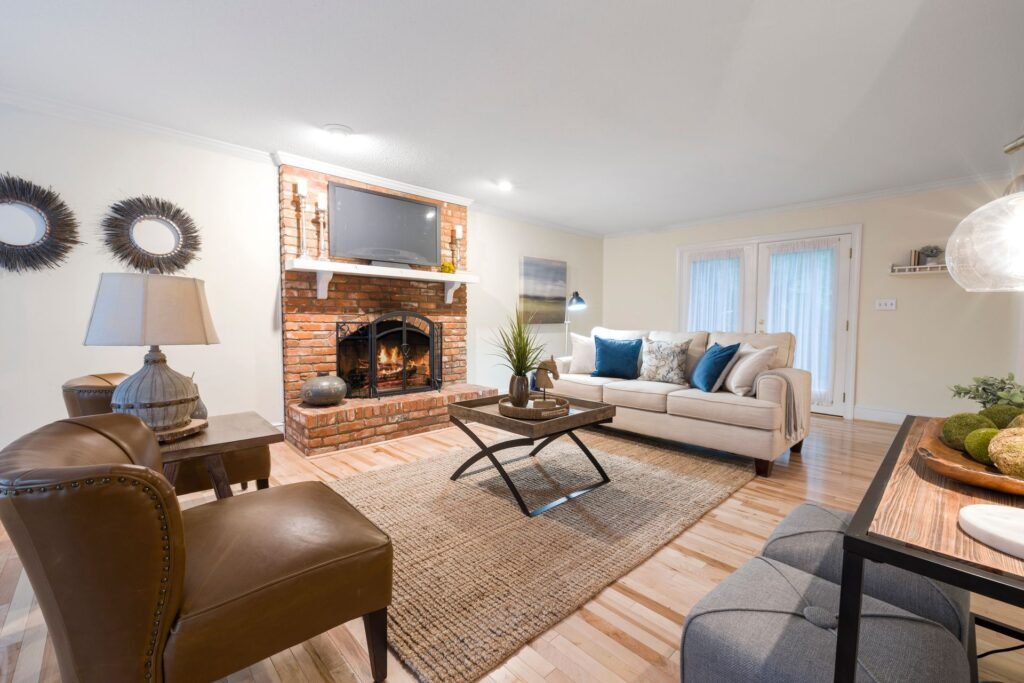
In slang, crib means home: your house, your apartment, your room, the place where you live and where you can relax.
If someone texts “come to my crib later” they are not inviting you to a baby bed, and they are not talking about cheating on a test. They are inviting you to their place. That one sense does most of the work in modern speech, and it is warm, casual, and a little bit proud. My crib says more than my house. It says this place is mine, I am comfortable here, and you are welcome here.
This guide sorts out every live sense of crib, because the word has more than one. The home sense comes first, then the long history that took crib from a feeding trough to a house, then the hip-hop story that carried it into texts and captions around the world. You will also meet the baby bed, the cheat sheet, and the verb to crib, which means to copy, and you will get a comparison table, a usage map, replies, myths, and the places where crib is the wrong word.
What Crib Means at a Glance
Crib means home in slang, used with warmth and pride. “Just chilling at the crib” means relaxing at home. “Come through to my crib” means come to my place. “My crib, my rules” means my home, my way of doing things. The word is informal, friendly, and rooted in African American English and hip-hop, and it is now used far beyond those roots in texts, captions, and casual speech.
The home sense is the one to learn first, because it is the one you will hear most. It works for a house, a flat, a rented room, a student dorm, or any place a person calls home. Size does not matter. A small studio can be a crib, and a large house can be a crib, because crib describes belonging, not size or wealth. What matters is that the speaker lives there, feels at ease there, and is talking about it as their own place.
Every live sense of crib in one list
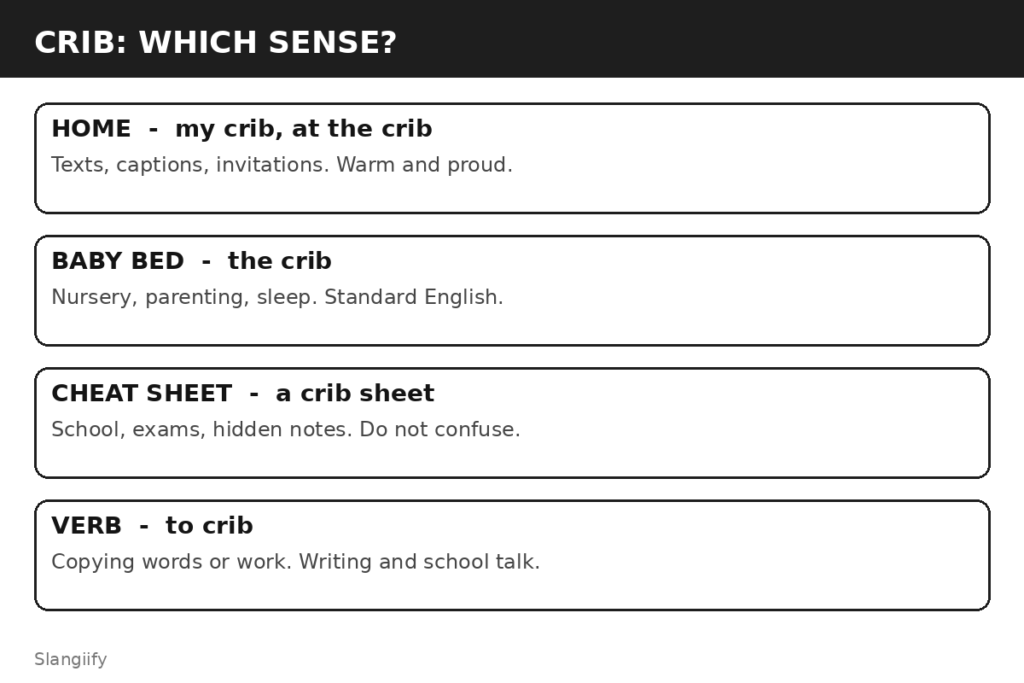
- My crib, the home sense. The place where someone lives. “Come to my crib after work, I will order food.”
- At the crib. At home, staying in, relaxing at home. “I am at the crib tonight, just resting.”
- A baby crib. A small bed with high sides for a baby or young child. “The baby is asleep in her crib.” This is the standard, non-slang meaning, and context keeps it separate.
- A crib sheet. Notes used to cheat in a test, or a summary sheet used as a quick aid. “He hid a crib sheet in his sleeve.” Also called a crib.
- To crib, the verb. To copy or steal words or work. “She cribbed the line from her favourite poet.”
- A crib in New Zealand. A small holiday home, often near the beach, usually simple in build. This is regional, not slang, and it is worth knowing if you read New Zealand writing.
- Crack a crib, old thieves slang. To break into a house. This is historical slang, rarely heard today, and it shows how old the house sense is.
Notice how the list separates by scene. Home talk, baby talk, school talk, and writing talk each use crib in a different way, and the scene tells you which one you heard. A text about an evening plan uses the home sense. A text about a baby uses the bed sense. A text about an exam uses the cheat sheet sense. A text about an essay uses the verb sense. Listen for the scene, and crib stops being confusing.
From Manger to Home: Where Crib Comes From
Crib is an old word with a long, winding road. It starts as a trough, a woven basket, a manger where animals feed, and it slowly becomes a small bed, a small house, and then a home in slang. The shape stays the same through the whole story: a small, enclosed place, with sides, where something precious is kept safe. A manger keeps feed safe. A baby bed keeps a baby safe. A home keeps a person safe. The word followed that feeling, from the farm to the bedroom to the front door.
Merriam-Webster traces crib to Middle English and Old English cribb, akin to Old High German krippa, meaning manger, and dates the first known noun use to before the 12th century, in the manger sense. The baby bed sense grew from the manger image, because the manger in the Christmas story is a bed for the infant Jesus, and a small bed with high sides looks like that manger. Wiktionary traces the same path from Old English cribb, meaning couch, bed, manger, or stall, through Proto-West Germanic kribbja, and notes the doublet creche, the French word for a manger scene. The history is not a slang invention. It is a thousand-year-old word that slang borrowed and made its own.
The small house step, Shakespeare and thieves slang
Long before hip-hop, crib already meant a small dwelling. Shakespeare uses smoky cribs for poor, cramped lodgings in Henry IV, Part 2, where sleep lies in smoky cribs on uneasy pallets, rather than in the perfumed chambers of the great. That use is literary, not slang, but it shows the house sense was already alive in the 1590s, as a small, humble place to live. Wiktionary lists the hovel sense with the Shakespeare quotation, and lists a boxy timber structure sense, a cage sense, and a confined space sense beside it, all built on the same enclosed shape.
Thieves slang took the house sense in a darker direction. A crib in thieves cant was a house to be broken into, and to crack a crib meant to break into a house. Dictionary.com notes the thieves slang root for the steal senses of crib, from the idea of putting something in a basket, and lists the house sense alongside the cheat and steal senses. A 19th century dictionary entry in the search record puts thieves slang for dwelling house at least as early as 1812, though the modern home sense in African American English is often treated as a separate, later development. The two histories may be independent, and it is safer to say the house sense has old roots and a modern rebirth, rather than one unbroken line.
The verb and the cheat sheet, a second branch
While crib was becoming a house, it was also becoming a verb for copying. The path runs through the basket sense: to put something in a basket, to hide it away, to take it quietly. From there, crib came to mean to steal writing, to copy answers, and to use a hidden aid in an exam. Merriam-Webster lists the cheat senses plainly: a small theft, a literal translation, a summary and key to a literary work, and something used for cheating in an examination. The crib sheet is the noun form of that branch: a sheet of notes, a translation, a key, carried into a test or kept at hand while writing.
This branch is still live, and it is the main source of confusion for learners. A student who says “I need a crib for the exam” means a cheat sheet, not a house. A writer who says “I cribbed that idea” means they copied it, not that they visited a house. The verb is always about copying, and the noun in school talk is always about a hidden aid. Keep the school scene separate from the home scene, and the two branches never cross.
Crib in Hip-Hop and Pop Culture
The modern home sense of crib is rooted in African American Vernacular English, and hip-hop carried it around the world. Merriam-Webster labels the home sense chiefly African American English slang, and quotes the usage “I was at the crib, chilling” from the Corpus of Regional African American Language. That label matters, because it credits the community that kept the word alive and gave it its modern warmth. Crib in this sense is not a neutral synonym for house. It carries pride in a home, pride in a neighbourhood, and a sense of arrival, and that pride is part of the meaning.
Hip-hop lyrics made crib a global word. Wiktionary quotes 50 Cent from 2003, in the song In da Club, listing “my crib, my cars, my pools, my jewels” among the things his success bought him. In that line, crib sits beside cars and jewels as a sign of success, and the list works because crib means a home worth showing off. Later lyrics kept the same pattern, with crib as the home base, the place a rapper returns to, the place friends gather, and the place that proves how far the speaker has come. The word travelled with the music, into slang lists, into TV writing, and into everyday texts far from any recording studio.
MTV Cribs and the house tour moment
MTV Cribs, the celebrity house tour show, turned crib into a TV word as well as a music word. Each episode walked viewers through a famous person’s home, room by room, with the star as guide, and the title did the explaining: a crib is a home, and this is a tour of one. The show helped listeners who had never heard hip-hop slang learn the word in one viewing, because the pictures did the work. You saw a living room, a kitchen, a pool, and a garage, and you understood that crib meant the whole place.
That TV moment also fixed a second meaning in the public mind: a crib worth touring is a crib worth showing off. In everyday speech, that showing-off edge is optional. A person can call a small rented room their crib with pride, and no tour is expected. The pride is in ownership and comfort, not in wealth. If you hear crib used with a tour, a video, or a photo dump of a new place, the showing-off sense is active. If you hear it in a simple plan, “come to my crib”, the sense is plain invitation, and wealth has nothing to do with it.
Crib on social media today
On TikTok, Instagram, and X, crib appears in captions, comments, and house tour videos, often with a photo of a new apartment, a cleaned room, or a cosy corner. “My crib is finally clean enough for guests” is a typical caption, and it works because crib is warmer than apartment and funnier than home. In group chats, crib is a planning word: “at my crib”, “your crib or mine”, “crib tonight”. In gaming and streaming chats, crib is rarer, because the home base is usually called a base or a spawn, and crib stays in real-life talk. The word is strongest where real homes are the topic, and that is a useful clue for learners.
For the neighbouring hip-hop home and car vocabulary, see our guide to what whip means when talking about cars. Whip and crib often appear in the same lyric, the same caption, and the same list of things a person is proud of, and learning them together helps the whole picture click.

The Other Cribs You Will Meet
Three other cribs are common enough to deserve their own section, because each one can surprise a reader who only knows the home sense. The baby bed is the oldest and most standard. The cheat sheet is the school sense. The verb is the writing sense. Learn all three, and no sentence with crib will catch you out.
The baby bed
Cambridge defines the bed sense as a small bed for a baby or young child with high bars around the sides so the child cannot fall out, and notes the UK word is cot. This is the meaning in baby shops, parenting articles, and safety guides, and it is the meaning in the phrase “the baby is in her crib”. It has no slang edge, no pride, and no invitation. If the sentence mentions a baby, sleep, bars, or a nursery, the bed sense wins, and the home sense does not apply. A parent who says “my crib” while holding a baby may still mean their home, but a parent who says “the crib” while pointing at a bed means the bed.
The crib sheet and the verb to crib
A crib sheet is a cheat sheet, a translation, or a summary used as an aid, often secretly. In school talk, it is a small piece of paper with answers, formulas, or notes, hidden in a sleeve or under a desk. In writing talk, a crib is a literal translation of a foreign text, used to help a student read it, and the practice is often frowned on. The verb to crib means to copy, to steal words, to take an idea without credit. Merriam-Webster gives the verb examples “she cribbed a line or two from her favourite poet” and “students cribbing off each other’s papers”, and both show the copying sense in action.
The verb also appears in a softer, everyday form: “I cribbed the recipe from a website” means I copied the recipe, with a change or two, and the tone is casual, not criminal. Context decides how serious the copying is. In an exam, cribbing is cheating. In a recipe, cribbing is borrowing. In a lyric, cribbing an idea is a serious charge. Listen for the scene, and the seriousness follows.
Regional cribs: New Zealand and the South Island
In southern New Zealand, a crib is a small holiday home, often near a beach, usually simple in build, and the northern word for the same thing is bach. Wiktionary lists the southern New Zealand holiday home sense, with bach as the northern synonym. This is not slang, and it is not the hip-hop sense, though the two share the small home idea. If you read a New Zealand travel article that says “we stayed at the crib in Dunedin”, the writer means a holiday house, not a slang home, and not a baby bed. Regional words deserve the same care as slang words: check the place, check the scene, and do not force the meaning you know best onto a sentence from somewhere else.
For the decade slang that often sits beside crib in music and TV writing, see our guide to popular 1970s slang words and phrases. The 1970s list includes pad, another home word, and comparing pad and crib shows how home slang changes while the feeling stays the same.
Crib vs Similar Words
| Word | Meaning | Tone | Where used | Example |
|---|---|---|---|---|
| Crib | Home, the place you live | Warm, proud, casual | Texts, captions, hip-hop, chats | “Come to my crib tonight.” |
| Pad | Home, a place to live | Cool, 1960s and 70s feel | Older slang, retro talk | “Come back to my pad.” |
| House | A building, a home | Neutral, plain | Everywhere, formal and informal | “This is my house.” |
| Home | Where you live and belong | Warm, neutral | Everywhere, all registers | “I am going home now.” |
| Crib sheet | Cheat notes for a test | Secret, school talk | School, exams, study | “He used a crib sheet.” |
| To crib | To copy or steal words | Casual, or accusing | Writing, school, music | “She cribbed that line.” |
| Yard | Home area, neighbourhood | Local, Jamaican slang | Jamaican English, music | “Back to my yard.” |
The table shows why crib survives: it is the only home word in the set that also carries hip-hop pride, a TV tour, and a history that runs from a manger to a house. Pad is cooler and older, house is plainer, home is warmer and wider, and none of them carries the same music history. When you want pride and casual warmth, crib is the word. When you want neutrality, house and home are safer. When you want a school sense, crib sheet is a different word entirely, and the table keeps it separate on purpose.
For the thieves slang family that shares crib’s older house history, see our guide to what crack means in text and conversation. Crack a crib is the old phrase that links the two words, and the guide explains why crack and crib must not be mixed up in modern speech.
Who Says Crib, Where, and to Whom
Crib as home is used across the English speaking world, with the strongest roots in the United States, in African American English, and in hip-hop culture, and with wide use in the UK, Canada, Australia, and online English. In the US, the home sense is common in texts, captions, and music, and the baby bed sense is common in parenting talk, and the two live side by side without confusion, because the scenes are so different. In the UK, the home sense is recognised, the baby bed is usually called a cot, and the cheat sheet sense is common in school talk. In New Zealand, the holiday home sense adds a third layer, and listeners there check the region before they check the slang.
Who says it to whom depends on the sense. The home sense is safe among friends, family, and peers, in texts, chats, and captions, and it is safe in a caption addressed to strangers, because the tone is welcoming. It is less safe in a formal email, a job application, or a conversation with a stranger who may not know slang, because it can sound too casual, or it can be misheard as the baby sense. The baby sense is safe everywhere, because it is standard English. The cheat sense is safe only in school talk, and it is an accusation in writing talk, so it needs care.
A quick usage map
- Speaker: Teens and adults in casual speech, hip-hop fans, music listeners, social media users, parents for the bed sense, students for the cheat sense.
- Place: Texts, group chats, captions, lyrics, house tour videos, living rooms, kitchens, dorms, baby shops for the bed sense, classrooms for the cheat sense.
- Audience: Friends and peers for the home sense, family for the bed sense, classmates for the cheat sense, a formal audience for none of the slang senses.
- Register: Informal and warm for the home sense, neutral for the bed sense, secret or accusing for the cheat and verb senses.
- Energy: The home sense is relaxed and proud, the bed sense is calm and practical, the cheat sense is tense and hidden.
How to Use Crib Naturally
Start with the home sense in a simple invitation or a simple statement of where you are. Crib needs a possessor or a clear context: my crib, your crib, his crib, at the crib, back to the crib. A bare crib on its own, without a possessor, can be unclear, because the listener does not know whose home you mean, or whether you mean a bed or a sheet. Add the possessor, add the verb, and the sentence clicks into place.
- Invite someone over: “Come to my crib after school, we can watch the match.” “Your crib or mine tonight?”
- Say where you are: “I am at the crib, just chilling.” “Back at my crib now, long day.”
- Show pride in a place: “New crib, who dis, come see it.” “Finally got my own crib, small but mine.”
- Talk about a baby bed, clearly: “The baby is asleep in the crib, keep it down.” “We need a new crib for the nursery.”
- Talk about copying, carefully: “I cribbed that joke from a podcast, sorry.” “Do not crib answers in the exam, it is not worth it.”
Notice how each example gives the listener a second clue: after school, at the crib, new crib, baby, exam. That second clue is the habit that makes crib safe. A bare “at the crib” in a baby shop could be misheard, and a bare “crib” in a classroom could be misheard, but a crib plus a clue leaves no gap. The habit costs one word, and it saves a whole misunderstanding.
For the chat language that often carries crib in everyday texts, see our guide to what chat means in text and online. Chat and crib travel together in group chats, where plans are made, invitations are sent, and home is the meeting point.
What to Say Back When Someone Says Crib
- To an invitation: “On my way, send the address.” “What time, and should I bring anything?” “Your crib or mine, I am easy.”
- To “at the crib”: “Nice, enjoy the rest.” “Chilling sounds perfect, see you tomorrow.” “Send a photo of the new place.”
- To a new home announcement: “Congrats, that is huge.” “Proud of you, when is the housewarming?” “Small but yours is the best kind.”
- To a baby bed sentence: “Sleeping well, lucky you.” “Keep it down, I will text instead of calling.”
- To a cheat or copy sentence: “Better to rewrite it in your own words.” “Own it, apologise, and fix it.” “Do not risk it in an exam.”
Replies work best when they match the sense you heard. Answering a home invitation with a comment about a baby bed, or answering a cheat sheet with a comment about a house, tells the speaker you heard the word but missed the sentence. Repeat the key clue back in your reply, home, baby, exam, and the conversation stays on track.
Myths vs Facts About Crib
Myth: crib is a new internet word
Fact: crib is over a thousand years old as a word, and the house sense has roots in the 1500s and 1800s. Hip-hop and TV gave the home sense a new life, but they did not invent the word, and they did not invent most of its senses.
Myth: crib always means a fancy house
Fact: crib means any home, large or small, rented or owned, fancy or plain. The pride in crib is pride in belonging, not pride in wealth. A small studio is a crib, and a mansion is a crib, and the word works the same in both.
Myth: crib means a baby bed in slang too
Fact: the baby bed is the standard meaning, not a slang meaning. Slang crib means home. The two meanings share a word and a history, but they live in different scenes, and context keeps them apart.
Myth: crib and pad mean exactly the same thing
Fact: crib and pad both mean home, but they come from different eras and different cultures. Pad is 1960s and 70s slang, crib in its modern form is hip-hop slang, and the choice between them tells the listener which world the speaker is in.
Myth: to crib means to visit a house
Fact: to crib means to copy or steal words, not to visit. Visiting a crib is “going to someone’s crib”. Cribbing a line is copying it. The verb and the noun belong to different branches, and mixing them up changes the meaning completely.
Myth: crib is only American
Fact: the modern home sense is rooted in American English, but it is used in the UK, Canada, Australia, and online English around the world, and New Zealand adds its own holiday home sense. The word travelled with music, TV, and social media, and it is now global casual English.
When NOT to Use Crib
Do not use crib for home in a formal setting, a job email, a rental application, or a conversation with someone who may not know slang, because it can sound too casual, and it can be misheard as the baby sense. Use house, home, apartment, or flat in those settings, and save crib for friends, peers, and captions. Do not use crib for a baby bed in a slang sentence, and do not use crib for home in a baby shop sentence, because the scene will pull the meaning the wrong way, and a listener will have to guess.
Do not use crib sheet or to crib lightly in school or work, because both imply cheating or copying, and the implication can follow a person. If you borrowed an idea, say you borrowed it, and credit the source, rather than saying you cribbed it as a joke. Do not use crack a crib in modern speech, because it is old thieves slang for burglary, and it will confuse listeners who only know the home sense. Finally, do not use crib to claim a home that is not yours, or to invite people to a place you do not live, because the word promises welcome, and a broken promise about home lands harder than a broken promise about a meeting place.
Quick Answers About Crib Slang
What does crib mean in slang?
Crib means home in slang: your house, apartment, or room, the place where you live. “Come to my crib” means come to my place, and “at the crib” means at home.
What does “my crib” mean?
“My crib” means my home, said with warmth and pride. It can mean a house, a flat, a dorm room, or any place the speaker lives and feels at ease.
Is crib slang for house?
Yes, crib is slang for house or home, rooted in African American English and hip-hop. It is casual and warm, and it is used in texts, captions, lyrics, and everyday speech.
What is a crib sheet?
A crib sheet is a cheat sheet: notes, answers, or a translation used as a hidden aid in a test or while writing. It is a different sense from the home sense, and school context makes the meaning clear.
What does it mean to crib something?
To crib something means to copy it or steal the words, often without credit. “She cribbed the line from a poet” means she copied the line. In an exam, cribbing means cheating.
What does MTV Cribs mean?
MTV Cribs is a celebrity house tour show, and the title uses crib in the home sense. Each episode tours a famous person’s home, room by room, and the show helped the home sense of crib reach a wide TV audience.
Is crib offensive?
No, crib is not offensive in the home sense, and it is not a slur. It is casual slang, so it can sound too informal in a formal setting, but it is warm and welcoming among friends, and it credits African American English and hip-hop culture in its modern use.
Sources and Further Reading
- Cambridge Dictionary on crib: defines the baby bed sense, the Christmas scene sense, and the mainly US slang home sense.
- Merriam-Webster on crib: lists the manger, bed, small dwelling, and chiefly African American English slang home senses, plus the cheat and verb senses, with etymology from Old English cribb.
- Wiktionary on crib: traces crib from Old English cribb through Proto-West Germanic, lists the Shakespeare hovel sense, the New Zealand holiday home sense, and the African American Vernacular home sense with lyric quotations.
- Dictionary.com on crib: lists the house, cheat, and steal senses of crib, with etymology from Middle English cribbe and Old English crib.
- Pexels photo page: Brown Couch in the Living Room by Curtis Adams: free license source of the featured image.
- Pexels photo page: Photo of Three Laughing Woman Sitting on White Couch by Andrea Piacquadio: free license source of the in body image.



Pingback: DINKS Meaning Slang: What DINKS Means Online