

Dada most often means father or daddy in baby talk, but the same spelling also names the Dada art movement, means older brother in South Asian English, and is sometimes used ironically to mean nonsense, so the right meaning depends on who is speaking and where you read it.
Dada is a small word with a long shadow. A toddler says it to call a parent. An art student writes it with a capital D to name a movement that broke every rule in 1916. A shopkeeper in Mumbai or Dhaka may be addressed as dada by a younger customer. A Harry Potter fan typing in all caps means something else entirely. No single dictionary entry covers all of that, and most web pages cover only one sense, which is why readers keep searching. This guide puts the four main meanings side by side, explains where each one comes from, and gives you simple clues to tell them apart in a text, a caption, or a conversation.
Dada at a Glance: Four Meanings, One Spelling
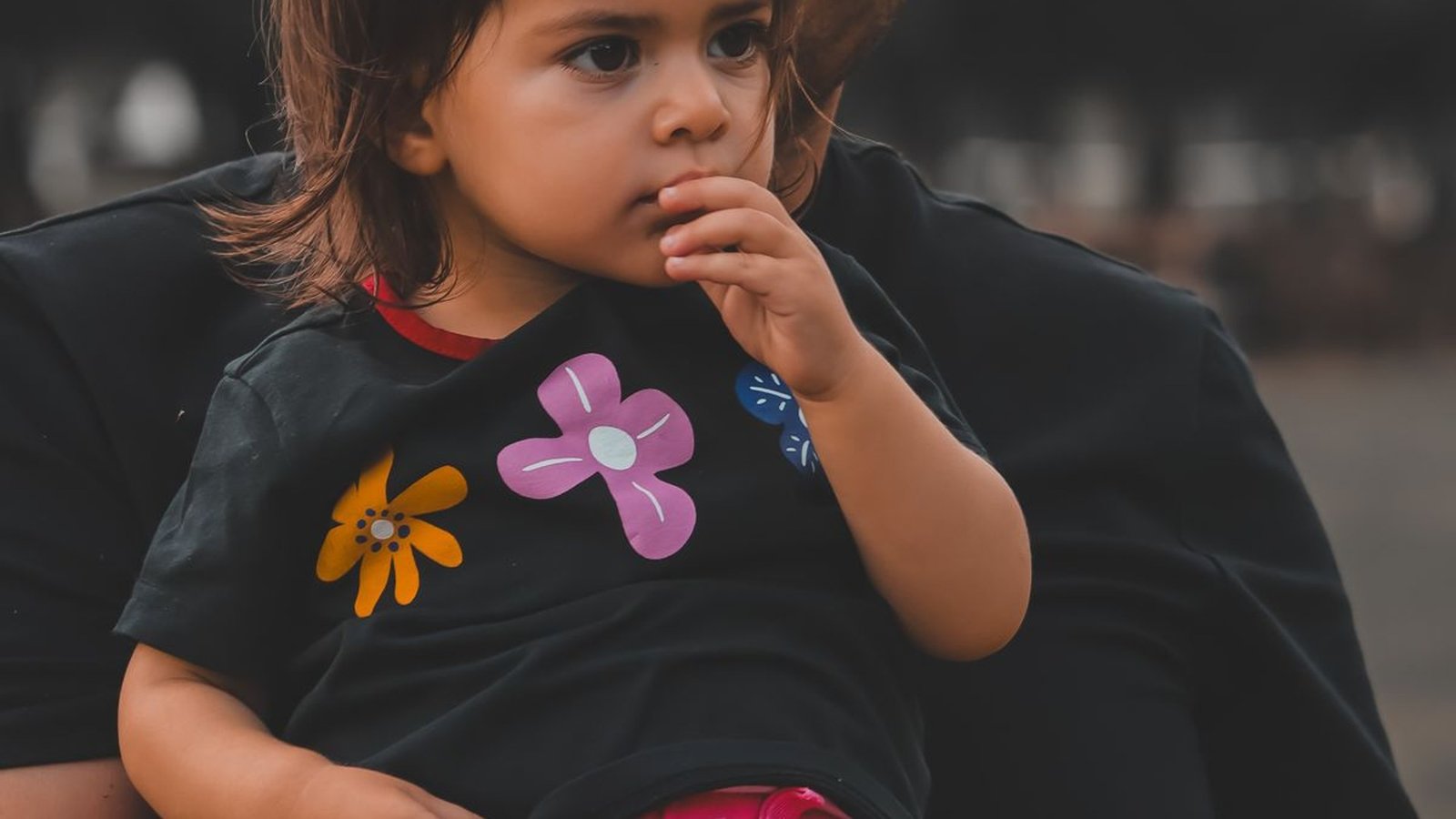
Dada has four main meanings: baby talk for father or daddy, the capital D Dada art movement of the early twentieth century, older brother or a respectful address for an older man in South Asian English, and the all caps abbreviation DADA for Defence Against the Dark Arts in Harry Potter, with a rare ironic slang sense of nonsense borrowed from the art movement. The table below is the fastest way to find your meaning, and the rest of the guide explains each row in full.
| Form you see | Meaning | Where you meet it | Quick clue |
|---|---|---|---|
| dada, lower case | Father, daddy | Toddlers, family chat, parenting posts | A small child is speaking, or a parent is quoted |
| Dada, capital D | The art movement | Art history, museums, design, culture writing | Words like art, collage, absurd, or 1916 are nearby |
| dada, South Asia | Older brother; respectful address for an older man | India, Bangladesh, Pakistan, diaspora communities | A South Asian speaker addresses an older man |
| DADA, all caps | Defence Against the Dark Arts | Harry Potter fandom, quizzes, fan chat | Hogwarts, spells, or classes are mentioned |
| dada, ironic | Nonsense, absurd, deliberately illogical | Art jokes, reviews, online commentary | Something is called dada because it makes no sense on purpose |
If you remember only one rule, make it this one: check the speaker and the setting before you pick a meaning. A toddler and an art historian can use the same four letters and mean completely different things, and both of them are right. Capitalization helps, but it is not a perfect guide, because many people type in lower case online. Context does the real work, and the clues in this guide make that work easy.
Dada as Baby Talk for Father
Dada as baby talk means father or daddy, and it is one of the first words many children say, formed from the easy repeated syllables da da that babies can produce before they can form harder sounds. Vocabulary.com describes dada as another way to say daddy or papa, a nickname for a father, and notes that across most cultures it is an extremely common first word spoken by babies. That cross cultural pattern is the heart of this meaning. The word is simple because the mouth that makes it is still learning.
In English, dada usually stays with very young children. A toddler points and says “Dada!” and everyone in the room knows who is meant. Parents quote it in captions and family chats: “She said dada for the first time today.” Older children and adults usually switch to dad, daddy, papa, or father, but some families keep dada as an affectionate nickname for a father well into childhood. In that use, it is warm and private, a family word rather than a public one.
The origin is imitation, not invention. Bab.la traces the informal sense of dada, meaning one father, to the late seventeenth century and to the imitation of a young child first syllables, under the entry for dad. Vocabulary.com makes the same point in plainer terms, calling it probably derived from baby talk. Nobody sat down and coined dada as a formal word for father. Babies made the sound, adults heard a name in it, and the name stuck.
Examples show the tone clearly. “Dada, play with me!” is a request, not a definition. “Where is dada?” is a question a parent asks a child. “Dada is home!” is a small celebration. In each case, the word is spoken by a child or about a father in a family setting. If you see dada in a parenting post, a family photo caption, or a story about a first word, this is almost certainly the meaning in front of you.
There is a second, related family sense worth knowing. In some families, dada is used as a pet name for a grandfather, especially by young children who use one warm word for the older men in their lives. That use is less common than the father sense, and it follows the same rule: a child, a family setting, and affection. Do not assume it in a formal context. In a family chat, it is usually clear from the photo or the story who dada is.
How dada sounds different from dad and daddy
Dad is the neutral everyday word. Daddy is affectionate and can sound childish or intimate depending on who says it. Dada is the youngest sounding of the three, tied to baby talk and first words. An adult calling their own father dada in public would sound deliberately playful or nostalgic. A toddler saying it sounds perfectly normal. That age signal is part of the meaning, and it helps you read the tone of a post at a glance.
Dada, the Art Movement
Dada, with a capital D, is an early twentieth century art movement that rejected logic, reason, and traditional ideas of beauty, using absurdity, chance, collage, and ready made objects to protest the horrors of the First World War. Vocabulary.com calls it a nihilistic art movement, especially in painting, that flourished in Europe early in the twentieth century and was based on irrationality and the negation of the accepted laws of beauty. That description sounds extreme because the movement was extreme on purpose. Dada artists believed the old rules had failed, so they broke them in public.
The movement was launched in Zurich in 1916, and bab.la names Tristan Tzara and others as its founders, with a similar group soon merging in New York. Leading figures included Jean Arp, Andre Breton, Max Ernst, Man Ray, and Marcel Duchamp, and the work favored montage, collage, and the ready made, which means taking an ordinary object and presenting it as art. Duchamp famous urinal, presented as a fountain, is the example most people meet first, and it still shocks a century later, which tells you how well the provocation worked.
The name itself is part of the joke. Vocabulary.com explains that the movement took the word from its silly, innocent sound and its multiple meanings, including rocking horse in French and yes, yes in Romanian, and that Dadaist artists ironically claimed that “Dada means nothing.” Bab.la traces the origin to French, literally hobby horse, the title of a review published in Zurich in 1916. Other stories about the naming, including a paper knife landing at random in a dictionary, are often repeated, but the safest summary is the one the sources agree on: the name was chosen for its childish, meaningless sound, and the artists liked that it meant nothing fixed.
Dada did not last long as a single movement, but its influence lasted. It fed into Surrealism, into modern collage and performance art, into punk and graphic design, and into the way we talk about art that breaks rules on purpose. When a critic calls a show dada, or a designer calls a poster dada, they usually mean it is absurd, playful, rule breaking, and proud of it. The word carries a century of art history in four letters, which is why it keeps appearing in museums, classrooms, and design writing.
For readers who meet dada in a cultural context, the capital D is a useful signal, but not a guarantee. Art writing often uses Dada and Dadaism interchangeably, and Dadaist for a follower of the movement. If you see those longer forms nearby, you are in art history, not baby talk. If you see words like collage, absurd, anti art, or Zurich, you are in the same place. The company the word keeps tells you its meaning.
What Dada artists actually did
Dada artists made poems from cut up newspaper words pulled from a hat, staged performances that mocked serious theater, pasted found objects into pictures, and signed ordinary things as art. The point was not to make something pretty. The point was to ask why art had to be pretty, serious, or logical at all, after a war that had shown how little logic and seriousness had protected anyone. That protest is what makes Dada more than a style. It was an argument, made with jokes, noise, and nonsense, about what art is for.
Dada in South Asian English: Older Brother
In South Asian English, dada means an older brother or a male cousin, and it is also used as a respectful form of address for an older man, a sense that comes from Hindi dādā and is common in India, Bangladesh, and neighboring communities. Bab.la lists this as a separate Indian English sense, with examples of dadas in villages, in family stories, and in respectful address, such as “Ram dada is my cousin friend” and a meeting with dadas to discuss the future of their youth. The meaning is family first, respect second, and age always matters.
This sense is everyday speech, not slang in the playful sense. A younger person calls an older brother dada. A customer may address an older shopkeeper as dada. A neighbor may use it for an older man in the community. In Bengali speaking Kolkata, dada remains the common word for elder brother, while in Dhaka the same word is heard alongside other local address terms. The shared core is respect for age, expressed through a family word.
Examples help separate this sense from the baby talk sense. “Dada, what is the cost of a kilo of potatoes?” is a respectful question to an older shopkeeper, not a child calling a father. “Dada went to see off his father in law” is a sentence about an older brother, not a toddler. The speaker is older, the setting is public or family adult life, and the tone is respectful. Those three clues together point to the South Asian sense.
Visitors and learners should use this sense only if they are part of the community or have been invited to use it. Addressing an older South Asian man as dada can be warm and correct in the right setting, and it can sound presumptuous if used by a stranger who does not share the language or the relationship. When in doubt, use a name, or sir, and listen for what others call him. If everyone around you says dada, you have your answer.
Two regional senses to know, briefly
You may also see dada glossed in slang lists as dreadlocks, in some Nigerian English usage, and as grandfather, in some Swahili speaking communities. Both senses are regional and far less common than the four main meanings in this guide, and they are reported in word lists rather than documented in the dictionaries opened for this article. Treat them as clues, not certainties. If a Nigerian or East African speaker uses dada that way, their context will make it clear. Do not use either sense yourself without hearing it from a speaker who owns it.
DADA in Harry Potter and Online Abbreviations
DADA in all caps is the abbreviation for Defence Against the Dark Arts, the Hogwarts subject in Harry Potter where students learn to defend themselves against dark creatures and dark magic, and in fan chat and quizzes it is by far the most common texting meaning of the four letter form. When a fan writes “My favorite DADA teacher was Lupin,” they are not talking about a father or an art movement. They are talking about a class, a teacher, and a story they love.
The abbreviation follows the usual pattern for initialisms: each letter is spoken separately, D A D A, and the capitals signal that it is short for a longer name. In texting and forum shorthand, DADA sits alongside other Harry Potter abbreviations for spells, houses, and classes. The clue is always nearby: Hogwarts, a professor name, a spell, a book, or a film. If any of those appear in the same message, DADA means the class.
A streetwear label also used the name Dada in the 1990s and early 2000s, when it gained popularity in hip hop fashion, and you may still see vintage clothing and sneakers under that name. That is a brand, not a slang meaning, and it rarely causes confusion, because it appears on labels and in fashion writing, not in conversation. If you see DADA on a jacket, think brand. If you see it in a fan quiz, think Hogwarts.
The Slang Sense: Dada as Nonsense
As slang, dada is sometimes used ironically to mean nonsense, absurdity, or something deliberately illogical, borrowing the spirit of the Dada art movement to describe a statement, a film, a piece of code, or an explanation that defies reason. This is the sense most searchers mean when they type “dada meaning slang,” and it is also the sense that needs the most honesty, because it is rare, ironic, and far less established than the father, art, and older brother meanings.
The logic of the sense is clear. If Dada art embraced nonsense on purpose, then calling something dada can mean it is nonsense on purpose too. An explanation that goes nowhere might be called “completely dada.” A film that delights in absurdity might be praised as “pure dada.” A piece of code that no one can follow might be joked about as dada by a frustrated programmer. In each case, the speaker is borrowing the art movement reputation to make a judgment, and the tone can be dismissive, amused, or admiring, depending on the sentence.
Be careful with how far you take this sense. No major dictionary opened for this article lists a general modern slang definition of dada as nonsense, and the pages that do discuss it treat it as a metaphor drawn from the art movement, not as a common Gen Z word. You will not hear teenagers using dada the way they use words like our guides to what cringe means in slang or what chat means in text and online describe everyday online speech. Dada as nonsense is a clever, occasional use, not a daily one. If you use it, use it as a joke or a reference, and expect some readers to need the art history explained.
That honesty is part of the value of this guide. A page that claims dada is a hot new slang word would be inventing a trend. The truth is more interesting: a baby word became an art movement, the art movement became a byword for absurdity, and the absurdity sometimes leaks back into everyday speech as a knowing joke. Knowing the chain lets you use the joke well, and lets you spot when someone else is using it.
Example sentences for the nonsense sense
“His explanation of the new policy was completely dada. I still do not understand it.” Here dada means nonsensical and confusing, and the complaint is clear. “That movie was pure dada. I loved it!” Here the same word is praise, because the absurdity was the point. “This code is dada. I have no idea what the programmer was thinking.” Here it is a frustrated joke among people who know the art reference. In all three, the art movement is doing the work. Without that shared reference, the sentence would just confuse.
Dada vs Similar Words
Dada is easily confused with dad, daddy, papa, and with the words for nonsense and absurdity, so the comparison below sets out what each word does, where it fits, and what happens if you swap one for another. The differences are small on the page and large in tone, which is why a table helps more than a paragraph.
| Word | Meaning | Tone and setting | Example |
|---|---|---|---|
| Dada (baby talk) | Father, daddy | Warm, childish, family | “Dada, play with me!” |
| Dad | Father | Neutral, everyday, all ages | “My dad is coming home.” |
| Daddy | Father, affectionate | Affectionate, can sound childish or intimate | “Daddy, tell me a story.” |
| Papa | Father | Warm, common in many languages and families | “Papa is in the garden.” |
| Dada (art) | The 1916 art movement | Cultural, historical, often capitalized | “Dada rejected traditional art.” |
| Nonsense / absurd | Something illogical or meaningless | Neutral description, no art reference | “That explanation was nonsense.” |
The practical rule is to match the word to the speaker. A child says dada. An adult talking about their parent says dad or daddy. An art student says Dada. A reviewer who wants a plain description says nonsense. Swapping them is rarely wrong in a way that breaks understanding, but it changes the feeling of the sentence, and feeling is often the whole point of a slang word.
Who Says Dada, Where, and to Whom
Dada is said by different people in different worlds: toddlers and their families say it at home, art students and museum goers say it in galleries and classrooms, South Asian speakers say it in family and community life, and Harry Potter fans type DADA in fan spaces, and the usage map below keeps those worlds separate so you do not mix their rules. The diagram that follows the table gives the same clues in visual form, for readers who want a fast check before they reply.
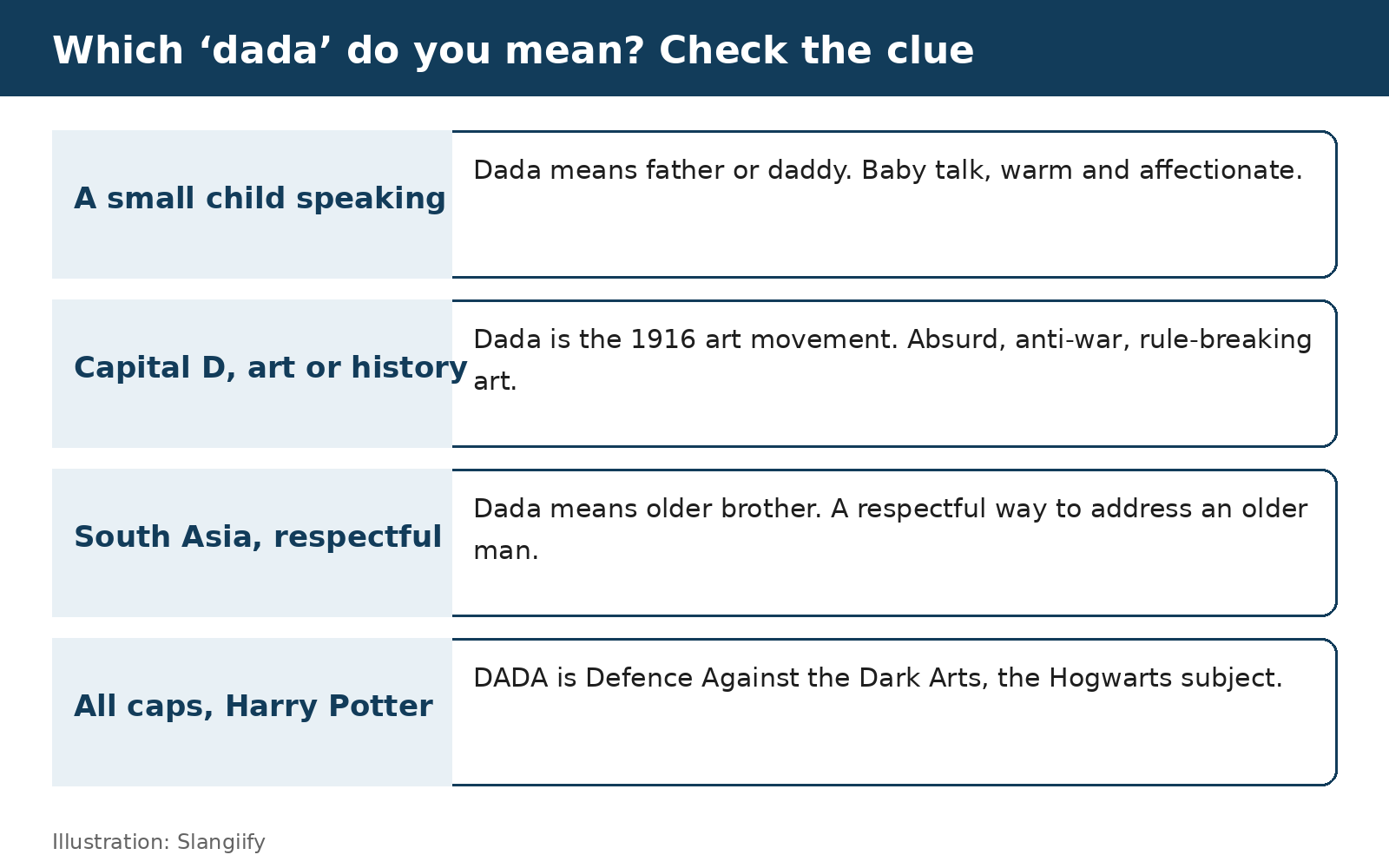
| Who says it | Where | To whom | Meaning |
|---|---|---|---|
| Toddlers, parents quoting them | Home, family chat, parenting posts | Father, family | Father, daddy |
| Artists, students, critics | Galleries, classrooms, art writing | Other art lovers, readers | The art movement |
| South Asian speakers | Home, market, community, diaspora | Older brother, older man | Older brother, respectful address |
| Harry Potter fans | Fan forums, quizzes, social media | Other fans | Defence Against the Dark Arts |
| Reviewers, jokers, commentators | Reviews, online commentary, jokes | Readers who know the art reference | Nonsense, absurd, ironic |
Platform matters. On a parenting forum, dada is a first word. On an art blog, it is a movement. On a South Asian community page, it is a brother. On a Harry Potter subreddit, it is a class. The same four letters change meaning with the room, which is why searching for dada without context so often fails. The room is the definition.
How to Tell Which Meaning Someone Means
Tell which meaning of dada is meant by checking four clues in order: the speaker, the capitalization, the nearby words, and the platform, and in most cases the first two clues alone settle it. Work through them like a short checklist, and you will rarely need to ask.
Clue 1: Who is speaking?
A child, a parent quoting a child, or a family photo points to father. An art student, a curator, or a design writer points to the movement. A South Asian speaker addressing an older man points to older brother. A fan in a Harry Potter thread points to the class. Speaker identity is the strongest clue because each meaning belongs to a different community.
Clue 2: How is it spelled?
Lower case dada in a family message usually means father. Capital D Dada in a cultural piece usually means the movement. All caps DADA in fan chat usually means the Hogwarts subject. Spelling is a helpful hint, not a law, because many people type in lower case everywhere online. Use it to confirm a guess, not to make one on its own.
Clue 3: What words are nearby?
Nearby words are the tie breaker. Play, home, first word, and baby point to father. Collage, absurd, Zurich, 1916, and Duchamp point to art. Brother, shop, respect, and a South Asian name point to older brother. Hogwarts, professor, spell, and class point to Harry Potter. Nonsense, illogical, and chaotic, used as a judgment, point to the ironic slang sense. Read the sentence around the word, not just the word.
Clue 4: Where did you read it?
Parenting sites, family chats, and baby milestone posts use the father sense. Museums, art history pages, and design blogs use the art sense. South Asian news, fiction, and community pages use the older brother sense. Fan wikis and quizzes use the abbreviation. If you are still unsure after all four clues, ask a short, polite question. “Do you mean the art movement, or dad?” takes five seconds and saves a misunderstanding.
What to Say When Someone Says Dada
Reply to dada by matching the world the speaker is in: celebrate a first word, talk art with an art lover, return respect to an older brother, and talk Hogwarts with a fan, and when the ironic sense appears, laugh or argue with the judgment, not with the word. The replies below cover the common cases.
| What you hear | Likely meaning | A good reply |
|---|---|---|
| “She said dada today!” | First word for father | “That is wonderful! How did he react?” |
| “That show was very Dada.” | Art movement style | “I saw the collage influence. Did you like it?” |
| “Dada, how much is this?” | Respectful address to an older man | Answer the question politely, using his name if you know it. |
| “Who taught DADA in year three?” | Harry Potter class | “Lupin. Best teacher in the series, in my view.” |
| “That plan is pure dada.” | Nonsense, ironic | “Do you mean it makes no sense, or that it is fun because it makes no sense?” |
When the ironic sense appears, it helps to ask what the speaker values. “Pure dada” can be praise for bold absurdity or a complaint about confusion, and the difference is in the speaker face, the emoji, or the next sentence. A short clarifying question is not rude. It shows you heard the reference and want to get the judgment right. That is exactly the kind of reply that keeps a conversation friendly.
Myths vs Facts About Dada
Dada collects myths because its meanings come from such different worlds, and the myths usually come from treating one meaning as the only meaning. The corrections below keep the four senses separate and stop the most common errors.
Myth: Dada is a new Gen Z slang word
Fact: Dada is an old word with several long established meanings, from baby talk traced to the seventeenth century to an art movement from 1916. The ironic nonsense sense borrows from that history, but it is occasional and referential, not a common everyday slang word among teenagers. Pages that present it as a new trend are overstating the evidence.
Myth: Dada always means father
Fact: Father is the most common everyday meaning, but it is not the only one. In art writing, in South Asian English, and in Harry Potter fandom, other meanings take over completely. Assuming father in those settings will misread the sentence. Context decides, as the clues above show.
Myth: The Dada art movement was just random nonsense with no point
Fact: Dada artists used nonsense deliberately, as a protest against a world that had produced a devastating war while claiming to be logical and civilized. The work was playful, but the argument was serious: if the old rules led to that outcome, the old rules needed breaking. Calling the movement random misses its purpose.
Myth: DADA and dada are the same in Harry Potter chat
Fact: In fan writing, the capitals matter. DADA is the abbreviation for a class name, spoken letter by letter. Lower case dada in the same forum would more likely be read as father or as the art reference. Fans use the capitals to keep the class distinct, and readers should follow that signal.
Myth: You can call any older man dada anywhere
Fact: The older brother sense belongs to South Asian English and to relationships where respect and familiarity are established. Using it as a stranger, or outside that community, can sound presumptuous or confusing. Listen first, and use a name or a polite form of address until you know the local custom.
When NOT to Use Dada
Do not use dada for a father in a formal or professional setting, do not use the art sense as a synonym for silly without the art reference, do not use the South Asian sense outside its community without an invitation, and do not use the ironic nonsense sense with readers who may not know the art movement. Each boundary protects a different relationship, and crossing it usually causes confusion rather than offense, which is still a cost.
In formal writing, use father, dad, or the person name. A business email, a school report, or a condolence message is not the place for baby talk, even affectionate baby talk. Keep dada for family chat, parenting posts, and stories about first words, where its warmth is welcome and its meaning is clear.
In art and culture writing, do not flatten Dada into a synonym for weird. If you call a show Dada, be ready to say what you mean: collage, chance, anti art, absurdity with a purpose. A vague “so dada” in a review tells the reader nothing. A specific reference to the movement, with one example, tells them a great deal. The same care applies to the ironic sense online. If your readers may not know the movement, add a short gloss the first time you use the word that way.
Finally, do not use dada to tease a child, a parent, or an older man. A toddler first word is a family milestone, not a joke. An older brother address is a sign of respect, not a nickname to try on a stranger. Slang works when it is shared. It fails when it is taken without the relationship behind it. Listen for how the people around you use the word, and follow their lead.
Quick Answers About Dada Slang
What does dada mean in slang?
In slang, dada is sometimes used ironically to mean nonsense or deliberate absurdity, borrowing the spirit of the Dada art movement, but this use is rare and referential, not a common everyday word. Most of the time, dada means father in baby talk, the Dada art movement, or older brother in South Asian English, depending on context.
What does dada mean in texting?
In texting, dada most often means father or daddy when a parent or family member writes it, and DADA in all caps most often means Defence Against the Dark Arts in Harry Potter fan chat. Check the capitalization and the nearby words. A family chat points to father. A Hogwarts mention points to the class.
Is dada offensive?
No, dada is not offensive in any of its main senses. It is affectionate as baby talk, historical as an art term, and respectful as an older brother address. It can sound odd if used in the wrong setting, such as calling a stranger dada, but odd is not offensive. The word itself carries no insult in normal use.
What is the Dada art movement in simple terms?
The Dada art movement was a group of artists and poets in Zurich in 1916 who rejected logic and traditional beauty after the First World War, using absurdity, chance, collage, and ordinary objects as art to protest the old order. Vocabulary.com describes it as based on irrationality and the negation of the accepted laws of beauty, and bab.la names Tristan Tzara, Jean Arp, Andre Breton, Max Ernst, Man Ray, and Marcel Duchamp among its leading figures.
What does dada mean in Hindi or Indian English?
In Indian English, from Hindi dādā, dada means an older brother or male cousin, and it is also a respectful form of address for an older man. Bab.la lists this as a separate Indian English sense, with examples from family and community life. It is everyday respectful speech, not baby talk, and it is used by younger speakers to older men.
What does DADA mean in Harry Potter?
DADA means Defence Against the Dark Arts, the Hogwarts subject where students learn to defend against dark creatures and dark magic. In fan chat it is written in all caps as an initialism, spoken letter by letter, and it appears in quizzes, discussions of teachers, and fan fiction about classes at Hogwarts.
Can dada mean nonsense?
Yes, dada can mean nonsense when used ironically, as a reference to the Dada art movement love of absurdity, but this use is uncommon and depends on the reader knowing the art reference. If you use it that way, expect to explain it, and do not assume every reader will catch the joke. For a plain description, nonsense or absurd is clearer.
Sources and Further Reading
Vocabulary.com defines dada as another way to say daddy or papa and as the name of the early twentieth century art movement, in its entry on dada, its definition, meaning, and synonyms. Bab.la gives the Zurich 1916 art movement, the hobby horse origin, the baby talk origin, and the Indian English older brother sense, in its dictionary entry for dada. The father and daughter photo is by Murat ISIK on Pexels, and the abstract painting photo is by Steve A Johnson on Pexels. For more on how everyday words shift meaning online, see our guides to what cringe means in slang and what chat means in text and online.