


Cuban slang is the informal, fast-moving Spanish spoken in Cuba, full of warm greetings, playful wordplay, and everyday words that often mean something quite different from their textbook Spanish meanings.
If you have heard someone say “Asere, ¿qué bolá?” and felt lost, you are not alone. Even fluent Spanish speakers from other countries can struggle in Havana, because Cuban Spanish drops sounds, shortens words, and leans on expressions that only make sense on the island. This guide explains what Cuban slang means, where it comes from, and how the most common words and phrases are actually used. You will find clear definitions, pronunciation help, real example sentences, and honest advice about which expressions a visitor can use and which ones to leave alone.

What Cuban Slang Means
Cuban slang means the informal vocabulary and expressions used in everyday Cuban Spanish, shaped by Caribbean speech, Canary Island settlers, and West African influences, and it is best understood as a whole way of speaking rather than a single word with one fixed definition. People search for “cuban slang” when they want to understand what they hear in Havana, in Cuban music, in films, or from Cuban friends and family, and the answer is a living set of greetings, nicknames, and idioms that change with tone, place, and who is talking.
That matters because there is no one Cuban slang word. A guide that lists only one term misses the point. Cuban slang covers how people greet each other, how they talk about buses and cars, work and money, food and parties, and how they soften bad news or tease a friend. The same word can sound warm in one sentence and sharp in the next. Tone and context do most of the work, which is why this guide gives you examples and not just translations.
It also helps to know what Cuban slang is not. It is not broken Spanish, and it is not a secret code. It is standard Spanish spoken with Cuban sounds, Cuban history, and Cuban humor layered on top. A learner who knows basic Spanish will recognize much of the grammar. What feels new is the vocabulary, the speed, and the habit of cutting the ends off words. Once you learn a core set of expressions, street conversations start to open up fast.
Cuban slang in one line
Think of it this way. If textbook Spanish is the map, Cuban slang is how people actually give directions on the street in Havana: shorter, warmer, funnier, and full of local shortcuts. You do not need to master all of it. You need enough to follow a greeting, catch a joke, and avoid the few words that can land badly.
How this guide is organized
We start with sound and history, then move through greetings, travel words, daily life words, and expressions that resist literal translation. After that comes comparison, a usage map, reply guidance, and myth corrections. Each word entry gives the meaning, a sense of tone, and an example sentence in Spanish with an English translation, so you can hear how it sits in a real sentence.
Why Cuban Spanish Sounds Different
Cuban Spanish sounds different because of its history and its accent: final consonants are often softened or dropped, everyday speech runs fast and informal, and centuries of migration from the Canary Islands and West Africa left words and rhythms that other Spanish varieties do not share. StoryLearning traces part of this distinctiveness to large numbers of immigrants from the Canary Islands who arrived in the 1800s and 1900s, bringing words of French and West African origin that are not found in other dialects of Spanish.
The accent is the first thing most listeners notice. Cuban speakers often weaken or drop the final consonant of a word, especially the letter s, so esos can sound closer to esoh. That single habit changes how whole sentences sound, and it explains spellings you will see online, such as qué volá for qué bolá. It is not sloppy speech. It is a consistent Caribbean pattern, shared in part with other island varieties, and Cubans understand each other perfectly well through it.
Two smaller habits help learners too. StoryLearning notes that the diminutive ending ito and ita is more likely to appear as ico and ica in Cuban Spanish, and that tú is used more often than usted, even with strangers, because Cuban Spanish is more informal than many other varieties. Neither point is a rule you must copy. Both help you recognize what you hear instead of hunting for a textbook form that never arrives.
The African influence deserves a clear mention because it explains some of the most famous Cuban words. StoryLearning explains that acere, the beloved word for a friend, originally comes from the Efik language of Nigeria and is not found in other Spanish dialects. That history sits behind the warmth of the word. When a Cuban calls someone acere, the word carries friendship, familiarity, and a long cultural journey in two syllables.
Music and daily life keep the vocabulary moving. Salsa, timba, reggaeton, and street talk recycle the same expressions, so a phrase you hear in a song on Monday may be the greeting you hear at a market stall on Tuesday. Slang in Cuba is not frozen in a dictionary. It lives in jokes, songs, and neighborhood talk, which is why a good guide teaches patterns and tone, not just a list to memorize.
The Core Cuban Greetings
The core Cuban greetings are ¿qué bolá?, asere or acere, socio, chévere, and dale, and together they cover most casual hellos, friendly addresses, and upbeat replies you will hear in Havana. Learn these five first. They do more work than any other group of words in this guide, and they appear in almost every list of Cuban slang for a simple reason: Cubans actually say them, all day, to people they like.
¿Qué bolá?
¿Qué bolá? means “What is up?” or “How is it going?” and it is the most Cuban greeting there is. BaseLang presents it as the way to ask what is going on with a friend, with the classic example “Acere, ¿qué bolá?” meaning “What is up, buddy?” You will also see it spelled ¿qué volá?, ¿qué bolero?, and ¿qué vuelta?, which reflect Cuban pronunciation more than different meanings. Use it with friends and people your own age. In a formal setting, stick with ¿cómo estás?
Example: “¿Qué bolá, asere? Hace tiempo que no te veo.” That means: “What is up, buddy? I have not seen you in a while.” The greeting works on its own, and it works as an opener before any real question. Answer it the way you would answer “What is up?” back home, with a short, honest reply, not a full life story.
Asere / Acere
Asere, also spelled acere, means friend, buddy, mate, or dude, and it is the warm, informal way Cubans address a friend, especially among men. BaseLang calls it a replacement for “friend” or “buddy,” and StoryLearning adds that you would not use it in formal settings, but you will hear it constantly among friends. It can also work as a filler word, a way of getting attention, or a softener at the start of a sentence, much like “hey, man” in English.
Example: “Bueno, acere, vámonos.” That means: “Well, buddy, let us go.” Visitors should wait for rapport before using it themselves. Hearing it is a good sign. It usually means you are being treated as a friend, not as a stranger. Women use it too, but the classic street greeting pairs it with male friends, and some Cuban women prefer socio or a name instead. Follow the lead of the people around you.
Socio
Socio literally means partner or associate, but in Cuban slang it works like “buddy” or “pal” as a friendly form of address. It is a safe, warm alternative to asere for visitors, and it carries less street edge. “Oye, socio, ¿qué bolá?” means “Hey, buddy, what is up?” If you want one friendly address word that rarely goes wrong, socio is a strong choice. It sounds respectful without sounding stiff.
Chévere
Chévere means cool, great, or awesome, and it is the easy positive word for almost any good news. StoryLearning gives the example “¡Qué chévere!” for “How cool!” It is shared with other Caribbean varieties, so it will not mark you out as trying too hard. Use it for food, music, plans, or a good story. It is enthusiastic without being loud, and it fits in conversations with strangers far better than the rougher slang in this guide.
Dale
Dale means “let us go,” “come on,” or “hurry up,” depending on context, and it is the Cuban nudge that gets things moving. StoryLearning gives the example “¡Dale, vamos a llegar tarde!” meaning “Come on, we are going to be late!” It can also mean “go ahead” or “do it” when someone is hesitating. Short, friendly, and useful, dale is one of the few Cuban expressions a visitor can use on day one without sounding forced.
Everyday Cuban Words for Getting Around
Everyday Cuban travel words replace the textbook terms for bus, car, ride, taxi, and police with guagua, máquina and almendrón, botella, botero, and caballito, and learning them makes directions, rides, and street talk far easier to follow. These are practical words, not party tricks. You will hear them at bus stops, on street corners, and in any conversation about getting from one place to another.
Guagua
Guagua means bus in Cuba, and it is the only everyday word for a bus on the island. StoryLearning traces the word to the Canary Islands, where it is also used instead of autobús. Example: “¿Vamos a ir en guagua?” means “Are we going by bus?” BaseLang gives a similar example about catching the guagua to the beach. If you ask for an autobús, people will understand you, but guagua is what you will hear in reply.
Máquina and Almendrón
Máquina means car in Cuban slang, from the Spanish word for machine, while almendrón is the nickname for the big old American cars from the 1950s that still run as shared taxis in Havana. StoryLearning notes that Cuba is known for its antique machines, and BaseLang gives the example of a taxi driver with a very nice almendrón. If someone says “cogimos una máquina,” they took a car. If they point at a gleaming old Chevrolet and call it an almendrón, they are admiring a classic, not insulting a wreck.

Botella
Botella literally means bottle, but in Cuban slang it means a ride, or hitchhiking, or catching a lift. BaseLang gives the request “Dame la botella hasta mi casa, por favor,” meaning “Please give me a ride to my house,” and StoryLearning gives the cheerful “¡Vamos a coger botella!” for “Let us catch a ride!” The meaning is clear from context. Nobody at a bus stop is offering you a drink when they talk about botella. They are talking about getting home.
Botero
Botero means a taxi driver, the person who gives the ride. BaseLang gives the example “Llama al botero, para que nos lleve al hotel,” meaning “Call the taxi driver so he takes us back to the hotel.” Pair it with máquina and almendrón and you have the whole Havana taxi conversation in three words: the driver, the car, and the ride itself.
Caballito
Caballito, literally “little horse,” is Cuban slang for a police officer on a motorcycle. BaseLang explains that most places use slang for the police, and in Cuba the motorcycle officers get this nickname. StoryLearning agrees, calling it a colloquial term for a police officer who rides a motorcycle. Example: “¡Hay muchos caballitos aquí!” means “There are a lot of motorcycle cops here!” It is descriptive street talk, not a word to use when you actually need help from an officer. In that case, use polite, standard Spanish.
Gao / Gabeto
Gao, also heard as gabeto, means home. BaseLang gives the sentence “Voy camino al gao,” meaning “I am on my way home,” and StoryLearning gives “Estoy en el gao” for “I am at home.” It is relaxed, everyday speech, the word you use with family and friends. “Nos pillamos en el gao” means “See you later at home,” which brings together two slang words in one short, natural goodbye.
La pincha and Pinchar
La pincha means work, or the place where you work, and pinchar means to work. StoryLearning explains that pinchar usually means to puncture in other varieties of Spanish, but in Cuba it means to work, so “Tengo que pinchar hoy” means “I have to work today.” BaseLang gives the matching goodbye “Me piro, tengo que ir a la pincha,” meaning “I am out of here, I have to go to work.” If a friend says they are going to la pincha, they are not going to a puncture. They are going to their job.
Cuban Words for People, Food, and Daily Life
Cuban daily life words cover the people you meet, the food you eat, and the small objects around you, and they are where visitors most often get tripped up, because many of them look like ordinary Spanish words with a different Cuban meaning. The entries below stay close to what the sources actually document, with the tone and the trap in each word spelled out.
Yuma
Yuma means a foreigner, especially someone from the United States, and it is the Cuban counterpart to gringo in much of Latin America. StoryLearning is clear that Cubans do not mean it offensively, so visitors should not take it personally if they hear it, and BaseLang gives the same advice in the same warm tone. Example: “Esos turistas son yumas” means “Those tourists are foreigners.” It is a label, not an insult, but it does mark you as an outsider. The polite reply is a smile and a greeting, not a correction.
Jamar
Jamar means to eat, with the sense of eating heartily or stuffing yourself. StoryLearning contrasts it with comer and gives the example “¡No podía dejar de jamar en la fiesta!” meaning “I could not stop stuffing myself at the party!” It is a happy, greedy word, best used about good food and good company. Paired with cable, it turns serious, as the expressions section explains.
Frutabomba
Frutabomba is the Cuban word for papaya, the tropical fruit. Both BaseLang and StoryLearning warn about the trap here: in Cuban Spanish, the word papaya refers to a part of the female anatomy, so you should ask for jugo de frutabomba, papaya juice, and not use papaya for the fruit. Example: “Para el desayuno, quiero jugo de frutabomba” means “For breakfast, I want papaya juice.” This is one of the most useful warnings in Cuban slang, and it saves real embarrassment at a breakfast table.
Monstruo
Monstruo means monster in standard Spanish, but in Cuba it is high praise for someone who is outstandingly good at something. BaseLang gives the example “Esa mujer es un monstruo bailando,” meaning “That woman is a dancing monster,” in the sense of a brilliant dancer. StoryLearning gives the parallel example of a monster in the kitchen. Tone is everything. Said with admiration, it is a compliment. Said flatly about a stranger, it could confuse. Keep it for praise you mean.
Guajiro / Guajira
Guajiro, feminine guajira, means a peasant or country person, usually someone who lives and works the land, especially in western Cuba. It appears in travel writing about the Viñales valley, where guides talk about los guajiros. It can be affectionate, descriptive, or gently teasing, depending on who says it and how. As a visitor, use it descriptively if you must, and never as a label for a person in front of you.
Jinetero / Jinetera
Jinetero, feminine jinetera, is a loaded word that needs care. StoryLearning describes locals using it for hustlers who sell rum or cigars to tourists, especially in Old Havana, while other guides note a wider range, from street sellers and unofficial guides to people who make money from tourists in less honest ways, and for women it can carry a much harsher meaning tied to sex work. The safe rule is simple: understand the word when you hear it, do not call anyone by it, and be cautious with anyone described this way in a warning. It is a word about the tourist economy, not a joke.
Chivo, Pulóver, Blumer, Fosforera, and Paladar
These five small words show how Cuban slang renames ordinary things. El chivo, literally the goat, means a bicycle in Cuba, so “Quiero alquilar un chivo” means “I want to rent a bike.” Pulóver, borrowed from the English pullover, means a T-shirt, and blumer, also spelled blume, means underwear. Fosforera means a lighter, where other countries say encendedor, so “¿Tienes una fosforera?” means “Do you have a lighter?” Paladar means a restaurant, often a small private one, so “Vamos a comer algo en el paladar de la esquina” means “Let us eat something at the restaurant on the corner.” None of these words is rude. All of them mark you as someone who has listened to real Cuban speech.
Cuban Expressions That Do Not Translate Word for Word
Cuban expressions that resist literal translation are where the humor and the heart of the dialect live, and they are also where learners make the most mistakes, because translating each word gives nonsense while the whole phrase is perfectly clear to a Cuban listener. Learn them as whole phrases, with their feeling attached, and you will avoid the classic error of translating word by word.
Le ronca el mango
Le ronca el mango literally means “the mango snores,” but it means something is extreme, too much, or very hard. StoryLearning gives the example “Le ronca el mango estar lejos de casa,” meaning “It is so hard to be far from home.” It is colorful, sympathetic, and a little dramatic, which is exactly the point. Use it for effort, heat, distance, or a tough situation, not for small complaints.
Me resbala
Me resbala literally means “it slips off me,” and it means “I do not care.” BaseLang gives the example “Me resbala lo que piensen ellos de mí,” meaning “I do not care what they think about me.” It sounds cooler and more final than a plain “no me importa.” Use it about opinions and gossip, not about people you love. Said to a friend, it can sound dismissive, so keep it for the situation, not the person.
Tu maletín
Tu maletín literally means “your briefcase,” but it means “your problem” or “that is your business.” BaseLang gives the example “Lo siento, pero ese es tu maletín,” meaning “I am sorry, but that is your problem.” StoryLearning gives the blunter “¡No me mires, tu maletín!” for “Do not look at me, it is your problem!” It is a boundary phrase, funny between friends, cold between strangers. Do not use it to shut down someone who genuinely needs help.
Buscar balas and Jamar un cable
Buscar balas literally means “to find bullets,” but it means to find work or make money. StoryLearning gives the example “Necesito buscar balas pronto,” meaning “I need to make some money fast.” Jamar un cable, literally “eating cables,” means being broke, out of money, or out of work. BaseLang gives the example “Estoy jamando un cable. No puedo salir esta noche,” meaning “I am out of money. I can not go out tonight.” Both phrases come from hard times, and both are said with humor. Treat them with respect. They describe real pressure, not a punchline.
En candela
En candela literally means “on fire” or “being burned,” and it means being in a hard time or a bad situation. BaseLang gives the check-in “¿Está todo bien contigo? Pareces en candela,” meaning “Is everything okay with you? You look like you are in a bad way.” It is a caring phrase when used as a question, and a vivid description when used about a situation. Do not use it lightly about a person who is actually struggling.
Desmaya esa talla
Desmaya esa talla is a phrase for letting go of something, forgetting a bad experience, a broken heart, or an embarrassing moment. BaseLang explains it as a way of saying forget about it, with the example about a woman and a man who was not good for her. It is kind advice, not a command. Said gently, it means “let it go.” Said sharply, it can sound like “get over it,” so watch your tone.
Me piro, Nos pillamos, En talla, and Tremendo paquete
Me piro means “I am off” or “I am out of here,” the casual goodbye for leaving a place. Nos pillamos means “see you later” or “we will catch each other later.” En talla means something fits, or people go well together. Tremendo paquete means a dramatic story or situation, roughly “that sounds heavy” or “that is so dramatic.” StoryLearning gives all four in context, and together they cover leaving, parting, matching, and reacting to news. A short exchange can use three of them at once: “Me piro, nos pillamos en el gao” is a complete, natural Cuban goodbye.
Words to handle with extra care
Two famous Cuban words need a warning rather than an invitation. Comemierda literally means something crude, but in Cuba it is used to tell someone to stop being foolish or to stop letting others fool them. BaseLang calls it the most popular and common word of its kind, and gives the example about demanding your rights. It is still rough language, and visitors should understand it without repeating it. The same caution applies to pinga, a versatile and vulgar word that StoryLearning flags as crude in some contexts even though Cubans use it constantly as an exclamation. Hearing these words is normal. Repeating them as a visitor is a fast way to sound rude. Listen, learn the meaning, and leave them out of your own speech until, and unless, Cuban friends invite you to use them.
Cuban Slang vs Other Spanish Slang
Cuban slang differs from other Spanish slang mainly in its greeting words, its Canary Island and West African roots, and its fast, softened pronunciation, so a word that is friendly in Havana can be unknown or odd in Mexico City or Madrid. The table below compares Cuban expressions with the nearest standard or regional equivalents, so you can see what to use where, and what not to carry from one country to another.
| Cuban expression | What it means in Cuba | Closest equivalent elsewhere | Watch out |
|---|---|---|---|
| Asere / Acere | Friend, buddy, dude | Amigo in standard Spanish; güey in Mexico | Cuba only in this form; StoryLearning says it is not found in other dialects |
| ¿Qué bolá? | What is up? How is it going? | ¿Cómo estás? or ¿Qué pasa? | Informal only; use ¿cómo estás? in formal settings |
| Guagua | Bus | Autobús in most of Latin America and Spain | Also used in the Canary Islands; elsewhere it can confuse |
| Yuma | Foreigner, especially from the US | Gringo in much of Latin America; extranjero in standard Spanish | Descriptive in Cuba, not an insult; do not use it as a label for a person to their face |
| Chévere | Cool, great, awesome | Guay in Spain; padre in Mexico; bacán in parts of South America | Shared across the Caribbean, so it travels better than most Cuban words |
The lesson of the table is simple. Cuban slang is local. A few words travel, like chévere and guagua, because they are shared with the Canary Islands or the wider Caribbean. The heart of the dialect, asere and qué bolá, stays Cuban. That is part of the charm. Learning them is a way of showing respect for a specific place and its people, not a shortcut to sounding fluent in all Spanish.
For readers coming from our other Spanish guides, the pattern will feel familiar. Our guide to how to say cool in Spanish, region by region shows how one idea splits into many local words, and Cuban chévere is one of the warmest of them. Our Dominican slang guide and our Puerto Rican slang guide cover neighboring Caribbean varieties that share some history with Cuba but keep their own greetings and jokes. Reading them side by side is the fastest way to hear how Caribbean Spanish varies from island to island. If you want the English side of the same idea, our guide to what cool means in text and online shows how praise words shift with context in English too.
Who Says Cuban Slang, Where, and to Whom
Cuban slang is said by Cubans of all ages in informal, everyday settings, most often among friends and family, on the street, at home, in music, and in neighborhood talk, and least often in formal, official, or professional settings where standard Spanish takes over. The usage map below breaks that down, because “who says it” matters as much as “what it means” for a visitor trying to fit in without overstepping.
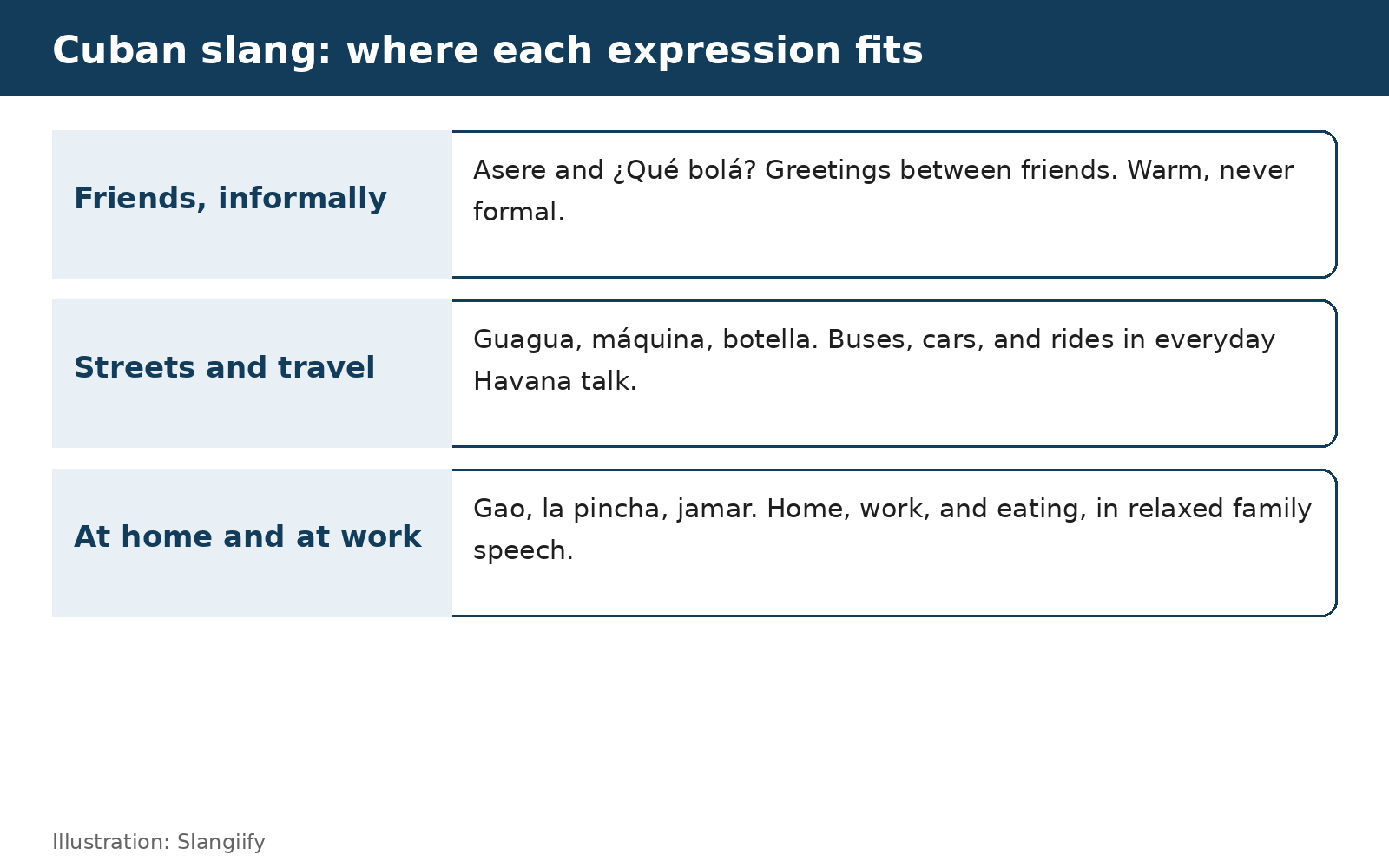
| Setting | Who you will hear | Typical words | Tone |
|---|---|---|---|
| Friends greeting each other | Young and older friends, mostly men for asere | Asere, ¿qué bolá?, socio, chévere, dale | Warm, fast, teasing |
| Street and travel | Passengers, drivers, vendors, neighbors | Guagua, máquina, botella, botero, caballito | Practical, direct, good humored |
| Home and family | Family, close friends, neighbors | Gao, la pincha, jamar, frutabomba | Relaxed, affectionate, private |
| Music and nightlife | Singers, dancers, party crowds | Guarachar, está volao, bembe, monstruo | Joyful, loud, celebratory |
| Formal and official | Officials, teachers, professionals at work | Standard Spanish, few slang words | Polite, clear, careful |
Age matters less than closeness. Older Cubans use the same greetings as younger Cubans, often with more of the old expressions mixed in. Young Cubans add music and internet words, but they still greet with qué bolá. What changes most is not age but relationship. The closer the bond, the warmer and rougher the slang gets. Strangers get a polite hola and a smile. Friends get asere and a joke.
Place matters too. Havana street talk is the most famous version, but Cuban slang is heard across the island, in Miami and other Cuban communities abroad, and in Cuban music heard worldwide. Cuban Americans in Florida keep many of the same words alive, which is why StoryLearning notes more than 1.5 million Cuban Americans living in the United States, primarily in Florida. A phrase learned in Havana will usually be understood in Miami, and the reverse is often true as well.
How to Use Cuban Slang Without Sounding Forced
Use Cuban slang sparingly, start with greetings, copy the tone of the people around you, and let Cuban friends lead before you try the rougher words yourself. The goal is understanding first and speaking second. A visitor who understands ten expressions and uses three of them well sounds far more natural than a visitor who drops thirty slang words into every sentence.
Start with five safe words
Begin with ¿qué bolá?, socio, chévere, dale, and guagua. These five are useful, friendly, and hard to get wrong. Practice them in short exchanges. Greet a shopkeeper with a smile and “¡Hola! ¿Qué bolá?” only if they greet you that way first. Answer good news with “¡Qué chévere!” Say “Dale” when a friend suggests a plan you like. Ask “¿Vamos en guagua?” when you need a bus. Small, correct uses build trust faster than a long rehearsed speech.
Listen before you copy
Listen for a full day before you copy a new word. Notice who says it, to whom, and what happens next. If everyone laughs, the word was probably a joke. If everyone nods, it was probably agreement. If one person looks uncomfortable, the word may have crossed a line. Cuban slang is social. It works because the speaker and the listener share history. A visitor borrows that history for a moment, and borrowing works best when it is gentle.
Keep your pronunciation soft
Do not force a heavy accent. Say the words clearly, at normal speed, and let the Cuban sounds come naturally. Trying to drop every final s on day one usually sounds like an imitation. Cubans are used to foreign accents and will understand clear Spanish with a few Cuban words mixed in. Clarity beats performance every time.
A short example conversation
Here is how a natural exchange might sound between two friends meeting on a Havana street. “Asere, ¿qué bolá?” “¡Qué bolá, socio! ¿Vamos a guarachar esta noche?” “Dale, pero primero tengo que ir al gao.” “Nos pillamos luego.” In English: “Buddy, what is up?” “What is up, pal! Are we going to party tonight?” “Let us go, but first I have to go home.” “See you later.” Notice how little slang is actually needed. The greeting, the invitation, and the goodbye do all the work.
What to Say Back
Replying to Cuban slang is mostly about matching warmth and brevity: answer a greeting with a greeting, answer praise with thanks or agreement, and answer a joke with a laugh rather than a long explanation. The table below gives you ready replies for the situations you will meet most often.
| What you hear | What it means | A good reply |
|---|---|---|
| ¿Qué bolá, asere? | What is up, buddy? | ¡Qué bolá! Todo bien, ¿y tú? (What is up! All good, and you?) |
| ¡Qué chévere! | How cool! How great! | ¡Sí, está chévere! (Yes, it is great!) |
| ¿Vamos a guarachar? | Shall we go party? | ¡Dale, vamos! (Let us go!) |
| Me piro, tengo que ir a la pincha. | I am off, I have to go to work. | Nos pillamos luego. (See you later.) |
| Estoy jamando un cable. | I am broke right now. | Tranquilo, otro día salimos. (No worries, we will go out another day.) |
If you do not understand something, say so plainly and warmly. “Perdona, no entendí. ¿Me lo repites más despacio?” means “Sorry, I did not understand. Can you repeat it more slowly for me?” Cubans are generally patient with learners who ask honestly. What feels awkward is pretending to understand and answering the wrong question. A short, honest request for a repeat is always better than a confident wrong answer.
Myths vs Facts About Cuban Slang
Cuban slang attracts myths because it sounds so different from textbook Spanish, and most of those myths fall apart once you hear how Cubans actually talk. The corrections below clear up the misunderstandings that cause the most confusion for learners and visitors.
Myth: Cuban slang is just bad Spanish
Fact: Cuban Spanish is a full, consistent variety of Spanish with its own sounds, vocabulary, and history, including Canary Island and West African influences documented by language guides. Dropping a final s or saying guagua instead of autobús is not an error. It is how the variety works, and it follows patterns that Cubans share and understand.
Myth: Asere is rude
Fact: Asere is warm and friendly among friends, and it is one of the most common greetings in Cuba. It becomes rude only when used in the wrong setting, such as with a stranger in a formal situation, or with a tone meant to challenge someone. The word itself is affectionate. The setting decides how it lands.
Myth: Yuma is an insult
Fact: Yuma is a descriptive word for a foreigner, and Cuban guides are clear that it is not meant offensively. It can feel blunt to a visitor who is not used to being labeled, but the intent is usually neutral or even friendly. A smile and a greeting are the right response, not a protest.
Myth: You need slang to be understood in Cuba
Fact: Clear, polite, standard Spanish works everywhere in Cuba, in hotels, restaurants, taxis, and shops. Slang helps you understand what others say and enjoy jokes and music more fully. It is not a requirement for getting around, ordering food, or asking for directions.
Myth: All Cuban slang is vulgar
Fact: Most Cuban slang is warm, funny, and everyday, from greetings to food words to travel words. A small set of words is vulgar or rough, and this guide flags those clearly. Treating the whole dialect as vulgar is unfair to the people who speak it, and it stops learners from hearing how affectionate most of it is.
When NOT to Use Cuban Slang
Do not use Cuban slang in formal meetings, with officials, in written business messages, when asking for help in a serious situation, or as a joke at a Cuban person expense, and do not use the vulgar words at all until Cuban friends clearly invite you to. These boundaries protect both you and the people you are talking to, and they show respect for a dialect that is not a costume.
Formal settings call for standard Spanish. A job interview, a government office, a hotel complaint, or a first meeting with an older stranger all work better with hola, por favor, and gracias than with asere and qué bolá. The same rule applies to writing. A text to a friend can be full of slang. An email to a business should not be.
Serious situations call for clarity. If you need medical help, directions in an emergency, or help from the police, use the clearest Spanish you have. Caballito is street talk for a motorcycle officer, not the word to use when you need an officer to help you. Save the slang for the celebration afterwards.
Finally, never use Cuban slang to mock or imitate a Cuban person. Repeating an accent for laughs, copying a greeting to tease someone, or using a rough word to sound tough will land badly, and rightly so. Slang is a gift when it is shared. It becomes a problem when it is taken without respect. Listen, learn, use a little, and let Cuban friends set the pace.
Quick Answers About Cuban Slang
What does asere mean in Cuban slang?
Asere, also spelled acere, means friend, buddy, mate, or dude, and it is the warm informal way Cubans address a friend. StoryLearning traces the word to the Efik language of Nigeria and notes that it is not found in other Spanish dialects. Use it with friends, not in formal settings, and wait for rapport before you try it yourself.
How do Cubans say “what is up”?
Cubans say “¿Qué bolá?” to mean “What is up?” or “How is it going?” It is the most Cuban greeting there is, and it is often paired with asere, as in “Asere, ¿qué bolá?” You may also hear it spelled ¿qué volá?, which reflects Cuban pronunciation. In formal settings, use ¿cómo estás? instead.
How do Cubans say “cool”?
Cubans say “chévere” to mean cool, great, or awesome, as in “¡Qué chévere!” for “How cool!” It is shared with other Caribbean varieties, so it travels well and works in most casual settings. It is enthusiastic without being rough, and it is one of the safest Cuban slang words for a visitor to use.
What does yuma mean in Cuba?
Yuma means a foreigner, especially someone from the United States, and it is the Cuban counterpart to gringo. Cuban guides are clear that it is not meant as an insult, so visitors should not take offense if they hear it. It simply marks someone as not from Cuba, and the polite reply is a smile and a greeting.
What does guagua mean in Cuban slang?
Guagua means bus in Cuba, and it is the everyday word for a bus on the island. StoryLearning traces it to the Canary Islands, where it is also used instead of autobús. If you ask for an autobús, people will understand you, but guagua is what you will hear in reply at bus stops and on the street.
Is Cuban slang hard for other Spanish speakers to understand?
Yes, Cuban slang can be hard even for fluent speakers of other Spanish varieties, because of the fast pace, the softened final consonants, and the local vocabulary shaped by Canary Island and West African history. That difficulty is normal and well documented. Learning the greetings and everyday words in this guide closes most of the gap, and asking for a slower repeat closes the rest.
What Cuban slang should a visitor learn first?
A visitor should learn ¿qué bolá?, socio, chévere, dale, and guagua first, because they cover greetings, friendly address, praise, agreement, and travel in five short words. Add asere, yuma, and frutabomba next, for understanding what others say. Leave the vulgar words alone. Understanding them is useful, repeating them is not.
Sources and Further Reading
BaseLang lists 30 Cuban expressions with examples, from acere and qué bolá to la pincha and comemierda, in its guide to Cuban slang from the streets of Havana. StoryLearning explains the Canary Island and West African roots of Cuban Spanish, the accent, and 35 words and phrases, in its guide to Cuban slang words to connect with the locals. The Havana waterfront photo is by alleksana on Pexels, and the classic car photo is by Dimitri Dim on Pexels.