


CTFU means cracking the f*** up, a slang way to say you are laughing very hard at something funny.
You will see it in texts and comments when a joke lands well. It is short and casual, and the swear word inside it makes it a poor fit for work or formal writing.

What CTFU Stands For, Letter by Letter
CTFU stands for cracking the f*** up. C means cracking, T means the, F is the swear word spelled out once below, and U means up. Together they describe laughing so hard it feels like coming apart, which is why it works as a reaction to something very funny.
C, T, F, and U, One Letter at a Time
C gives you cracking, T is the, F is the swear word fuck, and U is up. The full phrase is crack the f*** up. The verb at the center is crack up. Merriam-Webster defines crack up as causing someone to laugh out loud, and also as laughing out loud yourself.
Why People Shorten It to Four Letters
Four letters are faster than a full phrase, and speed matters in a fast chat. CTFU reads as a reaction on its own. You do not need a full sentence around it, though many people add one. It lets the sender laugh, react, and move on.
How Strong Is the Laugh Behind CTFU?
The laugh behind CTFU is strong, playful, and usually larger than real life. It sits above LOL and close to LMAO and ROFL, so it signals a big reaction to a joke or a surprise. Most of the time it marks tone, not a literal fit of laughter.
CTFU Compared With a Real Laugh
Think of CTFU as a laugh turned up for effect. A person might type it after a smile, a chuckle, or a real burst of laughter. The letters do not prove how loud the laugh was. They show how funny the moment felt. If LOL is a nod, CTFU is closer to a loud laugh.
When the Laugh Is More About Tone
Often CTFU sets a playful tone. A sender might add it to soften a tease, to show a joke was friendly, or to say, do not take this too seriously. In that use, the laugh is social. It says, I am joking, and this is light.
CTFU vs LOL, LMAO, ROFL, and the Rest
CTFU means laughing very hard and carries a casual, profane edge, while LOL is softer, LMAO and ROFL are close in strength, and dead and I’m weak describe being overcome by laughter. The right pick depends on the laugh, the setting, and how well the reader knows the slang.
The table below puts CTFU next to five close cousins. Real chats blur these lines, and one person may use three of them in a single conversation.
| Term | Meaning | Tone and intensity | Where used | Example |
|---|---|---|---|---|
| CTFU | Cracking the f*** up, laughing very hard | Strong, playful, profane, niche | Texts, group chats, comments, Discord | I was CTFU at that video. |
| LOL | Laughing out loud | Light, general, safe in casual chats | Almost everywhere, texts and comments | LOL, that is so true. |
| LMAO | Laughing my a** off | Strong, casual, mildly profane | Texts, comments, gaming chats | LMAO, I did not expect that. |
| ROFL | Rolling on the floor laughing | Very strong, playful, a bit old school | Texts, forums, gaming chats | ROFL, I cannot believe that. |
| Dead | So funny it killed me | Strong, dramatic, playful exaggeration | TikTok, Instagram, group chats | I am dead, that was perfect. |
| I’m weak | So funny I feel weak from laughing | Strong, warm, often admiring | Comments, group chats, posts | I’m weak, your caption wins. |
Which One Fits Your Message?
Pick LOL for a safe, light laugh. Pick LMAO or ROFL when the laugh feels bigger and the setting is relaxed. Pick CTFU for a strong laugh with a sharper, insider feel, when swearing fits the chat.
Where CTFU Comes From
CTFU comes from early internet slang built around crack the f*** up, with records online from at least 2005. No single inventor is known, and the exact first use is unclear. The safest account is that it grew in 2000s chat rooms and forums and spread from there.
What the Early Records Show
The Online Slang Dictionary lists CTFU as a verb and an acronym for crack the f*** up, meaning to laugh intensely. That entry was submitted on 29 August 2010 and last edited on 21 April 2013, so the term was already in use before those dates. Such records show when it was written down.
Why the Exact Origin Stays Unclear
An AddictiveTips guide to CTFU reports it was documented online as early as 2005 on Urban Dictionary, with examples on Twitter by 2008. The same guide says there is no officially known origin and points to 2000s chat rooms and forums as the likely home. Slang from chat rooms rarely leaves a clean paper trail.
How CTFU Works in Real Chats
CTFU works as a standalone reaction, as part of a sentence, or as a tag at the end of a message. It usually follows the funny thing, not before it, and it often travels with laughing emojis, a short comment, or a shared joke that both people already understand.
CTFU as a Standalone Reaction
The simplest use is CTFU on its own. Someone sends a meme or a clip, and the reply is just CTFU, often with a laughing emoji. That says, I saw it, it was funny, and I laughed. It needs no extra words because the funny thing sits right above it.
CTFU Inside a Sentence
CTFU also fits inside a sentence, usually as “I was CTFU.” You might see, “I was CTFU when he walked in with that haircut.” In this form, it acts like a verb phrase. It describes the laughing, and the rest of the sentence explains what caused it.

CTFU With Emojis and Memes
Emojis do much of the tone work. The crying laughing face is a common partner, and it helps a reader who does not know the acronym guess that laughter is meant. If you are learning chat slang and how short forms work in messages, CTFU shows speed winning over full clarity.
The Other Meanings People Sometimes Give CTFU
CTFU almost always means cracking the f*** up in chats and comments, but a few rare alternate expansions exist, and one unrelated medical use shares the same letters. Context almost always settles which meaning is meant, so check the setting before you assume the slang sense.
The Rare Alternate Expansions
Two far less common expansions appear in slang lists: cut the f*** up, meaning to let loose at a party, and cheer the f*** up, meaning to lighten your mood. Both are rare. A related variant, CDFU, short for cracking da f*** up, means essentially the same as CTFU.
The Medical Use, in Brief
In a different setting, CTFU can stand for CT scan follow up in medical notes. That use is rare, and it lives in clinical contexts, not in chats or memes. If you see CTFU in a hospital letter, the slang sense is almost certainly not meant.
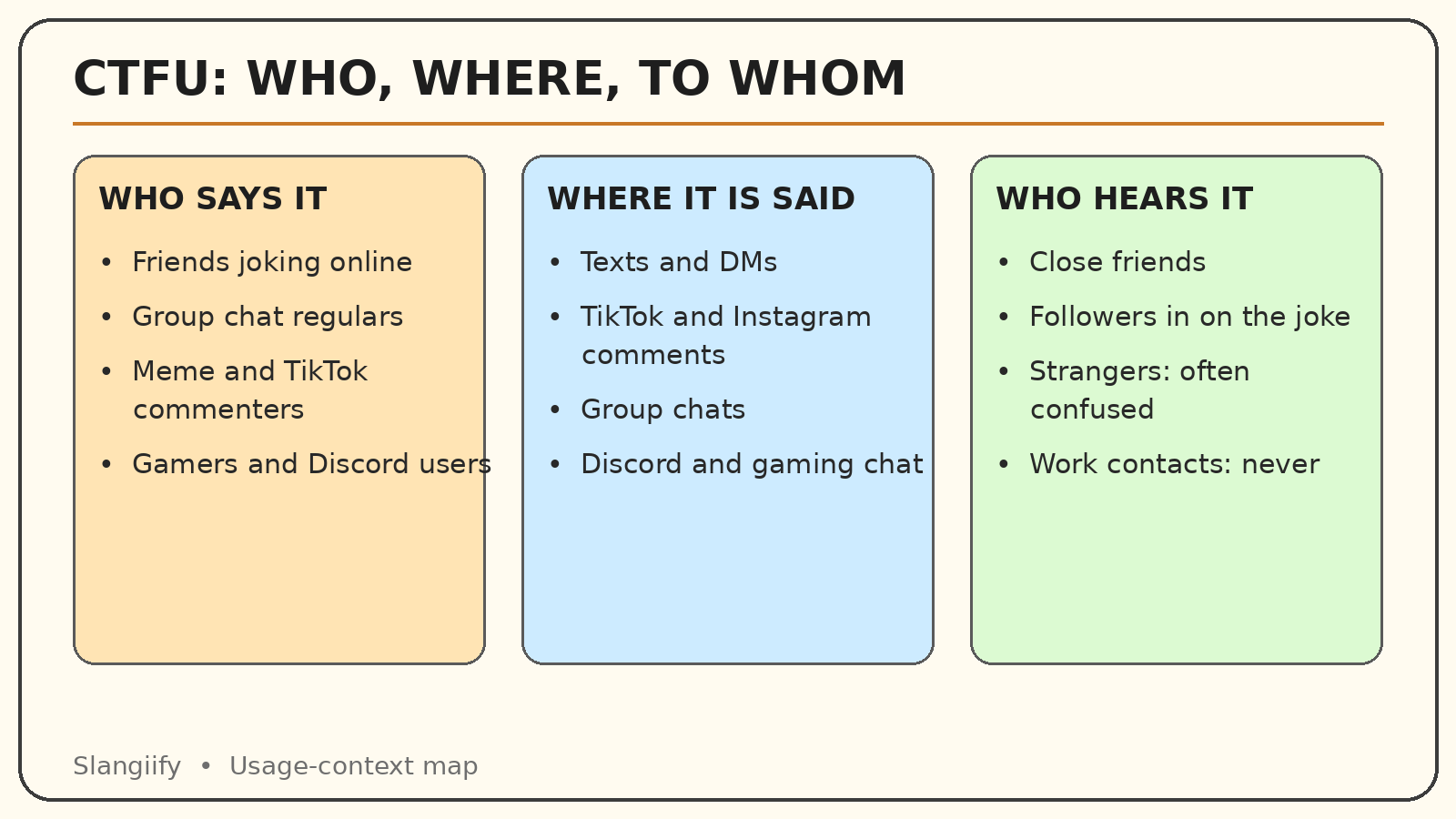
Who Says CTFU, Where, and to Whom
CTFU is used most by younger texters in casual settings, in texts, group chats, and comments on TikTok, Instagram, Discord, and Reddit, aimed at friends who share the same slang. It is far less common in formal writing or with strangers.
Who Uses It Most
The core users are teens and young adults who grew up with texting and social feeds, though age alone does not decide it. The shared trait is comfort with casual, profane slang. People who like clean language, or who text mostly for work, tend to use LOL or an emoji instead.
Where You See It
Texts and group chats are the home ground. TikTok and Instagram comments come next, where short reactions rule. Discord chats, Reddit threads, and meme pages also carry it. You will rarely see it in emails or formal posts, where it usually looks out of place.

Who It Is Aimed At
CTFU is aimed at friends and followers who will read it as friendly laughter, usually the person who shared the joke or posted the clip. It is not aimed at bosses, teachers, or clients. If you are unsure, watch how the other person laughs first.
How to Use CTFU Naturally
Use CTFU naturally by placing it right after something funny, keeping it short, and matching it to a relaxed audience. One CTFU per funny moment is enough, and a laughing emoji can help the tone land when the reader may not know the term.
A Simple Way to Drop It In
Start with the funny thing, then react. Watch the clip or read the message, then reply with CTFU, with or without an emoji. If you want a sentence, try, “I was CTFU at the part where he fell off the chair.” Keep it short, and reply at once. A delayed laugh lands less well.
Common Mistakes That Make It Sound Forced
The most common mistake is using CTFU for something that is not funny. If the message is sad or serious, a laugh term can read as mocking. Another mistake is stacking three laugh terms in one message. CTFU, LMAO, and ROFL together look forced. Short forms like CTFU belong to a wider family of texting slang that grew out of early chat culture.
What to Say Back When Someone Sends CTFU
When someone sends CTFU, they are telling you your joke landed, so reply with warmth, play along, or share the laugh back. A short, friendly response keeps the moment alive, while a long or serious reply can stall a light chat for no good reason.
If You Want to Match the Energy
Match the laugh with a laugh. “Right? I lost it too,” or, “I knew you would get that one,” keeps the tone warm and shared. Add a detail from the joke if you can. In a group chat, a reaction emoji on the message can do the same job without adding noise.
If You Want to Keep It Short
Short replies are fine. “Glad you liked it,” “told you,” or a single laughing emoji all work. If you do not know the term, reply to the laugh itself. The same friendly approach works for other short forms, from casual reply slang in everyday texts to laugh terms in comments.
Myths vs Facts About CTFU
Several myths surround CTFU, from claims about a single inventor to claims that it always means a literal fit of laughter. The facts are simpler: it is old internet slang with an unclear origin, it usually marks a playful tone rather than a literal laugh, and context decides the meaning.
Myth: CTFU Was Invented by One Person on One Day
Fact: No single inventor or coinage date is known. Early records place it in use by 2005, and 2000s chat rooms and forums are the likely home, but no reliable record names a creator.
Myth: CTFU Means You Literally Laughed Until You Broke Down
Fact: CTFU usually signals a strong laugh or a playful tone, not a medical event. People type it after a smile, a chuckle, or a real laugh. A CTFU after a gentle joke is a warm reaction, not a report of uncontrollable laughter.
Myth: CTFU Is Just a Ruder Version of LOL
Fact: CTFU is stronger and more niche than LOL, and the swear word changes how it lands. LOL is general and safe. CTFU is sharper and best kept to relaxed settings. They overlap, but they are not simple swaps.
Myth: CTFU Always Means the Same Thing
Fact: Context can shift the reading. In chats, the laughing sense wins almost every time. In a medical note, the clinical sense may win. Check the setting and the sentence around the letters before you settle on a meaning.
When NOT to Use CTFU
Do not use CTFU in formal, work, or school settings, with people who may not know it, or about sad topics. The swear word inside it, even censored, makes it a poor fit wherever clarity and respect matter most, or a calm tone is needed.
Formal and Work Messages
Work emails, job applications, and messages to a manager call for clean, clear language. CTFU can read as careless there, even if you meant it lightly. A laughing emoji or a plain sentence like “That made me laugh” carries the same warmth without the risk.
Messages to People Who May Not Know It
Older relatives, new contacts, and people who rarely use slang may read CTFU as confusion or rudeness. Start with plain language and emojis, and let slang in only after they use it too. Boundaries like these apply to much of slang, including slang that calls out lies and exaggeration.
Quick Answers About CTFU Slang
What does CTFU mean in text?
CTFU means cracking the f*** up, a slang way to say you are laughing very hard. In text, it is a quick reaction to a joke or a meme.
What is the CTFU definition in slang?
The slang definition is laughing intensely, or marking a playful tone. It comes from crack the f*** up, built on crack up, meaning to laugh out loud. It is stronger than LOL and close to LMAO.
Is CTFU rude or offensive?
CTFU can feel rude because it holds a swear word, even censored as f***. Most friends in casual chats will not take offence, but it is not polite language. Avoid it at work, at school, and with strangers.
What does CTFU mean on TikTok and Instagram?
On TikTok and Instagram, CTFU means laughing very hard at a video or caption. It usually appears as a short comment under a funny post, often with a laughing emoji, and signals that the viewer enjoyed it.
How do you reply to CTFU?
Reply with warmth and a short laugh back. Try “Right? I lost it too,” add a detail from the joke, or send a laughing emoji.
What is the difference between CTFU and LMAO?
Both signal a strong laugh, but CTFU is less widely known and more niche, while LMAO is more common. LMAO means laughing my a** off, and CTFU means cracking the f*** up. In most casual chats, either works.
Sources and Further Reading
The sources below are the only sources used for the verifiable claims in this article. Each one was opened and checked before writing.