


There is no single word for “cool” in Spanish slang. The right word depends entirely on where you are: chido in Mexico, guay in Spain, chévere across the Caribbean and northern South America, bacán in Chile and Peru, and copado in Argentina.
Every Spanish learner hits this wall sooner or later. You learn one word for cool, you use it with confidence, and a native speaker smiles in that way that tells you something is off. The word was not wrong, exactly. It was just from the wrong country. Spanish is spoken in more than twenty countries, and slang is the most regional part of any language. A teenager in Mexico City, a student in Madrid, and a surfer in San José, Costa Rica all have their own way of saying something is cool, and none of them use the same word.
This guide fixes that. Below you will find the word for cool in every major Spanish-speaking region, with real example sentences, pronunciation notes, a side-by-side comparison table, and honest guidance on what to say back and when to keep quiet. If you want the bigger picture first, our guide to Spanish slang covers the general vocabulary that works alongside these words. And if you are curious about the English side of the story, our guide to what “cool” means in slang covers its jazz-era origins and how each generation uses it today.

Contents
- What “Cool” in Spanish Slang Actually Means
- How to Say Cool in Mexican Slang: Chido, Padre, Padrísimo
- How to Say Cool in Spain Slang: Guay, Mola, Chachi
- Chévere, Bacán, Copado: Cool Beyond Mexico and Spain
- Chido vs Chévere: Which One Should You Learn First?
- The Full Region Word Map for Cool in Spanish
- Usage-Context Map: Who Says Each Word, and to Whom
- What to Say Back: Reply Guidance for Each Word
- Myths and Facts About Saying Cool in Spanish
- When NOT to Use These Words
- Quick Answers: FAQs About Cool in Spanish Slang
- Sources
What “Cool” in Spanish Slang Actually Means
There is no single word for cool in Spanish slang because Spanish is a regional language. The right word depends on where you are: chido in Mexico, guay in Spain, chévere across the Caribbean and northern South America, bacán in Chile and Peru, and copado in Argentina. Match the word to the country and you will sound natural.
In English, “cool” does a lot of heavy lifting. It can describe a person (“she is cool”), an object (“that jacket is cool”), an experience (“the concert was cool”), or a reaction (“cool, see you there”). Spanish slang splits that job across different words, and each word carries its own geography. That is the key insight most word lists miss: learning the word without learning the region is how learners end up saying something perfectly correct and still getting a strange look.
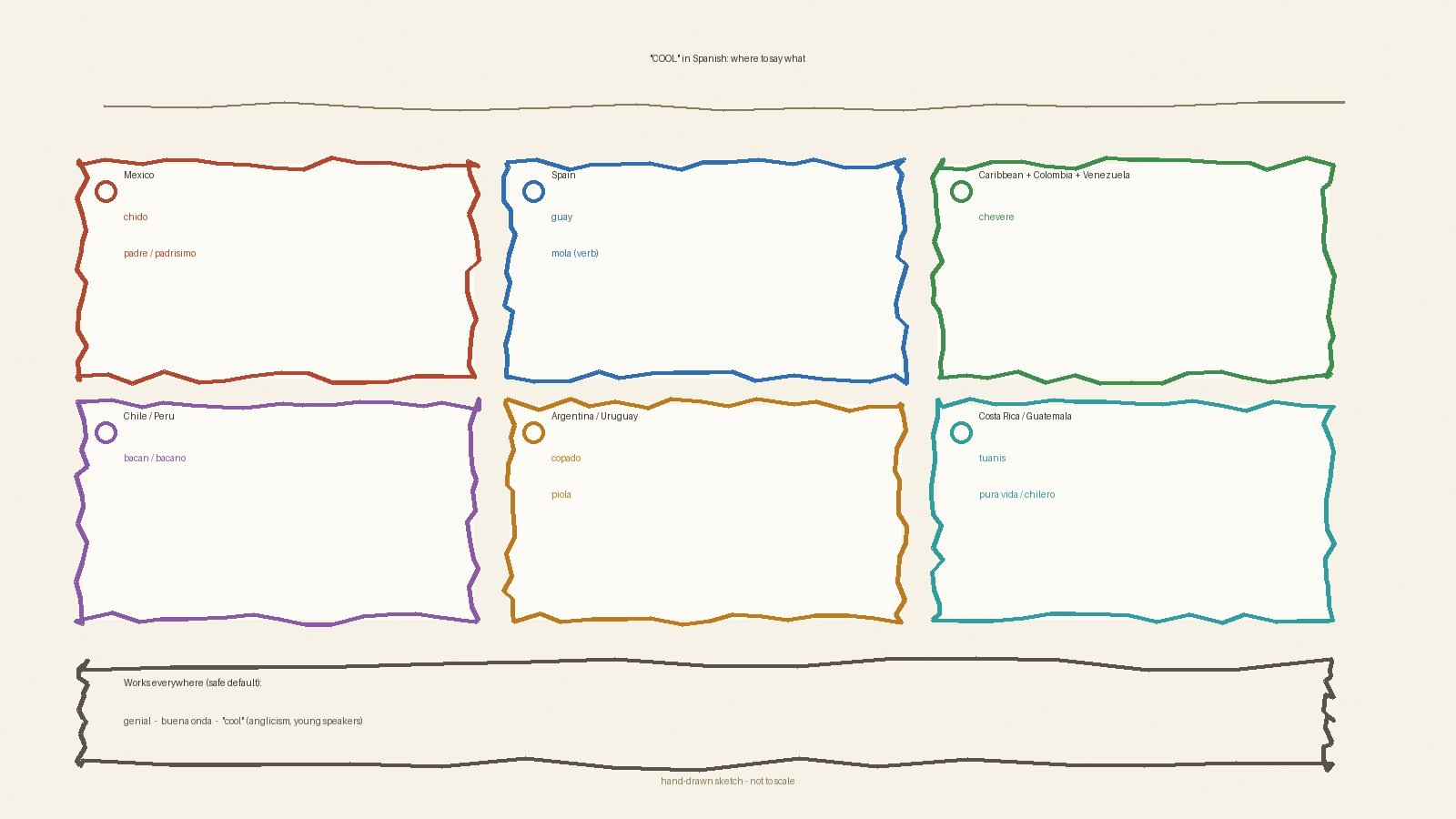
Here is how the split works in practice. Mexican speakers reach for chido or padre. Spaniards say guay or mola. Colombians, Venezuelans, and much of the Caribbean say chévere. Chileans and Peruvians say bacán. Argentinians say copado or piola. Costa Ricans say tuanis or pura vida. And when speakers are unsure, genial works almost everywhere, because it is closer to standard Spanish than to slang.
Two more things shape how these words behave. First, many of them change with gender. Chido becomes chida for feminine nouns, copado becomes copada, and bacán becomes bacana in some countries. Words ending in e or y, like chévere and guay, stay the same. Second, tone of voice matters as much as the word. Inklingo’s guide to guay points out that the word can turn sarcastic with a flat tone and an eye roll, exactly like “great” can in English.
How to Say Cool in Mexican Slang: Chido, Padre, Padrísimo
If you want to sound cool in Mexico, learn three words: chido, padre, and padrísimo. Chido is the everyday default among younger speakers. Padre is warm and positive across more age groups. Padrísimo means very cool or amazing. All three are informal, so save them for friends and casual moments.
Mexico has the richest set of “cool” words of any Spanish-speaking country, which makes sense given how much Mexican media travels. If you have watched Mexican shows or followed Mexican creators, you have heard these words a hundred times without realizing it. Our roundup of Mexican slang puts them in wider context, but here is what you need for “cool” specifically.

Chido
Chido (CHEE-doh) is the workhorse. It means cool, awesome, or great, and it is extremely common among young and middle-aged Mexicans. Lingopie’s guide to fourteen ways to say cool in Spanish notes that it shows up in parts of Central America too, but its home is Mexico. It agrees in gender: chido for masculine things, chida for feminine things.
La película estuvo bien chida. (The movie was really cool.)
Tu amiga es bien chida. (Your friend is really cool.)
What I like about chido is how flexible it is. It works for objects, people, plans, and reactions. Someone tells you their news and you can answer with a simple ¡qué chido! the way an English speaker says “that’s cool.” It never sounds stiff.
Padre
Padre (PAH-dreh) literally means “father,” which is the first thing every learner asks about. In Mexican slang it has nothing to do with family. It means cool, great, or impressive, and it skews slightly more wholesome and upbeat than chido. Older speakers use it comfortably, so it is a safe pick when you are talking to someone’s parents.
¡Tu coche está bien padre! (Your car is so cool!)
Me encanta tu casa. ¡Está muy padre! (I love your house. It is very cool!)
Mexican Spanish is full of everyday words with second lives, and torta is one of my favorites. If this kind of double meaning entertains you, the story of torta’s own slang life is worth a read.
Padrísimo
Padrísimo (pah-DREE-see-moh) is padre turned up to eleven. The -ísimo ending is Spanish’s built-in amplifier, so this means very cool, amazing, or fantastic. Use it when padre is not enough.
¡La boda estuvo padrísima! (The wedding was amazing!)
A word of caution for the ambitious: Mexican slang has an even stronger option, chingón, meaning something like “badass” or extremely cool. Quillbot’s Spanish slang table warns that it comes from the verb chingar, which is generally considered vulgar, so treat chingón as advanced vocabulary. Understand it when you hear it, but do not lead with it.
How to Say Cool in Spain Slang: Guay, Mola, Chachi
In Spain, guay is the word you will hear most for cool, especially from younger people. Mola is the verb version, as in “me mola” for “it is cool” or “I like it.” Chachi is playful and a little retro. Use these with friends in casual settings, and skip them in formal writing or business meetings.
Spanish slang from Spain sounds like a different language to many Latin American learners, and the “cool” words are a perfect example. Where Mexico says chido, Spain says guay. Where Latin America reaches for chévere, Spain reaches for mola. If you learned Spanish from a Spain-based course, these are probably the words in your head already.
Guay
Guay (pronounced like the English word “why” with a soft g in front: g-why) is the all-purpose cool of Spain. It works as an adjective (una película muy guay, a very cool movie), as an interjection (¡qué guay!, how cool!), and even as an adverb in phrases like pasarlo guay, to have a great time. Inklingo’s guide to the word guay calls it one of the most versatile slang words in Spain, and notes that it skews young, though adults use it too.
¡Qué guay tu camiseta! (Your t-shirt is so cool!)
Ayer lo pasamos guay en la fiesta. (Yesterday we had a great time at the party.)
The catch, and it is a big one: guay is almost exclusively a Spain word. Inklingo’s guide puts it bluntly with a comparison I love. Using guay in Latin America, they write, is like a British person saying something is “chuffed” in America. People will probably understand you, thanks to streaming shows, but you will sound foreign. Keep guay for Spain.
Mola / Molar
Molar (moh-LAR) is a verb meaning “to be cool,” and mola is its most common form. It is everywhere in casual Spanish conversation in Spain. Me mola means “I like it” or “it is cool to me,” and mola un montón means “it is super cool.”
Tu móvil mola mucho. (Your phone is super cool.)
La camiseta mola. (The t-shirt is cool.)
Chachi
Chachi (CHAH-chee) is the fun one. It means cool or great, and it has a slightly playful, almost retro flavor in modern Spain. Older Spaniards use it with real affection, and younger people use it with a wink. It will not confuse anyone, but it will mark you as someone who knows a little more than the textbook.
¡Qué chachi el plan de esta noche! (How cool tonight’s plan is!)
Chévere, Bacán, Copado: Cool Beyond Mexico and Spain
Across the Caribbean and northern South America, chévere is the friendliest all-purpose word for cool, common in Colombia, Venezuela, Cuba, and the Dominican Republic. In Chile and Peru, bacán does the same job, and bacano is the Colombian variant. Both sound warm and relaxed, and travelers can use them freely in casual conversation.
Mexico and Spain get most of the attention in beginner courses, but the rest of the Spanish-speaking world has its own favorites, and they are worth learning. These are the words you will actually hear if your friends are Colombian, Venezuelan, Chilean, Peruvian, or Argentine.
Chévere
Chévere (cheh-VEH-reh) is the great connector word of Latin American Spanish. Berlitz’s guide to 159 Spanish slang words lists it as used in most of Latin America, and that matches what travelers report: Colombia, Venezuela, Ecuador, Cuba, the Dominican Republic, Puerto Rico, and parts of Central America all use it. It is warm, friendly, and hard to misuse.
Qué chévere, no tenemos tarea. (How cool, we have no homework.)
Todo estuvo chévere en la reunión. (Everything was cool at the meeting.)
If your Spanish-speaking friends are from the Caribbean side of the map, chévere is the single most useful word in this article. Dominican slang and Puerto Rican slang both lean on it, alongside local favorites like gufeao and nítido in Puerto Rico.
Bacán and Bacano
Bacán (bah-KAHN) rules the southern Andes: Chile, Peru, and parts of Ecuador and Bolivia. In Colombia it often appears as bacano (bah-KAH-noh). Both mean cool, awesome, or impressive, with a relaxed, laid-back energy. FluentU’s rundown of thirty ways to say cool in Spanish adds a useful warning here: in some countries bacán can also mean “boss,” “lover,” or even “posh,” so pay attention to context outside its home turf.
¡La fiesta estuvo bacán! (The party was awesome!)
Tu chaqueta es bacana. (Your jacket is cool.)
Copado and Piola
Copado (koh-PAH-doh) is Argentina’s answer, used in Uruguay too. It is laid-back and friendly, popular with younger speakers. Piola (pee-OH-lah) is its Argentine cousin with a slightly different flavor: it means cool in the sense of calm or chill, and quedarse piola means “to stay cool” or “to keep it together.”
¡Este barrio está copado! (This neighborhood is so cool!)
Ese invento está piola. (That invention is cool.)
Chido vs Chévere: Which One Should You Learn First?
Learn chido first if you spend time with Mexicans or consume Mexican media, and learn chévere first if your circle is Colombian, Venezuelan, or Caribbean. Neither word is understood everywhere, so the choice is purely about who you talk to. If you only learn one universal fallback, make it genial, which works in nearly every country.
This is the comparison learners ask about most, and the honest answer is that it is the wrong question. Chido and chévere do not compete. They serve different audiences. Chido is Mexican to the core, while chévere belongs to the Caribbean and northern South America. A Mexican will understand chévere if they have met Colombians, and a Colombian will understand chido if they watch Mexican shows, but neither will reach for the other’s word naturally.
So pick based on your life, not on a ranking. Learning Spanish for a trip to Cancún or because you love Mexican music? Chido is your word. Dating a Colombian, working with Venezuelans, or heading to the Caribbean? Chévere will get more use in a week than chido gets in a year. And if your Spanish touches many countries, or you simply cannot decide, learn genial. Lingopie’s guide names genial as the most common and generally understood way to say cool in Spanish, and it doubles as perfectly acceptable standard Spanish, so it never sounds out of place.
The Full Region Word Map for Cool in Spanish
Here is every major regional word in one place. The table below is the cheat sheet version of this article: find your country or your friends’ country, and you have your word. The sketch map underneath shows the same geography at a glance.
| Word | Region | Tone | Where it is used | Example sentence |
|---|---|---|---|---|
| Chido / chida | Mexico, parts of Central America | Enthusiastic, youthful | Friends, chats, everyday objects and plans | La película estuvo bien chida. |
| Padre | Mexico | Warm, upbeat, all ages | Family-friendly casual talk, compliments | ¡Tu coche está bien padre! |
| Padrísimo | Mexico | Very enthusiastic | When something is amazing, not just nice | ¡La boda estuvo padrísima! |
| Guay | Spain | Casual, youthful | Friends, plans, reactions; adjective and interjection | ¡Qué guay tu camiseta! |
| Mola | Spain | Casual, approving | Reacting to things you like | Tu móvil mola mucho. |
| Chachi | Spain | Playful, slightly retro | Lighthearted compliments and plans | ¡Qué chachi el plan! |
| Chévere | Caribbean, Colombia, Venezuela, Ecuador, much of Latin America | Warm, friendly, relaxed | People, events, ideas; very hard to misuse | Todo estuvo chévere en la reunión. |
| Bacán / bacano | Chile, Peru (bacán); Colombia (bacano) | Laid-back, admiring | Parties, objects, people you admire | ¡La fiesta estuvo bacán! |
| Copado / copada | Argentina, Uruguay | Laid-back, youthful | Neighborhoods, plans, experiences | ¡Este barrio está copado! |
| Piola | Argentina, Chile | Chill, calm | Describing something low-key cool; quedarse piola = stay cool | Ese invento está piola. |
| Tuanis | Costa Rica, Nicaragua, Honduras, El Salvador | Relaxed, friendly | Everyday approval, similar to pura vida | Tu reloj es bien tuanis. |
| Pura vida | Costa Rica | Positive, easygoing | Greeting, farewell, and general approval | No hay problema. Todo pura vida. |
| Chilero / calidá | Guatemala | Cheerful, local | Casual local conversation | ¿No hay huracán? ¡Qué chilero! |
| Genial | Everywhere | Positive, slightly neutral | The safe universal fallback in any country | Tu idea es genial. |
| Buena onda | Argentina, Chile, Mexico | Warm, about people | Describing someone with a good vibe | Ella es buena onda. |
| Cool (anglicism) | Young urban speakers, many countries | Trendy, bilingual | Texts, social media, casual youth talk | ¡Qué cool está tu teléfono! |
The Universal Fallback Words: Genial, Buena Onda, Cool
When in doubt, genial is your safety net. It literally means “great” or “brilliant,” and it is understood in every Spanish-speaking country because it sits close to standard Spanish. Lingopie’s FAQ section names it as the most common and generally understood way to say cool, and I agree. It will never get a laugh or a strange look.
Buena onda (literally “good wave”) is the people word. In Argentina, Chile, and Mexico it describes someone cool in the sense of having a good vibe. Ella es buena onda means she is cool because she is pleasant to be around. It is warmer than genial and slightly more personal.
And yes, the English word “cool” itself has crossed over. Lingopie’s guide notes that among younger generations, especially in urban areas, people drop “cool” straight into Spanish sentences. It is not the most natural-sounding choice for a learner aiming at native-like speech, but nobody will misunderstand it.
Usage-Context Map: Who Says Each Word, and to Whom
The context decides more than the dictionary does. Young friends in a chat can trade chido or guay all day, but the same words fall flat in a classroom or a job interview. Slang marks you as an insider with one group and as an outsider with another, so learn who says each word before you use it.
Here is the practical map. Read it as a set of social rules, not just vocabulary.
| Word | Who says it | Where | To whom | When it lands best |
|---|---|---|---|---|
| Chido | Young and middle-aged Mexicans | Mexico, Mexican diaspora | Friends, peers, siblings | Reacting to news, describing weekend plans |
| Padre | Mexicans of all ages | Mexico, Mexican diaspora | Friends, family, in-laws | Complimenting a home, a car, an achievement |
| Guay | Young Spaniards especially | Spain | Friends, classmates | Reacting to plans, describing music or places |
| Mola | Spaniards of all ages | Spain | Friends, family | Saying you like something: me mola |
| Chévere | Caribbean and northern South American speakers | Colombia, Venezuela, Caribbean | Friends, coworkers in relaxed workplaces | Describing events, ideas, people |
| Bacán | Chileans, Peruvians | Chile, Peru, southern Andes | Friends, peers | Parties, trips, impressive things |
| Copado | Young Argentinians, Uruguayans | Argentina, Uruguay | Friends, peers | Neighborhoods, nights out, experiences |
| Tuanis | Costa Ricans, Nicaraguans | Central America | Friends, locals you know | Everyday approval, like “nice” |
| Genial | Everyone | Everywhere | Anyone, including strangers | When you are unsure of the local word |
Notice the pattern: every slang word on this page lives in the “friends and peers” column. That is not a coincidence. Slang is a membership badge. Using the local word with the local group says “I get you.” Using it with the wrong group says “I learned this from a list.” The table above is your shortcut past that mistake.
What to Say Back: Reply Guidance for Each Word
When someone calls your idea chévere or your outfit chido, the simplest reply is to mirror their energy: a smile plus “¡gracias!” or “¡qué bueno!” works everywhere. In Spain, “¡guay!” back is natural. Avoid correcting their word choice or reaching for a dictionary definition in the middle of a friendly moment.
Knowing the words is only half the skill. The other half is responding like a person, not a textbook. Here is what to do in the moments that actually happen.
Someone Says Your Thing Is “Chido” or “Padre”
Say ¡gracias! and keep the energy going: ¡gracias! ¿Verdad que sí? (thanks! Right?). If they said qué padre about your news, ¡sí, estuvo padrísimo! answers in kind and shows you know the amplifier form. Do not over-explain. A short, warm reply beats a paragraph.
Someone Says “Chévere” About Your Idea or Plan
¡Qué bueno que te gusta! (glad you like it!) is the natural answer. Or mirror it: ¡chévere, nos vemos ahí! (cool, see you there!). Colombians and Venezuelans use chévere as social glue, so responding in the same register keeps the conversation smooth.
Someone Says “Guay” or “Me Mola”
In Spain, ¡guay! right back is completely natural. If a Spaniard says me mola tu idea (I like your idea / your idea is cool), answer ¡genial, pues lo hacemos! (great, then let’s do it!). Matching their casual register matters more than matching the exact word.
When You Want to Return the Compliment
The golden rule: use their region’s word, not yours. If your Mexican friend says your playlist is chida, call their taste chido back, even if your Spanish teacher taught you guay. Nothing builds rapport faster than answering in someone’s own slang. And when you genuinely do not know the local word, genial plus a smile has never failed anyone.
Myths and Facts About Saying Cool in Spanish
Most confusion around cool in Spanish comes from three myths: that one word works everywhere, that guay is Latin American, and that literal translations like padre or genial carry the same weight as slang. Each is only partly true. The facts below fix the details so you can choose words with confidence instead of guessing.
Myth: One Word for Cool Works Across All of Latin America
Fact: No single slang word covers the whole map. Chévere comes closest in Latin America, with Berlitz’s slang guide placing it across most of the region, but it still sounds foreign in Mexico and Argentina. This is exactly why this article is organized by region instead of giving you one answer.
Myth: “Guay” Is the Latin American Word for Cool
Fact: Guay is Spain’s word, full stop. Inklingo’s guide to guay stresses that Latin Americans will understand it from shows and movies but do not use it themselves. If your Spanish world is Mexico, Colombia, or Argentina, guay is the wrong tool.
Myth: “Chido” Works in Spain Too
Fact: Spaniards will understand chido thanks to Mexican media, but they will hear it as Mexican, the same way an American hears “mate” as Australian. In Spain, reach for guay or mola instead. Regional words travel through screens, but they do not change passports.
Myth: “Padre” Means Father, So It Must Be Formal or Respectful
Fact: The slang meaning has nothing to do with the literal one. Padre as “cool” is 100 percent informal Mexican street language. Using it in a formal email would be like writing “that’s dope” in a cover letter. The literal translation is a false friend here.
Myth: Slang Dictionaries List the “Correct” Version of Each Word
Fact: Spelling and form shift by country. Bacán becomes bacano in Colombia. Chido becomes chida with feminine nouns. Padrísimo sometimes appears as padrisimo without the accent in texts. These are not errors. They are the language breathing.
When NOT to Use These Words
Keep every word on this page out of job interviews, academic writing, formal emails, and conversations with authority figures you do not know well. A few of them carry extra risk: chingón descends from a vulgar verb, poca madre can offend, and chulo can sound arrogant in Spain. Casual friends are the safe zone.
Formal Settings Are Off Limits
Job interviews, university essays, business meetings, official emails: none of these want chido, guay, or chévere. Use genial, excelente, or interesante instead. Genial is the interesting exception on this page because it passes as standard Spanish, but the rest are casual-only.
With Strangers and Authority Figures
Default to neutral language with people you have just met, older strangers, and anyone in a position of authority over you. Slang signals closeness, and using it too early can read as presumptuous rather than friendly. Let the other person go casual first.
The Edgy Ones: Chingón, Poca Madre, Chulo
Three words deserve their own warning label. Chingón is powerful Mexican slang for extremely cool, but Quillbot’s Spanish slang table notes it derives from chingar, a vulgar verb, so keep it among close friends. Estar de poca madre means something is cool in Mexico, yet FluentU’s rundown warns it can also be used to criticize someone, so never aim it at a person. Chulo can mean cool in Spain, but its literal meanings include “arrogant” and worse, so tone decides everything.
In Writing vs in Speech
These words live in speech, chats, and social media captions. In anything that will be read by people you do not know, a formal document, or a published piece of writing, they look out of place. Texting a friend qué chido is perfect. Putting it in a work report is not.
Quick Answers: FAQs About Cool in Spanish Slang
This article covered the full word map. The remaining sections are quick reference.
Sources
Inklingo, Lingopie, Berlitz, FluentU, and Quillbot guides to Spanish slang, as cited throughout.



Pingback: Cuban Slang Meaning: 35+ Words and Phrases Explained