

In 1960s slang, dig meant to understand, appreciate, or really like something or someone.
If you have watched an old film, heard a classic song, or read a book set in the 1960s and tripped over a line like “I dig it” or “Can you dig it?”, you have met one of the decade’s most friendly words. It has nothing to do with a shovel. In the slang of the era, dig was a warm, casual way to say that something made sense to you, that you liked it, or that you felt it on a deeper level. This guide explains the dig slang meaning in the 1960s, where the word came from, how people actually used it, how it compares with groovy, far out, and cool, and whether it still works in a conversation today.
What Dig Means in 1960s Slang
In 1960s slang, dig was a verb that meant to understand something, to appreciate it, or to really like it, and the exact shade depended on the sentence around it. “I dig this song” meant “I really like this song.” “Do you dig what I mean?” meant “Do you understand what I am saying?” “I dig your style” meant “I admire your style.” One short word covered understanding, liking, and admiration, which is why it stayed useful in so many kinds of conversation.
The key to reading dig is context. When the object was music, clothes, a film, or a person, dig usually leaned toward liking and admiration. When the object was an idea, a story, or an explanation, dig usually leaned toward understanding. Often it meant both at once: you understood something and you liked it because you understood it. That double sense is what made the word feel warmer than a plain “I like it.” It suggested a real connection, not just a passing opinion.
People searching for the dig slang meaning in the 1960s often ask whether dig was a noun or a verb. In this slang sense it was almost always a verb. You dig something, or you dig someone. You would not usually say “that is a dig” to mean a good song. The classic forms were “I dig it,” “I dig your style,” “Dig this,” and the question “Can you dig it?” Each one is still easy to recognize today, even if you never heard the word used this way in real life.
Dig in one sentence for each situation
Music: “I dig this record” means you love how it sounds and you keep coming back to it. People: “I dig her” means you admire her, enjoy her company, or find her interesting. Ideas: “I dig what you are saying” means you follow the argument and you agree with its spirit. A question: “Can you dig it?” asks whether the listener understands, likes, or feels the same way. Keep the object in mind and the meaning usually falls into place.
Why dig felt different from simply saying like
Like is flat. Dig carried enthusiasm and a sense of taste. Saying you dug a band suggested you had listened closely, that the music had reached you, and that you were part of the crowd that got it. That is why the word fit jazz clubs, record shops, coffee houses, and late night conversations so well. It was praise with personality, and it told the listener something about the speaker too: this person pays attention, and this person cares about the thing they are praising.
Where Dig Came From: Jazz Roots to the 1960s
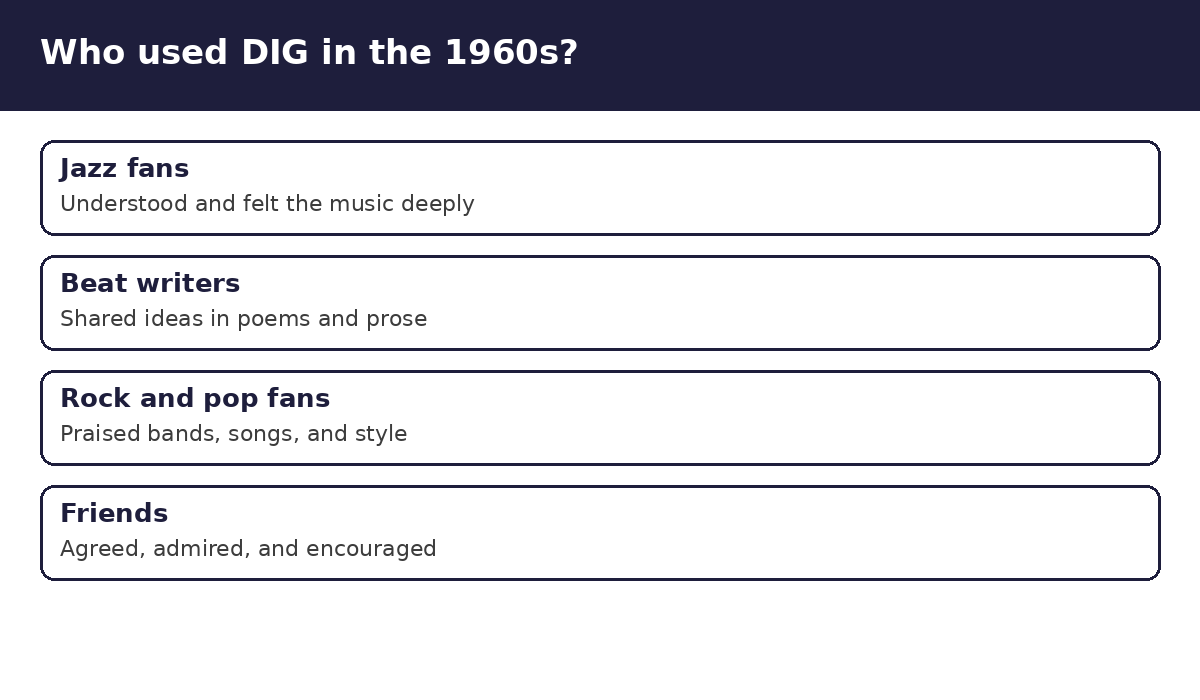
Dig did not start in the 1960s, even though the decade made it famous. Its slang sense of understanding and appreciating something grew out of African American jazz culture in the 1930s and 1940s, where musicians and fans used it to mean that they understood a piece of music or felt it deeply. From there it travelled through the Beat writers of the 1950s, into rock and pop music, and finally into everyday youth speech in the 1960s. By the late 1960s it was one of the most recognizable words of the era.
The jazz link matters because it explains the word’s feeling. In a jazz club, to dig a solo meant more than hearing the notes. It meant following the player’s ideas, feeling the swing, and appreciating the skill in real time. That sense of active listening stayed with the word as it spread. When a 1960s teenager said “I dig this band,” the praise carried a trace of that older meaning: I hear what they are doing, and I am with them.
The path from jazz to the mainstream ran through music, writing, and film. Beat Generation writers helped carry jazz slang into literary conversation in the 1950s. Rock musicians picked it up in the 1960s, and television and Hollywood films carried it into living rooms where teenagers repeated it the next day. Word Smarts traces the slang use to African American Vernacular English in the 1930s, connected with the excavation sense of the word, as in unearthing knowledge, and notes that it also came to denote approval, as in “I really dig your style!” That double root, understanding plus approval, is the whole story of the word in one line.
SlangBoost gives the same timeline in plain terms, noting that the slang meaning existed before the 1960s, first became popular in African American jazz culture during the 1930s and 1940s, and spread into mainstream American culture through jazz, Beat writers, rock musicians, television, films, and counterculture movements. The 1960s did not invent dig. The decade amplified it, gave it a mass audience, and fixed it in the public memory as a 1960s word, which is why people still search for it as “dig 1960 slang” today.
The long life of a short word
Dig survived the 1960s because it was useful, not just fashionable. Words that only signal a trend tend to fade fast. Dig kept a real job to do: it let a speaker combine understanding and liking in one syllable. Later generations kept it alive in retro conversation, in music writing, and in jokes about the decade, and it still pops up whenever someone wants a friendly, old school way to say “I get it and I like it.” Its age is part of its charm now. Using it signals nostalgia, not confusion.
How Dig Was Used in the 1960s
In the 1960s, dig was everyday casual speech among friends, music fans, and young people, used in conversation, in song lyrics, and in films, and it was almost always positive and relaxed. It was not formal language, and it was not street code. It was the kind of word you used when you were comfortable with the people around you and wanted to show genuine enthusiasm without sounding stiff.
The classic phrases, decoded
“I dig it” was the simplest form, meaning “I like it,” “I get it,” or “I am into it,” depending on context. “I really dig that” added emphasis, the way a modern speaker might say “I absolutely love that.” “Dig this!” worked as an invitation: listen to this, look at this, pay attention to this, because it is good. “Can you dig it?” was the famous question form, and it could mean “Do you understand?” or “Do you feel the same way?” or both. The speaker was checking for shared feeling, not just shared facts.
“I dig your style” and “I dig your vibe” praised a person’s look, manner, or way of carrying themselves. “She digs old rock bands” described someone’s taste in a warm, approving way. “Do you dig what I am saying?” asked for understanding after an explanation or a story. In each case the grammar stayed simple: a subject, dig, and an object. That simplicity helped the word travel. Anyone could pick it up after hearing it once or twice, and the meaning was clear from the sentence even if the listener had never looked it up.
Dig in conversation: three short exchanges
At a record shop: “Have you heard the new album?” “Yeah, I dig it. The second side is the best part.” Here dig means real musical liking, earned by listening. Between friends: “I am thinking of wearing this jacket to the dance.” “I dig your style, wear it.” Here dig means admiration for taste and encouragement. After a long story: “So that is why I left the job.” “Yeah, I dig what you are saying.” Here dig means understanding, plus sympathy. Same word, three jobs, and no confusion, because the situation does the explaining.
Dig and tone: warm, never sharp
Dig was a friendly word. It softened praise and made agreement feel personal. It did not carry sarcasm by default, and it was not used to insult someone. If a speaker wanted to be sharp, they reached for other words. Dig stayed on the warm side of the vocabulary, which is one reason it still reads as charming today rather than dated in a bad way. A word that was kind in the 1960s still sounds kind when it is quoted now.
Dig vs Similar 1960s Words
Dig shared the 1960s stage with groovy, far out, and cool, but each word did a different job, and mixing them up loses the flavor of the decade. Dig was about understanding and personal liking. Groovy was about something being excellent, fashionable, or enjoyable in itself. Far out was about amazement, something surprising, unusual, or impressive. Cool was the broadest word of all, a general stamp of approval that could cover style, calm, quality, or attitude. A song could be groovy and far out at the same time, and a listener could dig it for all those reasons, but the words were not interchangeable.
| Word | Core meaning | Tone | Where it was used | Example |
|---|---|---|---|---|
| Dig | Understand, appreciate, really like | Warm, personal, enthusiastic | Music, ideas, people, style | “I dig this band.” |
| Groovy | Excellent, fashionable, enjoyable | Upbeat, very 1960s | Music, parties, fashion | “That is a groovy tune.” |
| Far out | Amazing, surprising, mind opening | Excited, amazed | Ideas, experiences, art | “That solo was far out.” |
| Cool | Good, stylish, calm, acceptable | Relaxed, broad approval | Almost anywhere casual | “That is cool.” |
| Like | Enjoy, prefer | Neutral, plain | Everyday speech | “I like this song.” |
The practical difference is the speaker’s role. Groovy and far out describe the thing. Dig describes the relationship between the speaker and the thing. That is why “I dig it” feels more personal than “It is groovy.” The first tells you about the speaker’s taste and feeling. The second tells you about the record. Readers who want the full story of the broadest approval word of the era can read our guide to what cool means in text and online, and our guide to popular 1960s slang words and phrases puts dig back in its decade, alongside the other expressions people actually used.
Modern readers sometimes ask whether dig is the same as the modern slang “I am feeling this.” The feeling is close. Both say that something resonates with the speaker. The difference is flavor: “I am feeling this” is current, while dig is deliberately retro. Using dig today is a style choice, a small nod to the 1960s, while “I am feeling this” makes no historical claim at all. Both are friendly. Only dig carries the vinyl, the jazz club, and the decade with it.
Who Said Dig, Where, and to Whom
Dig was said by jazz musicians and fans first, then by Beat writers, rock fans, students, and young people in general, in clubs, at concerts, in record shops, in coffee houses, and in casual conversation among friends, and it was rarely used in formal or official settings. The usage map below shows how the word moved from a specialist music term to a general youth expression, and why it still sounds like music talk even when it is used about an idea.
| Setting | Who you would hear | Typical use | Tone |
|---|---|---|---|
| Jazz clubs, 1930s to 1950s | Musicians and serious fans | Praising a solo or a player’s feel | Knowledgeable, insider, warm |
| Beat circles, 1950s | Writers, poets, coffee house crowds | Showing understanding of an idea or poem | Thoughtful, relaxed |
| Record shops and concerts, 1960s | Teenagers, students, music fans | Praising a band, album, or song | Enthusiastic, friendly |
| Everyday friendship, 1960s | Friends, classmates, young couples | Praising style, agreeing with a story | Casual, affectionate |
| Film and television, 1960s onward | Characters written as hip or youthful | Signalling era and attitude fast | Playful, stylized |
| Formal settings | Almost nobody | Standard English instead | Polite, careful |
Age and closeness shaped the word’s use more than geography. Young people used it most, but older jazz fans had used it for years before the teenagers arrived. What mattered was shared taste. Dig worked best between people who already liked the same music, the same scene, or the same ideas. Between strangers it could still work, because it was friendly, but it worked best as a signal: we are on the same wavelength. That signal function explains why film writers loved it. One line of dialogue could place a character in a scene, a generation, and a mood all at once.
For readers tracing how decade slang builds a whole vocabulary, our guide to popular 1970s slang words and phrases shows what changed when the 1960s ended, and our guide to what awesome means in text and online shows how a later praise word took over part of dig’s job. Dig itself never fully left. It moved from everyday speech into retro speech, which is a smaller but longer lasting home.
What to Say Back When Someone Says Dig
Replying to dig is easy, because the word invites agreement, and the best reply usually matches the speaker’s warmth and brevity. If someone says “I dig your jacket,” a simple “Thanks, I appreciate that” works, or, in the same spirit, “Glad you dig it.” If someone asks “Can you dig it?” after explaining an idea, answer the real question: “Yeah, I get it” if you understand, or “I am not sure yet, run it by me again” if you do not. Pretending to understand when you do not is the one reply that breaks the friendly tone, because dig is built on real understanding, not polite nodding.
| What you hear | What it means | A good reply |
|---|---|---|
| “I dig this song.” | I really like this song. | “Me too, the chorus is the best part.” |
| “I dig your style.” | I admire how you look or carry yourself. | “Thanks, that means a lot.” |
| “Can you dig it?” | Do you understand, or do you feel the same? | “Yeah, I dig it completely.” |
| “Dig this!” | Listen to this, look at this, it is good. | “Okay, I am listening.” |
| “I dig what you are saying.” | I understand and agree with your point. | “Good, I was hoping that made sense.” |
If you want to use dig yourself, keep it casual and keep it sincere. Use it for things you genuinely like or genuinely understand. “I dig this record” lands when you have actually listened to the record. Said about something you have never heard, it sounds like a costume. The word rewards honesty, which is fitting for a word that started as a test of whether a listener really heard the music.
Dig in Music, Film, and Pop Culture
Dig lives on in pop culture because the 1960s never really left the public imagination, and every revival of the decade’s music, fashion, or films brings the word back with it. Jazz writing kept it alive first, since the word belonged to that world before it belonged to the decade. Rock and pop writing kept it alive next, because critics and fans describing classic bands reached for the vocabulary of the era. Film and television kept it alive most visibly, because a single “Can you dig it?” in a script tells an audience, in three words, that a character is hip, relaxed, and rooted in that time.
That pop culture life has a side effect worth noting. Many people today meet dig first as a quote, not as living speech. They hear it in a film, read it in a novel set in the 1960s, or see it on a retro social media post, and they look up the meaning because the context is historical. That is exactly the search behind “dig slang meaning 1960s.” The reader is not trying to learn a new word for daily texting. The reader is trying to decode a piece of culture, and a good answer has to give the history along with the definition, or the quote stays half understood.
Social media has given dig a second, smaller life. Retro music accounts, vintage fashion pages, and nostalgia posts use it as a knowing wink. A caption like “I still dig vinyl” works because the audience understands both layers: the literal liking, and the deliberate old school flavor. In that setting dig is not trying to pass as current slang. It is proudly dated, and that is the point. The word’s age is the joke, the tribute, and the meaning, all at once.
Myths vs Facts About Dig
Myth: Dig in the 1960s meant digging a hole, used as a joke
Fact: The slang sense had nothing to do with shovels, except as a distant metaphor for unearthing understanding. In conversation it meant understanding, liking, or appreciating something. Anyone who heard “I dig this band” in the 1960s understood it as praise, not gardening. The literal meaning existed alongside the slang meaning, and context made the difference obvious.
Myth: Dig was invented in the 1960s
Fact: The slang use came earlier, from African American jazz culture in the 1930s and 1940s, and it travelled through the Beat Generation before the 1960s made it mainstream. The decade popularized dig, it did not create it. That longer history is why the word feels deeper than a typical decade fad. It had already done decades of work in music before teenagers adopted it.
Myth: Dig was rude or rebellious
Fact: Dig was friendly and positive. It was informal, and it would have sounded out of place in a formal speech, but it was not an insult, a protest word, or a secret code. Parents might have found it youthful, but they would not have found it offensive. Its rebellion, if any, was mild: it marked a speaker as relaxed, musical, and young, not as hostile.
Myth: Nobody uses dig anymore, so it is dead slang
Fact: Dig is rare in everyday speech today, but it is not dead. It survives in retro conversation, music writing, film dialogue, and nostalgia posts, and most English speakers still recognize it on sight. A word that is still understood, still quoted, and still useful as a style choice has not died. It has retired from daily duty into a specialist role, which is a normal second life for slang.
Myth: Dig and groovy mean the same thing
Fact: They overlap in feeling but differ in grammar and focus. Groovy describes a thing as excellent or fashionable. Dig describes a speaker’s understanding and liking of a thing. “That is groovy” praises the record. “I dig that record” praises the record and reveals the speaker’s taste. The comparison table above shows the split clearly, and keeping it in mind stops the two words blurring into one generic 1960s label.
When NOT to Use Dig Today
Do not use dig in formal writing, in a job application, in an academic essay, in a legal or business email, or when clarity matters more than flavor, and do not use it so often that it becomes a costume. In those settings the word’s retro charm works against you. A hiring manager reading “I dig your company” will hear informality, not enthusiasm, and a formal report that says “the team digs the plan” will read as careless rather than warm. Plain words serve those settings better: “I admire your company,” “I understand the plan,” “I support the plan.”
There is a second boundary, subtler than formality. Dig carries a specific cultural history, rooted in African American jazz culture. Using it with respect, as a quoted piece of history or as a sincere nod to that music, is fine. Using it as a parody voice, or piling on 1960s stereotypes for laughs, is not. The difference is intent and tone. A genuine “I dig this record” honors the word’s origin. A mocking imitation of a 1960s character does not. When in doubt, use dig sparingly, sincerely, and about music or ideas you actually care about, and the word will do its work without causing trouble.
Finally, do not use dig when the listener is likely to be confused and confusion would cost something. If you are giving instructions, explaining a medical or safety point, or talking with someone who is still learning English, choose the plainest words available. Slang is for connection, not for obstacles. Save dig for the conversation after the work is done, when everyone is relaxed and the meaning can be enjoyed rather than decoded under pressure.
Quick Answers About Dig
What does dig mean in 1960s slang?
In 1960s slang, dig means to understand, appreciate, or really like something or someone, as in “I dig this song” for liking a song, or “Do you dig what I mean?” for asking whether someone understands. The exact shade comes from the sentence, but the feeling is always warm and positive.
Where did dig slang come from?
Dig slang came from African American jazz culture in the 1930s and 1940s, where it meant understanding or appreciating music deeply, and it spread through Beat writers, rock music, television, and films into mainstream youth speech in the 1960s. The 1960s made it famous, but the word’s roots are older than the decade.
What does “Can you dig it?” mean?
“Can you dig it?” means “Do you understand?” or “Do you feel the same way?” depending on context, and it often means both at once. The speaker is checking for shared understanding and shared feeling, not just asking for a yes or no. A good reply is “Yeah, I dig it” when you agree, or an honest “Not yet” when you need more explanation.
Is dig offensive?
No, dig is not offensive. It is a friendly, positive expression from 1960s slang, used to show understanding, liking, or admiration. It is informal, so it fits casual conversation, music talk, and retro posts better than formal writing, but it carries no insult and no rude meaning in this sense.
Is dig still used today?
Yes, dig is still used today, mainly in retro conversation, music writing, film dialogue, and nostalgia posts, though it is much less common in everyday speech than it was in the 1960s. People still recognize it instantly, which is why it works so well as a deliberate old school choice in a caption or a conversation about classic music.
What is the difference between dig and groovy?
Dig describes a speaker’s understanding and liking of something, as in “I dig this band,” while groovy describes the thing itself as excellent or fashionable, as in “That is a groovy tune.” Dig is personal and relational, groovy is descriptive. The two words often appear together about the same song, but they do different jobs in the sentence.
What does “I dig your style” mean?
“I dig your style” means “I admire your style,” praising how someone looks, dresses, or carries themselves, with warmth and sincerity. It is a compliment about taste and presence, not just about one item of clothing, and it works best between people who are already friendly, where the praise will be taken as genuine.
Sources and Further Reading
Word Smarts explains the jazz and African American Vernacular English roots of dig, and its use as approval, in its guide to hippie slang from the 1960s. SlangBoost sets out the full 1960s meaning, the jazz origin, the spread through Beat writers and rock music, and a comparison with similar slang, in its guide to dig in 1960 slang. For the wider decade, our own guides to 1960s slang and cool in slang place dig among the expressions people actually used alongside it.