
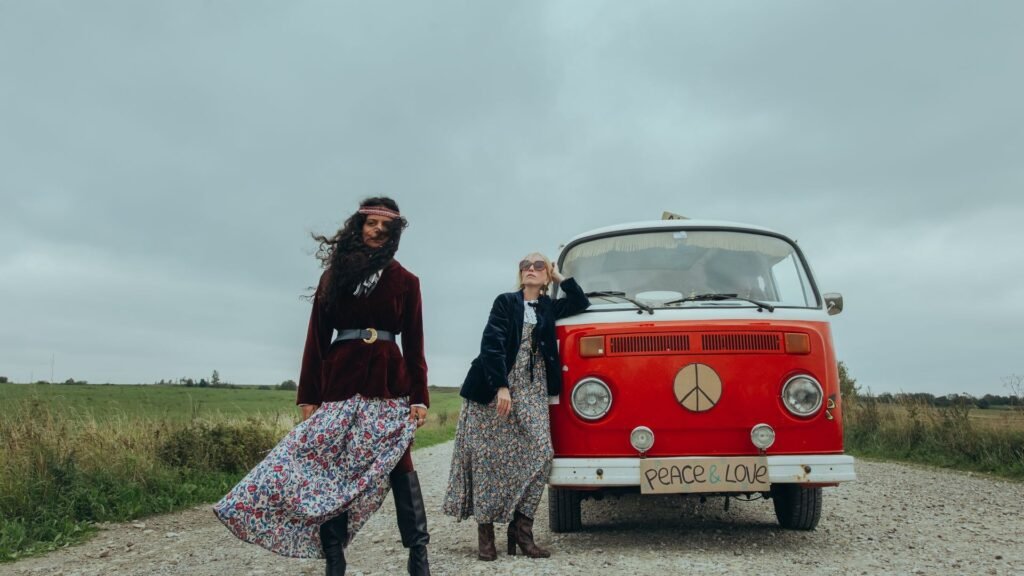

“60s slang” is the vocabulary of the 1960s counterculture: warm, defiant, music-soaked words like groovy, far out, and dig it that turned everyday talk into a badge of belonging.
If somebody calls your outfit “so 60s” today, they are not checking a calendar. They mean tie-dye and peace signs, rock music and protest marches, an entire attitude packed into three characters. This guide unpacks the label: what the words meant, who actually invented them (spoiler: mostly not hippies), how real 60s conversations sounded, which words survived into modern English, and how to borrow the fun ones without sounding like a costume.
On This Page
- The Word “60s” Does More Than Name a Decade
- Whose Words Were These, Really?
- The Vocabulary, Sorted by What It Did
- How a Real 60s Conversation Sounded
- Reading 60s Talk Today: A Translation Table
- Three Movie-Fueled Myths, Debunked
- Where 60s Slang Lives Now (and Where It Shouldn’t)
- Speaking 60s Without Sounding Like a Costume
- Quick Answers
- Sources and Further Reading
The Word “60s” Does More Than Name a Decade
When people say “60s,” they rarely mean the calendar years 1960 through 1969. They mean a cultural package: hippies and rock festivals, miniskirts and protest marches, a whole attitude toward authority, music, and dress. As slang, “60s” works like an adjective, and that shortcut is exactly why the vocabulary behind it is worth learning.
It helps to know the decade had two halves. The early 60s, from 1960 to about 1963, still talked a lot like the 1950s slang era: neat, polite, a little square. The “60s” everyone means started around 1964, when the Beatles landed in America and youth culture took the wheel, and ran hot through 1969. The slang followed the same arc. Early-decade words like “neato” and “dullsville” were holdovers from the 50s; by 1967, the Summer of Love had replaced them with “groovy,” “vibes,” and “far out.”
That lopsided timeline is why “60s slang” is really shorthand for the counterculture’s vocabulary, not the whole decade’s. Office workers in 1965 did not say “far out” in meetings. College students, musicians, activists, surfers, and mods did, and their words are the ones we remember.
Whose Words Were These, Really?
Most 60s slang was not invented in the 60s. Jazz musicians, Black street and church culture, Beat poets, British working-class kids, and TV comedy writers did the inventing; white hippies and the music press did the popularizing. The credit question matters, because the real history of this vocabulary is a story of borrowing, and a good slang guide should say so plainly.
The jazz and Black roots run deepest
The single biggest donor to 60s slang was African American jazz culture of the 1920s through the 1950s. Words like “groovy” (from the “groove” of a record), “dig it,” “cat,” “far out,” and “out of sight” were born in Black jazz clubs and on bandstands, then traveled into white youth culture through rock music. As Mr. Pop Culture’s history of the decade’s slang notes, the Beat Generation’s literary scene gave wider America words like “dig it” and “cool” before the hippies ever picked them up. The counterculture popularized the vocabulary, but it did not create most of it.
The Beats hand the baton over
Between jazz and hippies stood the Beat Generation: writers and wanderers of the 1950s who made nonconformity sound cool. Wikipedia’s account of the Summer of Love notes the 1967 gathering was directly inspired by Jack Kerouac’s On the Road and the Beat writers. “Hipster” shrank into “hippie,” “cool” went mainstream, and the idea that slang could be a lifestyle, not just decoration, passed straight from the Beats to the flower children.
Britain talks back
Then came the British Invasion. When the Beatles appeared on American television in 1964, British words crossed the Atlantic with them: “fab” (fabulous), “gear” (great, stylish), and the whole mod vocabulary of sharp-dressed London youth. Mr. Pop Culture describes how that 1964 moment blended counterculture ideals with pop sensibilities, making American kids eager to sound a little bit British. Mod slang, “grotty” (gross, the anti-groovy), and “spiffy” all rode that wave.
Television makes it national
Slang spreads fastest through a screen. Rowan & Martin’s Laugh-In, which ran on NBC from January 1968 to July 1973, was a weekly slang factory beamed into millions of living rooms. Its rapid-fire catchphrases, “sock it to me,” “you bet your bippy,” “look that up in your Funk & Wagnalls,” became schoolyard currency overnight. Even the show’s title was slang: a play on the era’s “love-ins” and protest “sit-ins.”
The movement gives it teeth
Finally, the politics. The civil rights and anti-war movements gave 60s slang its edge: “the Man” (authority, especially police and government), “right on” (solidarity), “power to the people,” “pig” (a hostile word for police). The Summer of Love’s own history records how deeply anti-war sentiment and suspicion of government ran through the 1967 scene. Timothy Leary voiced his famous line “turn on, tune in, drop out” at the January 1967 Human Be-In in Golden Gate Park, and it became the decade’s unofficial motto. This was slang with a target, and that is what separated 60s talk from the decades around it.
The Vocabulary, Sorted by What It Did
Sixties slang did jobs: it praised, it bonded, it defied, it relaxed. Sorted by function instead of alphabet, the word list reads like a manual for belonging. Here are the decade’s core words, each with what it was for and how it sounded in a sentence.
Words that said “I love this”
Praise was the decade’s default setting. If you liked something, you reached for one of these.
Groovy
Cool, excellent, fantastic. The signature word of the decade. Dictionary.com defines groovy as slang for “highly stimulating or attractive; excellent,” and notes the word was first recorded back in 1850 to 55, long before hippies got hold of it. Jazz musicians are often credited with turning the “groove” of a record into a compliment. Example: “This party is so groovy, man.”
Far out
Amazing, mind-blowing, wonderfully strange. The hippie’s favorite superlative for anything unconventional. Example: “That light show was far out.”
Out of sight
Fantastic, remarkable, even better than “far out.” Borrowed from jazz-era Black communities. Example: “Your tie-dyed shirt is outta sight.”
Boss
Excellent, top-quality. A short, punchy compliment that teenagers loved. Example: “That car is boss.”
Bitchin’
Really good, cool. California’s contribution to the praise vocabulary. Example: “That’s a bitchin’ surfboard.”
A gas
A fun time, a blast. If something was a gas, you were having one. Example: “The concert was a gas.”
Words that said “I’m with you”
Solidarity words. These turned agreement into a group hug.
Dig it
To understand, enjoy, or approve of something. “Can you dig it?” meant “Are you with me?” A jazz-era phrase the 60s carried into the mainstream. Example: “I dig this band. Can you dig it?”
Right on
Strong agreement, especially in activist circles. It signaled you stood with the cause. Example: “We want peace now!” “Right on, brother!”
Keep on truckin’
Keep going, don’t give up. Part encouragement, part philosophy. Example: “Exams are brutal, but keep on truckin’.”
Power to the people
A rallying cry for equality and self-determination, chanted at marches and printed on posters. It moved from the streets into everyday speech as a sign-off of solidarity.
Words that said “I reject this”
Every in-group needs an out-group, and 60s slang named its enemies precisely.
Square
A conventional, boring, uncool person. The decade’s great insult: if you didn’t get it, you were a square. Example: “Don’t be such a square, come to the show.”
The Man
Authority: police, government, bosses, the whole establishment. Fighting the Man was the counterculture’s entire project. Example: “You can’t trust the Man, man.”
The fuzz
The police. A protest-culture favorite, possibly a dig at officers being “soft” or a twist on “the force.” Example: “Split! The fuzz is coming!”
Uptight
Tense, rigid, overly strict. The opposite of everything the decade valued. Example: “Loosen up, don’t be so uptight.”
Plastic
Fake, phony, inauthentic. A cutting word in a decade obsessed with being real. Example: “That smile is so plastic.”
Drag
Something boring or annoying. If it killed the vibe, it was a drag. Example: “Homework is such a drag.”
Words that said “let’s relax”
The mellow vocabulary: how to take it easy in 60s style.
Hang loose
Relax, don’t stress. The carefree motto of the decade, shared with surfers. Example: “Just hang loose, the test isn’t that hard.”
Copacetic
Fine, okay, satisfactory. An old word (first recorded in 1919) that the 60s adopted as its laid-back seal of approval. Example: “Don’t worry, everything’s copacetic.”
Crash
To sleep or stay over at someone’s place. Crash pads were the decade’s hostels. Example: “Can I crash at your pad tonight?”
Bread
Money. Hippies wanted a word for cash that didn’t sound like the establishment. Example: “I don’t have the bread for tickets.”
Words that named the tribe
Labels for the people in the scene, and the ones outside it.
Hippie
A member of the counterculture: peace, love, communal living, psychedelic music. The word exploded during the 1967 Summer of Love, when as many as 100,000 young people converged on San Francisco’s Haight-Ashbury. Example: “The park was full of hippies handing out flowers.”
Flower child
A young, idealistic hippie, often pictured with flowers in their hair. The gentle, romantic face of the movement. Example: “She was a true flower child, barefoot and smiling.”
Cat
A cool person, usually a guy. Straight from jazz slang. Example: “That cat can really play guitar.”
Mod
A sharp-dressed follower of London’s mod subculture: scooters, tailored suits, modern jazz and soul. Example: “He’s a mod, always dressed to kill.”
Chick
A girl or young woman. Extremely common in 60s speech, but it sounds dated and dismissive today. This one belongs in the history books, not in your mouth. Example (1960s only): “She’s a groovy chick.”
Freak
Originally an insult for oddballs, reclaimed by the counterculture as a badge of pride: a “freak” was someone gloriously outside the mainstream. Example: “Let your freak flag fly.”
How a Real 60s Conversation Sounded
Sixties slang worked in sentences, not lists. Nobody said “groovy” alone and stopped; people strung praise, people-words, and scene-words into a flow that told you exactly which room they came from. These reconstructions show how the pieces fit together.
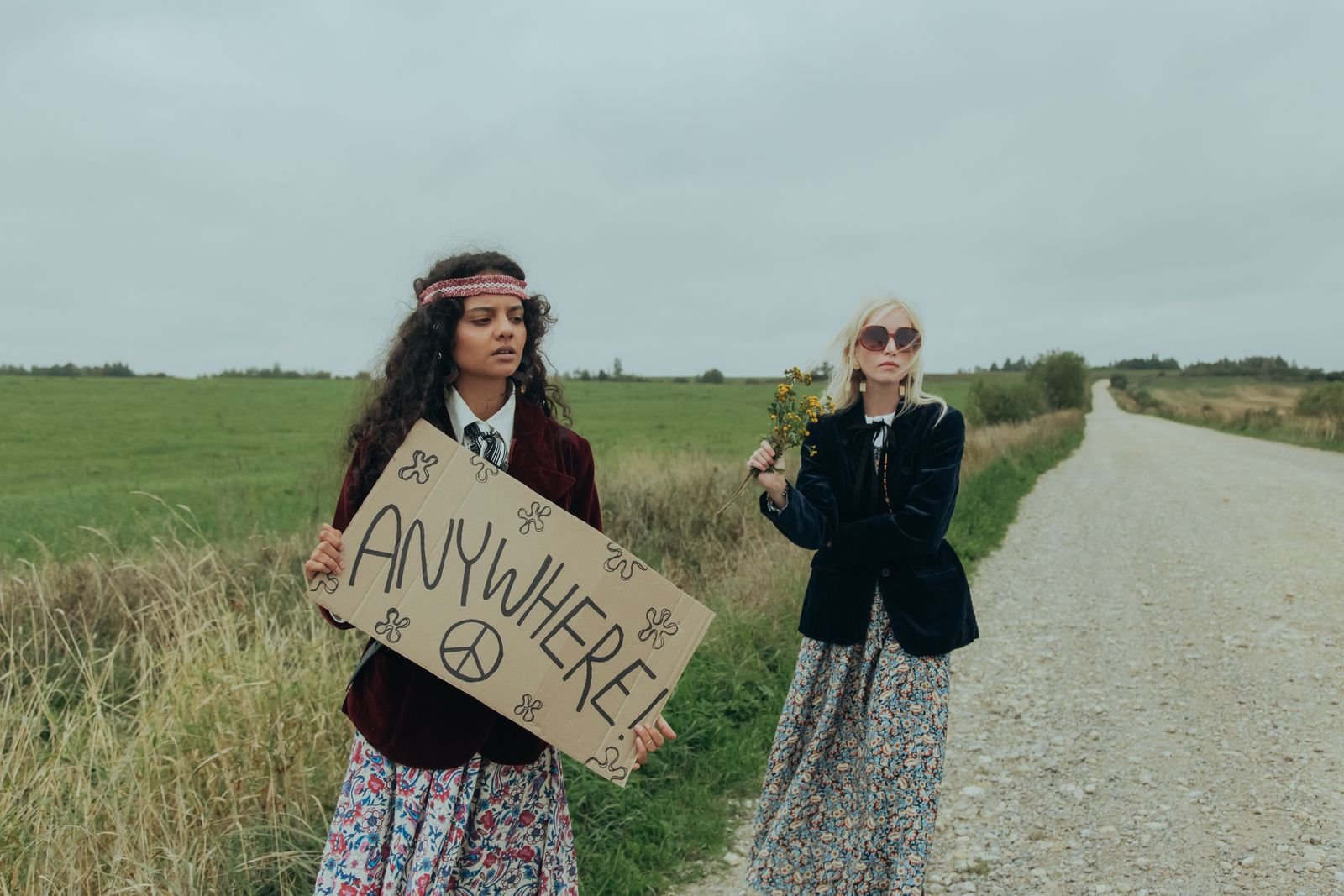
Hitchhiking with an “Anywhere!” sign was the decade’s travel language.
A Haight-Ashbury crash pad, summer 1967
“That show at the Fillmore was outta sight, man. I mean, far out.”
“I can dig it. The vibes in that place were so heavy.”
“Yeah? Well, don’t freak out, but we’re out of bread. Bummer.”
“Hang loose. My pad’s got floor space. You can crash.”
Notice the rhythm: praise (“outta sight,” “far out”), agreement (“I can dig it”), feeling-words (“vibes,” “heavy”), then practical slang (“bread,” “pad,” “crash”). This is how the vocabulary actually moved, in waves of enthusiasm followed by logistics.
A London club, mod night, 1965
“Your threads are gear tonight. Absolutely fab.”
“Cheers. You look a bit grotty though, mate. Rough night?”
“Don’t be cheeky. I’m mod to the bone.”
British 60s slang was drier and more fashion-obsessed than the American hippie version. Compliments came with a little bite, and “mod” was an identity you defended.
A campus anti-war meeting, 1968
“The Man wants to draft us for a war nobody voted for.”
“Right on. Power to the people.”
“March is Saturday. Bring your friends, and if the fuzz shows up, don’t freak out. Just split.”
Here the slang is doing political work. “The Man” names the enemy, “right on” seals the alliance, and the whole exchange fits in thirty seconds. Protest slang had to be short because it was often shouted.
A suburban teen quoting Laugh-In, 1969
“Sock it to me!”
“You bet your bippy.”
“Look that up in your Funk and Wagnalls!”
Not everyone was a hippie, and most teenagers were not at Woodstock. For millions of kids, 60s slang arrived through the television, and quoting Laugh-In catchphrases at school was the safest way to sound with it.
Reading 60s Talk Today: A Translation Table
Languages need translators, and decades do too. This table lines up core 60s words with what they meant, what later decades turned them into, and what young people say now, so you can watch the exact same idea travel through time.
| 60s word | What it meant | Later decades | Gen Z says | The idea that traveled |
|---|---|---|---|---|
| Groovy | Cool, excellent | Survived as retro nostalgia | “Fire,” “ate” | Praise keeps needing stronger words |
| Far out | Amazing, mind-blowing | Still “far out” in the 70s | “Insane,” “crazy” | Amazement outlives every synonym |
| Dig it | Understand, enjoy | “I hear you” (70s) | “I feel that,” “valid” | Agreement as empathy |
| The Man | The authorities | “The establishment” (70s) | “The system,” “ops” | Every generation renames power |
| Pad | Home, apartment | “Crib” (70s onward) | “Crib” (still!) | Home gets a cool alias, then keeps it |
| Square | Uncool conformist | “Uncool,” “lame” (70s/80s) | “Mid,” “NPC” | The out-group always gets a label |
| Bread | Money | Still “bread” in the 70s | “Bread,” “bag” | Money slang barely changes |
| Bummer | Disappointment | Still “bummer” in the 70s | “L,” “that’s rough” | Bad news needs a soft landing |
The pattern is honest: some words died (“sock it to me”), some never left (“vibes,” “bread,” “bummer”), and the ideas underneath them, praise, solidarity, defiance, comfort, are permanent. If you want to watch the handoff continue, our guide to 1970s slang picks up right where this decade ends, and the 1980s slang guide shows what the next generation did with the leftovers.
Three Movie-Fueled Myths, Debunked
Sixty years later, movies have done as much to shape what we think 60s slang was as the decade itself did. Three corrections are in order.
Myth 1: Real hippies talked like Austin Powers
They did not. Mike Myers’ three Austin Powers films (1997, 1999, and 2002) are loving satires of 1960s Swinging London spy movies, not documentaries. Real hippies said “groovy” and “far out,” but nobody in 1967 said “shagadelic” or “yeah, baby!” Those were invented for the films. Actual 60s slang was earthier and more political, “right on,” “power to the people,” than the movie version.
Myth 2: 60s slang was all about drugs
Drugs contributed a few words (“trip,” “acid,” “pot,” “head”), but the bulk of the vocabulary was about music, fashion, peace, and everyday life: “groovy,” “threads,” “pad,” “bummer,” “hang loose.” The Summer of Love itself was about far more than substances: spiritual searching, anti-war protest, communal living, and free love. Reducing the decade’s language to drug references misses the civil rights movement, the British Invasion, and the fashion revolution that shaped most of the words.
Myth 3: Hippies invented all of it
Many of the most famous 60s words, “groovy,” “dig it,” “cat,” “far out,” “out of sight,” came from Black jazz musicians of the 1920s through the 1950s, decades before the first hippie. The counterculture popularized them but did not create them. The real origin story of 60s slang is a story about African American culture being adopted, and sometimes watered down, by white youth, and any honest guide should say that out loud.
Where 60s Slang Lives Now (and Where It Shouldn’t)
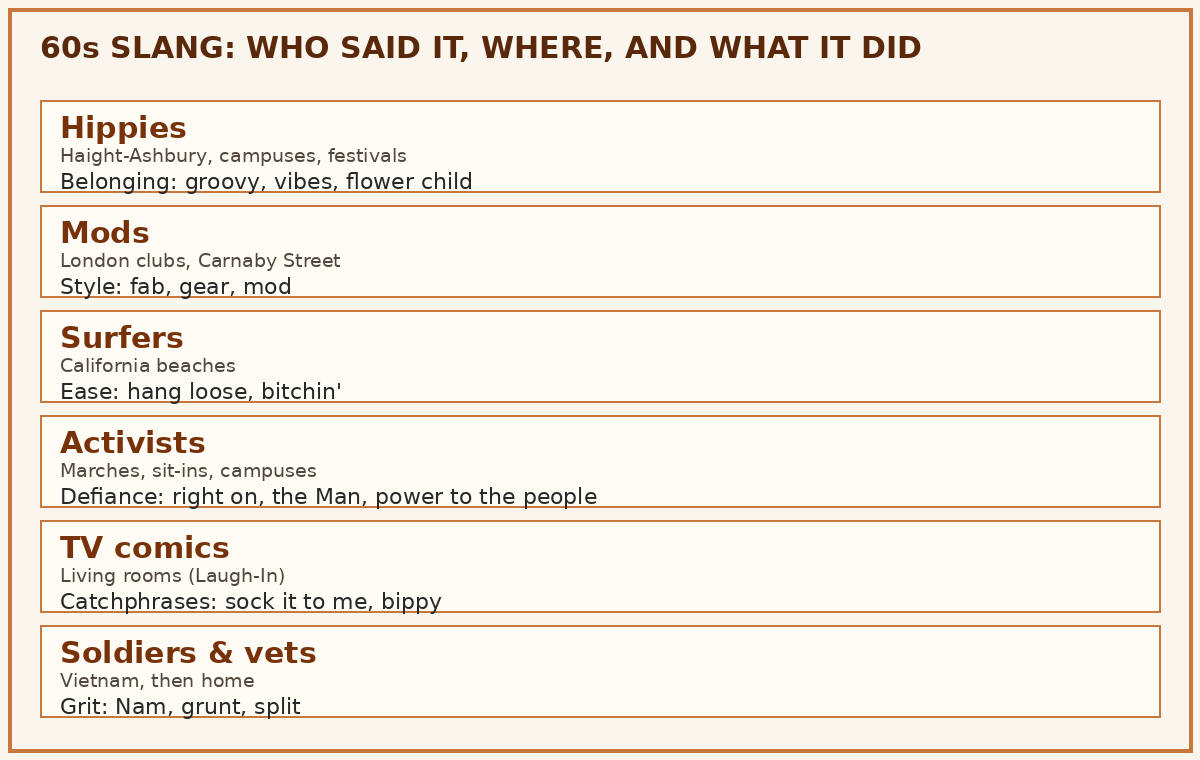
Sixties slang never fully died. Words like “vibes,” “bummer,” “hang loose,” “freak out,” and “mellow” are ordinary modern English; the rest survives as costume-party shorthand, brand nostalgia, and grandparent-speak. Knowing which is which keeps you from misfiring. The map below shows who carried the words, and the photo shows the look that carried them.

The headband-and-meadow look is still the visual shorthand for “the 60s.”
Lines you can still use safely
These survived because they fill a real gap in modern English: “vibes” (the feeling of a place), “bummer” (soft disappointment), “hang loose” (relax), “freak out” (panic), “mellow” (calm), “pad” (your place, among friends). Nobody will blink if you use them. They are not retro; they are just English now.
Lines to leave in 1969
Some words only work as jokes now. “Groovy,” “far out,” and “sock it to me” will get a laugh at a themed party and a blank stare in a meeting. “Chick” is worse than dated: it is dismissive, so retire it completely. And “the fuzz” will make you sound like a costume, not a rebel. The rule is simple: if the word needs a wig to work, don’t wear it to work.
When NOT to use 60s slang
A few boundaries worth respecting. Don’t use protest slang (“the Man,” “right on,” “power to the people”) to decorate opinions you don’t hold; it reads as costume activism. Don’t call women “chicks,” ever. Don’t lecture anyone about the decade using its own slang; nothing kills “groovy” faster than a history lesson. And at work, keep it to the survivors (“vibes,” “bummer”) unless your office is unusually far out.
Speaking 60s Without Sounding Like a Costume
Want to play along when someone drops a 60s phrase, at a themed party, quoting a grandparent, or just for fun? There is a genuine sequence to it.
- Pick two or three words, max. “Groovy,” “far out,” and “man” will carry you. Stacking ten slang words in one sentence is how parodies talk, not people.
- Match the energy, not the dictionary. If someone says “That concert was outta sight!” with real enthusiasm, answer with enthusiasm: “Far out! Totally groovy.” Matching feeling matters more than matching vocabulary.
- Learn the three classic replies. “Can you dig it?” gets “I can dig it!” or “Right on!” “What a bummer, man” gets “Yeah, that’s heavy. Hang loose.” “Sock it to me!” gets whatever truth they were asking for, delivered dramatically. That is the whole joke of the phrase.
- Know your exit. Drop the slang, land the joke, then talk normally. One “groovy, man” is charming. Twenty is a bit.
Quick Answers
What does “60s” mean in slang?
In slang, “60s” means the 1960s counterculture and its vocabulary: hippies, rock music, protest movements, and words like “groovy,” “far out,” and “dig it.” As an adjective (“that’s so 60s”), it describes anything with a peace-and-love, retro-rebellious vibe.
What are the most famous 60s slang words?
The most famous are “groovy,” “far out,” “dig it,” “right on,” “bummer,” “hippie,” “freak out,” “out of sight,” “the Man,” “pad,” and “sock it to me.” These words defined the decade and are still recognized today, even by people who never lived through the 60s.
Where did 60s slang come from?
Mostly from three sources: African American jazz culture of the 1920s to 1950s (“dig it,” “cat,” “far out”), the hippie counterculture of the mid-to-late 60s (“vibes,” “flower child”), and British Invasion pop culture (“fab,” “gear,” “mod”). Television’s Laugh-In and the protest movements added the rest.
Is 60s slang still used today?
Some of it, yes. Words like “vibes,” “bummer,” “mellow,” “hang loose,” “freak out,” and “bread” (for money) are still completely normal in modern English. Others, like “groovy” and “sock it to me,” survive as retro jokes. For how the language kept evolving, see our 1990s slang guide and the 1940s slang guide where jazz-era words like “dig it” were born.
What is the difference between 60s and 70s slang?
Sixties slang was idealistic and political (“right on,” “power to the people,” “flower child”), while 70s slang was more laid-back and street-flavored. Many 70s words were direct descendants of 60s ones. Our 1970s slang guide covers the full handoff between the decades.
Why do people say “groovy” when joking about the 60s?
Because it was the decade’s signature word. Dictionary.com defines groovy as slang for “highly stimulating or attractive; excellent,” and the Austin Powers films of the late 90s cemented it as the go-to parody word. Saying “groovy, baby” is quoting a 1997 comedy quoting the 60s, which is why it always lands as a joke.
Did hippies really say “far out”?
Yes, genuinely. Unlike the Austin Powers catchphrases, “far out” was real hippie speech, borrowed from 1950s jazz culture and used for anything amazing or unconventional. It was common enough at gatherings like Woodstock, which drew more than 460,000 people to Bethel, New York, in August 1969, that it became part of the shared identity of the scene.
Sources and Further Reading
- Dictionary.com’s entry for “groovy”: definition and first recorded use
- Wikipedia: Summer of Love: the 1967 gathering, the Human Be-In, and Leary’s “turn on, tune in, drop out”
- Wikipedia: Woodstock: the August 1969 festival and its scale
- Wikipedia: Rowan & Martin’s Laugh-In: the show’s 1968 to 1973 run and its catchphrases
- Wikipedia: Austin Powers: the 1997, 1999, and 2002 films and their 60s satire
- Mr. Pop Culture: “Sock It to Me!”: Beat Generation roots and the British Invasion’s slang
- BigWords101: Some Sixties’ Slang: a long word list used to cross-check meanings



Pingback: 1970s Slang Meaning: Popular 1970s Slang Words and Phrases Explained
Pingback: 50s Slang: 40+ Vintage 1950s Words & Phrases Explained