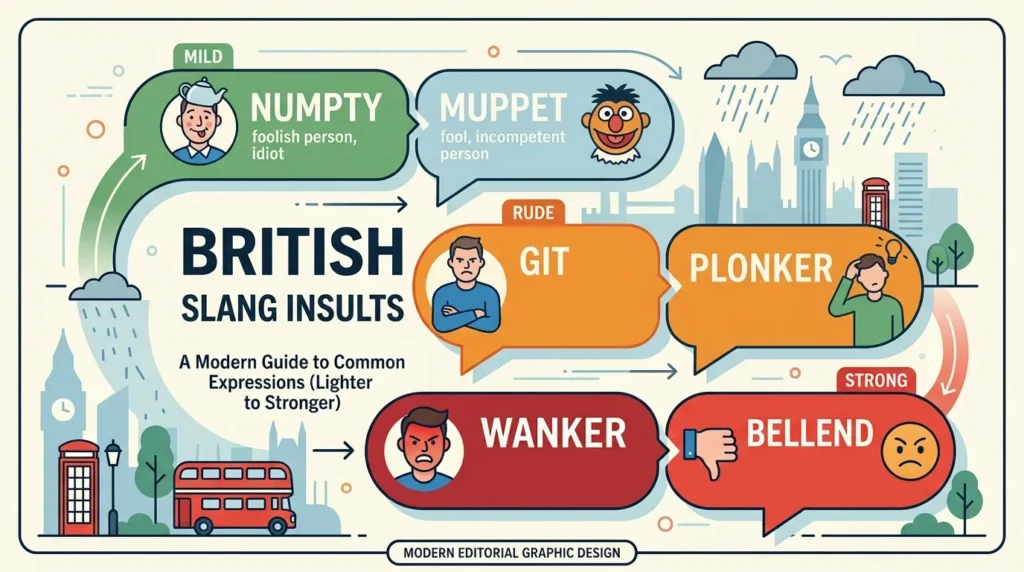

British slang insults are informal words used to call someone foolish, annoying, unpleasant, arrogant, or ridiculous. Some, such as numpty and muppet, can sound almost playful between friends. Others, including wanker, bellend, and twat, are genuine profanity and can cause offense.
The difficult part is that British insults do not have one fixed emotional strength. Tone, friendship, region, setting, and delivery can turn the same word from friendly banter into an argument. Britain also contains many regional speech traditions, so an expression familiar in Scotland may sound unusual elsewhere.
| Quick Answer | Meaning |
|---|---|
| What are British slang insults? | Informal British words used to tease, criticize, mock, or insult someone |
| Common mild examples | Numpty, muppet, plonker, wally |
| Common stronger examples | Tosser, wanker, bellend, twat |
| Typical context | Friends, arguments, comedy, social media, sports, everyday conversation |
| Tone | Playful to highly offensive |
| Formal use | Usually inappropriate |
| Main rule | Relationship and tone matter as much as the word |
What Are British Slang Insults?
British slang insults are informal expressions associated with British English and its regional varieties. They usually describe someone as stupid, incompetent, irritating, dishonest, arrogant, or simply ridiculous.
They are different from neutral words such as foolish or annoying because slang carries extra social meaning. Calling your friend a muppet after they spill a drink can sound affectionate. Calling an angry stranger a wanker is much more confrontational.
There is also no single uniform form of “British slang.” England, Scotland, and Wales have their own regional vocabulary, while Northern Irish speech has additional influences and overlaps with Irish English. Age and social group matter too.
Popular British Slang Insults at a Glance
These strength levels are practical guides rather than fixed rules. A mild expression can still sound hostile when said aggressively.
| Slang Term | Simple Meaning | Typical Tone | Usage Warning |
|---|---|---|---|
| Numpty | Silly or stupid person | Mild | Often playful |
| Muppet | Foolish or incompetent person | Mild | Common teasing insult |
| Plonker | Silly person | Mild | Often humorous |
| Wally | Foolish person | Mild | Can sound old-fashioned |
| Twit | Silly person | Mild | Very light by modern standards |
| Berk | Stupid or irritating person | Mild | Usually sounds softer than its origin |
| Prat | Person behaving stupidly | Mild to moderate | Informal |
| Pillock | Stupid or silly person | Moderate | More insulting than it sounds |
| Git | Stupid or unpleasant person | Moderate | Can be affectionate or hostile |
| Mug | Gullible person | Moderate | Often about being fooled |
| Melt | Timid, weak, or embarrassing person | Mild to moderate | Meaning varies by speaker |
| Wazzock | Stupid person | Mild | More old-fashioned |
| Bampot | Foolish person | Mild to moderate | Mainly Scottish |
| Tosser | Stupid or unpleasant person | Strong | Offensive |
| Wanker | Very unpleasant or stupid person | Strong | Vulgar |
| Bellend | Stupid or annoying person | Strong | Sexual literal meaning |
| Knobhead | Idiotic or obnoxious person | Strong | Vulgar |
| Dickhead | Stupid or unpleasant person | Strong | Vulgar |
| Twat | Stupid or unpleasant person | Strong | Offensive sexual term |
| Arsehole | Very unpleasant person | Very strong | Direct profanity |
Mild British Insults Often Used as Banter
Numpty
A numpty is someone who has done something foolish, silly, or incompetent. It is generally one of the softer British insults.
Example:
“You put salt in your coffee, you absolute numpty.”
Among friends, that may sound more amused than angry.
Muppet
Calling someone a muppet means they are behaving stupidly, cluelessly, or incompetently. It is usually informal rather than deeply offensive.
Example:
“I left the tickets at home. I’m such a muppet.”
Notice that people can use it about themselves as well.
Plonker
A plonker is a silly or stupid person. Modern usage often has a comic or slightly old-fashioned feel.
Example:
“You drove all the way here without your wallet? Plonker.”
It works especially well as a reaction to a harmless mistake.
Wally
Wally is another light way of calling somebody foolish or silly.
Example:
“Wrong train again? You wally.”
It rarely carries the same aggression as stronger profanity.
Twit
A twit is a foolish person. It sounds mild enough that it may appear where stronger insults would feel inappropriate.
Example:
“Which twit left the window open?”
The word can sound dated, but it remains easily understood.
Berk
A berk is an irritating or stupid person. Interestingly, its historical roots are considerably ruder than its present-day sound: it developed through rhyming slang connected to a much stronger taboo word. Modern speakers often use berk without thinking about that origin.
Example:
“Some berk blocked the driveway.”
This is a good example of why a word’s history does not always match its current strength.
Wazzock
Wazzock means a stupid person and now tends to sound old-fashioned or deliberately comic.
Example:
“Get out of the way, you wazzock.”
You are more likely to hear it for humorous effect than as the cutting edge of modern youth slang.
Also Read: Truffle Butter Slang Meaning: Definition, Origin & Use
Also Read: Tuff Slang Meaning: What Tuff Means in Text and Online
Moderate British Insults
Prat
A prat is someone behaving stupidly or making themselves look foolish.
Example:
“I tried to push a door marked pull and looked like a right prat.”
The phrase make a prat of yourself means to embarrass yourself through foolish behavior.
Pillock
Pillock means a stupid or silly person, but it can land harder than plonker or muppet.
Example:
“You pillock, you sent it to the wrong group chat.”
Among friends it may still be comic, but it is not automatically friendly.
Git
A git is a stupid, annoying, or unpleasant person, often but not exclusively a man.
Example:
“You cheeky git, you ate the last biscuit.”
The adjective makes a major difference. Cheeky git may be playful, while miserable git sounds more critical.
Mug
Calling someone a mug usually suggests that they are gullible, easily fooled, or letting other people take advantage of them.
Example:
“I paid for everyone again. I feel like a mug.”
A related expression is mug someone off, meaning to make a person look foolish, deceive them, or treat them badly.
Melt
Melt can describe someone seen as weak, overly soft, timid, embarrassing, or lacking backbone. The exact shade depends heavily on the speaker and context.
Example:
“Stop being a melt and just ask her.”
Because slang changes quickly, this is a term where context matters more than a neat one-word translation.
Bampot
Bampot is Scottish slang for a foolish person.
Example:
“What kind of bampot parks there?”
It is a useful reminder that a list of British insults should not treat every expression as equally common across Britain.
Strong British Slang Insults
Tosser
A tosser is a stupid or unpleasant person. It is recognized as offensive British slang.
Example:
“He pushed past everyone in the queue. What a tosser.”
It is considerably riskier with strangers than light terms such as numpty.
Wanker
Wanker literally relates to masturbation, but as an insult it usually means a very stupid, obnoxious, selfish, or unpleasant person. It is offensive and vulgar.
Example:
“Some wanker nearly hit me because he was looking at his phone.”
Americans sometimes encounter the word mainly through British comedy, but hearing it in a joke does not make it polite.
Bellend
Bellend literally refers to the head of the penis and is also used for a stupid or annoying person, particularly a man.
Example:
“He keeps playing videos on full volume. Absolute bellend.”
The humorous sound of the word can hide how crude its literal meaning is.
Knobhead
Knobhead, often shortened in conversation to knob, is a vulgar way to describe an idiotic, irritating, or obnoxious person.
Example:
“Don’t be a knobhead. Put it back.”
This is firmly casual language and should stay out of professional settings.
Dickhead
Dickhead is not uniquely British, but it is common enough in British conversation to belong in the same practical vocabulary. It describes someone behaving stupidly, selfishly, or unpleasantly.
Example:
“Who parks across two spaces like that? Dickhead.”
Its strength varies, but it is still profanity.
Twat
Twat has a vulgar anatomical meaning and is also an offensive word for a stupid or unpleasant person.
Example:
“He knew the meeting was canceled and didn’t tell anyone. What a twat.”
This one can be used jokingly among close friends, but that does not turn it into a mild word.
Arsehole
Arsehole is the British form corresponding to American asshole. As an insult, it means an extremely unpleasant or stupid person.
Example:
“He laughed when she dropped everything. What an arsehole.”
It is direct, hostile-sounding profanity in many situations.
Also Read: YOLO Meaning Slang: What It Means and How to Use It
Why “Absolute” and “Right” Make British Insults Sound Different
British speakers often intensify insults with words such as absolute, complete, total, proper, or right.
Compare:
“You numpty.”
“You absolute numpty.”
The second version sounds more dramatic, but it does not always become more hostile. Sometimes the exaggerated wording actually adds humor.
Right also appears in phrases such as:
“He made a right prat of himself.”
“She looked a right wally.”
Here, right works roughly like complete or proper rather than referring to direction.
How Tone Can Turn an Insult Into Friendly Banter
The dictionary meaning is only half the message.
Imagine one friend laughing and saying:
“You absolute muppet.”
Now imagine an angry stranger staring directly at someone and saying:
“You absolute wanker.”
Both sentences insult someone, but the social meaning is completely different.
Three clues help you judge what is happening:
Relationship: Close friends have more room for teasing than strangers.
Delivery: Laughter and exaggerated disbelief can soften an insult. Shouting usually does the opposite.
Situation: Teasing someone for dropping a sandwich is different from insulting them during a serious dispute.
Emojis create similar effects online. “You numpty 😂” clearly signals a different mood from “You wanker.”
British Insults on TikTok, Texting, and Social Media
Most British insults do not acquire a completely new definition simply because they appear online.
Instead, social media changes their presentation.
A word like muppet, numpty, or plonker may appear under a video showing a harmless mistake:
“Bro locked himself out again. Absolute numpty 😭”
Stronger words appear in reactions to annoying behavior:
“Imagine talking to staff like that. Bellend.”
Memes also spread regional British vocabulary beyond the places where it originated. That means someone using a Scottish or London-associated term online may not actually come from that region.
Internet visibility should therefore not be confused with universal everyday British usage.
British and American Insults Are Not Exact Translations
Trying to translate every British insult into one American word can lose the tone.
| British Term | Rough American Equivalent | Important Difference |
|---|---|---|
| Numpty | Dummy | Often more playful |
| Muppet | Idiot / goof | Frequently comic |
| Plonker | Fool | More distinctly British |
| Git | Jerk | Can sound affectionate between friends |
| Mug | Sucker | Focuses on being fooled |
| Tosser | Jerk-off | Both crude |
| Wanker | Jerk-off / asshole | Strong British profanity |
| Arsehole | Asshole | Mostly spelling and pronunciation difference |
These are approximate comparisons, not direct translations.
A speaker’s delivery may make git sound warmer than jerk, while wanker may sound much harsher than an American learner expects.
British Slang Insults That Need Extra Caution
Some words found in lists of “funny British insults” carry meanings that are too specific or socially loaded to treat as ordinary banter.
Nonce
Nonce should not be treated as another word for “idiot.” In modern slang it refers to a sexual offender, especially someone who commits sexual crimes involving children.
People sometimes throw the word around carelessly online, but its real meaning makes it a serious accusation.
Chav
Chav is commonly used as a derogatory social label rather than a simple synonym for “stupid person.” It can carry stereotypes connected with class, clothing, behavior, and social status.
For learners, recognizing the word is more useful than adding it to a casual insult vocabulary.
Slag
Slag can be used as a harsh, often gendered sexual insult. Its tone is very different from playful words such as muppet.
Treating both as equally harmless “British banter” misses an important difference.
Ponce
Ponce has had several insulting meanings, including a pimp and an offensive label for a man perceived as insufficiently masculine.
Because of those associations, it is not a particularly useful word for learners looking for harmless modern teasing.
Regional Differences Across Britain
British English is not one accent or one slang vocabulary.
Scottish English contributes expressions such as bampot and is strongly associated with numpty, although numpty is now understood much more widely.
Some older English insults, including wazzock, wally, and plonker, may sound more familiar to certain generations than to younger speakers.
Other expressions travel easily through television, football culture, comedy, music, memes, and social media. A word that began regionally can therefore become recognizable nationwide without becoming equally common everywhere.
For language learners, “British” is best treated as a broad label rather than proof that every person in the UK regularly uses every term on the list.
Also Read: PTSO Meaning Slang: What It Means in Text and TikTok
Formal Versus Informal Usage
Most slang insults belong in informal conversation, and even the mild ones need some social awareness.
Among close friends:
Muppet, numpty, plonker, wally, git, and prat may work as teasing if that style already exists in the friendship.
With strangers:
Even mild insults can sound hostile. Avoid assuming someone will recognize your intended humor.
At work:
Words such as wanker, bellend, twat, tosser, knobhead, and arsehole are generally poor choices. Mild joking language may still be inappropriate depending on workplace culture.
At school:
Teachers and school rules may treat vulgar slang as swearing even when students claim they were joking.
In formal writing:
Use neutral alternatives such as foolish, irritating, unprofessional, inconsiderate, or incompetent unless the slang itself is the subject.
Real British Slang Insult Conversations
A harmless mistake
“Mate, you’ve got your shirt on inside out.”
“Oh, brilliant.”
“You absolute numpty.”
Here, numpty is light teasing.
Friendly frustration
“You ate my chips?”
“I thought you were finished.”
“You cheeky git.”
The word cheeky helps make the exchange playful.
Someone gets fooled
“You paid him before he even started the job?”
“Yeah.”
“You mug.”
Here, mug means someone who has allowed themselves to be taken advantage of.
Complaining about a stranger
“He just pushed to the front of the queue.”
“What a tosser.”
This is much more openly insulting.
Strong anger
“He took the credit for the whole project.”
“What an absolute wanker.”
The expression communicates real contempt.
Self-deprecating humor
“I sent the message to the client instead of my colleague.”
“You didn’t.”
“I did. I’m such a prat.”
British insults often work just as naturally when directed at yourself.
How British Insults Become Affectionate
An unusual feature of informal conversation is that an insult can sometimes signal closeness.
A friend saying:
“Come here, you idiot.”
may not actually be expressing contempt.
British slang can work similarly. Git, muppet, numpty, and even stronger words occasionally appear between close friends with affection rather than hostility.
But familiarity is the key. You cannot safely copy the vocabulary without also copying the relationship that makes it acceptable.
That is why watching two longtime friends insult each other does not mean the same wording is safe with a stranger, coworker, customer, or someone you have just met.
Are British Slang Insults Actually More Creative?
British insults often stand out because many do not sound obviously aggressive to outsiders.
Plonker, wazzock, muppet, and numpty have a comic rhythm. Other insults use ordinary nouns in unexpected ways, allowing almost anything to become an insult when the delivery is right.
That does not mean every British conversation is full of elaborate put-downs. The creative reputation comes partly from comedy, television, online clips, sports culture, and the way British banter is presented internationally.
In real conversation, ordinary words such as idiot, prat, git, and stronger profanity remain just as useful as elaborate phrases.
Origin and Evolution of British Insults
British insults come from many different linguistic routes.
Some began as ordinary nouns that gradually gained insulting meanings. Others came from sexual vocabulary, rhyming slang, regional dialects, or humorous comparison.
Berk is a striking example. Its modern meaning is simply a stupid or irritating person, yet its history traces back to rhyming slang connected with a much stronger obscenity.
Wanker and bellend moved from literal sexual meanings into broader insults for unpleasant people.
Other terms survive largely because they sound funny. Plonker and wazzock can feel almost deliberately theatrical today.
Slang rarely changes in a straight line. A word can become softer, stronger, dated, fashionable again, regional, ironic, or meme-driven depending on who is using it.
Also Read: DTF Meaning Slang: What It Means in Text and Dating
Respectful Use for Non-British Speakers
Understanding British insults is usually easier than using them naturally.
Start by recognizing the strength of the word rather than trying to imitate every expression you hear.
Mild vocabulary such as muppet or numpty is easier to interpret. Strong words such as wanker, bellend, twat, and arsehole deserve more caution.
Avoid forcing slang into sentences simply to sound British. Native slang sounds natural partly because of rhythm, accent, timing, friendship, and shared cultural expectations.
If you are unsure whether a word is affectionate or hostile, pay attention to the reaction of the person receiving it. Their reaction tells you more than the vocabulary alone.
Frequently Asked Questions
What is the most common British slang insult?
There is no reliable single “most common” British insult across every region and age group. Words such as git, prat, muppet, numpty, wanker, and tosser are widely recognizable, but frequency varies greatly by generation, location, friendship group, and setting.
What is a funny British insult for an idiot?
Numpty, muppet, plonker, and wally are useful mild examples. They can describe someone who has done something silly without automatically sounding vicious. Their effect still depends on tone, so even a harmless-sounding word can become rude when delivered aggressively.
Is “wanker” a bad word in Britain?
Yes. Wanker is an offensive word with a sexual literal origin. In everyday insulting use, it commonly describes someone considered very stupid, unpleasant, selfish, or obnoxious. Friends may sometimes use it jokingly, but it remains profanity.
Is “muppet” an insult in British slang?
Yes. Calling someone a muppet means they are stupid, foolish, or incompetent. It is usually much milder than wanker or twat and commonly appears as playful criticism after a harmless mistake.
What does “you mug” mean in British slang?
Calling someone a mug suggests that they are gullible, foolish, or allowing others to take advantage of them. The related phrase mug someone off means to make someone look foolish or treat them badly, often through deception.
What does “you absolute weapon” mean in British slang?
Calling somebody a weapon can work as an ironic insult meaning that they are behaving like an idiot, liability, or chaotic person. Usage is highly contextual and regional, so it should not be treated as a universal British equivalent of idiot.
Are British insults affectionate?
They can be. Friends sometimes use mild insults to signal familiarity, humor, or affection. The same expression may sound hostile between strangers. The relationship between speakers, facial expression, delivery, situation, and surrounding words all affect the intended meaning.
Which British insults should tourists avoid using?
Tourists and language learners should be especially careful with wanker, tosser, bellend, twat, knobhead, and arsehole. Words carrying specific accusations or social baggage, such as nonce, also should not be treated as harmless British humor.
Conclusion
British slang insults range from the almost affectionate numpty and muppet to openly offensive words such as wanker, bellend, twat, and arsehole. Knowing the dictionary meaning is useful, but understanding the relationship between speakers matters even more.
The safest approach is to separate words you can comfortably recognize from words you should actively use. Listen for tone, notice whether the speakers are friends, and remember that Britain has significant regional and generational variation. A phrase that sounds hilarious in a comedy scene can feel completely different when directed at a stranger in real life.
Related Slang Terms
Explore more slang meanings from our dictionary:

Pingback: Tuff Slang Meaning: What Tuff Means in Text and Online
Pingback: Jit Slang Meaning: Definition, Examples, Origin & Usage
Pingback: Tuff Meaning Slang: What Tuff Means in Text & Online
Pingback: British Slang for Idiot: 14 Words Brits Use Explained