

This Gen Z slang quiz has 20 multiple choice questions that test whether you can actually understand the slang Gen Z uses every day, from “fire” and “bet” to “rizz” and “IYKYK,” and every answer is explained right under the question so you learn as you play.
If you have ever read a comment from a teenager and felt like it was written in a different language, you are not alone. Gen Z slang moves fast, and a word that meant one thing last year can mean something else by the next semester. I have watched parents, teachers, and older siblings all squint at the same sentence and come away with three different guesses about what it meant. This quiz fixes that. It is built for parents who want to understand their kids, teachers who want to connect with a class, friend groups looking for a fun game night, and anyone who is simply curious about how young people talk online in 2026.
You do not need to study for this. Just read each scenario, pick the answer that feels right, and then read the explanation under it. The questions are grouped into three levels, beginner, intermediate, and advanced, so you can feel the difficulty climb as you go. A scoring guide at the end tells you what your total means, a glossary explains every word tested, and a short section shows you how to run the whole thing with friends or a class. One honest note before we start: much of this slang has roots in African American Vernacular English and Black American English, with more coming from ballroom and LGBTQ+ communities, and it often reaches teenagers years after it was first used in those communities, as the team at Decka points out in their guide to Gen Z slang. The quiz is a way to learn the words, and learning where they came from is part of learning them properly.
Table of Contents
- How This Quiz Works
- Beginner Level: Questions 1 to 7
- Intermediate Level: Questions 8 to 14
- Advanced Level: Questions 15 to 20
- Your Score, Explained
- Words From the Quiz, Explained
- How to Run This Quiz With Friends or a Class
- FAQs About the Gen Z Slang Quiz
- Sources and Further Reading
How This Quiz Works
This quiz works like a game you can play alone or with a group: you get 20 scenario based questions, each with four possible answers, and you score one point for every correct answer, with the correct answer and a short explanation shown right under each question so you can check yourself as you go. There is no timer, no sign up, and no trick. The questions are grouped into three levels. Beginner questions cover the words you will see most often, like “fire” and “bet.” Intermediate questions cover words that need a little more context, like “rizz” and “bussin.” Advanced questions cover the terms that trip up even confident slang users, like “IYKYK” and “understood the assignment.” Play it in order, or jump straight to the level that matches you.
Here is how to play. Read the scenario in each question and pick A, B, C, or D before you look at the answer. If you are playing with friends, have everyone write their answers down before anyone says theirs out loud, and give one point per correct answer. If you are playing alone, keep a tally on your phone or a scrap of paper. When you finish all 20, add up your points and find your score band in the scoring table below. A score of 17 to 20 means you are fluent. A score of 12 to 16 means you are solid. A score of 7 to 11 means you know the basics. A score of 0 to 6 means you have some catching up to do, and the glossary at the end is your best friend.
Every question is a little scene from real life, a text message, a comment, a caption, a party, a group chat. That is deliberate. Slang does not live in a dictionary, it lives in conversations, and the fastest way to learn it is to see it used the way people actually use it. The competing quiz pages I looked at, including the Gen Z slang quiz on Kylian and the quiz on My Perfect Words, use the same leveled, scenario based format, and it works because it tests understanding, not memorization. Where this quiz goes further is that every answer comes with an explanation, so a wrong answer still teaches you something, and the glossary at the end covers every word in the quiz in one place.
Beginner Level: Questions 1 to 7
The beginner level covers the seven most common Gen Z slang words, the ones you will see in comments, captions, and group chats almost every day. If you can answer most of these, you already speak more Gen Z than you think.
Question 1: Your friend posts a photo of her new outfit and the first comment says, “That outfit is fire.” What does “fire” mean here?
- A) The outfit is literally on fire
- B) The outfit looks excellent
- C) The outfit is too hot to wear
- D) The outfit is old fashioned
Correct answer: B) The outfit looks excellent. “Fire” is the classic Gen Z praise word, and it means something is excellent or amazing. It has nothing to do with actual flames. A song can be fire, a meal can be fire, and an outfit can be fire. If you want a deeper look at this word family, our guide to fye slang explains the phonetic spelling of fire that grew out of Southern American English.
Question 2: You text your friend, “Want to grab pizza after class?” and she replies, “Bet.” What is she saying?
- A) She wants to place a wager on something
- B) Okay, sure, I am in
- C) No way, I am not coming
- D) She needs time to think about it
Correct answer: B) Okay, sure, I am in. “Bet” is Gen Z shorthand for agreement, and it works like saying “okay,” “sure,” or “deal.” It can also be a challenge, as in “I bet you can not do it,” but in a reply like this one it simply means yes. It is one of the shortest and most useful words in the whole slang set.
Question 3: Your cousin says, “No cap, that was the best concert I have ever been to.” What does “no cap” mean?
- A) He is not wearing a hat
- B) He is telling the truth, no lie
- C) He is exaggerating for effect
- D) He is confused about what happened
Correct answer: B) He is telling the truth, no lie. “Cap” means a lie, so “no cap” means no lie, or “for real.” It is a way of swearing that you mean what you just said. The opposite is “cap,” which is what you call a statement you think is false, as in “That is cap.”
Question 4: Someone comments on a dance video, “She slayed that performance.” What happened?
- A) She ruined the performance
- B) She did it excellently
- C) She was too scared to finish
- D) She left the stage early
Correct answer: B) She did it excellently. “Slay” means to do something brilliantly, with confidence and style. It started in ballroom culture and spread through social media, and today it covers everything from a dance routine to a job interview outfit. “She slayed” is one of the warmest compliments in Gen Z slang.
Question 5: Your friend watches a new movie and texts you, “It was mid.” What did she think of it?
- A) It was amazing, one of the best ever
- B) It was mediocre, just average
- C) It was way too long
- D) It was too scary to finish
Correct answer: B) It was mediocre, just average. “Mid” is short for middle, and it means something is average, unimpressive, or not worth the hype. It is the opposite of “fire.” Saying a hyped movie was mid is a stronger statement than it sounds, because it means the thing failed to live up to expectations. Our guide to mid meaning in slang covers the word in full, with examples and replies.
Question 6: Your brother reads a weird story online and says, “That sounds sus.” What does he mean?
- A) The story sounds suspicious
- B) The story sounds sweet
- C) The story sounds funny
- D) The story sounds boring
Correct answer: A) The story sounds suspicious. “Sus” is short for suspicious, and it means something feels off or untrustworthy. It exploded through the game Among Us, where players called each other sus during votes, and it has stayed in everyday slang ever since. You can call a person, a story, or a deal sus.
Question 7: Your friend says, “I lowkey love that song.” What is she telling you?
- A) She hates the song and says so loudly
- B) She secretly or moderately likes it
- C) She has never actually heard it
- D) She wrote the song herself
Correct answer: B) She secretly or moderately likes it. “Lowkey” means secretly, quietly, or to a moderate degree. It softens a statement, so “I lowkey love that song” means she likes it but maybe does not want to admit it loudly, or she likes it a little rather than a lot. The opposite is “highkey,” which means openly and strongly.
Intermediate Level: Questions 8 to 14
The intermediate level moves past the words everyone knows and into slang that needs a little context to read correctly. These are the terms that show up in captions, comments, and group chats where the meaning hides behind the scene, not just the word.
Question 8: Someone says, “He has so much rizz, everyone likes him.” What does “rizz” mean?
- A) He is very rich
- B) He has charm and flirting ability
- C) He is very tall
- D) He is funny but nothing else
Correct answer: B) He has charm and flirting ability. “Rizz” is short for charisma, and it means the charm someone uses when flirting or winning people over. It is one of the biggest Gen Z words of the last few years, and it works as a noun, as in “he has rizz,” and as a verb, as in “he rizzed her up.” You will hear it constantly in dating and crush talk.
Question 9: Someone walks into a party, claps once, and shouts, “Vibe check!” What are they doing?
- A) Checking the temperature in the room
- B) Assessing the mood of the room
- C) Checking their phone for messages
- D) Announcing that they are leaving early
Correct answer: B) Assessing the mood of the room. A “vibe check” is a quick read of the atmosphere, and it can be a joke, a real question, or a playful interruption. If the vibe check passes, the energy is good and everyone is having fun. If it fails, the mood is off, and someone might need to change the music or lighten things up.
Question 10: Your friend takes a bite of a burger and says, “This is bussin.” What does she mean?
- A) The burger is really good
- B) The burger is cold
- C) The burger is too expensive
- D) The burger is too big to finish
Correct answer: A) The burger is really good. “Bussin” means something is really good, and it is used most often for food, though people also use it for music and outfits. It comes from African American Vernacular English, and the word carries a warmth that plain “good” does not. If a meal is bussin, you should probably order the same thing.
Question 11: Your friend says, “He ghosted me after our first date.” What happened?
- A) He dressed up as a ghost for Halloween
- B) He cut off all contact without any explanation
- C) He moved to another country
- D) He ended things with a polite message
Correct answer: B) He cut off all contact without any explanation. “Ghosting” means disappearing from someone’s life suddenly, with no reply, no call, and no explanation. It is one of the most talked about dating behaviors of the Gen Z era, and it can happen after one date or after months of talking. The word works because the person vanishes the way a ghost would.
Question 12: A comment under a photo says, “His drip is unreal.” What is the comment about?
- A) His stylish outfit
- B) The fact that he is wet
- C) The fact that he is clumsy
- D) The fact that he arrived late
Correct answer: A) His stylish outfit. “Drip” means a stylish outfit or a fashionable look, and it usually covers the whole fit, from the shoes to the accessories. It is praise for taste, not just for one item. If someone says your drip is unreal, they are saying you dressed better than almost everyone else in the room.
Question 13: A sports commentator calls a player “the GOAT of tennis.” What does GOAT mean?
- A) She owns a goat as a pet
- B) She is the greatest of all time
- C) She is stubborn like a goat
- D) She is new to the sport
Correct answer: B) She is the greatest of all time. “GOAT” is an acronym for Greatest Of All Time, and it is used for the best person ever in a field, usually sports, music, or gaming. It started as sports talk and spread everywhere, and now people debate the GOAT of almost anything, from rappers to chefs to TikTok creators.
Question 14: Your friend says, “I have FOMO about missing the concert.” What is she feeling?
- A) Fear of missing out
- B) A deep love of live music
- C) Tiredness after a long week
- D) Pure excitement about the show
Correct answer: A) Fear of missing out. “FOMO” stands for Fear Of Missing Out, and it is the anxious feeling that everyone else is having fun without you. It is one of the oldest terms in this quiz, and social media made it much more common, because you can now watch the concert you missed in real time on your friends’ stories.
Advanced Level: Questions 15 to 20
The advanced level is where confident slang users get tripped up. These terms rely on context, tone, and shared knowledge, and getting them right means you really understand how Gen Z talks, not just the words on the surface.
Question 15: Someone posts a photo of an inside joke with the caption “IYKYK.” What does it mean?
- A) If you know, you know
- B) I love you, you know
- C) I know your name
- D) In your kitchen, you know
Correct answer: A) If you know, you know. “IYKYK” stands for If You Know, You Know, and it is used when a joke or reference only makes sense to people who were there or who share the context. It is a wink to the in-group, and it deliberately leaves outsiders out. If you have to ask what it means, that is the point.
Question 16: A friend looks at your themed party outfit and says, “She understood the assignment.” What is she saying?
- A) She finished her school homework
- B) She nailed the theme perfectly
- C) She was confused by the dress code
- D) She left the party early
Correct answer: B) She nailed the theme perfectly. “Understood the assignment” means someone did exactly what the situation called for, and did it brilliantly. It comes from school language, where understanding the assignment means you got the task right, and Gen Z turned it into praise for outfits, performances, and any moment where someone delivered exactly what was needed.
Question 17: Your friend looks at a dramatic outfit and says, “He is doing the most.” What does she mean?
- A) He is being over the top
- B) He is doing nothing at all
- C) He is helping everyone a lot
- D) He is being quiet and shy
Correct answer: A) He is being over the top. “Doing the most” means going overboard, trying too hard, or being extra about something. It is usually a gentle tease rather than a real insult. The outfit might be dramatic on purpose, but the comment says the effort went a little further than the moment needed.
Question 18: Your friend leans in and says, “Spill the tea.” What does she want?
- A) You to pour her a drink
- B) You to share the gossip
- C) You to make dinner
- D) You to clean up the kitchen
Correct answer: B) You to share the gossip. “Tea” means gossip or juicy news, and “spill the tea” means tell me what happened. The word has roots in ballroom and LGBTQ+ culture, where “tea” was the truth or the gossip shared among friends, and it is now one of the most widely used slang words of all. Our guide to tea slang covers its history and its many uses.
Question 19: A comment says, “He is just flexing his new car.” What is he doing?
- A) Exercising his muscles
- B) Showing off
- C) Selling the car
- D) Hiding the car from friends
Correct answer: B) Showing off. “Flex” means to show off something you are proud of, usually wealth, success, or a new purchase. It can be playful or boastful depending on the tone, and it can also mean showing strength, as in “flexing on the haters.” Our guide to flex slang explains the difference between a fun flex and an annoying one.
Question 20: A comment under a dance video says, “She ate that performance.” What does it mean?
- A) She had lunch before the show
- B) She did it perfectly
- C) She was hungry during the dance
- D) She forgot the choreography
Correct answer: B) She did it perfectly. “Ate” means someone did something flawlessly, as if they devoured the moment and left nothing behind. It is usually followed by “that,” as in “she ate that,” and the longer version “ate and left no crumbs” means the same thing with extra emphasis. Our guide to ate slang covers the phrase in full, including when it fits and when it does not.
That is all 20 questions. Add up your correct answers and find your band in the table below.
Your Score, Explained
Your score tells you where you stand, and it is more useful than a simple pass or fail, because each band points to a different next step: a low score means you should start with the glossary, a middle score means you know the basics and need the advanced terms, and a high score means you are fluent enough to teach the quiz to someone else. The bands are set so that a casual user lands in the middle, and only a genuinely fluent speaker reaches the top.
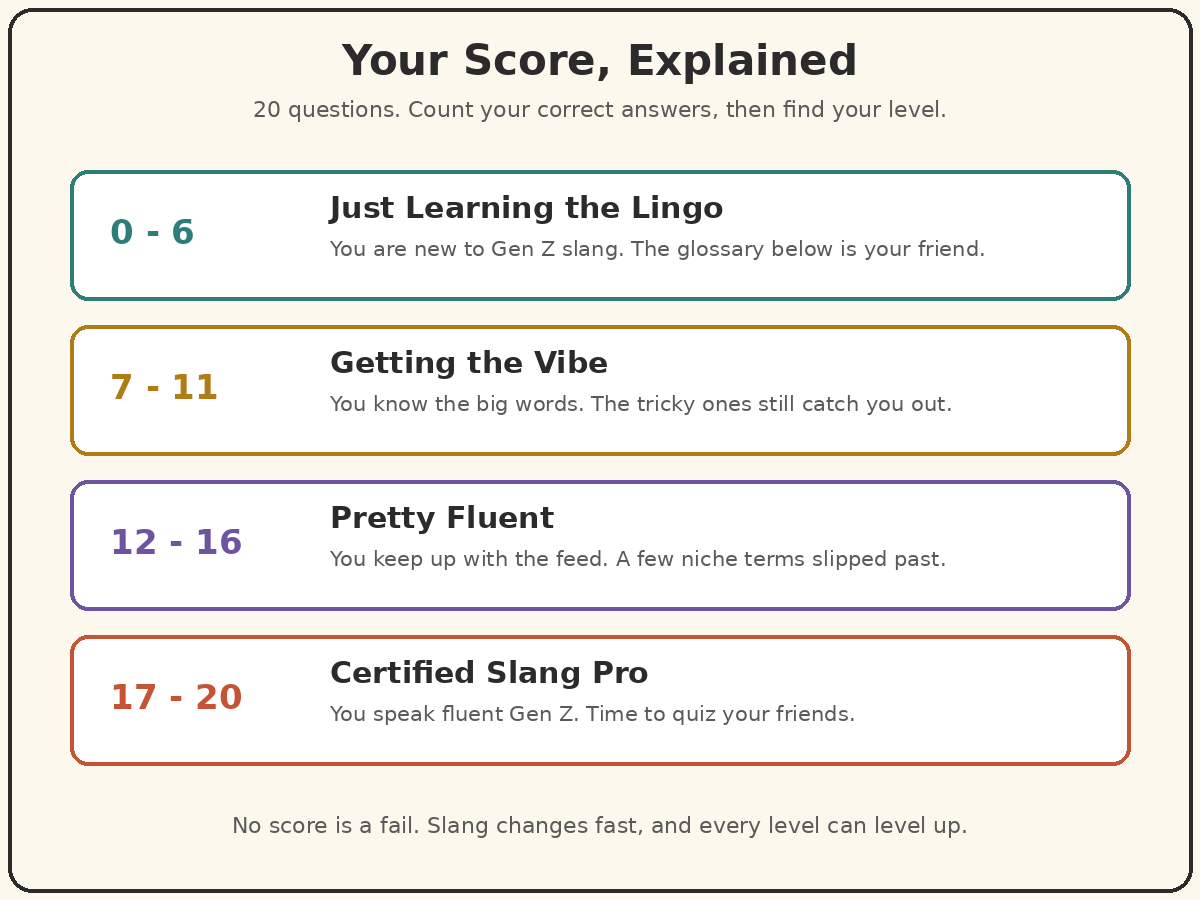
| Score | Level | What It Means | What To Do Next |
|---|---|---|---|
| 0 to 6 | Still learning | You know a few of the words, but most of this slang is new to you, and group chats probably feel like a foreign language. | Read the glossary below slowly, then retake the quiz in a week. |
| 7 to 11 | Getting there | You know the basics, like fire, bet, and slay, but the intermediate and advanced terms still trip you up. | Focus on the intermediate questions and the words you missed. |
| 12 to 16 | Solid | You understand most Gen Z slang in context and can follow a group chat without getting lost. | Study the advanced level, especially IYKYK and understood the assignment. |
| 17 to 20 | Fluent | You speak Gen Z fluently, and you probably use these words yourself without thinking about it. | Run the quiz for your friends and see if anyone beats you. |
A few honest notes about the score. First, the quiz tests the most common meanings, and slang can shift by region and by friend group, so a word you use differently at home might still be right in your circle. Second, getting a question wrong is not a failure, it is the fastest way to learn, because the explanation under each question gives you the meaning in context. Third, the best score is not the highest one, it is the one you beat next time you take the quiz. If you scored low, read the glossary, spend a week noticing these words in comments and captions, and then retake it. Most people jump a full band on the second try.
Words From the Quiz, Explained
This glossary covers every term tested in the quiz, plus a few extra words that came up in the questions and answers, so you can look up any word in seconds and see exactly what it means. Each entry is short on purpose, because the quiz already gave you the context, and this section is here for quick reference.
Fire
Excellent or amazing. A song, outfit, or meal can all be fire.
Fye
A phonetic spelling of fire, pronounced like “fye,” meaning excellent. Our guide to fye slang traces it to Southern American English.
Bet
Agreement, as in “okay, sure, I am in.” It can also be a challenge, as in “I bet you can not do it.”
No cap
No lie, for real. A way of saying you mean exactly what you just said.
Cap
A lie. If someone says “that is cap,” they think the statement is false.
Slay
To do something excellently, with confidence and style. Rooted in ballroom culture.
Rizz
Charm and flirting ability, short for charisma. “He has rizz” means he is good at winning people over.
Mid
Mediocre or average, short for middle. Our guide to mid meaning in slang has more examples and replies.
Sus
Suspicious, or something that feels off. Made famous by the game Among Us.
Lowkey
Secretly, quietly, or moderately. “I lowkey like it” means you like it but not loudly.
Vibe check
A quick read of the mood in a room or a group. It can be a joke or a real question.
Bussin
Really good, used most often for food. It comes from African American Vernacular English.
GOAT
Greatest Of All Time. Used for the best person ever in a field, usually sports or music.
FOMO
Fear Of Missing Out. The anxious feeling that everyone else is having fun without you.
IYKYK
If You Know, You Know. Used when a joke only makes sense to people who share the context.
FR
For Real. Used to agree with someone or to stress that you mean what you said.
NGL
Not Gonna Lie. Used before an honest opinion, as in “NGL, that was boring.”
TBH
To Be Honest. Used before a candid thought, as in “TBH, I did not like it.”
Ghosting
Cutting off all contact with someone without any explanation, usually in dating.
Drip
A stylish outfit or fashionable look. If your drip is unreal, you dressed very well.
Hits different
Feels uniquely strong or special. A song can hit different on a rainy night.
Understood the assignment
Nailed exactly what the situation called for, usually a theme, an outfit, or a performance.
Doing the most
Being over the top or trying too hard. Usually a gentle tease, not a real insult.
Tea
Gossip or juicy news. “Spill the tea” means tell me what happened.
Flex
To show off something you are proud of, like a new car or a win.
Ate
Did it perfectly. “She ate that” means she performed flawlessly and left nothing behind.
Aura
A person’s vibe or presence, the energy they give off. Our guide to aura meaning in slang explains how the word is used in gaming and everyday talk.
Geeked
Excited or hyped up, full of energy about something. Our guide to geeked meaning in slang covers its uses and its limits.
CTFU
Cracking the f*** up, meaning laughing very hard. Our guide to ctfu meaning in slang explains where it fits and where it does not.
FS
For Sure. A quick way to agree, as in “FS, I will be there.”
FW
To like or support something, short for f*** with, as in “I fw that song.”
Dope
Cool or excellent. A classic praise word that has stayed in slang for decades.
Cool
Good or approved. One of the oldest slang words still in everyday use.
Cringe
Embarrassing or awkward, used for something that makes you wince. Our guide to cringe meaning in slang covers the word in full.
Chat
The audience or community, especially on Twitch and live streams. “Chat, what do you think?” means the viewers.
Based
True to yourself, standing by your opinion even when it is unpopular.
Periodt
Final, end of discussion. A firm way to close a statement, as in “She is the best, periodt.”
Say less
I am convinced, no need to explain more. A quick yes when someone has already sold you on the idea.
How to Run This Quiz With Friends or a Class
Running this quiz for a group is simple, and it works best when you treat it like a game night, not a test: print it or open it on a screen, give everyone a way to answer, and keep the energy light so a wrong answer feels fun instead of embarrassing. You need no special tools, no app, and no preparation beyond reading the questions once through so you can host with confidence.
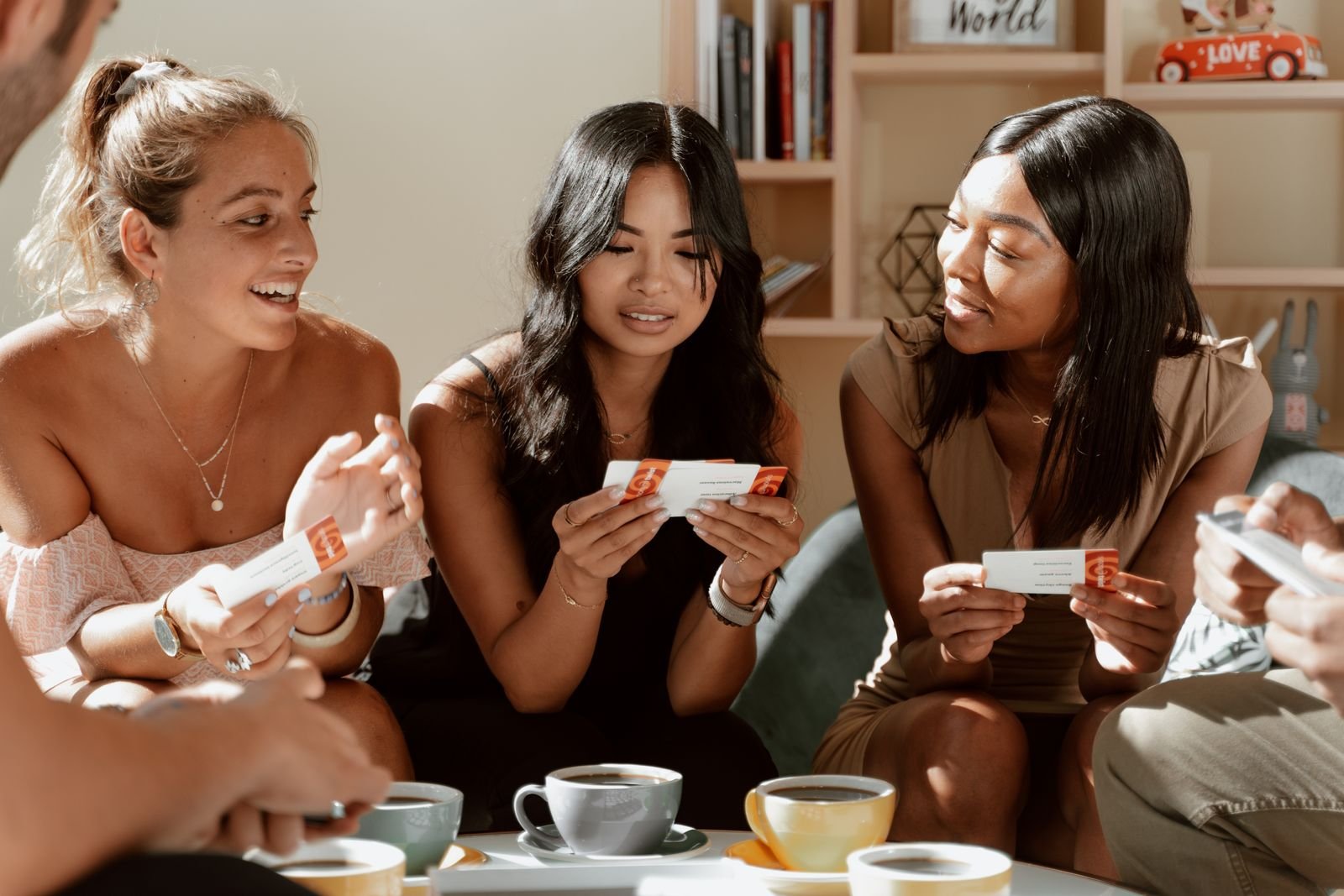
Start by deciding how people answer. The simplest way is pen and paper: everyone writes A, B, C, or D for each question, and nobody says their answer out loud until the host reads the correct one. If you are in a classroom or a big group, split into teams of three or four and let each team agree on one answer before it is revealed. Teams make the game louder and more fun, and they let shy players join in without being put on the spot. If you are playing online, use a poll in the chat or have everyone type their letter at the same time.
Read each question out loud, including the scenario, and give people about 20 seconds to decide. Then read the four options once more, take the answers, and reveal the correct one along with its explanation. The explanation is the real teaching moment, so do not skip it. If someone got it wrong, ask them what they thought it meant before you correct them, because the wrong guess often reveals a funny misunderstanding that the whole group learns from. Keep score on a whiteboard or a shared screen so everyone can see the leaderboard grow.
For a classroom, the quiz works as a warm up or a Friday activity, and it opens a real conversation about language. After the game, ask the class where they think these words come from, and use the glossary to talk about roots in African American Vernacular English and ballroom culture, which Kylian also highlights in their quiz guide. That conversation matters more than the score, because it teaches respect for the communities that created the language, not just the words themselves. You can also ask students to write one original question of their own using a word from the glossary, and the best ones can go into the next round of the quiz.
For a party or a family game night, add small stakes to keep it lively. The winner picks the next game, or the lowest scorer has to use three slang words correctly in a sentence. Keep the prizes silly, because the point is laughter, not competition. And if a parent is playing against their teenager, expect the teenager to win, and expect the parent to learn more in 20 minutes than in a year of overhearing group chats. That is the whole point of the quiz.
FAQs About the Gen Z Slang Quiz
Is this Gen Z slang quiz free?
Yes, this quiz is completely free to take, share, and play with friends or a class. There is no sign up, no payment, and no app to download. Just open the page, read the questions, and keep score on paper or on your phone.
How many questions are in the quiz?
There are 20 questions in total, split into three levels: 7 beginner questions, 7 intermediate questions, and 6 advanced questions. Each question has four possible answers, and the correct answer and an explanation are shown right under the question.
What is a good score on this quiz?
A score of 12 to 16 is solid, and it means you understand most Gen Z slang in context. A score of 17 to 20 means you are fluent. A score of 7 to 11 means you know the basics, and a score of 0 to 6 means you should start with the glossary and retake the quiz after a week of noticing these words in comments and captions.
Can I share this quiz with my friends or my class?
Yes, you can share the link with anyone, and you can run it in a classroom, at a party, or in a group chat. Teachers can use it as a warm up activity, and friend groups can play it as a game night challenge. The scoring table and glossary are built to work in a group setting.
Is Gen Z slang appropriate for school?
Most Gen Z slang is fine for casual classroom use, but it is not appropriate for formal essays, exams, or official writing. Words like “fire,” “bet,” and “slay” are harmless in conversation, while a few terms in this quiz carry strong language in their full forms, so teachers should preview the glossary and skip any word they do not want in their classroom. The quiz itself keeps the language clean and explains each term plainly.
Where can I learn more Gen Z slang after this quiz?
Start with the glossary above, then read the full Slangiify guides linked from it, including our guides to fye, mid, aura, geeked, and ctfu slang. You can also learn by watching how the words are used in TikTok comments, Instagram captions, and group chats, and by asking a Gen Z friend what a word means when you are unsure. Real usage teaches faster than any list.



Pingback: Golf Meaning Slang: 40+ Golf Terms Explained Simply