

In slang, “golf” is not one word with one meaning, it is a whole vocabulary of scoring terms, shot names, betting words, and course jokes that golfers use to describe every good shot, bad shot, and gamble on the course.
Say the word golf to a non-golfer and they picture a quiet green field, a small white ball, and a long walk in the sun. Say it to a golfer and they hear a language. A birdie is a good hole. A snowman is a bad one. A fried egg is a ball buried in sand. A mulligan is a second chance. A Nassau is a bet. The 19th hole is a bar. None of those meanings is obvious from the outside, and that is the point. Golf slang is a code, and once you learn it, a round sounds less like a quiet walk and more like a running conversation full of jokes, groans, and small victories.
Table of Contents
- What Does “Golf” Mean in Slang?
- Where Did the Word “Golf” Come From? The GOLF Acronym Myth
- Golf Scoring Slang: Birdie, Eagle, Albatross, Bogey, and Snowman
- Bad-Shot Slang: Shanks, Worm Burners, Fried Eggs, and Chili Dips
- Around the Green: Gimmes, Lip Outs, and the Dance Floor
- Golf Betting Slang: Nassau, Skins, Press, and Sandbaggers
- Golf People and Places: Duffers, Hackers, Mulligans, and the 19th Hole
- Golf in Texts, Captions, and Emoji
- Who Says Golf Slang, and Where Does It Show Up?
- What to Say Back When Someone Drops Golf Slang
- When NOT to Use Golf Slang
- Myths vs Facts About Golf Slang
- FAQs About Golf Slang
- Sources and Further Reading
What Does “Golf” Mean in Slang?
Golf slang is the shared vocabulary golfers use on the course, in the clubhouse, and in texts about the game, and it covers scores, shots, lies, bets, players, and places, so learning it means learning dozens of small words rather than one single definition. Nobody says “golf” itself as a secret code word for something else in normal use. The slang lives inside the game, in the names golfers give to what happens hole by hole.
That is the first thing to get clear, because a lot of people search for the golf meaning in slang expecting one neat answer. Golf does not work that way. Birdie is slang. Snowman is slang. Mulligan is slang. Put them together and you get a language golfers speak without thinking, and outsiders have to learn piece by piece. The word golf is the door. The slang is everything behind it.
Think of it as three layers. The first layer is scoring, the numbers that tell you how a hole went. The second layer is shots, the names for what the ball actually did. The third layer is culture, the betting games, the characters, and the clubhouse jokes. A new golfer usually learns scoring first, because that decides who won. Then the shot names follow, because every bad shot needs a name to laugh at. Then the culture words arrive, and by the time you know what a Nassau is, you are not a beginner any more.
Golf Slang vs Golf Terms
Not every golf word is slang. Par, fairway, green, bunker, and putter are plain golf terms, the official vocabulary of the game. Slang is the informal layer on top: birdie instead of one under par, snowman instead of eight, fried egg instead of a plugged lie in a bunker, dance floor instead of the green. The official terms tell you what happened. The slang tells you how it felt. A scorecard says eight. A golfer says snowman, and everyone in the group knows exactly how that hole went without seeing the card.
Where Did the Word “Golf” Come From? The GOLF Acronym Myth
The word golf does not come from an acronym at all, and the famous story that GOLF stands for Gentlemen Only Ladies Forbidden is a twentieth century joke, not history, while the real word comes from the Dutch word kolf or kolve, meaning club, through the Scots word gouf, with the first written mention in a Scottish statute of 1457. The acronym story is fun, it is widely shared, and it is wrong, and it is worth killing early because it colours everything else people believe about the game.
The GOLF Acronym Story, Debunked
Vintage Is The New Old tackles the acronym question directly, and its answer is clear: the idea that GOLF stands for Gentlemen Only Ladies Forbidden is a myth, a backronym invented long after the word existed, and the word’s true roots are Dutch and Scots. A backronym is a phrase invented after the fact to fit letters that were never meant to stand for words, and golf is a classic case. Someone took a short old word, split it into four letters, and built a joke around it, and the joke was good enough to outlive the truth for decades.
The timing gives the game away. Golf was already being played and written about in the fifteenth century, hundreds of years before acronyms became a normal way of making words. The Scottish Parliament tried to ban golf and football in 1457, because young men were playing games instead of practising archery, and that ban is the first written mention of the game. A word that appears in a law from 1457 cannot have been invented as an acronym in the twentieth century.
Golf Scoring Slang: Birdie, Eagle, Albatross, Bogey, and Snowman
Golf scoring slang gives every score on a hole a name, so a birdie means one under par, an eagle means two under, an albatross means three under, a bogey means one over, a double bogey means two over, and a snowman means an eight, and learning those names is the fastest way to follow a scorecard, a leaderboard, or a golf conversation. Par is the starting point, the number of strokes a good golfer is expected to take on a hole, usually three, four, or five. Every other scoring word is measured against par.
| Term | Score | Tone | When It Is Heard | Example |
|---|---|---|---|---|
| Birdie | One under par | Happy, proud, everyday good news | After a strong hole, often on a par four or five | “I birdied the seventh with a ten-foot putt.” |
| Eagle | Two under par | Excited, rare, worth telling people about | After a holed approach or a long putt on a par five | “He eagled the twelfth, the whole group went wild.” |
| Albatross | Three under par | Astonished, once in a lifetime | After a hole in one on a par four, or a two on a par five | “An albatross, I still cannot believe it happened.” |
| Bogey | One over par | Mildly annoyed, normal, part of the game | After a missed putt or a small mistake | “Just a bogey, I will take that and move on.” |
| Snowman | Eight on any hole | Groaning, joking, painful | After a blow-up hole, said with a laugh or a sigh | “I made a snowman on the third, that hole is gone.” |
Birdie: One Under Par, and Where the Word Came From
A birdie is a score of one under par on a hole, so a three on a par four, a four on a par five, or a two on a par three, and it is the most common good score in golf, the one every golfer chases on every hole. Birdies feel great because they mean you beat the hole. Golfers also use birdie as a verb: “I birdied the fifth” is normal golf speech, and “a birdie chance” means a putt for birdie, the moment when a good hole can become a great one.
The word birdie comes from nineteenth century American slang, where “bird” meant something cool, excellent, or first rate, and golfers at Atlantic City Country Club are often credited with coining the term in 1903, when a shot that flew beautifully was called a bird of a shot. The Other Golf Channel traces this origin in its slang guide, and the story fits the language of the time. There is a neat link here to the wider slang of cool, and our guide to cool slang covers how that family of words grew. The Atlantic City story is best read as the most popular version of the truth rather than a proven fact, but the timing and the language are clear: birdie appears in golf in the early twentieth century, it grows out of American slang where bird meant excellent, and it sticks because it is short, happy, and easy to say.
A bogey is one over par, so a five on a par four, and it is the most normal bad score in golf, the one that says you made a small mistake and paid for it with a stroke. Bogeys are not disasters. They are the tax you pay for playing golf. Even good golfers make bogeys, and a round with a few bogeys and a few birdies is a perfectly normal round. The word itself comes from an old golfing bogeyman, a figure from a song, and the name stuck because a bogey feels like a small ghost following you around the course.
Bad-Shot Slang: Shanks, Worm Burners, Fried Eggs, and Chili Dips
Bad-shot slang is the funniest part of golf language, because every bad shot has a vivid nickname, and the names turn embarrassment into a joke: a shank flies sideways, a worm burner stays low, a fried egg is plugged in sand, a chili dip is a fat chip, and a yip is a nervous twitch on a short putt. Golfers need these words because bad shots happen constantly, and laughing at them is healthier than throwing a club.
The bad shot names work because they are pictures. A worm burner is a shot that stays so low it could burn a worm on the ground. A fried egg is a ball half buried in sand, with the top showing like the yolk of an egg in a pan. A chili dip is a chip hit so fat that the club digs into the ground behind the ball. A skull is a chip hit so thin that the club strikes the middle of the ball and sends it flying low and fast across the green. You do not need a diagram to understand these words. You can see them.

Shank, Worm Burner, Chunk, and Skull
A shank is a shot struck with the hosel, the part of the club where the shaft meets the head, and the ball flies sharply sideways, often at a right angle to the target, and it is the most feared miss in golf. Golfers are superstitious about the word itself, and many refuse to say it on the course, because they believe saying it will cause it to happen. They call it the S word, and everyone knows what they mean. A shank is different from a slice or a hook, which still go roughly forward. A shank goes sideways, sometimes into the next fairway, sometimes into the trees, and it is a shock when it happens, because the swing felt normal and the result was not.
Fried Egg, Chili Dip, Snap Hook, Banana Ball, and Whiff
A fried egg is a ball that lands in a bunker and buries itself in the sand, with only the top of the ball showing, like the yolk of a fried egg sitting in the white, and it is one of the hardest lies in golf. The Other Golf Channel lists fried egg in its slang guide as a plugged lie, and the name is perfect, because the picture is exact. Playing a fried egg needs a steep hit, a closed club face, and a firm swing, and even then the ball may come out low and run across the green. Golfers practise the shot because it comes up more often than they would like, and they dread it because it turns a simple bunker shot into a small crisis.
Around the Green: Gimmes, Lip Outs, and the Dance Floor
Around the green, golf slang covers the short shots and the small dramas of putting, so a gimme is a short putt nobody makes you take, a lip out is a putt that circles the hole and stays out, break is the curve of a putt, the fringe is the short grass around the green, up and down means chipping on and holing the putt, and the dance floor is the green itself. This is the part of the game where matches are won and lost, and the slang is intimate, because the green is where golfers stand close together and watch each other putt.
Gimme, Lip Out, and Break
A gimme is a very short putt, usually a foot or two, that the other players agree is good without the golfer having to hit it, and it is a courtesy in casual and match play, not a rule in stroke play. The idea is simple: the putt is so short that missing it would be a freak accident, so the group saves time and spares the golfer the embarrassment of a miss by saying “that is good.” A gimme is given, not taken, which means the golfer should not pick up the ball and assume it was good. The other players decide. In a serious stroke play competition, there are no gimmes, and every putt must be holed, which is why tournament golfers sometimes look nervous over a putt a casual golfer would never have to hit.
Up and Down, Sandy, and the Dance Floor
Up and down means getting the ball onto the green with one shot and into the hole with the next, usually after missing the green, and it is the classic save in golf. A golfer who misses a green and then gets up and down has saved par, and the group will praise the short game that made it possible. A sandy is a special kind of up and down: getting up and down from a bunker, so the ball comes out of the sand and the next putt drops. A sandy feels better than a normal up and down, because a bunker shot is harder, and the save feels more earned.
Golf Betting Slang: Nassau, Skins, Press, and Sandbaggers
Golf betting slang names the games golfers play for money, pride, or a drink after the round, and the main ones are Nassau, a three part bet on the front nine, back nine, and whole round, skins, where each hole is worth a prize, press, a new bet that doubles the stakes, wolf, a game of picking partners, and snake, a fine for three putting. Betting is a big part of casual golf, and it is worth saying clearly that the bets are usually small: a few dollars a hole, a drink, lunch, or bragging rights. The slang makes the games sound grander than they are, and that is part of the fun.
Nassau, Skins, Press, and Wolf
A Nassau is a bet split into three parts: the front nine, the back nine, and the whole eighteen holes, and each part is worth the same amount, so a golfer can lose the front, win the back, and still have the overall bet to play for on the last holes. The name comes from Nassau Country Club on Long Island, where the game is said to have been invented, and the format is popular because it keeps the match alive. A Nassau is often played with automatic presses, which means a new bet starts automatically when one side goes two down, and the presses can pile up.
Skins is a game where each hole is worth a skin, a unit of money or points, and if two or more players tie a hole, the skin carries over to the next hole, so the value grows until someone wins a hole outright. A press is a new bet, started in the middle of a match, usually when one side is losing and wants a chance to get even. “I will press” means “let us start a fresh bet from this hole, for the same amount, on top of the original bet.” Wolf is a game for four players, where one player is the Wolf on each hole, and the Wolf picks a partner after seeing the tee shots, or plays alone against the other three for double points. Wolf is a social game, full of bluffing, teasing, and second guessing.
Sandbagger: The Accusation Golfers Fear
A sandbagger is a golfer who deliberately keeps their handicap higher than it should be, by playing badly on purpose in casual rounds or by hiding good scores, so they get extra strokes in competitions and win bets they should not win. The word comes from sandbags, heavy weights that slow a boat or a horse. Calling someone a sandbagger is a serious accusation, and it is one of the few golf insults that can start a real argument. Sandbagging matters because golf is one of the few sports where players of very different abilities can compete fairly, thanks to the handicap system, and the system works only if handicaps are honest.
Golf People and Places: Duffers, Hackers, Mulligans, and the 19th Hole
Golf slang has names for the people who play and the places they play, so a duffer is a casual, not very good golfer, a hacker is a golfer who plays badly and often, a scratch golfer plays to par with no handicap, a bandit is a golfer whose handicap is suspiciously generous, a mulligan is a free do-over, a breakfast ball is a mulligan on the first tee, and the 19th hole is the bar after the round. These are the characters and the places of golf culture, and knowing them is knowing the social side of the game.
Scratch Golfer and Bandit
A scratch golfer is the opposite: a golfer who plays to par, with a handicap of zero, and who can shoot par or better on a good day. Scratch golfers are rare, and they are respected, because shooting par takes skill, practice, and nerve. A bandit is a golfer who plays far better than their handicap suggests, and who wins a lot of competitions as a result. The word is used with suspicion and with a laugh, often at the same time. A bandit might be a golfer who has improved quickly and whose handicap has not caught up, or a golfer who does not enter all their scores. Either way, the group knows, and the word is a way of saying, we see you.
Mulligan, Breakfast Ball, and the 19th Hole
A mulligan is a free do-over, a second shot that does not count, usually taken after a bad first shot, and it is a casual, friendly rule, not an official one. The origin of the word is unclear, with stories about a golfer named Mulligan in the 1920s, and the uncertainty is part of the charm. A breakfast ball is a mulligan on the first tee, so called because it is taken early in the morning, before breakfast has settled, and it is the most common mulligan in golf. A golfer who tops the first drive can say “breakfast ball” and hit another one, and the group will laugh and move on.
Golf in Texts, Captions, and Emoji
In texts and online, golf slang shows up in short, punchy forms: a golfer texts “birdied the ninth” after a good hole, a caption says “grip it and rip it” under a drive video, a comment says “snowman” under a scorecard photo, and the golfer emoji and the golf flag emoji do the work of a whole sentence. The language is the same as on the course, just shorter, faster, and aimed at an audience that may not play golf at all, which is why captions often add a little context a course conversation would not need.
The Golfer Emoji and the Golf Clap
The golfer emoji, a small figure swinging a club, and the flag in hole emoji, a small flag marking the hole, are the visual shorthand for golf online, and they show up in captions, comments, and texts where the word golf would be too long or too plain. A golfer emoji under a highlight means “great shot” without any words. A flag emoji in a caption means “on the course today” without a sentence. The emojis are simple, they are clear, and they work across languages, which matters on a global platform where golfers speak many languages but share the same game.
“Playing Golf” as a Sexual Innuendo: A Short, Clear Boundary
The phrase “playing golf” is sometimes used as a sexual innuendo in texts and jokes, as a vague euphemism for a private encounter, and it is worth naming that use plainly so readers are not confused when they meet it, while also saying clearly that it is a joke use, not a standard meaning, and it should not be used in polite company, at work, or with people who do not know the joke. The innuendo works because golf is a game with holes, clubs, and long walks in private places, and the words lend themselves to double meanings if someone wants to make them, which is true of many sports.
Who Says Golf Slang, and Where Does It Show Up?
Golf slang is said most by regular golfers, club members, weekend players, golf fans on television and social media, and the friends and family who hear about rounds secondhand, and it shows up on the course, in the clubhouse, in group chats, in captions, and in comment sections, aimed at playing partners, rivals, and followers who follow the game. The diagram below maps the whole picture in one glance: who says it, where it shows up, and who it is aimed at.
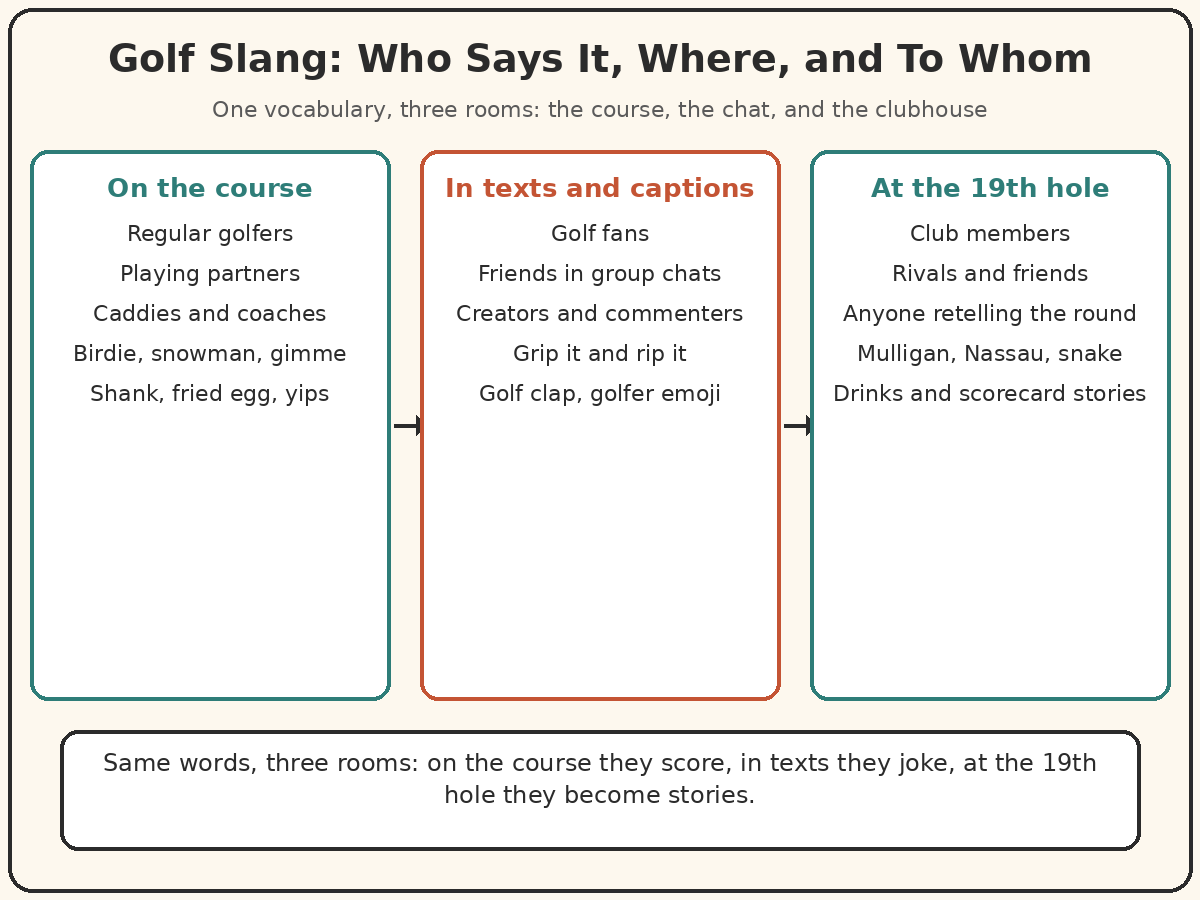
Start with the speakers. Regular golfers are the core users, and they use the slang without thinking, because it is the language of their weekend. Club members use it in the clubhouse, where the slang is part of belonging. Weekend players use it more lightly, borrowing the words they hear from better golfers. Golf fans who do not play use it in comments and captions, because watching golf on television teaches the vocabulary, even if the fan has never held a club. Caddies, coaches, and commentators use it professionally, and their use is the most precise.
What to Say Back When Someone Drops Golf Slang
When someone drops golf slang on you, the best reply is short, warm, and in the same language, so a birdie gets a “nice birdie” or a “beautiful, tell me about the putt”, a snowman gets a “brutal, the next hole is yours” or a laugh and a “we have all been there”, a mulligan gets a “take it, we all need one sometimes”, and a gimme gets a nod and a “that is good”. The rule is to match the tone: celebrate the good shots, soften the bad ones, and keep the conversation moving, because golf slang is social, and the reply is part of the game.
Replies for Good Shots and Bad Shots
For a birdie, say “lovely birdie, how did you play it?” and then listen, because the golfer will want to tell you. For an eagle, say “an eagle, that is a story for the clubhouse” and mean it, because eagles are rare and worth celebrating loudly. For a sandy, say “great sandy, that bunker shot was class” and watch the golfer smile. The tone for good shots is warm and a little bit envious, in the friendly way. “Nice birdie, I hate you” is a classic golf compliment, and it means the opposite of what it says.
When NOT to Use Golf Slang
Golf slang should stay on the course, in the clubhouse, and in conversations with people who play or follow golf, and it should stay out of formal writing, work emails, job interviews, and any conversation where the other person does not know the game, because a snowman means nothing to a non-golfer, a sandbagger sounds like an insult to a stranger, and a betting term sounds like gambling to a boss. The slang is a code, and a code is only useful when the other person has the key.
Calling Someone a Sandbagger Is an Accusation
Calling someone a sandbagger is the one golf slang use that can cause real harm, because it accuses a person of cheating, and it should never be said lightly, in public, or to a stranger. If you think someone is sandbagging, the right move is to check the facts, talk to them privately, or raise it with the competition organiser, not to shout it across the fairway. A joke between friends is one thing. An accusation in a competition is another, and the difference is the tone, the setting, and the relationship. When in doubt, do not say it. The same caution applies to bandit, which is a softer accusation but still a claim that someone is playing better than their handicap says they should.
Myths vs Facts About Golf Slang
Myth: GOLF Stands for Gentlemen Only Ladies Forbidden
This is a myth, and the fact is that golf comes from the Dutch kolf and the Scots gouf, meaning club, with a first written mention in 1457, hundreds of years before the acronym joke was invented. Vintage Is The New Old explains the backronym clearly, and the dates settle it: a word from the fifteenth century cannot be an acronym from the twentieth.
Myth: A Mulligan Is an Official Rule
This is a myth, and the fact is that a mulligan is a casual, friendly do-over, not a rule in the official laws of golf, and it is never allowed in a serious competition. Golfers use mulligans in friendly rounds, on the first tee, and after a bad shot, and the group agrees to it because the round is for fun. In a tournament, there are no mulligans, and a golfer who takes one is breaking the rules. The myth survives because mulligans are so common in casual play that they feel official. They are not, and knowing that makes you a better golfer and a fairer playing partner.
Myth: Only Men Played Golf When the Word Was Born
This is a myth, and the fact is that women have played golf for centuries, including Mary, Queen of Scots, in the sixteenth century, and the game was never only for men, even if some clubs excluded women for long periods. The myth and the acronym story feed each other, and both are wrong in the same way: they confuse the rules of some clubs with the history of the game.
FAQs About Golf Slang
Is GOLF really an acronym?
No. GOLF is not an acronym, and the story that it stands for Gentlemen Only Ladies Forbidden is a twentieth century joke, not history. The real word comes from the Dutch kolf or kolve, meaning club, through the Scots gouf, and the first written mention is a Scottish statute from 1457. The acronym was invented long after the word existed, as a backronym, a phrase built to fit letters that were never meant to stand for words. If you hear the acronym story on the course, you can correct it gently, with the dates as your evidence, and the correction will usually be welcome, because golfers like a good story, and the true story is a good one.
What does birdie mean?
A birdie means one under par on a hole, so a three on a par four, a four on a par five, or a two on a par three. It is the most common good score in golf, and it means you beat the hole by a stroke. The word comes from nineteenth century American slang, where bird meant cool or excellent, and golfers at Atlantic City are often credited with coining it in 1903. A birdie is a happy word, a small victory, and a round with a few birdies is a good round. Golfers also use it as a verb: “I birdied the fifth” is normal golf speech.
What is a mulligan?
A mulligan is a free do-over in casual golf, a second shot that does not count, usually taken after a bad first shot. It is a friendly, informal rule, not an official one, and it is never allowed in a serious competition. A breakfast ball is a mulligan on the first tee, taken early in the morning before the round has settled. The origin of the word is unclear, with stories about a golfer named Mulligan in the 1920s, and the uncertainty is part of the charm. A mulligan is a kindness, and it is offered most often when nerves are high and the group wants everyone to relax.
What does snowman mean in golf?
A snowman means an eight on any hole, named for the shape of the number 8, which looks like a snowman with a round head and a round body. It is a joke about a bad hole, and the joke softens the pain, because saying “I made a snowman” is funnier and kinder than saying “I made an eight.” A snowman usually means the hole went badly wrong, with a bad drive, a bad approach, and a missed putt, or a penalty, and it can turn a good round into an average one. But one snowman does not ruin a round, and the best golfers forget it fast and move on to the next hole.
What is a fried egg in golf?
A fried egg is a ball plugged in a bunker, half buried in the sand with only the top showing, like the yolk of a fried egg in a pan. The Other Golf Channel lists it as a plugged lie, and the name is perfect because the picture is exact. A fried egg is one of the hardest lies in golf, because the sand holds the ball tight and the golfer needs a steep, firm swing to blast it out. Even a good bunker player can struggle with a fried egg, and the shot often comes out low and runs across the green. The name makes a horrible lie sound almost funny, which helps when you are standing in sand with a ball buried up to its equator.
What does “golf” mean in texting?
In texting, “golf” almost always means the game, the round, or the plan to play, as in “golf tomorrow?” or “golf was brutal today.” The slang lives in the words around it, birdie, bogey, mulligan, snowman, and the word golf itself is the frame, not the joke. A text that says “birdied the ninth” means the sender made a birdie. A text that says “snowman on the third” means the sender made an eight. If a text says “golf” and nothing else, it is probably a plan or a question, and the safest reply is to ask when, where, or how it went. If you want to test your slang knowledge in a fun way, our Gen Z slang quiz is a light, quick way to check how many modern slang words you know.
What is the difference between a birdie, an eagle, and an albatross?
A birdie is one under par, an eagle is two under par, and an albatross is three under par, and the difference is rarity as much as score. Birdies happen often, eagles happen rarely, and albatrosses happen almost never, so a birdie is a good hole, an eagle is a great hole, and an albatross is a once in a lifetime hole. The names follow the bird logic: a small bird for a small achievement, a big bird for a bigger one, and the biggest bird for the biggest score. If you remember the order birdie, eagle, albatross, you remember the scale, and you can follow any leaderboard without getting lost.
Sources and Further Reading
The sources below are the pages opened for this guide, and they are the only external sources cited here. For a lighter take on praise words that work like birdie does in a sentence, our guide to awesome slang covers a word that cheers without starting an argument. See also our guides to football terms slang and baseball slang.
- The Other Golf Channel golf slang guide, scoring terms, bad shot names, and the birdie origin story, including fried egg as a plugged lie in a bunker.
- Vintage Is The New Old on what golf stands for, the GOLF acronym myth debunked, and the Dutch kolf and Scots gouf roots of the word.
- Pexels photo of golfers on a golf course by Анна Ходоровская, the in-body photo used in this guide, credited in its caption.