


In slang, “gonzo” means bizarre, extreme, wildly subjective, and over-the-top, a word for anything so loud and chaotic that it feels like it broke the normal rules on purpose.
You have probably seen it in a comment under a festival clip, or in a caption under a photo of an outfit that looks like three different decades collided in a closet. “That set was absolutely gonzo.” “Gonzo energy all night.” The word does a lot of work in a very small space. It says the thing was wild, it says the person doing it knew it was wild, and it says the wildness was the point. It is praise, but it is praise with an edge, the kind you give to something that went too far and was better for it.
What makes gonzo interesting is that it did not start on the internet. It started in journalism, in 1970, in a magazine piece about a horse race that barely mentioned the horses. A writer named Hunter S. Thompson turned up to the Kentucky Derby, missed his deadline in the normal sense, and sent in something so strange and so funny that an editor had to invent a word for it. That word stuck, then it escaped journalism, then it escaped into music, film, fashion, and the group chat. Today most people who say gonzo have never read a word Thompson wrote, and that is fine. The word works either way. But knowing where it came from makes it land better, because the story behind it explains why it means what it means.
This guide covers the gonzo slang meaning in text and online, what the adjective and the noun actually mean, where the word came from and the Kentucky Derby piece that gave it its name, the messy and honestly disputed etymology, what gonzo journalism really is and why Thompson said objectivity was a myth, how gonzo escaped journalism into film, music, fashion, and social media, how it compares with wild, chaotic, extra, unhinged, and over-the-top, who says it and where it shows up, how to use it naturally, what to say when someone calls something gonzo, when to leave the word alone, and the myths people repeat about it, including the Muppet one. If you like words that started in one world and took over another, our guide to gnarly slang covers a surfer word that made the same kind of jump.
Table of Contents
- What Does Gonzo Mean in Slang?
- Where Did Gonzo Come From?
- The Messy Etymology of Gonzo: Nobody Really Knows
- What Is Gonzo Journalism, Really?
- Gonzo Beyond Journalism: Film, Music, Fashion, and the Feed
- Gonzo vs Wild, Chaotic, Extra, Unhinged, and Over-the-Top
- Who Says Gonzo, and Where Does It Show Up?
- How to Use Gonzo Naturally
- What to Say When Someone Calls Something Gonzo
- When NOT to Use Gonzo
- Myths vs Facts About Gonzo
- FAQs About Gonzo Slang
- Sources and Further Reading
What Does Gonzo Mean in Slang?
Gonzo means bizarre, extreme, wildly subjective, and over-the-top. As an adjective it describes a thing, a performance, or a style that is loud, chaotic, and deliberately far past normal. As a noun it names the weirdness itself, the quality of being gonzo.
That short answer covers most uses, but the word has layers, and the layers matter because they change the tone. At its heart, gonzo is about excess with intent. A quiet, weird thing is strange. A loud, weird thing that leans into its own weirdness is gonzo. The word carries a sense that somebody chose the chaos, or at least enjoyed it, and that the audience is meant to notice. It is not a word for accidents. Nobody calls a traffic jam gonzo, because a traffic jam is not trying to be anything. A festival set with a marching band, a smoke machine, and a singer in a ten-foot hat is gonzo, because the whole point is the excess.
Dictionary.com defines gonzo as an adjective in two senses. The first is the journalism sense, describing writing that is filled with bizarre or subjective ideas. The second is broader, and it is the one most people use today: crazy or eccentric. The same dictionary entry gives the noun sense as eccentricity, weirdness, or craziness. That spread of meanings tells you a lot about how the word travels. It started as a label for a style of writing, and it stretched until it could cover almost anything that feels too big, too loud, or too strange for the room it is in.
Gonzo as an Adjective
As an adjective, gonzo sits in front of a noun and turns the volume up on it. A gonzo outfit is not just bold. It is the kind of outfit people photograph, the kind that mixes prints, colors, and eras without asking permission. A gonzo edit is not just a fast video cut. It is a video that throws zooms, sound effects, and jump cuts at the viewer until the whole thing feels like a fever dream. A gonzo movie is not just strange. It is a film that treats the strange as normal and dares the audience to keep up.
The adjective also works as a claim about style. Calling something gonzo says the excess is deliberate, not a mistake. That is an important distinction, because a lot of slang for “too much” is negative. “Extra” can be an insult. “Chaotic” can be a complaint. Gonzo sits in a sweeter spot. It usually sounds admiring, or at least entertained, and that is why it shows up in captions and comments as praise. When someone writes “gonzo set last night” under a concert clip, they are saying the show was wild and they loved it, in five words.
There is also a softer use where gonzo just means very enthusiastic or unfiltered. A gonzo rant is a long, passionate, slightly unhinged monologue about something the speaker cares about. A gonzo thread is a social media thread that keeps going, keeps escalating, and refuses to be reasonable. In these uses the word is less about weirdness and more about energy, the sense that someone stopped holding back and let the whole thing out at once.
Gonzo as a Noun
As a noun, gonzo names the quality itself. “That party had real gonzo to it.” “The whole film is pure gonzo.” Used this way, the word is closer to a vibe than a description, and it is rarer than the adjective form, but it shows up in reviews and captions where people want to praise the spirit of a thing rather than its details. The noun form is also the one that connects back to the journalism sense most directly, since “gonzo” as a noun can mean the style itself, the approach, the whole way of doing things.
Think of it like the word “chaos.” You can say a party was chaotic, which is the adjective, or you can say the party was pure chaos, which is the noun. Gonzo works the same way, and the noun form carries a little more weight because it turns the quality into a thing you can point at. “Pure gonzo” is a phrase that does a lot of heavy lifting in a review. It tells the reader that the whole experience was too much in the best possible way, and it does it in two words.
Gonzo in Text and Online
In text and online, gonzo is usually a one-word reaction or a short caption. “Gonzo.” “Absolutely gonzo.” “That edit is gonzo, I can’t.” The word is short enough for a comment, strong enough to stand on its own, and flexible enough to fit a photo, a video, a story, or a rant. It shows up under concert clips, festival photos, chaotic cooking videos, fashion posts, and movie trailers, anywhere the content is louder than normal and the audience wants to say so.
The word also travels well because it does not need a target the way some slang does. It can praise a person, a performance, an outfit, a video, a party, or a whole night. “Gonzo night” is a complete sentence in a group chat, and everyone who reads it knows exactly what kind of night it was. The word is vague in the right way, specific about the energy and loose about the details, and that looseness is why it fits so many settings.
One more thing worth noticing: gonzo is almost always positive or at least entertained. It can be used as a warning, as in “that party is going to be gonzo, bring earplugs,” but even the warning is half an invitation. The word does not really have a purely negative form. If someone wanted to complain about a chaotic mess, they would reach for a different word. Gonzo is the word you reach for when the chaos is the fun part.
Where Did Gonzo Come From?
Gonzo came from journalism, not the internet. In 1970, Boston Globe magazine editor Bill Cardoso read a piece Hunter S. Thompson had written about the Kentucky Derby and called it “pure Gonzo journalism.” The label stuck, Thompson made it famous, and the word then escaped into everyday slang.
The story starts in Louisville, Kentucky, in May 1970. Thompson had been sent to cover the Kentucky Derby for Scanlan’s Monthly, a magazine that liked its writers to have a point of view. What happened next is one of the great messes in American magazine history, and it is also the reason the word exists. Thompson turned up, drank too much, lost his notes, and failed to file the kind of straight report the magazine might have expected. Instead he sent in “The Kentucky Derby Is Decadent and Depraved,” a piece that barely covered the race and spent most of its energy describing the crowd, the drinking, the hats, the heat, and the general collapse of manners around the track. The article appeared in Scanlan’s Monthly in June 1970, and it read less like sports writing and more like a confession from someone who had been swept into the party and decided to report on it from the inside.
That is the piece Cardoso read, and his reaction is the moment the word was born in print. Cardoso, who edited the Boston Globe’s Sunday magazine, called the article “pure Gonzo journalism.” He did not mean it as an insult. He meant that Thompson had done something new, a kind of reporting where the reporter was part of the story, where the writer’s own experience was the story, and where the usual rules about distance and objectivity had been thrown out. The label was a compliment, and it was also a challenge. Thompson took it up and ran with it.
The word’s earliest known print appearance is actually a little earlier, and it is a fun detail. The 14 June 1970 issue of the Boston Globe’s Sunday magazine used the word in a line about someone who “smoked pot and went Gonzo on STP.” That was a drug reference, a slang use of the word as a verb for going wild, and it appeared before Thompson’s Derby piece had even made the rounds. So the word was already floating around as slang when Cardoso picked it up. What Cardoso did was give it a home, a definition, and a connection to a style of writing that would make it famous.
Bill Cardoso and the Label
Cardoso matters because he was the one who named the thing. Writers invent styles all the time without knowing it, and most of those styles die without a name. A name gives a style a shape, a way for readers to recognize it and ask for more of it. Cardoso gave Thompson’s approach a name, and the name was strange enough to be memorable and vague enough to be useful. That combination is rare, and it is why the word survived.
Cardoso’s own account of where he got the word is part of the story, and it is also part of the problem, because he told more than one version. He claimed the word came from South Boston Irish slang for the last man standing after an all-night drinking marathon, and he also claimed it came from the French Canadian word gonzeaux, meaning “shining path.” Both stories are disputed, and neither has a clear record behind it, so the honest thing to say is that Cardoso introduced the word to Thompson, and nobody can prove where Cardoso got it. The naming is certain. The origin of the name is not.
Hunter S. Thompson and Fear and Loathing
Thompson is the reason anyone outside a newsroom ever heard the word. After the Derby piece, he leaned into the style completely, and his next big project made it legendary. Fear and Loathing in Las Vegas first appeared serialized in Rolling Stone, and Thompson first used the word “gonzo” in print there, on 11 November 1971. The book follows a drug-fueled trip to Las Vegas, and it features a character called Dr. Gonzo, a name that tied the word to Thompson’s world even more tightly. The book was a success, and the word rode along with it into the wider culture.
Thompson’s version of gonzo was not just a style of writing. It was a way of being in the world. He put himself at the center of the story, he exaggerated, he joked, he got angry, and he refused to pretend he was a neutral observer. That refusal is the heart of the whole thing, and it is why the word still means what it means. Gonzo is not just weird. It is weird on purpose, by someone who is in the middle of it and not pretending otherwise.
Why the Derby Piece Mattered
The Derby piece mattered because it proved the style could work. Before it, the idea of a reporter writing about himself instead of the event would have sounded like a failure, a reporter who could not do his job. After it, the same thing sounded like a new kind of journalism, one that was honest about how reporting actually feels, which is messy, subjective, and shaped by the reporter’s own experience. The piece is still read today, and it is still funny, which is rare for a magazine article from 1970 about a horse race. The humor is the point. Thompson made the chaos readable, and Cardoso gave the readability a name.
There is also a simple lesson in the story for anyone who uses the word now. Gonzo started as a word for something that broke the rules and got away with it. That is still what it means. A gonzo outfit breaks the rules of fashion and gets away with it. A gonzo edit breaks the rules of video and gets away with it. The word has never really changed. It just found new rooms to walk into.
The Messy Etymology of Gonzo: Nobody Really Knows
The etymology of gonzo is genuinely unclear and disputed. Several stories compete to explain where the word came from, none of them is settled, and the most honest answer is that Bill Cardoso introduced it to Hunter S. Thompson, who popularized it, and the rest is guesswork.
That is an unusual thing to say about a word this famous. Most slang has a clear story, a song or a show or a street corner where it started. Gonzo has a clear story about who made it famous, and a foggy story about where it came from before that. The fog is part of the fun, and it is also a warning. Any article that tells you gonzo definitely comes from one place is guessing, and the guessing has been going on for fifty years without a winner.
The South Boston Drinking Story
Cardoso’s first story was that gonzo came from South Boston Irish slang for the last man standing after an all-night drinking marathon. It is a great story, and it fits the word’s energy perfectly. A word for the person who is still standing, still drinking, still going, after everyone else has given up, sounds exactly like what gonzo means. The problem is that there is no record of the word being used that way in South Boston, and no one has been able to confirm the story. It may be true. It may be a story Cardoso invented after the fact, the kind of origin tale a person tells when they want a good word to have a good story. Wordorigins.org, which has looked into the word carefully, treats both of Cardoso’s claims as disputed, with no record to back them.
The French Canadian “Shining Path” Story
Cardoso’s second story was that gonzo came from the French Canadian word gonzeaux, meaning “shining path.” This one is even harder to verify, and it has the same problem as the first: no clear record, no trail of use, and a meaning that does not obviously connect to the word’s actual sense. A “shining path” is a poetic phrase, and it sounds like something a person might invent to make a word sound more interesting than it is. It is worth mentioning because Cardoso told it, and because it shows how slippery the whole question is, but it should not be treated as fact.
The James Booker Song Story
Another story credits a piece of music. James Booker, a New Orleans piano player, released an instrumental song called “Gonzo” in 1960, a full decade before Cardoso used the word. The song exists, and the timing is tempting. It is easy to imagine the word drifting from a song title into slang, and then into a magazine editor’s vocabulary. But there is no evidence connecting Booker’s song to Cardoso’s use, and a song title is not the same as a word in circulation. The song is a real clue, and it is the earliest dated use of the word as a title, but a clue is not a proof.
The Italian and Spanish Guesses
The Oxford English Dictionary, which is careful about this kind of thing, suggests the word may come from the Italian word gonzo, meaning foolish, or the Spanish word ganso, meaning a goose, or a fool. Both guesses make sense on the surface, since “foolish” and “goose” both point toward the word’s sense of wild and silly behavior. Green’s Dictionary of Slang offers another guess, that the word is a blend of “gone” and “crazo,” or of “gone” and the Italian suffix “-zo.” These are all educated guesses from serious dictionaries, and they are all marked as guesses, which is the honest way to present them. A blend of “gone” and “crazo” would fit the word’s sound and sense beautifully, but beauty is not evidence.
What We Can Actually Say
Wordorigins.org sums the situation up plainly: all we can say for certain is that Cardoso introduced the word to Thompson, who popularized it. That is the solid ground, and everything else is a story someone told later. If you are writing about gonzo, that sentence is the one to trust. It is also a useful reminder about how slang works. Words do not always have clean birth certificates. Sometimes they just appear, get used by the right person at the right moment, and take off, and the origin story gets invented afterward by people who want a neat answer. Gonzo is one of those words, and the mess is part of its charm.
I think there is something fitting about that. A word that means chaotic and unfiltered has a chaotic and unfiltered origin story, with competing claims and no clean answer. The word refused to be pinned down from the start, and it still refuses. That is not a failure of research. It is the word being true to itself.
What Is Gonzo Journalism, Really?
Gonzo journalism is a style of reporting written without claims of objectivity, often including the reporter as part of the story in the first person, where the writer’s own experience, opinions, and reactions are part of what the reader is reading. It breaks the old rule that a journalist should disappear from the story.
The old rule was simple: a reporter should be invisible, a neutral eye that records what happened and lets the facts speak for themselves. Thompson thought that rule was a lie. He said objective journalism was a myth, and he put it bluntly in a line that gets quoted to this day: “You can’t be objective about Nixon.” His point was that a writer always has a point of view, and pretending otherwise is dishonest. Gonzo journalism drops the pretense. The writer admits where they stand, admits what they felt, and lets the reader judge the story with that information in hand.
The style has a few clear marks. First, the reporter is a character, not a camera. In a normal report, the writer stays off the page. In a gonzo piece, the writer is on the page, in the room, reacting, drinking, getting lost, and telling you about it. Second, the writing is first-person and personal. It uses “I” freely, and it lets the writer’s voice, jokes, and anger shape the piece. Third, it mixes fact with satire and exaggeration. The events are real, and the reporting is grounded in truth, but the telling is heightened, funny, and deliberately over the top. Historian Douglas Brinkley, who has written about Thompson at length, described his approach as involving “virtually no rewriting,” a style that came out fast and raw, close to the experience itself.
The Rules Thompson Broke
Thompson broke the rules that journalism schools taught, and he broke them in public, on purpose. The first rule he broke was distance. A reporter was supposed to stand apart from the story, to observe without getting involved. Thompson got involved, on purpose, and made his involvement the story. The second rule he broke was neutrality. A reporter was supposed to present both sides and let the reader decide. Thompson picked a side, loudly, and dared the reader to argue with him. The third rule he broke was tone. A reporter was supposed to be calm and measured. Thompson was funny, furious, sarcastic, and sometimes drunk on the page, and the tone was part of the point.
Breaking rules is easy. Breaking them well is hard, and that is why Thompson matters. His pieces worked because the reporting underneath was real. He was actually there, he actually talked to people, and he actually understood the scene he was describing. The exaggeration sat on top of real observation, not instead of it. That is the difference between gonzo journalism and just making things up. A gonzo piece is grounded in truth and then bent, stretched, and lit up for effect, and the reader can feel the truth underneath the jokes.
First-Person, Participatory, and Unapologetic
The first-person voice is the engine of the style. When a writer says “I was there, and this is what it felt like,” the reader gets something a neutral report cannot give: the experience of being in the room. Thompson’s Derby piece works because he tells you what the crowd smelled like, what the heat felt like, what the drunks around him were saying, and how the whole scene slid from a sporting event into a kind of public collapse. A straight report would have told you who won the race. Thompson told you what it was like to be there, and for most readers that was the more interesting story.
Participatory is the other half of it. Thompson did not watch from the press box. He was in the crowd, in the bar, in the conversation, and the piece shows it. That participation is what makes the writing feel alive, and it is also what makes it risky, because a reporter who participates can lose the distance that lets them see clearly. Thompson’s answer to that risk was to be honest about it, to let the reader see the participation and judge for themselves. The honesty is the method, not a flaw in it.
Why It Still Matters
Gonzo journalism still matters because the argument at its heart never went away. Every writer has a point of view, and every newsroom has to decide how much of that point of view to show. Thompson’s answer was to show all of it, and to trust the reader to handle it. That answer is still argued about today, in newsrooms, in classrooms, and on social media, where every creator is their own reporter and their own subject at the same time. In a way, the whole internet runs on gonzo now. A creator who films themselves reacting to an event, who tells you what they think and how it felt, is doing a version of what Thompson did in 1970, with a phone instead of a typewriter.
It is worth reading Thompson if you want to understand the word deeply, and it is also worth reading him because he is funny. The Derby piece, Fear and Loathing in Las Vegas, and his later campaign writing are all worth an afternoon, and they will change how you hear the word gonzo. You will stop hearing it as a vague word for “wild,” and start hearing it as a specific idea: a person who jumps into the middle of something, refuses to pretend they are neutral, and tells you the truth as they experienced it, jokes and all.
Gonzo Beyond Journalism: Film, Music, Fashion, and the Feed
Today gonzo has escaped journalism completely and now describes anything loud, chaotic, and over-the-top: a gonzo outfit, a gonzo festival set, a gonzo edit, a gonzo movie, and any piece of content that treats excess as a style choice rather than a mistake. The journalism sense is still there, but the everyday sense is bigger.
The jump from journalism to everything else happened slowly, and it happened because the word’s core idea travels well. A style of writing that is subjective, personal, and exaggerated has a clear cousin in a film that is subjective, personal, and exaggerated, or a music set that is loud, messy, and personal. The word crossed from one art form to another because the art forms share a feeling, and the feeling is the thing the word names. Once it crossed into film, it was only a matter of time before it crossed into fashion, music, and the group chat.

Gonzo in Film
In film, gonzo usually describes a movie that is wild, subjective, and over the top, often with a first-person or hallucinatory feel. A gonzo movie does not pretend to be a neutral window on the world. It shows you the world through a character’s eyes, distorted, exaggerated, and funny, and it trusts you to enjoy the distortion. Films about Thompson himself, like the adaptation of Fear and Loathing in Las Vegas, are the obvious examples, but the label gets used more widely, for any film that feels like it was made by someone who jumped into the chaos instead of filming it from a safe distance.
The word also shows up in reviews as a shortcut. A critic who calls a film “gonzo” is telling the reader, in one word, that the film is strange, loud, funny, and probably not for everyone, and that the strangeness is the point. It is a useful word for a critic because it carries both the praise and the warning at once. A gonzo film is worth watching, and it is also a lot, and the reader should know that before they press play.
Gonzo in Music and Festival Culture
In music, gonzo is the word for a set or a performance that goes off the rails in the best way. A gonzo festival set is one where the band plays too loud, the singer climbs something, the crowd loses its mind, and everyone agrees it was the best set of the weekend. The word fits live music perfectly, because live music is already about energy and excess, and gonzo is the word for energy and excess turned up to the point where it becomes a style.
Festival culture is where the word feels most at home today. A festival is a place where normal rules are suspended for a weekend, where outfits are louder, music is louder, and people are louder, and gonzo is the word that describes the whole atmosphere at once. “Gonzo weekend” is a phrase that tells a whole story in two words: it was wild, it was too much, and it was exactly what we wanted. The word also shows up in comments under festival clips, where a thirty-second video of a crowd going wild gets a single-word reply: gonzo.
Gonzo in Fashion
In fashion, a gonzo outfit is one that mixes prints, colors, eras, and silhouettes without apology. It is the opposite of a quiet, minimal look. A gonzo outfit wants to be noticed, and it wants to be noticed from across the room. The word works in fashion because fashion has its own version of the gonzo idea: the person who dresses for themselves, who treats the street like a stage, and who refuses to tone it down for anyone. That is Thompson’s idea in a different form, a person who jumps into the middle of things and refuses to pretend to be neutral.
The fashion use also shows how far the word has traveled from its origin. A word that started as a label for a magazine article now describes a jacket. That sounds strange until you think about what the word actually means, and then it makes perfect sense. The jacket and the article share a quality, and the quality is the word. Both are loud, both are personal, and both are better for being too much.
“Go Gonzo” as a Verb Phrase
People also use “go gonzo” as a verb phrase, meaning to let loose completely, to stop holding back and go all in. “We went gonzo on the decorations.” “He went full gonzo in the second half.” “Time to go gonzo on this playlist.” The phrase is a close cousin of “go wild” and “go all out,” but it carries a specific flavor: not just energy, but weird, creative, slightly unhinged energy. Going gonzo is not just doing a lot. It is doing a lot in a way that is unmistakably yours, with your own strange taste all over it.
The phrase shows up in captions and group chats where someone is about to do something big and wants to announce it. It is a declaration, a little bit of a warning, and a little bit of a promise, all in two words. And like the adjective, it is almost always positive. Nobody says “I went gonzo” about a mistake. They say it about a night, a project, a party, or a performance that they are proud of, even if it was a mess.
Gonzo on Social Media
On social media, gonzo is a caption word and a comment word, and it does the job of a whole paragraph in a single beat. A video of a chaotic cooking attempt, a wild outfit, a festival crowd, or a bizarre edit gets “gonzo” in the comments, and everyone knows what it means. The word also shows up in bios and hashtags, where creators use it to signal their style: loud, unfiltered, not for everyone, and proud of it.
The social media use is also where the word keeps growing. Every new platform gives it a new setting, and every new setting gives it a slightly new shade. On TikTok it is an edit word. On Instagram it is a caption word. In a group chat it is a reaction word. The word is flexible because its meaning is a feeling, not a fact, and feelings travel well. That flexibility is why a fifty-year-old journalism term is still alive in comments written by teenagers who have never heard of Hunter S. Thompson. If you want a contrast, our guide to geeked slang covers a word that lives in a similar online space but means something very different, a hyped-up, overexcited high rather than a loud, chaotic style.
Gonzo vs Wild, Chaotic, Extra, Unhinged, and Over-the-Top
Gonzo means bizarre and extreme with a deliberate, stylish edge, while wild is general energy, chaotic is disorder without intent, extra is trying too hard, unhinged is out of control, and over-the-top is simply too much. The words overlap, but each one aims at a different thing, and the table below lays out the differences.
| Term | Meaning | Tone | Where It Is Used Most | Example |
|---|---|---|---|---|
| Gonzo | Bizarre, extreme, wildly subjective, deliberately over-the-top | Admiring, entertained, stylish | Reviews, captions, festival talk, film and music writing | “That was a gonzo set, the crowd lost its mind.” |
| Wild | Energetic, uncontrolled, intense | Excited, casual, general | Everyday speech, party talk, sports, group chats | “The party last night was wild.” |
| Chaotic | Disordered, messy, unpredictable | Often negative, sometimes amused | Group chats, memes, stories about bad days | “My morning was pure chaos, nothing went right.” |
| Extra | Overdramatic, trying too hard, doing too much | Teasing, mildly critical | TikTok comments, fashion talk, group chats | “She is so extra with that entrance.” |
| Unhinged | Out of control, irrational, unfiltered to a worrying degree | Shocked, joking, sometimes concerned | Memes, X, TikTok comments, rants | “That rant was unhinged, in the best way.” |
| Over-the-top | Exaggerated past the point of normal, too much | Descriptive, neutral to critical | Reviews, everyday speech, reactions | “The effects were over-the-top, but fun.” |
The closest pair is gonzo and wild, and the difference is intent. Wild is what happens. Gonzo is what someone chose. A wild night is a night that got out of hand. A gonzo night is a night that was designed to be too much, and everyone involved knew it. Wild is an accident. Gonzo is a style.
Chaotic is the negative cousin. A chaotic morning is a bad morning, a string of things going wrong. A gonzo morning would be a strange one, but the word would suggest the strangeness was fun, not a disaster. If you swap the words, the sentence changes meaning completely, and that is why the distinction matters. Chaotic describes disorder. Gonzo describes disorder as a choice.
Extra is the word to watch out for, because it is the one most likely to be an insult. Extra means someone is doing too much to get attention, and the tone is usually teasing or critical. Gonzo is rarely an insult, because it praises the excess instead of mocking it. A gonzo outfit is a compliment. An extra outfit is a joke at the wearer’s expense. The difference is whether the speaker thinks the excess worked.
Unhinged is the edgier cousin, and it is the one that leans closest to a warning. An unhinged rant is a rant that has gone past funny and into worrying territory, even when the speaker means it as a joke. Gonzo stays on the fun side of that line. A gonzo rant is passionate and loud, but it does not scare anyone. Unhinged is what you say when the energy has stopped being charming. If you want the full story of that word’s softer side, our guide to cringe slang covers a word that lives in the same awkward, over-the-top space but points at embarrassment instead of energy.
Over-the-top is the plainest word in the group, and it is the most useful when you want to be neutral. It describes the amount without judging it. A gonzo performance is over-the-top, but over-the-top does not tell you whether the performance was good. Gonzo does, because gonzo says the excess was the point, and the point landed. Use over-the-top when you want to describe. Use gonzo when you want to praise.
Who Says Gonzo, and Where Does It Show Up?
Gonzo is said most by writers and critics, music and festival fans, fashion lovers, TikTok and Instagram users, and group chat regulars, and it shows up in reviews, captions, comments, livestream chats, and group chats, usually aimed at a performance, an outfit, a video, or a night that was too much in the best way. The diagram below maps the whole picture in one glance.
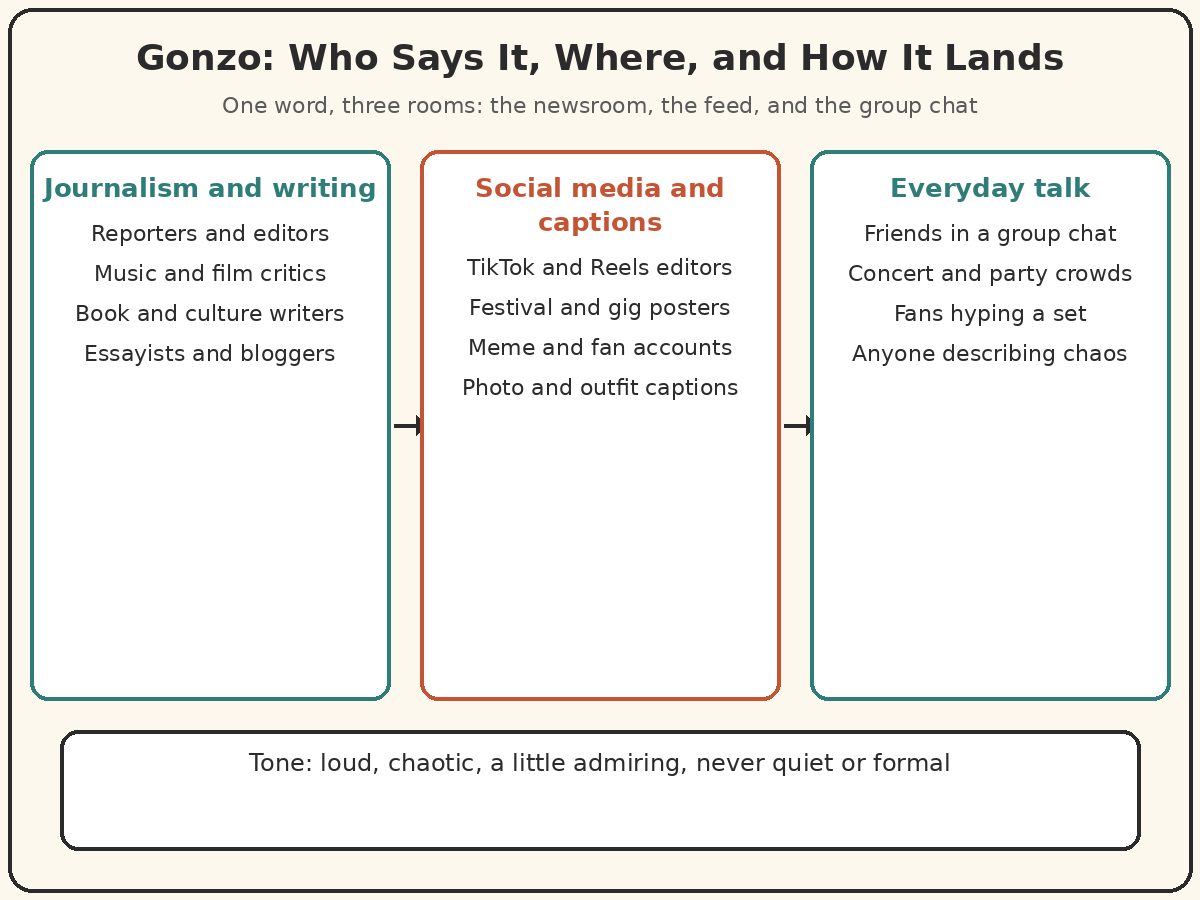
Start with the speakers. Writers and critics are the word’s original users, and they still use it the most precisely. A film critic who calls a movie gonzo is making a specific claim about its style, not just saying it was weird. Music writers use it the same way, to describe a performance that was loud, personal, and unfiltered. Then come the fans, especially festival and concert fans, who use the word as praise for a set that went beyond normal. Fashion lovers use it for outfits that break the rules. And then there are the everyday users, the group chat regulars and commenters who use it as a reaction word, a quick way to say “that was a lot, and I loved it.”
Then look at the places. Reviews are the word’s home, because a review needs a word that carries both praise and a warning, and gonzo does both at once. Captions are the second home, because a caption needs a word that is short and loud, and gonzo is both. Comments under concert clips and festival videos are the third home, where a single word can carry a whole reaction. Livestream chats use it during wild moments, when the chat moves too fast for sentences. Group chats use it as a summary, a one-word review of a night that does not need a longer explanation.
The audience matters as much as the speaker. Gonzo is almost always aimed at something the speaker thinks earned the praise: a band that played too loud, a creator who went all in on a strange idea, a friend who wore something unforgettable, or a night that went off the rails in the right direction. The word needs a target that was trying to be too much, and a crowd that can see the attempt and appreciate it. Without the crowd, the word is just a description. With the crowd, it is a cheer.
Who Says It
Critics say it most precisely, fans say it most often, and friends say it most casually. A critic uses gonzo to place a work in a tradition, the Thompson tradition of loud, subjective, personal art. A fan uses it to say “I was there and it was incredible.” A friend uses it to say “last night was a lot,” and the word carries the smile. The same word, three different registers, and all three are correct.
Where It Shows Up
It shows up anywhere the content is louder than normal and the audience wants to say so. Festival recaps, concert clips, fashion posts, chaotic cooking videos, movie trailers, and group chat summaries are the main spots. It also shows up in headlines, where a writer wants a single word that tells the reader the story is going to be strange and fun. A headline that says “gonzo” is a promise, and readers who like that promise will click.
The Tone It Carries
The tone is loud, chaotic, a little admiring, and never quiet or formal. Gonzo is not a word for a boardroom, a wedding toast, or a condolence card. It is a word for a crowd, a party, a show, or a feed, and it sounds wrong in a quiet room. That is not a weakness. It is the word doing its job. A word that means “too much” should sound like too much, and gonzo does.
How to Use Gonzo Naturally
Use gonzo as an adjective before a noun, as a one-word reaction, or in the phrase “go gonzo,” and only for things that are deliberately loud, strange, or over-the-top, never for ordinary things and never in formal settings. The word is easy to use, but it is also easy to overuse, and the trick is to save it for moments that deserve it.
The simplest use is the adjective. “That was a gonzo performance.” “Gonzo outfit, I love it.” “The whole video is gonzo from start to finish.” The adjective goes before the noun, and it does the work of a whole sentence of praise. It is a good choice when you want to say something was wild and you mean it as a compliment. It is a bad choice when the thing was just normal, because the word will sound like you are trying too hard. A normal dinner is not gonzo. A dinner where the host cooked in a costume, set the table on fire by accident, and everyone laughed is gonzo.
The one-word reaction is the easiest form. “Gonzo.” Under a video, under a photo, in a group chat, on its own, it works. It works because the word is strong enough to stand alone, and because everyone reading it knows what it means. It is the same move as replying “iconic” or “insane” to a post, a single word that carries a whole reaction. Use it when the content is genuinely wild. Do not use it on a normal post, or it will read as sarcasm, and not the good kind.
“Go gonzo” is the verb phrase, and it is for announcements. “We are going gonzo on the playlist tonight.” “Time to go full gonzo on this project.” The phrase says you are about to stop holding back, and it sets an expectation. It works best when you actually follow through. Announcing that you are going gonzo and then doing something normal is worse than not announcing it at all, because the gap between the word and the action is the joke, and the joke will be on you.
Texting and Caption Examples
Here are some natural examples, the kind of lines people actually write.
“Last night was fully gonzo, I still can’t believe the DJ played that at 2am.” This works because it describes a night that was genuinely over the top, and the word carries the whole story.
“Gonzo fit, no notes.” Short, confident, and clearly a compliment. The “no notes” adds to the praise, and the word gonzo does the rest.
“That edit is gonzo, the zooms alone took me out.” This is a comment under a video, and it names the thing that made the video wild, which makes the praise feel specific instead of generic.
“We went gonzo on the decorations and now the living room looks like a circus.” This is the verb phrase in action, and the self-awareness is what makes it funny. The speaker knows it was too much, and they are proud of it.
“Gonzo set. Gonzo crowd. Gonzo night.” Three fragments, three uses of the word, and each one adds to the last. It is a caption style that works because the repetition is the point. The word gets louder each time it appears, which is exactly how a gonzo night feels.
Common Mistakes
The most common mistake is using gonzo for something that is just bad. A video that is badly made is not gonzo. A party that was boring is not gonzo. The word means wild in a good way, or at least in an entertaining way, and using it for something that was simply a mess will confuse the reader. Save it for chaos that worked.
The second mistake is using it too often. Gonzo is a strong word, and strong words lose their power when they appear everywhere. If every outfit is gonzo, then no outfit is gonzo, and the word becomes noise. Use it once, mean it, and let it land. The people who use slang best are the ones who use the strong words sparingly.
The third mistake is using it in a formal setting. Gonzo is not a word for work emails, school essays, or a message to a stranger. It is a casual word, and it sounds out of place in a formal sentence. A work presentation that calls a campaign “gonzo” will get a laugh, but it will be the wrong kind of laugh, and the person laughing will not be taking the work seriously.
What to Say When Someone Calls Something Gonzo
When someone calls something gonzo, they are usually praising it, so the best reply is to agree with energy, laugh, or ask what made it so wild. A simple “Right? It was unreal” or “I know, I was there, it was insane” keeps the conversation going, and a question like “What was the wildest part?” invites a story.
If someone calls your outfit gonzo, take it as a compliment. “Thank you, I went for it today” is the perfect reply, because it accepts the praise and owns the choice. The word is not an insult, and treating it like one will confuse the person who said it. They were trying to say you looked amazing and a little bit fearless, and the right move is to say thank you and mean it.
If someone calls your video or your work gonzo, the best reply is to lean into it. “That was the goal” or “I was going for maximum chaos” tells them you did it on purpose, and that is exactly what they wanted to hear. The word is a compliment to the creator’s intent, and the creator who accepts it gracefully gets more of it.
If someone calls a night or a party gonzo and you were there, the reply is a story. “Remember when the speaker fell over?” or “The best part was the conga line at midnight.” The word is an invitation to relive the night, and the best response is to accept the invitation. A one-word reply works too, “Gonzo is right,” but a story is better, because the word was always a story in the first place.
If someone uses gonzo in a review of something you made and you are not sure whether they mean it well, look at the rest of the sentence. A review that says “a gonzo, joyful mess” is praise. A review that says “gonzo to the point of exhaustion” is a mixed verdict, and the right reply is to thank them and move on. The word is rarely the whole verdict, and the words around it tell you the rest.
When NOT to Use Gonzo
Do not use gonzo in formal writing, at work, in school, or to describe a person in a way that could sound dismissive, and do not use it for sensitive topics, tragedies, or anything where “wild” would be the wrong word entirely. The word is casual, loud, and fun, and it belongs in casual, loud, fun settings.
Formal writing is the first place to avoid it. An essay, a report, a cover letter, or a work email is not the place for a word that means “bizarre and over-the-top.” The word will make the writing sound unserious, and the reader will wonder whether the writer knows the difference between a casual word and a formal one. There are plenty of formal words for “unconventional” and “bold,” and those are the ones to use.
Work is the second place to avoid it, unless you know your workplace well. A creative team might love the word, and a design studio might use it daily. A law firm, a hospital, or a bank will not, and using it there will make you sound like you are not taking the work seriously. Know the room before you use the word, and when in doubt, leave it out.
Describing a person is the third place to be careful. Calling an outfit gonzo is a compliment. Calling a person gonzo can sound like you are calling them crazy, and the line between “wild and fun” and “unstable” is thinner than it looks. “He is a gonzo guy” might be praise from a friend, but it might also be a dismissal, and the person hearing it will not always know which one you meant. Describe what a person does, not who they are, and the word stays safe.
Sensitive topics are the fourth place to avoid it. A tragedy, a crisis, a loss, or a serious news story is not gonzo, and calling it gonzo would be tone-deaf. The word is for entertainment, art, parties, and style, not for real suffering. If the topic is serious, use a serious word. The same rule applies to anything where the chaos was not a choice. A natural disaster is chaotic, but it is not gonzo, because nobody chose it and nobody is enjoying it.
Finally, do not use gonzo to describe something you did not actually find wild. The word is a claim, and a claim that does not match reality will make you sound like you are exaggerating for attention. Our guide to glaze slang covers a word that lives in a similar praise space but means over-the-top flattery, and the lesson there applies here too: praise lands best when it is honest. Save gonzo for the moments that deserve it, and it will keep its power.
Myths vs Facts About Gonzo
People repeat a lot of confident claims about gonzo, and several of them are wrong. The myths below are the ones that show up most often, and the facts are the corrections, stated plainly.
Myth: The Muppet Gonzo Invented the Word
This is the most common myth, and it is wrong. The Muppet character Gonzo debuted in December 1970, after Bill Cardoso had already used the word to describe Thompson’s Derby piece, and after the word’s earliest known print appearance in the Boston Globe Sunday magazine that June. The Muppet did not invent the word. The Muppet borrowed it, or was named with it, after it was already in use. It is an easy mix-up, because the Muppet is strange and wild in exactly the way the word suggests, but the timing is clear, and the word came from journalism, not from a puppet.
Myth: Gonzo Means the Same as Crazy
It does not, or at least not exactly. Crazy is a general word for something irrational or out of control, and it can be negative. Gonzo is more specific: it means bizarre and extreme with intent, with style, and usually with a sense of fun. A crazy driver is a danger. A gonzo driver is a character in a movie. The difference is whether the wildness is a choice and whether it is entertaining. Gonzo is crazy with a purpose, and the purpose matters.
Myth: The Etymology Is Settled
It is not, and anyone who tells you it is settled is guessing. The competing stories, the South Boston drinking tale, the French Canadian shining path, the James Booker song, the Italian and Spanish guesses, and the gone plus crazo blend, are all unproven. Wordorigins.org is clear on this point: all we can say for certain is that Cardoso introduced the word to Thompson, who popularized it. That is the fact. Everything else is a story, and the stories disagree with each other.
Myth: Gonzo Journalism Is Just Making Things Up
It is not. Gonzo journalism is grounded in truth, but it blends fact with satire and exaggeration, and the reporting underneath is real. Thompson was actually at the Derby, he actually talked to people, and he actually understood the scene. The style is honest about its subjectivity, and that honesty is the method. Making things up is fiction. Gonzo journalism is reporting that refuses to pretend the reporter is invisible, and the difference is everything.
Myth: Gonzo Is Always a Compliment
Mostly, but not always. Gonzo is usually positive, but it can be a warning, as in “that party is going to be gonzo, bring earplugs,” and it can be a mixed verdict in a review, as in “gonzo to a fault.” The word carries admiration, but it also carries a sense of excess, and excess is not always a good thing. Context decides, and the words around gonzo tell you which way it leans.
Myth: Only Journalists and Critics Use the Word
Not anymore. The word escaped journalism decades ago, and today it belongs to festival crowds, fashion lovers, TikTok editors, group chats, and anyone describing a night that went too far in a good way. The journalism sense is still the origin, and it is still a real use, but it is no longer the main use. Most people who say gonzo today have never read Thompson, and the word works fine for them anyway. That is how slang survives: it leaves its home and finds new rooms, and each room gives it a new shade of meaning.
FAQs About Gonzo Slang
What does gonzo mean in slang?
In slang, gonzo means bizarre, extreme, wildly subjective, and over-the-top. It describes something loud, chaotic, and deliberately past normal, like a gonzo outfit, a gonzo festival set, or a gonzo edit. The word is almost always positive or entertained, and it says the excess was the point, not a mistake. As a noun, it names the weirdness itself: “the whole night was pure gonzo.” If you want a one-word version, think “wild, but on purpose and with style,” and you will be close.
Is gonzo the same as gonzo journalism?
Not quite, but they are related. Gonzo journalism is the original sense, a style of reporting written without claims of objectivity, with the reporter as part of the story in the first person. The slang sense is broader: any thing, performance, or style that is bizarre, extreme, and over-the-top. The slang sense grew out of the journalism sense, and it kept the core idea, which is subjectivity, excess, and a refusal to pretend to be neutral. A gonzo outfit is not journalism, but it shares the same spirit, which is why the same word fits both.
Where did gonzo come from?
Gonzo came from journalism, and it was named in 1970. Boston Globe magazine editor Bill Cardoso called Hunter S. Thompson’s article “The Kentucky Derby Is Decadent and Depraved,” published in Scanlan’s Monthly in June 1970, “pure Gonzo journalism.” Thompson then popularized the style, and he first used the word in print in Rolling Stone on 11 November 1971, in the serialization of Fear and Loathing in Las Vegas. Where Cardoso got the word is genuinely unclear, and several competing stories exist, but none of them is settled. The naming is certain. The etymology is not.
Is gonzo rude or offensive?
No, gonzo is not rude or offensive, and it is not a slur or a swear word. It is a casual, playful word, and it is almost always used as praise or as an entertained reaction. The only risk is calling a person gonzo in a way that sounds like you are calling them crazy, so describe what a person does or wears rather than who they are. “Gonzo outfit” is a compliment. “Gonzo guy” can be read the wrong way, so use the adjective on things, not on people, and the word stays safe.
Can you use gonzo at work?
It depends on the workplace, and when in doubt, leave it out. A creative team, a design studio, or a media company might use the word daily, and it would sound natural there. A law firm, a hospital, a bank, or a formal client email is not the place for it, because the word is casual and loud, and it will make the writing sound unserious. The safest rule is to use gonzo with people you know well, in settings where casual language is normal, and to keep it out of anything formal, anything written to a stranger, and anything where a misunderstanding could cost you.
What does “go gonzo” mean?
“Go gonzo” means to let loose completely, to stop holding back and go all in, usually in a wild, creative, slightly unhinged way. “We went gonzo on the decorations” means the decorations were extreme and everyone knew it. “Time to go gonzo on this playlist” means the playlist is about to get loud and strange. The phrase is a declaration and a promise, and it works best when you actually follow through. It is a close cousin of “go wild” and “go all out,” but with a specific flavor: not just energy, but weird, personal, unfiltered energy.
Did the Muppet Gonzo invent the word?
No, the Muppet Gonzo did not invent the word. The Muppet character debuted in December 1970, after the word was already in use: Bill Cardoso had called Thompson’s Derby piece “pure Gonzo journalism” earlier that year, and the word had already appeared in print in the Boston Globe Sunday magazine on 14 June 1970. The Muppet borrowed the word, or was named with it, after it existed. It is an easy mix-up, because the Muppet is strange and wild in exactly the way the word suggests, but the timing is clear, and the word came from journalism, not from a puppet. If you want a contrast in how slang words travel, our guide to cool slang covers a word that also started in one world and ended up everywhere, but with a very different journey.