
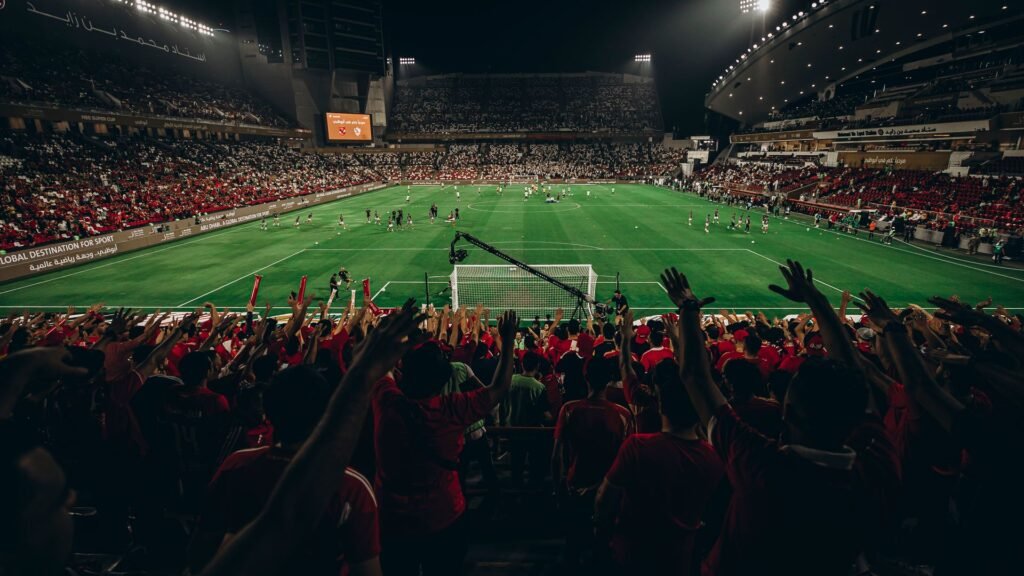

Football terms slang is the informal language of the world’s most popular sport: the nicknames, tactical phrases, and fan expressions that turn a simple match into a conversation full of hat-tricks, gaffer rants, and last-minute heartbreak, and learning a few dozen of them is the fastest way to follow any game like a local.
Watch a match with a football fan and you will hear a second language. A striker does not score three goals, he bags a hat-trick. A manager is not a manager, he is the gaffer. A team does not defend deeply, they park the bus. None of this is in the rulebook, but all of it is in the stands, in the pub, and in every comment section after a big game. Football slang is how fans show they belong, and it changes from country to country, from league to league, and from one generation to the next.
This guide covers the words you will actually hear. It starts with soccer, the game most of the world calls football, then moves to fan and pundit slang, the tactical terms analysts love, and finally American football, where “football” means a different sport with its own dictionary. Britannica’s football slang guide calls the sport’s vocabulary a lexicon drawn from many languages, and that is exactly right: this is a global language built from Portuguese flair, Italian tactics, German pressing, and English pub talk. By the end, you will know what a false nine is, why a goal can be a worldie, and when to accuse a team of bottling it.
Table of Contents
- What Is Football Slang?
- Soccer Slang: The Words You Hear Every Match
- Fan and Pundit Slang
- Tactics Talk: The Words Coaches and Analysts Use
- American Football Slang
- Football Slang That Escaped Into Everyday Speech
- Terms Fans Mix Up
- How to Learn Football Slang Fast
- FAQs About Football Terms Slang
- Sources and Further Reading
What Is Football Slang?
Football slang is the informal vocabulary that players, coaches, commentators, and fans use to talk about the game quickly and with feeling. It covers nicknames for players and positions, shorthand for tactics, dramatic words for great and terrible moments, and insults for rivals. It is different from the official laws of the game, which say things like “direct free kick.” Slang says “stonewall penalty” or “he was robbed,” and everyone in the room knows exactly how the speaker feels about it.
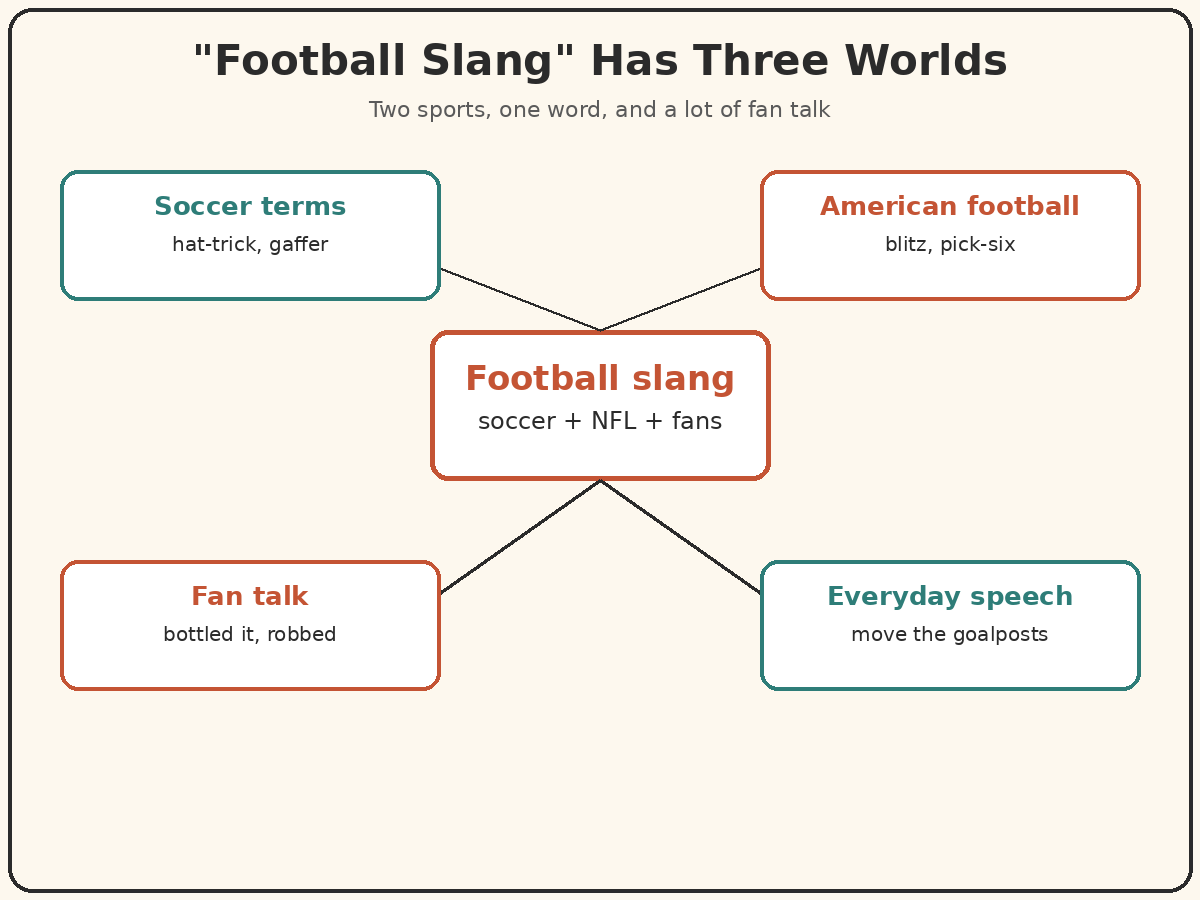
One warning before we start: “football” means two different sports. Outside the United States, it means soccer, and that is the game this guide leads with, because it is the meaning behind almost every search for football slang. In the United States, football means the NFL game, and its slang gets its own section below. The two share a few words, like “hat trick” and “blitz,” but they are mostly separate languages. If someone says “football” and you are not sure which one they mean, the accent and the country usually give it away.
Soccer Slang: The Words You Hear Every Match
These are the words commentators use every weekend and fans shout from the stands. Learn this section and you can follow almost any match broadcast without reaching for a dictionary.
Hat-trick
Three goals by one player in a single match. A “perfect hat-trick” is one goal with the right foot, one with the left, and one with the head. The term comes from cricket, where a bowler who took three wickets in a row was awarded a hat, and football borrowed it long ago. When a player scores three, the crowd expects him to take the match ball home.
Brace
Two goals by one player in a single match. Less flashy than a hat-trick, but still a fine day at the office. “He got a brace” is something you will hear in almost every match report.
Clean sheet
A match in which a team concedes no goals. Goalkeepers and defenders treat clean sheets like trophies, and a run of them is the first thing a manager brags about. The American equivalent is a shutout. Britannica lists it among the common terms every fan should know.
Derby
A match between two local rivals, clubs from the same city or region with a shared history. The North London derby, El Clasico, and the Superclasico are the famous ones, but every country has derbies where form goes out the window and the atmosphere turns electric. A derby is never just about the points.
Gaffer
British slang for the manager or head coach. “The gaffer told us to press higher” is something you will hear in every post-match interview. It is a term of respect, mostly, and it is used by players and supporters alike. The American word is simply “coach,” which sounds far less colorful.
Nutmeg
Playing the ball through an opponent’s legs. It is the most humiliating skill in football, a small moment of magic that gets replayed endlessly and talked about for years. Getting nutmegged in front of a crowd is the kind of thing teammates never let you forget.
Bicycle kick
An acrobatic kick where a player throws himself backward into the air and strikes the ball over his own head. Also called an overhead kick. It is arguably the most spectacular skill in the sport, and when one goes in, it is an instant highlight. Cristiano Ronaldo’s bicycle kick for Real Madrid against Juventus in 2018 is considered one of the greatest goals ever scored.
Banger
A powerful shot, usually struck from distance, that finds the back of the net. Also called a cracker, a pearler, a rocket, a screamer, or a thunderbolt. Commentators save their loudest voices for bangers, and fans argue for days about which one was the best of the weekend.
Worldie
A spectacular goal or performance. A worldie is a goal that makes the whole stadium stand up, usually from long range or with extraordinary skill. It is the fan’s word for what analysts call a high-quality chance finished perfectly.
Tap-in
A very close-range finish, usually into an empty or nearly empty net. Strikers get mocked for scoring “only tap-ins,” but as every striker will tell you, being in the right place at the right time is a skill in itself. A player accused of relying on them is called a “tap-in merchant.”
Sitter
An easy chance that should be scored. Missing a sitter is the most frustrating moment in football, and the player who does it will hear about it from the crowd, the commentators, and his own teammates for the rest of the match.
Howler
A major mistake, usually by a goalkeeper or defender. A howler is not a small error. It is the kind of blunder that ends up on blooper reels for years. Goalkeepers live in fear of them, because one howler can undo ninety minutes of good work.
Cap
One appearance for a national team. The term comes from the old days when players literally received a physical cap for each international game they played. A player with 100 caps has played 100 times for his country, and that number is a badge of honor.
Nil
Zero in a football scoreline. A 1-nil win means 1-0, and a nil-nil draw is 0-0. It sounds old-fashioned, but it is still the standard way British commentators read a score, and it gives a match report a rhythm that “zero” never will.
Park the bus
Defending very deep with many players behind the ball, usually to protect a lead or survive against a stronger team. The phrase was popularized by Jose Mourinho, and it is used both as a tactic and as an insult. Fans of attacking football hate it. Fans of winning 1-0 love it.
Panenka
A penalty kick softly chipped into the middle of the goal, trusting the goalkeeper will dive to one side. It is named for Czechoslovak midfielder Antonin Panenka, who used it as a signature move. It looks cool when it works and humiliating when the keeper stays put.
Golazo
Spanish for a spectacular goal. It crossed into English commentary because no English word captures the feeling quite as well. A golazo is not just a good goal. It is a goal that makes you jump out of your seat.
Remontada
Spanish for a comeback, especially a dramatic turnaround from a losing position. Barcelona’s 6-1 win over Paris Saint-Germain in 2017 is the most famous remontada of all, and the word has become shorthand for any great escape in football.
Fan and Pundit Slang
This is the language of the stands, the pub, and the post-match phone-in: emotional, exaggerated, and very funny when you know what it means. It is also where football slang overlaps with general internet slang, since fans live on social media. Our guide to what aura means in slang covers one word that started on football Twitter and now shows up everywhere.
12th man
The supporters in the stadium, whose noise and energy are seen as giving their team an extra player. Home crowds take pride in being a good 12th man, and away fans take pride in silencing one.
Bottle job
A collapse under pressure, usually by a team that was winning or expected to win. “Bottlers” are players or teams accused of lacking nerve in big moments. It is one of the harshest insults in football, because it questions character, not just ability.
Masterclass
An outstanding performance, usually by one player or a manager’s tactics. The opposite, a terrible performance, is a “disasterclass.” Both words are thrown around far too easily on social media, where every good game is a masterclass and every bad one is a disasterclass.
Dark arts
Gamesmanship such as time-wasting, tactical fouls, and provocation. It is the polite way of saying a team is cheating without technically breaking the rules. Managers who are good at the dark arts are either geniuses or villains, depending on which team you support.
Washed
Past one’s best. A player who used to be great and now looks slow or ordinary is called washed. It is a brutal word, and fans use it the moment a star has two bad games in a row, which is far too soon in almost every case.
Cooked
Beaten, exhausted, or in serious trouble. A defender who has been dribbled past three times is cooked. A team that is 3-0 down at halftime is cooked. It is one of the many food words football has borrowed, and it works because everyone knows what it feels like.
Agenda
A fan-bias campaign for or against a player, club, or country. “He has an agenda against our club” is the standard complaint when a pundit criticizes your team. Whether the agenda is real or imagined is beside the point. The word exists because football fans are convinced the world is against them.
Robbed
A claim that a team or player was unfairly denied by a referee or a decision. “We were robbed” is heard in every stadium every weekend. Sometimes it is true. Most of the time it is a fan coping with a loss, and that is fine too.
Farmer’s league
An insult for a league considered weak or uncompetitive. Fans of big leagues use it to dismiss smaller ones, and fans of smaller leagues use it right back. It is snobbery, pure and simple, and it is never going away.
Banana skin
A deceptively tricky match for a favorite. A banana skin is the game a big team is expected to win easily and then loses. It is a favorite word of commentators before cup ties against lower-league teams.
Group of death
A brutally difficult group in a tournament draw, where several strong teams are stuck together and at least one big name has to go home early. Fans dread it and neutrals love it.
Hairdryer treatment
A furious dressing-room scolding from a manager. The phrase comes from Sir Alex Ferguson, whose shouting was said to feel like a hairdryer in the face. It is the most famous image in football management, and every fan knows what it means without needing it explained.
Tactics Talk: The Words Coaches and Analysts Use
Tactical language used to belong to coaches. Now analysts and fans use it too, and it shows up in every serious match discussion. These are the words that make you sound like you actually understand the game.
Low block
A deep defensive shape close to a team’s own goal. A team in a low block gives up territory and dares the opponent to break them down. It is the organized version of parking the bus.
High press
Aggressive defending near the opponent’s goal, trying to win the ball back quickly instead of retreating. Teams that press high are exciting to watch and exhausting to play for.
Gegenpressing
A German-influenced term for counter-pressing immediately after losing the ball. Jurgen Klopp made it famous, and it is built on a simple idea: the best moment to win the ball back is the second you lose it, while the opponent is still disorganized.
False nine
A forward who drops deep into midfield instead of staying near the goal, dragging defenders out of position and creating space for others. Lionel Messi played the role to perfection at Barcelona, and it changed how the position was understood.
Tiki-taka
A short-passing, possession-heavy style associated with Spain and Barcelona. It is beautiful when it works and boring when it does not, and fans have argued about which one it is for more than fifteen years.
Catenaccio
An Italian defensive system built around organization and protecting space. The word literally means a door bolt or lock, which tells you everything about the philosophy. It won a lot of trophies and made a lot of neutrals fall asleep.
xG
Expected goals, a model that estimates the quality of a scoring chance. A shot from six yards out has a high xG. A shot from forty yards has a low one. Fans now argue about xG the way they used to argue about possession stats, and analysts use it to judge whether a result was deserved or lucky.
Overload
A numerical advantage in one part of the pitch, created by sending extra players to one side. Overloading one wing to isolate a defender on the other is a standard attacking plan at the top level.
Transition
The moment possession changes from one team to the other. Modern football is obsessed with transitions, because a team that is organized when it loses the ball and fast when it wins it back is very hard to beat.
American Football Slang
In the United States, football means the NFL game, and its slang is just as rich. These are the terms you will hear on every broadcast, from the first kickoff to the last kneel-down. Our guide to baseball slang covers another American sport with its own deep dictionary, and football’s is just as fun.
Hail Mary
A long, desperate pass toward the end zone, usually on the last play of a half or game. The term refers to the Catholic prayer and describes a throw made with hope rather than expectation. It became widely popular in the NFL in the 1970s, and it has since escaped into everyday speech as a word for any desperate last attempt.
Pick-six
An interception returned for a touchdown. It is called that because a touchdown is worth six points. It is the most exciting defensive play in football, and it can swing a game in seconds.
Blitz
The defense sends extra rushers, such as linebackers or defensive backs, after the quarterback. Every pass play has a pass rush, but it is only a blitz when the defense sends more rushers than usual. A good blitz ends the play before it starts.
Sack
Tackling the quarterback behind the line of scrimmage before he can throw. Sacks are counted, celebrated, and argued about, and the players who get them are among the highest-paid defenders in the sport.
Red zone
The area between the opponent’s 20-yard line and the goal line. Teams are judged on how often they score touchdowns once they get there, and “red zone efficiency” is one of the most quoted stats in the game.
Three and out
A drive that ends after three plays and a punt. It is the most frustrating outcome in football, and fans groan the moment the third-down pass falls incomplete.
Audible
The quarterback changes the play at the line of scrimmage after reading the defense. It is a sign of a smart quarterback and a confident offense, and the shouting and hand signals before the snap are part of the theater.
Pancake
A block that knocks a defender flat on his back. Offensive linemen keep count of their pancakes, and a good one gets replayed on the broadcast and celebrated on the sideline.
Moving the chains
Gaining a first down, named for the sideline chain crew that measures for first downs. It is the unglamorous work of football: three yards here, four yards there, keeping the drive alive.
Garbage time
The late minutes of a game when the outcome is already decided and the stats matter less. Starters come out, backups come in, and fantasy football owners watch nervously as their players pad numbers that do not change the result.

Football Slang That Escaped Into Everyday Speech
Football has given ordinary English some of its best phrases. These started on the pitch and now show up in offices, politics, and family arguments, often used by people who have never watched a full match.
Move the goalposts
To change the rules or criteria unfairly, usually in the middle of an argument or a project. It comes from the idea of shifting the target so nobody can ever score. If your boss keeps changing what “done” means, they are moving the goalposts.
Own goal
A mistake that harms your own side, from a player accidentally scoring against his own team. In everyday speech, it means any self-inflicted disaster, like an email that was supposed to stay private going to the whole company.
Level playing field
A situation where everyone has a fair and equal chance. It comes from the idea that a flat, even pitch is fair to both teams, and it is now one of the most common phrases in business and politics.
Kick off
To start something, from the kick that starts a match. Meetings kick off, projects kick off, and arguments kick off, and nobody thinks about football when they say it anymore.
On the ball
Alert, quick, and in control. A player who is “on the ball” is switched on and ready, and the phrase now describes anyone who is sharp at work or in life.
Back of the net
A fantastic goal scored with power, so hard that the ball hits the back of the net rather than just crossing the line. In everyday use it is a cheer for any great result, and it is also the name of one of the most quoted comedy lines in British television history.
Terms Fans Mix Up
Football slang is full of pairs that sound similar and mean different things. Getting them wrong is the fastest way to look like a newcomer, so here are the ones that cause the most confusion.
Sack vs tackle for loss
A sack is specifically a tackle of the quarterback behind the line on a pass play. A tackle for loss is any tackle behind the line, including on running plays. Every sack is a tackle for loss, but not every tackle for loss is a sack. Sportmentary’s glossary makes this distinction because broadcasters mix them up constantly.
Clean sheet vs shutout
Same idea, different sport and different country. A clean sheet is soccer’s word for conceding no goals. A shutout is the American word for the same thing in soccer and other sports. Use “clean sheet” for soccer and “shutout” for American football, and everyone will understand you.
Derby vs rivalry
A derby is a specific kind of rivalry, usually between local teams from the same city or region. A rivalry can be between teams from anywhere, like two national teams that have met in big finals. All derbies are rivalries, but not all rivalries are derbies.
Offside vs offsides
In soccer, the law is “offside,” no S at the end, and it means an attacking player is ahead of the second-to-last defender when the ball is played. In American football, the penalty is “offsides,” with an S, and it means a player crossed the line of scrimmage before the snap. Using the wrong one marks you instantly as a fan of the other sport.
How to Learn Football Slang Fast
Learning football slang is easier than it looks, because the words repeat constantly. Here is the method that actually works:
- Start with game situations. Terms like red zone, three and out, and moving the chains come up on nearly every drive in American football, and hat-trick, clean sheet, and derby come up in every soccer broadcast. Learn these first and the flow of the game makes sense.
- Watch with this guide open. When a broadcaster uses a term you do not know, look it up during the next stoppage. Hearing a word in context helps it stick far better than memorizing a list.
- Learn the positions. Much slang refers to positions, such as false nine, edge rusher, or shutdown corner. A basic position chart unlocks dozens of phrases at once.
- Notice the patterns. Coverage schemes are often numbered by deep defenders, packages like nickel and dime refer to the number of defensive backs, and tactical words like low block and high press describe where on the pitch a team defends. Once you see the pattern, new terms are easier to guess.
- Use the terms yourself. Talking through a match with friends or in a fantasy league is the quickest way to make the vocabulary automatic. The first time you say “he bottled it” at the right moment, you will know it worked.
FAQs About Football Terms Slang
What does “football slang” mean?
Football slang is the informal language of football: the nicknames, tactical phrases, and fan expressions that players, coaches, commentators, and supporters use to talk about the game. It is different from the official rules, and it changes from country to country and from soccer to American football.
What is a hat-trick in football?
A hat-trick is three goals by one player in a single match. A “perfect hat-trick” is one goal with the right foot, one with the left, and one with the head. The term comes from cricket, where a bowler who took three wickets in a row was awarded a hat.
What does “gaffer” mean in football?
Gaffer is British slang for the manager or head coach. It is used by players and supporters alike, and it is a term of respect. “The gaffer” is the person in charge of the team, the tactics, and the dressing room.
What does “park the bus” mean?
To park the bus is to defend very deep with many players behind the ball, usually to protect a lead against a stronger team. It is both a tactic and an insult, praised by fans of the team doing it and mocked by everyone else.
What is a pick-six in football?
A pick-six is an interception returned for a touchdown in American football. It is called that because a touchdown is worth six points. It is one of the most exciting defensive plays in the sport.
Why is it called a Hail Mary?
The term refers to the Catholic prayer and describes a long, low-probability pass thrown with hope rather than expectation, usually on the last play of a game. It became widely popular in the NFL in the 1970s and has since become a general phrase for any desperate last attempt.
What is the difference between soccer slang and American football slang?
Soccer slang comes from the global game and covers words like hat-trick, gaffer, nutmeg, and tiki-taka. American football slang comes from the NFL game and covers words like blitz, sack, pick-six, and red zone. They share a few words, but they are mostly separate vocabularies, and the country and the broadcast usually tell you which one you are hearing. If you enjoy word lists like this one, our early 2000s slang guide covers the words and phrases that defined the era when both games were exploding online.
Sources and Further Reading
- Britannica’s Football Slang 101 covers World Cup terms, fan slang, tactics, and global football vocabulary in one large glossary.
- Sportmentary’s glossary of common football lingo groups American football slang by offense, defense, special teams, and game situations.
- Guide to Football’s slang and commentary glossary lists 65 soccer slang terms with short definitions.
- Pexels photo by Eslam Mohammed Abdelmaksoud, used as the featured image.
- Pexels photo by Alexander Nadrilyanski, used in the body of this article.